

Brief

In a retail world focused on omnichannel strategies, product and service innovations, IT investments and technology-enabled stores of the future, winning retailers are taking a new look at their store labor models and budgets. Store associates represent one of the biggest contributors to the success or failure of brick-and-mortar stores. In many ways, they’re a retailer’s most powerful asset.
Survey after survey reveals that customer service in stores is the top factor affecting customer advocacy. Across retail sectors, a store associate’s availability, knowledge, advice, assistance and friendliness exert a stronger influence on a shopper’s likelihood to recommend a retailer to friends or acquaintances than product assortment, shopping environment and even price. On the flip side, poor service is a major contributor to customer defection. When Bain & Company recently surveyed shoppers on the subject, more than 25% of their top frustrations were due to bad experiences with sales associates.
As retailers build omnichannel strategies that require them to balance the needs of digital and physical channels, and as they grapple with rapidly rising labor costs and service requirements, they feel an increased urgency to revisit store labor. After all, a salesforce represents more than half of a typical retailer’s selling, general and administrative expenses. This comes at a time when store associates’ jobs have grown more demanding. In addition to their traditional responsibilities, they now need to handle everything from online purchase returns to searching online for out-of-stock merchandise and working with new technologies like mobile checkout platforms or smart kiosks. Also, retailers’ ability to spend on store labor is now under intense pressure not only from wage inflation but also from declining traffic to physical stores, the need to fund digital investments and, in the US, the Affordable Care Act.
The instinct for many is to simply make across-the-board cuts in line with declining traffic and store sales. But fewer hours can hurt the customer experience, resulting in fewer conversions and increased customer defections, thus further reducing sales productivity. This cost-cutting doom loop can create devastating consequences. On the other hand, taking a more thoughtful approach to store labor can lower costs by as much as 15% while keeping customers loyal.
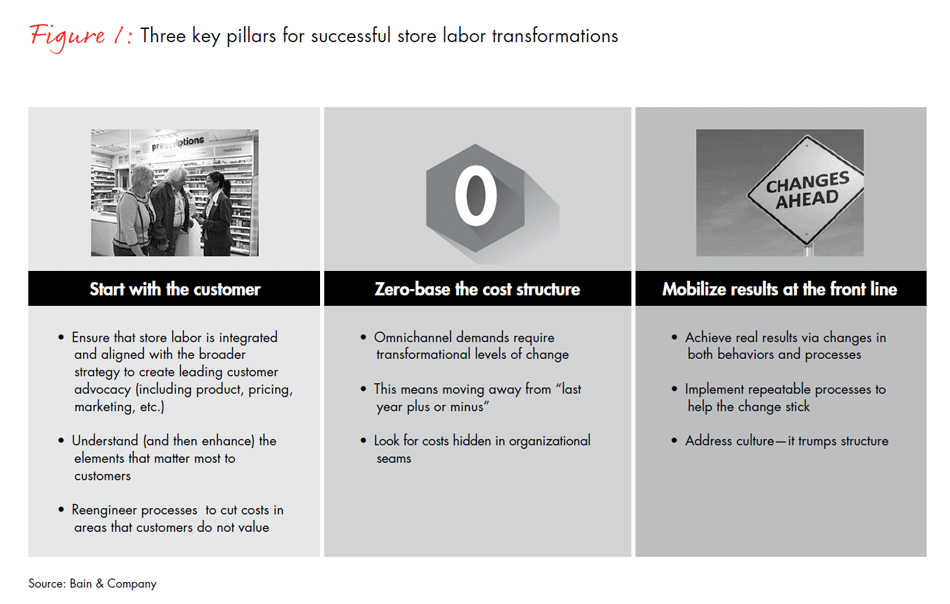
Companies that successfully transform their store labor operations for retailing’s new realities benefit from a three-step process (see Figure 1):
- They invest to clearly understand what matters to their customers
- They zero-base their store labor model (activities, processes and organization)
- They mobilize for change at the front line
Learn what customers value most and what they value least
It’s no secret that companies with leading customer advocacy outgrow their competitors by more than 2-to-1. Winners consistently deliver on a baseline set of service expectations, and they selectively wow their customers by going beyond addressing customer-articulated complaints. Increasingly, they’re also turning to technology to support their customers and associates, and providing the right levels of training and coaching.
For many retailers, the hard part is figuring out which of the dozens of customer touchpoints matter most to customers, and need to be stellar, and which of them are least important to customers—and thus ripe for cost reduction. Tools such as customer surveys, focus groups, in-store intercepts, ethnographic studies and other behavioral analyses help retailers discover what contributes to customer purchase behavior and advocacy. (Customer advocacy is commonly measured by a Net Promoter ScoreSM, determined by asking the question: Would you recommend this store to a friend?) In our experience, winners then triage and differentially focus on the few specific areas that most impact customer advocacy.
A US department store surveyed its customers on what they valued most in different categories and then tracked time spent on various store activities. Among its findings: Making associates available in fitting areas had relatively little impact on NPS®. The store diverted resources away from such less-valued activities, freeing up time for activities that had the most positive impact on the customer experience, such as offering knowledgeable advice and helping customers find specific items. The change delivered a double effect: It lowered store costs and boosted customer advocacy.
Allison Gans, a partner in Bain's Retail practice, discusses three key strategies that successful retailers use to save on labor costs.
It’s time to zero-base
Often, when retailers think about budgets, they start by looking at what they did last year. They adjust by 2%, 3% or whatever level they need to compensate for changes in store sales and costs.
In a swiftly shifting retail world, the best companies generate results by taking a zero-base approach. They start with a clean slate and determine the right mix of employees, the right scheduling and forecasting, and the right processes and activities. They base their decisions not only on topline revenue but also on what matters most to customers as well as factors such as the nature of the store, the required tasks and traffic by daypart. They rethink how many associates should be working during off-peak times and how to free up hours from low-value-added activities. They set the zero-based staffing for a store at one customer and build from there, redesigning processes to take advantage of newly available technology to improve productivity.
A flexible labor model developed from a zero-base approach helped an Italian grocer trim labor costs in selected hypermarkets by 10% within six months. Other companies utilize zero-basing as an opportunity to reduce complexity. One European retailer, for example, eliminated unproductive SKUs and limited unvalued promotional frequency. The moves reduced store labor costs by narrowing the workload while simultaneously improving the customer experience.
Consider a global restaurant chain that had multiple store formats. While its staffing model accounted for major differences in formats, it did not take into account other differences among stores, such as the percentage of orders eaten on the premises. Nor did it staff aggressively enough to service peak traffic. That led to underinvesting in the busiest days. It also led to underinvesting in stores with a complicated mix that required more activity to serve. By taking a zero-base approach, the company saw how it could develop a more sophisticated labor model, shifting hours to the right stores, to the right activities and to the right times of day. It improved service levels at underperforming stores and increased profits.
A US apparel retailer cut store labor costs by 10% in part by improving back-end processes and redesigning activities to maximize high-quality customer-facing time. The retailer’s associates were spending significant time setting the floor, cluttering the aisle with clothing, which took time away from working with customers. The root cause: both the frequency and inconsistency of store deliveries. The retailer worked with its distribution centers to determine a more practical and manageable delivery schedule and to increase visibility into the timing of deliveries as well as the size of those deliveries. The objective was to ensure that the right levels of staffing were in place without disrupting visual merchandising execution.
Mobilize for results
Finally, once you understand how to delight your target customer and have zero-based your store labor, the next big step is to mobilize the field organization (district managers, store managers and sales associates). Zero-basing requires a fundamental change to the associates’ behaviors, activities and processes. The best companies rely on pilot projects and make a serious commitment to communicate and measure results. They also create a super user group composed of associates from all levels, including those on the floor. This group helps to improve the quality of the solutions and makes changes much more palatable to their peers; it also ensures a rollout that is fast enough to deliver value. Our work with hundreds of clients on change-management efforts has helped us develop our Results Delivery® approach, a proven system of identifying and managing the risks of change.
A specialty retailer operating in multiple regions recently rolled out a sales productivity initiative across its stores. Sales productivity had varied dramatically, so the company identified best practices such as prioritizing checkout assistance over floor coverage and making store managers more available on the floor as a floating resource. The retailer implemented a plan for mobilizing district managers and store managers. Among the steps: It gave each store manager a monthly action plan that laid out specific tactics, dates and owners for three of the best practices. At the end of each month, store managers performed a self-assessment, including whether the actions were completed and why they were successful or unsuccessful. District managers reviewed the store scorecards, self-assessments and action plans prior to store visits, and they provided recommendations, coaching and support based on their observations during the visit. This program helped spur growth while improving store managers’ and sales associates’ capabilities.
A US department store was understaffing peak hours and overstaffing off-peak hours and, as a result, missing opportunities to deliver on customer expectations and boost revenue. To remedy the situation, the retailer embarked on a pilot project in selected stores to shift hours from the middle of the day to late afternoons, evenings and weekends. The company knew the changes would be difficult to implement because they required changing hours, which would affect associates’ personal lives and workloads. It chose pilot stores that were both representative of the store base and run by managers who were change agents. District managers visited pilot stores on a weekly basis and conducted check-in surveys, holding regular calls with store managers to discuss results. After three months of measuring and tweaking, the changes rolled out to the full store base. These changes were championed by store managers who helped explain why they were necessary, the results that they achieved in pilots and the best way to make them happen in other stores. Two years after rolling out the program throughout its store base, the retailer reduced store labor by 10% and grew its top line by 4%.
Achieving such benefits begins by acknowledging that it may be time to take a new look at store labor (see below: “Eight questions to get you started”). Indeed, today’s retailers face challenges on many fronts. We see companies using this shifting environment as an opportunity. Winners adapt their store labor model to what matters most to customers, they zero-base their operations instead of relying on what worked for them in the past, and they are systematic in mobilizing store labor for the required changes in behaviors, activities and processes. In all segments of retailing, leading companies see associates as a secret weapon for achieving the seemingly contradictory goals of improving customer advocacy and boosting store efficiency.
Eight questions to get you started
Joining the ranks of retailers that have transformed their store labor operations begins by asking and answering a series of questions.
Customers:
- Do you clearly understand which of your customer touchpoints most affect customer experience and advocacy and which of them matter least?
- Do you know what you’re allocating, in quality and quantity of labor, to both customer-facing and non-customer-facing activities—and what’s really happening on the floor?
Zero-base:
- Do you regularly revisit the underlying assumptions and algorithms in your labor model—what creates work, and what level of work is required?
- Have you recently redesigned core processes—for instance, how deliveries are received and shelves are restocked—inside and outside of the store to maximize efficiency?
- Do you have a single communication pipe to stores for filtering and prioritizing all requests and a single decision maker for those requests?
Mobilize:
- To mobilize the front line, have you identified, codified, prioritized and rolled out best practices for back-office and floor activities, and are your stores actively incorporating them?
- Are your managers (store-level and above) providing the right balance and tactics for coaching and oversight?
- Are your associates engaged and ready to make changes, and are they guided by a proven change-management approach that ensures sponsorship at all levels?
Allison Gans is a Bain & Company partner based in New York. Lewis Weinger and Michael Brookshire are partners based in Dallas. All are members of Bain’s Retail practice.
Trademark: Net Promoter® and NPS® are registered trademarks of Bain & Company, Inc., Fred Reichheld and Satmetrix Systems, Inc.
Net Promoter ScoreSM is a trademark of Bain & Company, Inc., Fred Reichheld and Satmetrix Systems, Inc.
Trademark: Results Delivery® is a registered trademark of Bain & Company, Inc.
Published in June 2015