

Brief
Buoyed by powerful economic growth, strong corporate profits and government deregulation, M&A activity in Asia-Pacific has staged a strong recovery from the 2008 financial crisis. The numbers tell it all. In 2010 the value of M&A deals in the region grew 19%. Despite such macro-economic uncertainties as the sovereign debt crisis, deal value rose by 6% in 2011. The region now accounts for about 24% of global M&A. While China remains the largest overall deal market, surging activity in both India and Australia fueled Asia’s M&A recovery, with values rocketing by 141% in India and 83% in Australia in 2010 alone. The size of the deals has grown, too. According to Dealogic, 104 deals of more than $1 billion accounted for 41% of Asia’s deal value, with the financial services and industrials sectors leading the way. Most notably, companies from Asia’s emerging markets have started to become increasingly active in cross-border outbound M&A: In 2011 they made acquisitions worth $88 billion outside their home region compared with just $12 billion 10 years ago, boosting their share in global cross-border M&A to 19% from just 5% in 2001.
This surge in M&A activity reflects Asia’s increasingly important position over the next two decades as one of the world’s economic growth engines. The region is expected to generate almost half—46%—of the global real GDP growth in 2012 and represent 31% of the world’s GDP in 2030, according to the Economist Intelligence Unit. Given its role in powering global growth, the consensus is that Asia-Pacific’s share of global M&A deals will continue its upswing. But there are a couple of cautions. Macroeconomic uncertainty could derail the momentum. And meanwhile, some Western companies have expressed concerns about inflated valuations among acquisition targets in Asia.
The promise in outbound M&A
Among the most important developments in Asia’s M&A activity is the rapid rise in outbound deals. For many Asian companies, organic growth alone is not sufficient to meet aggressive growth targets and aspirations to become global players in their industries. Outbound M&A offers them the chance to gain access to new markets—with opportunities for increased distribution, market share, customer ties and positioning—faster than they could on their own and often at a lower cost. Consider, for example, Tata’s acquisition of Jaguar Land Rover.
Outbound deals can also accelerate new product development at a lower cost by acquiring innovative technology—the impetus behind WuXi PharmaTech’s acquisition of US-based AppTec Laboratory—or enable a company to buy a brand with a strong cachet that can’t be replicated, as China-based Geely achieved with its purchase of Volvo. The Chinese government is promoting consolidation of companies in the automobile, cement, steel, machinery, rare earth and aluminum industries through M&A.
Acquisitions also can provide access to natural resources, ensuring an adequate domestic supply to meet the needs of emerging markets.
These deals hold the promise of attractive gains, but there’s a nagging reality. While M&A can deliver great value if well-conceived and properly executed, they are inherently risky—as is any major growth initiative, whether organic or inorganic. Whether a deal is domestic or cross-border, or whether the acquirer is a regional or global player, M&A is an area where rookie mistakes are rife and only companies that have carefully built up the required M&A capabilities and experience routinely succeed. Select Asian companies are leading the way and setting examples that show how companies can improve their odds of winning with M&A.
Four traits of successful acquirers
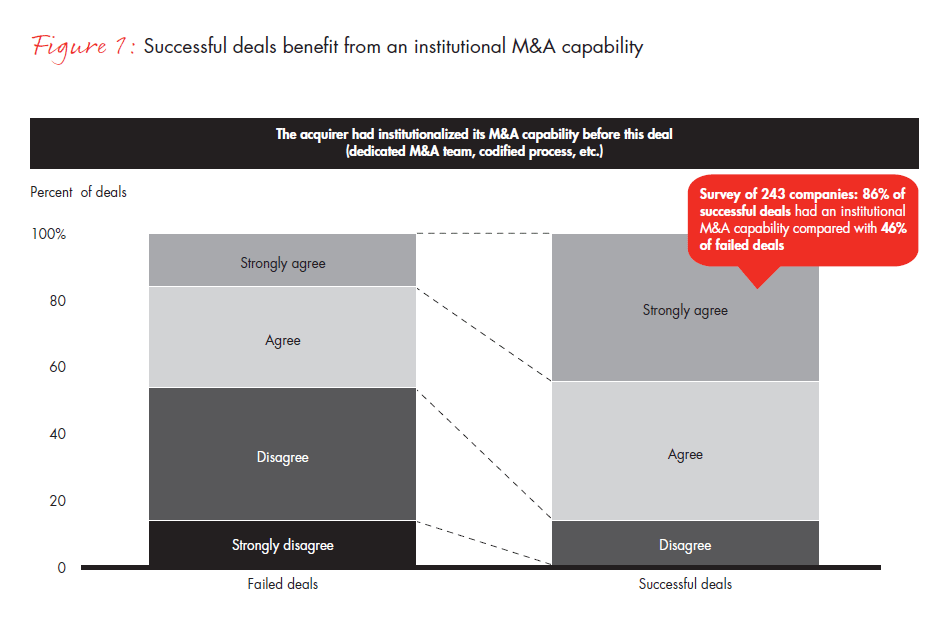
What boosts the odds of success? Delivering on an acquisition’s promise requires a clearly defined strategy and execution plan. And frequent acquirers, who’ve advanced on the learning curve, outperform companies that do deals infrequently or are one-time acquirers. In fact, when we surveyed 243 executives, we found that 86% of successful deals were made by companies that had institutionalized an M&A capability, compared with 46% of failed deals (see Figure 1).
We’ve learned that M&A winners have four traits for success.
1. Develop a well-defined M&A strategy with clear objectives and guidelines that are linked to the company’s overarching growth strategy.
Singapore-based Olam International has used acquisitions to grow into a leading global supply chain manager for food ingredients and agricultural products. In 2006, the company wasn’t making M&A deals, but only four years later, its acquired companies were generating around 30% of its earnings. Between 2007 and 2010, Olam completed no fewer than 17 deals, investing a total of $1.4 billion and achieving a 25% return on equity and a 14% return on invested capital from those acquisitions.
What sets Olam apart? The company establishes clear objectives for its M&A initiatives: It uses M&A to build leadership positions in its existing businesses, expand into adjacencies, overcome entry barriers in new geographies, acquire new capabilities and take advantage of favorably priced targets with high business overlap.
Also, it has well-defined guidelines for deal frequency, size, timing and level of ownership. For example, Olam favors the “string of pearls” approach. Instead of a few headline-making deals, it focuses on a series of small deals over a multiyear period, establishing a maximum deal size of 10% of its market cap and a maximum annual deal volume of 15% of its market cap. The company makes acquisitions throughout economic cycles and does not try to time the market. It seeks deals that would give it a controlling stake or management control and will not enter deals without a strong strategic rationale.
Similarly, Indian household and personal care products maker Godrej uses a well-honed acquisition strategy to rapidly grow its domestic leadership and expand its international reach. Recognizing that M&A was critical to achieving its global growth goals, the company spent two years of disciplined preparation even before setting foot on the M&A market. It took the time required to select the right people to assemble a strong M&A team and to develop a playbook including a detailed integration manual and a rigorous screening process to identify the right acquisition candidates. Having built a strong foundation, the company accelerated its deal activity, making eight deals in the last 18 months.
Godrej defined exactly where it wanted to play in the global arena. It participates only in emerging market deals, focuses on three core categories (hair care, home care and personal wash) and targets companies with leading positions in their respective markets. This focused approach enables a disciplined screening of potential targets to ensure a strategic fit. Its recent acquisitions are market leaders: Megasari is Indonesia’s second largest household insecticides player; Issue Group and Argencos are the hair color leaders in several Latin American markets; and Darling Group is the leader in hair extensions across 14 countries in sub-Saharan Africa. The results of Godrej’s carefully executed M&A strategy? In 2010, the company’s global business accounted for more than 30% of its revenue, largely fueled by its international acquisitions.
2. Institutionalize the M&A program—policy, process and people—to ensure discipline and focus.
Successful acquirer Olam has a six-member core M&A deal team in place with 50 years of combined transaction experience. Each member specializes in different agricultural commodities, and the team works hand in hand with business unit leaders through every stage of an acquisition. The team ensures that each deal is aligned with the company’s M&A guidelines and corporate strategy. The team also creates a detailed investment thesis that clearly articulates the business fit, strategic importance, acceptable valuation range, key risks and potential integration issues for each acquisition.
In addition, the team performs due diligence aimed at asking and answering the big questions that will drive most of the business value—a step that will dictate integration priorities. The due diligence process leads to the development of a detailed integration plan to capture synergies, mitigate key deal risks and get results faster. It also involves screening for cultural alignment and misalignment, which helps the company head off culture clashes and retain key talent.
3. Focus integration efforts on value creation, tight process control and quick resolution of people issues.
Successful acquirers plan early, integrate quickly where it matters most, prioritize culture and maintain firepower in the core business.
A Southeast Asian retailer’s story shows how an acquirer— in this case, a private equity firm—used integration to rapidly extract the deal’s value after purchasing the loss-making company. The acquired company was a regional business, but it was essentially run as separate businesses in each country. The new managers shut down the most unprofitable retail operations and focused on two core markets, Singapore and Malaysia. By implementing a set of regional integration initiatives, they quickly achieved significant cost savings.
The company consolidated and standardized processes across finance, human resources and credit approvals. For marketing, this meant ensuring a consistent message and branding. It created regional synergies by renegotiating volume discounts with suppliers and standardizing terms and conditions. And it identified and addressed “people issues” that could threaten a successful integration. For example, the new managers involved senior management from the acquired company in the organization’s restructuring, and the new management devoted significant energy to clarifying all roles and responsibilities.
Three years after its purchase, the retailer’s enlarged brand portfolio, expanded distribution network and more efficient operations and supply chain delivered an impressive turnaround—the company’s revenues grew by 15% a year, three times the market growth rate, and added 13 percentage points to its margins in four years.
In the same way, Olam’s 2007 acquisition of Queensland Cotton became a blockbuster deal that has vaulted Olam from the number 10 player in cotton to number two. How did they do it? Within 100 days after closing the deal, the company spelled out a value creation plan aimed at accelerating the synergies and capturing the full value of the deal while also mitigating risk.
The Queensland Cotton acquisition was particularly complex, involving three geographies, four value chain steps, multiple product adjacencies and a number of external factors like water allocation and crop subsidies. The company carefully defined more than 30 initiatives in the first month of integration—initiatives focused on growing the cotton business, reducing costs, generating overhead synergies and expanding into new business opportunities such as wool and almonds in Australia.
Because each deal is different, veteran acquirers adapt their integration manuals to meet a merger’s specific requirements. Since most of Godrej’s acquisitions are scope deals that add a new geography, the company focuses most of its efforts on integrating selectively. Its initial objective is to preserve and enhance the value of the acquired company’s existing brand, while empowering its management team to handle sales and distribution activities. At the same time, it works to create back-end synergies in key areas, such as IT and the supply chain, by integrating the acquired company’s activities with Godrej’s. Only later does the company seek to achieve front-end and revenue synergies by cross-selling products from other geographies.
4. Practice. Frequent acquirers do better than oneoff acquirers.
Our research shows that companies that acquire frequently outperform in the long term. In a recent Bain study analyzing 1,615 companies and more than 18,000 deals between 2000 and 2010, we found that frequent acquirers generate superior annual excess returns—on average 1.4 times higher than those of infrequent acquirers and more than double the excess returns of companies not active in M&A.
When it comes to M&A, experience counts. But the most successful acquirers make a point of learning from that experience. To continuously improve Olam’s M&A capabilities, the company refines the deal-making process by conducting postmortems and effectively codifying and documenting its M&A efforts. At its annual senior management committee meetings, Olam systematically reviews M&A activity during the prior year to take stock of what went well and what could be further improved.
These four traits of maintaining a well-defined strategy, institutionalizing the M&A program, focusing integration where it matters most and learning from experience will separate the companies that profit from Asia’s growing M&A marketplace from those that are left behind.
Satish Shankar is a Bain & Company partner based in Singapore. He leads the firm’s Asia-Pacific M&A practice. Suvir Varma is a Bain partner also based in Singapore. He leads the firm’s Asia-Pacific Private Equity practice.
Published in March 2012