
Skip to Content
  • Offices

    Offices

    North & Latin America
    • Atlanta
    • Austin
    • Bogota
    • Boston
    • Buenos Aires
    • Chicago
    • Dallas
    • Denver
    • Houston
    • Los Angeles
    • Mexico City
    • Minneapolis
    • Monterrey
    • Montreal
    • New York
    • Rio de Janeiro
    • San Francisco
    • Santiago
    • São Paulo
    • Seattle
    • Silicon Valley
    • Toronto
    • Washington, DC
    Europe & Africa
    • Amsterdam
    • Athens
    • Berlin
    • Brussels
    • Copenhagen
    • Dusseldorf
    • Frankfurt
    • Helsinki
    • Istanbul
    • Johannesburg
    • Kyiv
    • Lisbon
    • London
    • Madrid
    • Milan
    • Munich
    • Oslo
    • Paris
    • Rome
    • Stockholm
    • Vienna
    • Warsaw
    • Zurich
    Middle East
    • Doha
    • Dubai
    • Riyadh
    Asia & Australia
    • Bangkok
    • Beijing
    • Bengaluru
    • Brisbane
    • Ho Chi Minh City
    • Hong Kong
    • Jakarta
    • Kuala Lumpur
    • Manila
    • Melbourne
    • Mumbai
    • New Delhi
    • Perth
    • Seoul
    • Shanghai
    • Singapore
    • Sydney
    • Tokyo
    See all offices
  • Alumni
  • Media Center
  • Subscribe
  • Contact
  • Global | English

    Select your region and language

    Global
    • Global (English)
    North & Latin America
    • Brazil (Português)
    • Argentina (Español)
    • Canada (Français)
    • Chile (Español)
    • Colombia (Español)
    Europe, Middle East, & Africa
    • France (Français)
    • DACH Region (Deutsch)
    • Italy (Italiano)
    • Spain (Español)
    • Greece (Elliniká)
    Asia & Australia
    • China (中文版)
    • Korea (한국어)
    • Japan (日本語)
  • Saved items (0)
    Saved items (0)

    You have no saved items.

    Bookmark content that interests you and it will be saved here for you to read or share later.

    Explore Bain Insights
  • Industries
    Main menu

    Industries

    • Aerospace & Defense
    • Agribusiness
    • Chemicals
    • Construction & Infrastructure
    • Consumer Products
    • Financial Services
    • Healthcare & Life Sciences
    • Industrial Machinery & Equipment
    • Media & Entertainment
      Industries
      Media & Entertainment
      • Media Lab
    • Metals
    • Mining
    • Oil & Gas
    • Paper & Packaging
    • Private Equity
      Industries
      Private Equity
      • Due Diligence
      • Exit Planning
      • Firm Strategy & Operations
      • Portfolio Value Creation
    • Social Impact
    • Retail
    • Technology
    • Telecommunications
      Industries
      Telecommunications
      • Capital Expenditure
      • Telco Digital Transformation
    • Transportation
    • Travel & Leisure
    • Utilities & Renewables
  • Consulting Services
    Main menu

    Consulting Services

    • Customer Experience
    • Sustainability
    • Innovation
    • M&A
    • Operations
    • People & Organization
    • Private Equity
    • Sales & Marketing
    • Strategy
    • AI, Insights, and Solutions
    • Technology
    • Transformation
  • Digital
  • Insights
    Main menu

    Insights

    • Industry Insights
    • Services Insights
    • Bain Books
    • Webinars
    • Bain Futures
    View all Insights
    Featured topics
    • Tariff Response
    • Artificial Intelligence
    • Thriving in Uncertainty
    • Executive Conversations
    • Macro Trends
    • M&A Report
    • Healthcare Private Equity Report
    • Paper & Packaging Report
    • Technology Report
    • CEO's Guide to Sustainability
    • CEO Insights
    • CFO Insights
    • COO Insights
    • CIO Insights
    • CMO Insights
    View all featured topics
  • About
    Main menu

    About

    • What We Do
    • What We Believe
    • Our People & Leadership
    • Client Results
    • Awards & Recognition
    • Global Affiliations
    Further: Our global responsibility
    • Sustainability
    • Social Impact
    • World Economic Forum
    Learn more about Further
  • Careers
    Main menu

    Careers

    • Work with Us
      Careers
      Work with Us
      • Find Your Place
      • Our Work Areas
      • Integrated Teams
      • Students
      • Internships & Programs
      • Recruiting Events
    • Life at Bain
      Careers
      Life at Bain
      • Blog: Inside Bain
      • Career Stories
      • Our People
      • Where We Work
      • Supporting Your Growth
      • Affinity Groups
      • Benefits
    • Impact Stories
    • Hiring Process
      Careers
      Hiring Process
      • What to Expect
      • Interviewing
    FIND JOBS
  • Offices
    Main menu

    Offices

    • North & Latin America
      Offices
      North & Latin America
      • Atlanta
      • Austin
      • Bogota
      • Boston
      • Buenos Aires
      • Chicago
      • Dallas
      • Denver
      • Houston
      • Los Angeles
      • Mexico City
      • Minneapolis
      • Monterrey
      • Montreal
      • New York
      • Rio de Janeiro
      • San Francisco
      • Santiago
      • São Paulo
      • Seattle
      • Silicon Valley
      • Toronto
      • Washington, DC
    • Europe & Africa
      Offices
      Europe & Africa
      • Amsterdam
      • Athens
      • Berlin
      • Brussels
      • Copenhagen
      • Dusseldorf
      • Frankfurt
      • Helsinki
      • Istanbul
      • Johannesburg
      • Kyiv
      • Lisbon
      • London
      • Madrid
      • Milan
      • Munich
      • Oslo
      • Paris
      • Rome
      • Stockholm
      • Vienna
      • Warsaw
      • Zurich
    • Middle East
      Offices
      Middle East
      • Doha
      • Dubai
      • Riyadh
    • Asia & Australia
      Offices
      Asia & Australia
      • Bangkok
      • Beijing
      • Bengaluru
      • Brisbane
      • Ho Chi Minh City
      • Hong Kong
      • Jakarta
      • Kuala Lumpur
      • Manila
      • Melbourne
      • Mumbai
      • New Delhi
      • Perth
      • Seoul
      • Shanghai
      • Singapore
      • Sydney
      • Tokyo
    See all offices
  • Alumni
  • Media Center
  • Subscribe
  • Contact
  • Global | English
    Main menu

    Select your region and language

    • Global
      Select your region and language
      Global
      • Global (English)
    • North & Latin America
      Select your region and language
      North & Latin America
      • Brazil (Português)
      • Argentina (Español)
      • Canada (Français)
      • Chile (Español)
      • Colombia (Español)
    • Europe, Middle East, & Africa
      Select your region and language
      Europe, Middle East, & Africa
      • France (Français)
      • DACH Region (Deutsch)
      • Italy (Italiano)
      • Spain (Español)
      • Greece (Elliniká)
    • Asia & Australia
      Select your region and language
      Asia & Australia
      • China (中文版)
      • Korea (한국어)
      • Japan (日本語)
  • Saved items  (0)
    Main menu
    Saved items (0)

    You have no saved items.

    Bookmark content that interests you and it will be saved here for you to read or share later.

    Explore Bain Insights
  • Industries
    • Industries

      • Aerospace & Defense
      • Agribusiness
      • Chemicals
      • Construction & Infrastructure
      • Consumer Products
      • Financial Services
      • Healthcare & Life Sciences
      • Industrial Machinery & Equipment
      • Media & Entertainment
      • Metals
      • Mining
      • Oil & Gas
      • Paper & Packaging
      • Private Equity
      • Social Impact
      • Retail
      • Technology
      • Telecommunications
      • Transportation
      • Travel & Leisure
      • Utilities & Renewables
  • Consulting Services
    • Consulting Services

      • Customer Experience
      • Sustainability
      • Innovation
      • M&A
      • Operations
      • People & Organization
      • Private Equity
      • Sales & Marketing
      • Strategy
      • AI, Insights, and Solutions
      • Technology
      • Transformation
  • Digital
  • Insights
    • Insights

      • Industry Insights
      • Services Insights
      • Bain Books
      • Webinars
      • Bain Futures
      View all Insights
      Featured topics
      • Tariff Response
      • Artificial Intelligence
      • Thriving in Uncertainty
      • Executive Conversations
      • Macro Trends
      • M&A Report
      • Healthcare Private Equity Report
      • Paper & Packaging Report
      • Technology Report
      • CEO's Guide to Sustainability
      • CEO Insights
      • CFO Insights
      • COO Insights
      • CIO Insights
      • CMO Insights
      View all featured topics
  • About
    • About

      • What We Do
      • What We Believe
      • Our People & Leadership
      • Client Results
      • Awards & Recognition
      • Global Affiliations
      Further: Our global responsibility
      • Sustainability
      • Social Impact
      • World Economic Forum
      Learn more about Further
  • Careers
    Popular Searches
    • Agile
    • Digital
    • Strategy
    Your Previous Searches
      Recently Visited Pages

      Content added to saved items

      Saved items (0)

      Removed from saved items

      Saved items (0)

      Brief

      Banking Strategy for the Long Game

      Banking Strategy for the Long Game

      Heed the macro trends that are reshaping the industry.

      By Niels Peder Nielsen, Thomas Olsen and Karen Harris

      • min read
      }

      Brief

      Banking Strategy for the Long Game
      en

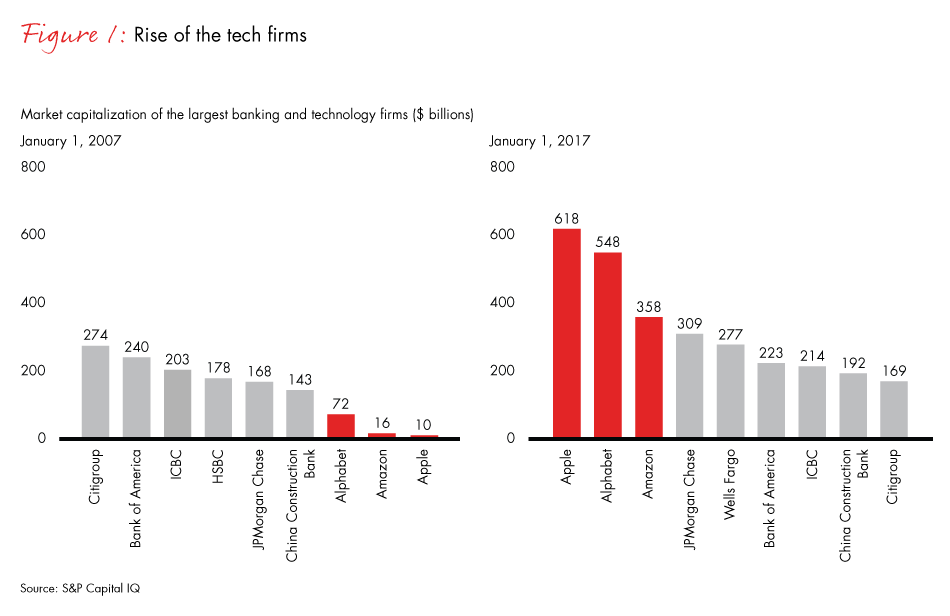
      With “disrupt,” “adapt” and “agility” appearing almost 400 times in the latest annual reports of the 20 largest global banks, it’s clear that bankers face an identity crisis. They can be forgiven a degree of paranoia: Of the 20 largest global banks as of early 2017, one-third were new to the list since a decade ago. Even more startling is their shift in relative market share compared with the major technology firms (see Figure 1).

      banking-strategy-for-the-long-game-fig01_embed

      Anxiety about these massive shifts leads many bank management teams and boards to focus overwhelmingly on the short game, especially the next quarter’s stock performance. Yet in many ways, the underlying business remains a long game. For example, consumers in the UK change their primary bank only once every 15 to 20 years on average, based on data from the UK’s Competition and Markets Authority. Tier 1 capital—the long-term capital that serves as a last defense against failure—has reached a record-high $2.4 trillion for the 20 largest banks globally. Bank equity investors currently pay for 13 years of annual earnings in Western markets. And the loan portfolio for the top 20 banks is fairly long term, with one-third of loans maturing in more than five years.

      Banking thus is much more than a current flow business; banks transform short-term actions into long-term value for stakeholders. So discussions about strategy, which typically cover three-year horizons, should in fact extend to a decade-long perspective. Banks need to manage for the long game, through the cycles, even as they adapt in the short term through test-and-learn experimentation. Given the technological and market changes roiling the industry, the coming decade may well bring even greater transformation to banking. As the deck gets reshuffled, bank leadership teams will want to understand several key questions:

      • What are all of the possible disruptions relevant to our institution?
      • How would they affect our profit pools, sources of advantage, competitive position and operating model?
      • What can our bank do to reinforce the core business, capture emerging profit pools, create options and hedges, and place a few big bets?

      The nature of banking is changing quickly, and disruptions are inevitable. Thomas Olsen, who leads Bain’s Strategy practice in the Asia-Pacific region, shares why banks need to take a long-term view.

      Seven macro themes to watch

      To that end, Bain & Company’s Macro Trends Group has analyzed a set of interrelated macroeconomic themes that, taken together, sketch out a framework for this period of transformation. We have a high level of confidence in these themes, although the timing and degree of influence will vary for different banks. The following are among the most important for banking.

      • Capital superabundance. Total world financial assets are projected to grow to $900 trillion by 2020, or 10 times the size of the underlying global economy. This state will persist at least through the next decade, which for banks means an environment of persistently low interest rates and pressure on spreads. A turn in the interest rate cycle, which many bankers anticipate, might at best be temporary in nature and unevenly distributed across countries.
      • Ages and stages of life. Later family formation stems from persistent unemployment in some markets, as well as from today’s higher costs of young adulthood, including rising real estate and education costs. These factors have created a new life stage: extended adolescence. People in this stage have different financial services requirements, with fewer current responsibilities but high future needs. At the same time, preretirement has emerged as another new stage, as some people work longer or remain semiattached to the workforce, even becoming entrepreneurs as a second or third career. Both new phases present new product opportunities for banks.
      • Widgets to digits. Computational power, networking, storage, and sensor technologies and software are approaching a critical threshold. Their next milestone will be to translate nearly every widget in the physical world into the symbols of the digital world. Small businesses will need an entirely new set of financing options for the oncoming slate of service automation devices supporting or disrupting their new business models. Furthermore, automation of many bank functions combined with distributed ledger technology could have a major effect on how transactions and payments are processed, which will change banks’ roles.
      • Bell curves to barbells. Technology has created new large-scale providers that function as utilities, enabling start-ups to enter at smaller scale. Whereas start-ups in the past had to buy everything from servers to marketing materials, and thus needed to carefully consider scale, today they can obtain computing resources through the cloud on a perusage basis, use social media for marketing and achieve scale by “renting” distribution through fees to companies such as JD.com. This shift creates new opportunities for start-ups and new commercial opportunities for banks that devise more innovative and flexible funding models to support start-ups’ capital needs.
      • Rise of platforms. Business models that facilitate the creation of value by others rather than internally are growing rapidly. They will form protected harbors more dynamic than the walled fortresses of firms, but more secure than the choppy seas of the open market. Banks have built extensive trust architecture and have access to intimate details of their customers’ finances. Extending that trust architecture to encompass third parties should make customers’ lives easier and more secure while creating new opportunities to capture value. Banks do, however, run the risk of being out-innovated by companies such as Alibaba that already mine and deploy customer data, and are making forays into payments.
      • Spatial economics. An array of new technologies, including autonomous vehicles, ubiquitous connectivity and drones, are causing the cost of distance to decline sharply, altering the way we live and work. Spatial economics will radically change the bank branch network. While the overall number of branches will likely keep dwindling, banks will have to consider moving branches that do remain viable to new locations, particularly to distant suburbs and exurbs outside the traditional commuter belt.
      • Post-globalization. The current cycle of globalization has peaked and is starting to ebb as geopolitical tensions rise. However, banks remain a critical “utility” for countries. As the historical advantages of the global universal banking model wane, banking across borders may become less appealing than building a strong national bank. For bankers, especially in retail banking, this puts a premium on investing in trust, reputation and local scale.


      How banks can prepare

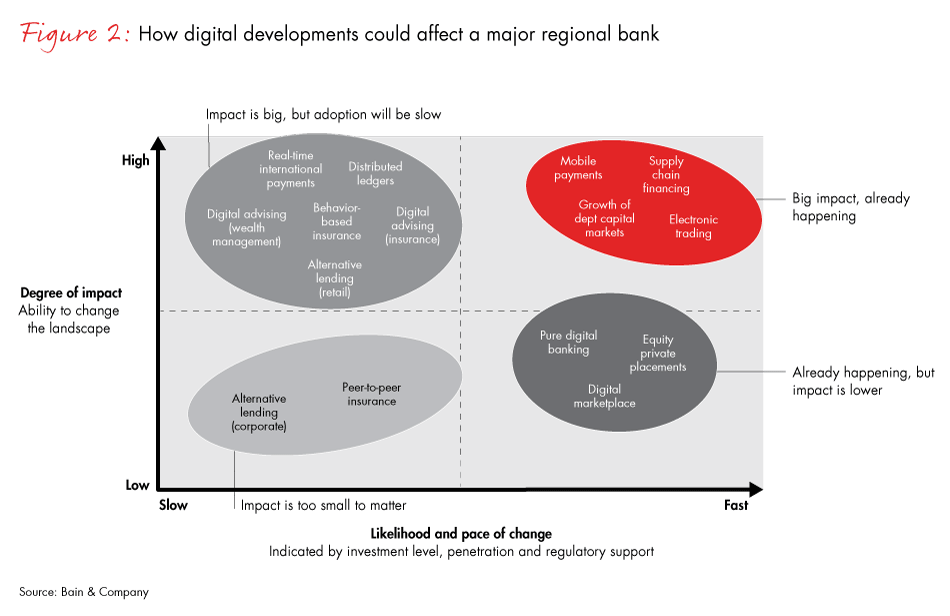
      Individual banks may not be significantly affected by all of these themes. To play the long game, each bank needs to determine which developments to prepare for and how, based on its particular assets, profit pool, business model and operating model. As a way to structure these decisions, some companies have found it useful to sort developments in a matrix, with likelihood and pace of change as one dimension, and degree of impact as another dimension. Developments that are already a mainstream proposition or likely to happen in the medium term and pose a large threat to a bank’s business would merit immediate attention and investment (see Figure 2).

      banking-strategy-for-the-long-game-fig02_embed

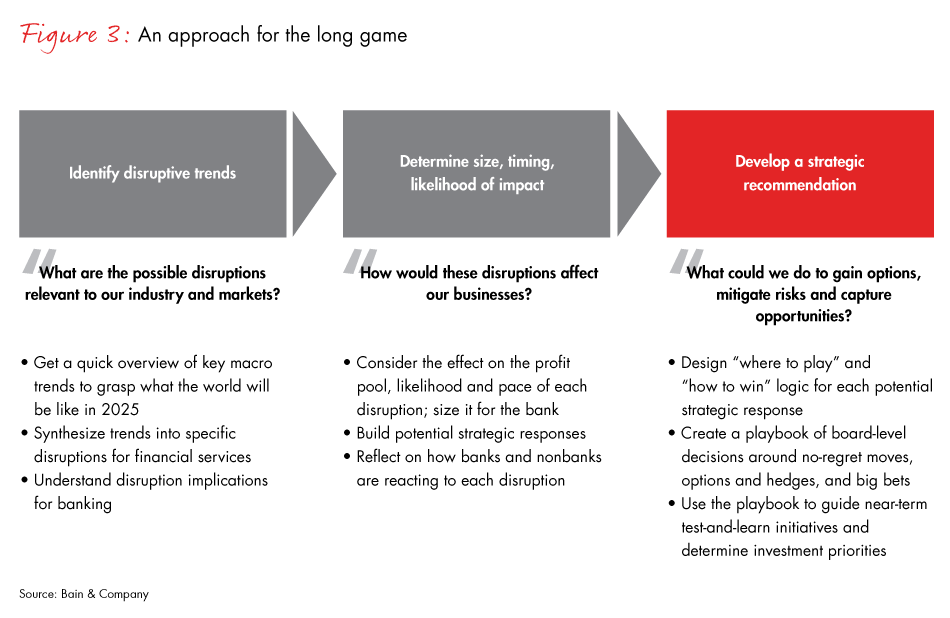
      Waiting indefinitely to see how these themes unfold is not a viable option. Instead, senior banking teams benefit by committing to an explicit set of investments that prepare their organizations to seize the opportunities that unfold (see Figure 3). That’s a more effective approach than scrambling reactively and allowing rivals or the external environment to define the rules of competition. The best strategies blend three critical elements.

      • No-regret moves. Some actions will increase a bank’s competitive edge no matter which themes play out soonest and most forcefully. They include making everyday banking products more simple and digital, which removes costs that don’t add value from the customer’s perspective; migrating customers from the branch to online banking and call centers, as banks such as ABN Amro have been doing; upgrading the customer experience with truly convenient, easy-to-use mobile interfaces that feature chatbots; and automating workflows for greater efficiency and speed.
      • Options and hedges. Leadership teams can evolve their way to a high-value option by focusing on micro-battles—discrete, customer-focused initiatives pursued by a small team. Micro-battles allow a bank to rapidly test and learn what works before scaling up. Some of these moves give a bank a stronger position in the event of a major industry shift, even if the immediate business benefits are not clear. In Korea, for instance, a number of banks, including KEB Hana, Woori, Shinhan, KB Kookmin and IBK, have joined a consortium to develop services using blockchain technology.

        Other options stem from the fact that, with activist investors applying pressure to public companies, many companies have increased buybacks and dividends while their capital expenditures and research and development budgets have declined on a relative basis. The dearth of funding innovation gives banks an opening to devise new forms of financing for long-term corporate projects, or new forms of financial structuring that are equity based rather than debt based, especially for smaller businesses without access to equity markets or venture capital.

      • Big bets. The most challenging balancing act involves large-scale investments that have different payoffs depending on how future uncertainties play out. One big bet consists of building a pure online bank to serve as an “engine 2” for the future, alongside the “engine 1” that generates revenue and profit today. Santander recently doubled down in this regard by relaunching Openbank, its subsidiary operating in Spain, as the first bank in the country to go fully digital. Openbank is transferring all IT assets and client transactions to the cloud and is revamping its online and mobile presence as part of a group-wide mission to recruit 30 million digital customers by 2018.
      banking-strategy-for-the-long-game-fig03_embed

      Banks can monitor a wide range of signposts and map them to possible strategic moves. Relevant signposts about the rise of platforms, for instance, could include the intensity of investments by venture capital and private equity funds, the rate of adoption by millennial consumers or banking license applications by major technology companies. Facebook late last year unveiled its newly acquired licenses for e-money and payment services out of Ireland, signaling it will enter the space in Europe. Signposts allow a bank to plan its moves before the adoption rate of a new service or technology soars—by which time it’s too late to participate.

      Although discussions about the long game do sometimes take place in bank executive suites, they often stay at too high a level, without leading to action. And although strategic plans typically are presented to the board, directors often have little or late influence on the plan. That’s a shame, as bankers can improve decisions with long-term consequences by taking these trends into account, and bank boards can make valuable contributions, especially those that strengthen their bench of tech-savvy board members. Incorporating macro themes into the long-term planning process helps banks build a strategy that will accommodate a future well beyond the next few quarters.

      Niels Peder Nielsen and Thomas Olsen are partners in Bain & Company’s Financial Services practice. They are based, respectively, in Copenhagen and Singapore. Karen Harris leads Bain’s Macro Trends Group and is based in New York.


      banking-strategy-for-the-long-game-fig01_full

      banking-strategy-for-the-long-game-fig02_full

      banking-strategy-for-the-long-game-fig03_full
      Authors
      • Niels Peder Nielsen
        Alumni, Copenhagen
      • Headshot of Thomas Olsen
        Thomas Olsen
        Partner, New York
      • Headshot of Karen Harris
        Karen Harris
        Managing Director, Macro Trends Group, New York
      Contact us
      Related Industries
      • Financial Services
      Financial Services
      New Bank Strategies Require New Operating Models

      It’s high time to shake up creaky structures and ways of working.

      Read More
      Financial Services
      How Banks Can Turn Around Unprofitable Corporate Clients

      Get the house in order in advance of higher interest rates.

      Read More
      Future of Banking
      Perform Today, Prove Tomorrow, Propel the Stock Valuation

      Leading banks build credibility with investors by aligning their strategy, execution, and equity story.

      Read More
      Financial Services
      Rethinking Transformation: Lawrence Lam on Leading Change at Prudential

      Frankie Leung speaks with Lawrence Lam, CEO of Prudential Hong Kong, about organizational transformation and sustaining change through a people-led approach.

      Read More
      Future of Banking
      Voting with Their Feet: Banking Consumers Want a Seamless Digital Experience

      Half of consumers’ digital purchases go to a competitor of their primary bank, and half of those who buy anywhere encounter friction in the process.

      Read More
      Published in September 2017
      Tags
      • Financial Services
      • Future of Banking

      How We've Helped Clients

      Sustainability Voluntary Carbon Markets: A Bank Moves Early to Seize the Opportunity

      Read case study

      Performance Improvement Lean Six Sigma solves a commercial bank's growth problem

      Read case study

      Enterprise Technology Bridging the Gap Between Business and Technology

      Read case study

      Ready to talk?

      We work with ambitious leaders who want to define the future, not hide from it. Together, we achieve extraordinary outcomes.

      Stay ahead in a rapidly changing world. Subscribe to Bain Insights, our monthly look at the critical issues facing global businesses.

      *I have read and understand Bain’s Privacy Notice.

      Please read and agree to the Privacy Policy.
      Bain & Company
      Contact us Sustainability Accessibility Terms of use Privacy Modern Slavery Act Statement Cookie Policy Sitemap Log In

      © 1996-2026 Bain & Company, Inc.

      Contact Bain

      How can we help you?

      • Business inquiry
      • Career information
      • Press relations
      • Partnership request
      • Speaker request
      See all offices