
Skip to Content
  • Offices

    Offices

    North & Latin America
    • Atlanta
    • Austin
    • Bogota
    • Boston
    • Buenos Aires
    • Chicago
    • Dallas
    • Denver
    • Houston
    • Los Angeles
    • Mexico City
    • Minneapolis
    • Monterrey
    • Montreal
    • New York
    • Rio de Janeiro
    • San Francisco
    • Santiago
    • São Paulo
    • Seattle
    • Silicon Valley
    • Toronto
    • Washington, DC
    Europe & Africa
    • Amsterdam
    • Athens
    • Berlin
    • Brussels
    • Copenhagen
    • Dusseldorf
    • Frankfurt
    • Helsinki
    • Istanbul
    • Johannesburg
    • Kyiv
    • Lisbon
    • London
    • Madrid
    • Milan
    • Munich
    • Oslo
    • Paris
    • Rome
    • Stockholm
    • Vienna
    • Warsaw
    • Zurich
    Middle East
    • Doha
    • Dubai
    • Riyadh
    Asia & Australia
    • Bangkok
    • Beijing
    • Bengaluru
    • Brisbane
    • Ho Chi Minh City
    • Hong Kong
    • Jakarta
    • Kuala Lumpur
    • Manila
    • Melbourne
    • Mumbai
    • New Delhi
    • Perth
    • Seoul
    • Shanghai
    • Singapore
    • Sydney
    • Tokyo
    See all offices
  • Alumni
  • Media Center
  • Subscribe
  • Contact
  • Global | English

    Select your region and language

    Global
    • Global (English)
    North & Latin America
    • Brazil (Português)
    • Argentina (Español)
    • Canada (Français)
    • Chile (Español)
    • Colombia (Español)
    Europe, Middle East, & Africa
    • France (Français)
    • DACH Region (Deutsch)
    • Italy (Italiano)
    • Spain (Español)
    • Greece (Elliniká)
    Asia & Australia
    • China (中文版)
    • Korea (한국어)
    • Japan (日本語)
  • Saved items (0)
    Saved items (0)

    You have no saved items.

    Bookmark content that interests you and it will be saved here for you to read or share later.

    Explore Bain Insights
  • Industries
    Main menu

    Industries

    • Aerospace & Defense
    • Agribusiness
    • Chemicals
    • Construction & Infrastructure
    • Consumer Products
    • Financial Services
    • Healthcare & Life Sciences
    • Industrial Machinery & Equipment
    • Media & Entertainment
      Industries
      Media & Entertainment
      • Media Lab
    • Metals
    • Mining
    • Oil & Gas
    • Paper & Packaging
    • Private Equity
      Industries
      Private Equity
      • Due Diligence
      • Exit Planning
      • Firm Strategy & Operations
      • Portfolio Value Creation
    • Social Impact
    • Retail
    • Technology
    • Telecommunications
      Industries
      Telecommunications
      • Capital Expenditure
      • Telco Digital Transformation
    • Transportation
    • Travel & Leisure
    • Utilities & Renewables
  • Consulting Services
    Main menu

    Consulting Services

    • Customer Experience
    • Sustainability
    • Innovation
    • M&A
    • Operations
    • People & Organization
    • Private Equity
    • Sales & Marketing
    • Strategy
    • AI, Insights, and Solutions
    • Technology
    • Transformation
  • Digital
  • Insights
    Main menu

    Insights

    • Industry Insights
    • Services Insights
    • Bain Books
    • Webinars
    • Bain Futures
    View all Insights
    Featured topics
    • Tariff Response
    • Artificial Intelligence
    • Thriving in Uncertainty
    • Executive Conversations
    • Macro Trends
    • M&A Report
    • Healthcare Private Equity Report
    • Paper & Packaging Report
    • Technology Report
    • CEO's Guide to Sustainability
    • CEO Insights
    • CFO Insights
    • COO Insights
    • CIO Insights
    • CMO Insights
    View all featured topics
  • About
    Main menu

    About

    • What We Do
    • What We Believe
    • Our People & Leadership
    • Client Results
    • Awards & Recognition
    • Global Affiliations
    Further: Our global responsibility
    • Sustainability
    • Social Impact
    • World Economic Forum
    Learn more about Further
  • Careers
    Main menu

    Careers

    • Work with Us
      Careers
      Work with Us
      • Find Your Place
      • Our Work Areas
      • Integrated Teams
      • Students
      • Internships & Programs
      • Recruiting Events
    • Life at Bain
      Careers
      Life at Bain
      • Blog: Inside Bain
      • Career Stories
      • Our People
      • Where We Work
      • Supporting Your Growth
      • Affinity Groups
      • Benefits
    • Impact Stories
    • Hiring Process
      Careers
      Hiring Process
      • What to Expect
      • Interviewing
    FIND JOBS
  • Offices
    Main menu

    Offices

    • North & Latin America
      Offices
      North & Latin America
      • Atlanta
      • Austin
      • Bogota
      • Boston
      • Buenos Aires
      • Chicago
      • Dallas
      • Denver
      • Houston
      • Los Angeles
      • Mexico City
      • Minneapolis
      • Monterrey
      • Montreal
      • New York
      • Rio de Janeiro
      • San Francisco
      • Santiago
      • São Paulo
      • Seattle
      • Silicon Valley
      • Toronto
      • Washington, DC
    • Europe & Africa
      Offices
      Europe & Africa
      • Amsterdam
      • Athens
      • Berlin
      • Brussels
      • Copenhagen
      • Dusseldorf
      • Frankfurt
      • Helsinki
      • Istanbul
      • Johannesburg
      • Kyiv
      • Lisbon
      • London
      • Madrid
      • Milan
      • Munich
      • Oslo
      • Paris
      • Rome
      • Stockholm
      • Vienna
      • Warsaw
      • Zurich
    • Middle East
      Offices
      Middle East
      • Doha
      • Dubai
      • Riyadh
    • Asia & Australia
      Offices
      Asia & Australia
      • Bangkok
      • Beijing
      • Bengaluru
      • Brisbane
      • Ho Chi Minh City
      • Hong Kong
      • Jakarta
      • Kuala Lumpur
      • Manila
      • Melbourne
      • Mumbai
      • New Delhi
      • Perth
      • Seoul
      • Shanghai
      • Singapore
      • Sydney
      • Tokyo
    See all offices
  • Alumni
  • Media Center
  • Subscribe
  • Contact
  • Global | English
    Main menu

    Select your region and language

    • Global
      Select your region and language
      Global
      • Global (English)
    • North & Latin America
      Select your region and language
      North & Latin America
      • Brazil (Português)
      • Argentina (Español)
      • Canada (Français)
      • Chile (Español)
      • Colombia (Español)
    • Europe, Middle East, & Africa
      Select your region and language
      Europe, Middle East, & Africa
      • France (Français)
      • DACH Region (Deutsch)
      • Italy (Italiano)
      • Spain (Español)
      • Greece (Elliniká)
    • Asia & Australia
      Select your region and language
      Asia & Australia
      • China (中文版)
      • Korea (한국어)
      • Japan (日本語)
  • Saved items  (0)
    Main menu
    Saved items (0)

    You have no saved items.

    Bookmark content that interests you and it will be saved here for you to read or share later.

    Explore Bain Insights
  • Industries
    • Industries

      • Aerospace & Defense
      • Agribusiness
      • Chemicals
      • Construction & Infrastructure
      • Consumer Products
      • Financial Services
      • Healthcare & Life Sciences
      • Industrial Machinery & Equipment
      • Media & Entertainment
      • Metals
      • Mining
      • Oil & Gas
      • Paper & Packaging
      • Private Equity
      • Social Impact
      • Retail
      • Technology
      • Telecommunications
      • Transportation
      • Travel & Leisure
      • Utilities & Renewables
  • Consulting Services
    • Consulting Services

      • Customer Experience
      • Sustainability
      • Innovation
      • M&A
      • Operations
      • People & Organization
      • Private Equity
      • Sales & Marketing
      • Strategy
      • AI, Insights, and Solutions
      • Technology
      • Transformation
  • Digital
  • Insights
    • Insights

      • Industry Insights
      • Services Insights
      • Bain Books
      • Webinars
      • Bain Futures
      View all Insights
      Featured topics
      • Tariff Response
      • Artificial Intelligence
      • Thriving in Uncertainty
      • Executive Conversations
      • Macro Trends
      • M&A Report
      • Healthcare Private Equity Report
      • Paper & Packaging Report
      • Technology Report
      • CEO's Guide to Sustainability
      • CEO Insights
      • CFO Insights
      • COO Insights
      • CIO Insights
      • CMO Insights
      View all featured topics
  • About
    • About

      • What We Do
      • What We Believe
      • Our People & Leadership
      • Client Results
      • Awards & Recognition
      • Global Affiliations
      Further: Our global responsibility
      • Sustainability
      • Social Impact
      • World Economic Forum
      Learn more about Further
  • Careers
    Popular Searches
    • Agile
    • Digital
    • Strategy
    Your Previous Searches
      Recently Visited Pages

      Content added to saved items

      Saved items (0)

      Removed from saved items

      Saved items (0)

      Gaming Report

      Boosting Marketing Performance in Mobile Games

      Boosting Marketing Performance in Mobile Games

      Making great games is no longer enough; great marketing is critical.

      By Anders Videbaek, Benjamin Sommer, and Anders Christofferson

      • min read
      }

      Report

      Boosting Marketing Performance in Mobile Games
      en
      At a Glance
      • With 40% of the world’s population playing video games, the audience is getting saturated. Effective marketing is more important than ever.
      • Game studios spend about 25% of their revenue on marketing, higher than in other industries. But much of it is misdirected.
      • Successful marketing requires targeted ads, strategic channel decisions, and alignment between development, marketing, and finance.
      • Artificial intelligence and data-driven insights enhance marketing effectiveness by optimizing campaigns and improving engagement.

      This article is part of Bain's 2024 Gaming Report

      Explore the report

      Today, more than 3.1 billion people play video games, about 40% of the world’s population. Mobile gaming represents slightly more than half of the global gaming market, and we can expect that percentage to grow given the ubiquity of devices. As the audience of gamers becomes saturated, it costs more to acquire new gamers, and developers with new games must fight harder to win players away from their current games.

      At the same time, gamers have access to more games than ever before, thanks to expanding distribution paths and the overall growth of the industry. Competition for players’ attention also comes from other media: 67% of game players say that they often consume other media while gaming. This is likely to make it more difficult to maintain high advertising rates, as advertisers may require proof of attention, rather than just reach.

      Given these challenges, successful marketing will make or break many game developers. On average, gaming companies with revenue less than $1 billion spend about 25% of their revenue on marketing, and some spend much more. That’s higher than spending at other software companies, which spend about 15% (see Figure 1).

      Figure 1
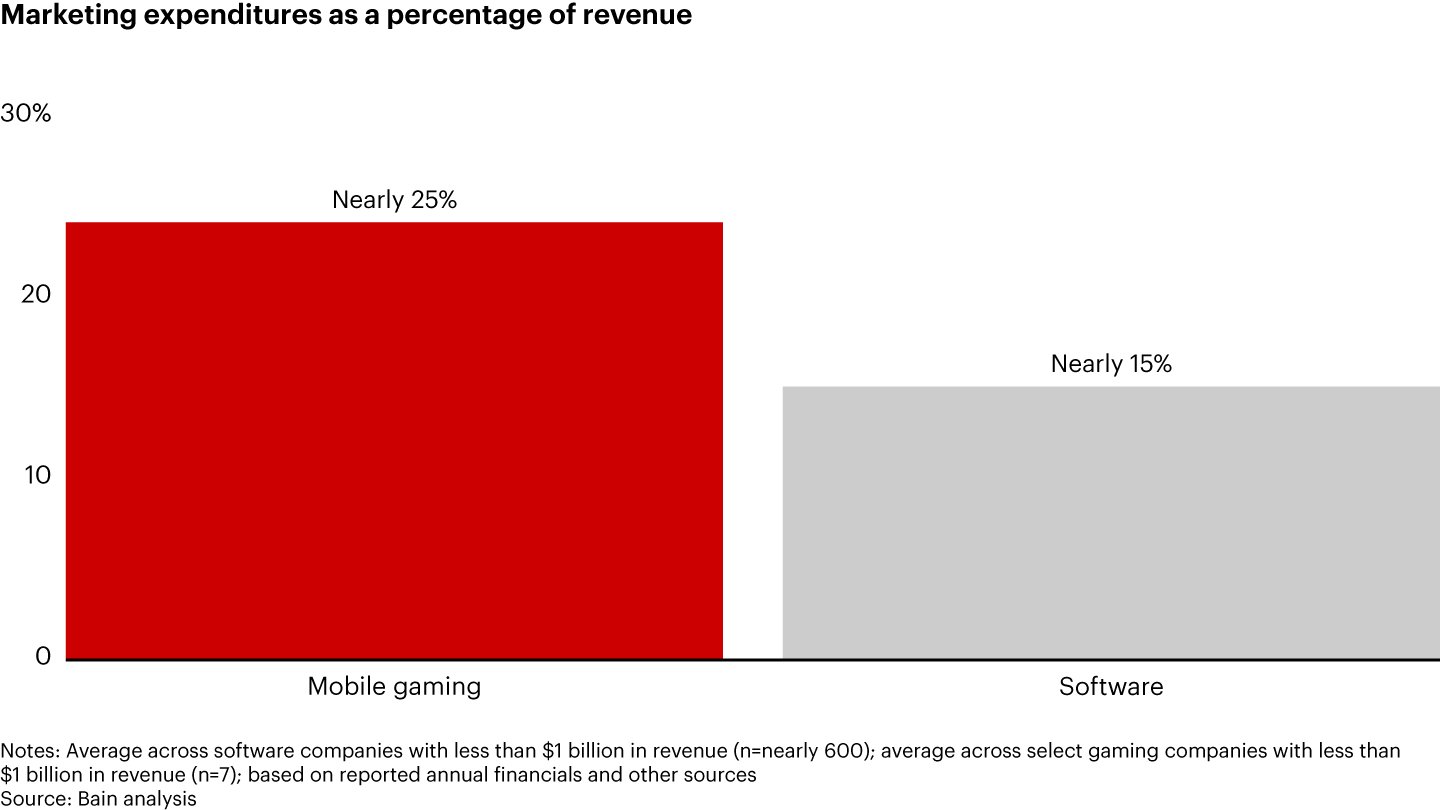
      Gaming companies spend about a quarter of their revenue on marketing, more than other software companies

      Unfortunately, much of that spending is misdirected when companies fail to market their games effectively in a crowded field. Game developers may spend more on marketing but fail to set clear targets based on metrics like the lifetime value of a customer. In some cases, gaming companies do a poor job of aligning their marketing teams with their product teams, resulting in confusion over who is being targeted and why.

      Successful mobile gaming companies, on the other hand, are highly effective marketing machines, focusing their efforts on identifying and acquiring new users. Marketing leaders increasingly rely on advanced and unique marketing models to differentiate themselves from competitors. Scopely’s Monopoly Go! offers a good example. Scopely (which is owned by Savvy Games Group) says it spent seven years developing the mobile version of the classic board game and $500 million in advertising, with about a quarter of that going toward user acquisition. The big bet on classic intellectual property paid off: Scopely says that the title has earned $2 billion in revenue just 10 months after its launch.

      Performance varies

      Mobile gaming is a high-risk business, and the chance of failure is greater than in many other industries. The likelihood of declining revenue is also high: More than 40% of all gaming companies with more than $10 million in revenue may see a decline in that revenue over a three-year period, compared with only 10% to 20% for other types of software businesses (see Figure 2).

      Figure 2
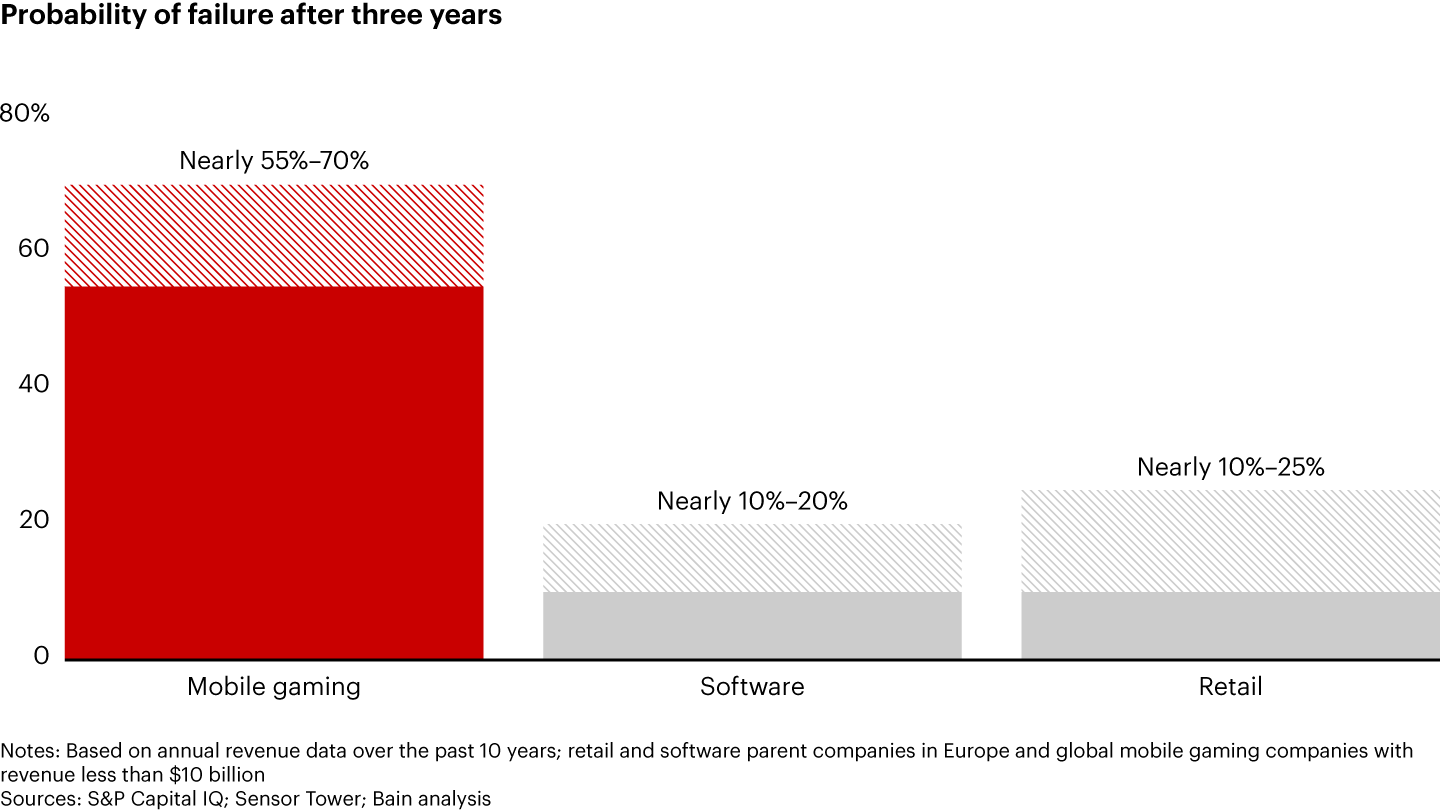
      Mobile gaming is a high-risk industry, with failure more likely than in software or retail

      These risks make it all the more important to develop the skills that help ensure the effectiveness of marketing expenditures. Too often, companies focus on raw numbers of downloads, paying to acquire customers who may play the game only once. Unless companies target the appropriate segments and follow up with engaging gameplay, many new players won’t stick around long enough to deliver a return on the acquisition costs.

      Companies struggling with their marketing performance frequently slip in one of three areas: targeting ads appropriately; making the right channel decisions; and aligning strategy among game development, marketing, and finance.

      • Paid performance marketing has been the most important channel for successful mobile gaming companies. Sometimes, however, these ads can be too generic, poorly targeted, or misleading, showing graphics or activities that aren't part of gameplay. Successful advertisements are tailored to the target audience, nuanced for the respective distribution platform (e.g., TikTok, Instagram, or YouTube), and designed to grab attention without being too disruptive to the user.
      • Closely related, successful game developers also invest more in understanding the differences within audiences and algorithms across platforms, continuously refining their understanding with A/B testing. A deeper understanding allows for more informed optimization, taking account of small details such as time of day or keyword choice across channels.
      • Finally, developers often fail to align their own functions as they scale games, which contributes to ineffective marketing spending. The teams across game development (responsible for content and marketing tools), finance and analytics (gatekeeping budgets and performance targets), and marketing (developing and executing campaigns) need to stay in sync on story and business priorities as they change.

      Supercell’s recent addition to Clash of Clans, along with the related marketing campaign, shows what can happen when departments align. In May, the company launched a new campaign featuring Manchester City football star Erling Haaland. Cross-platform ads featured Clash of Clans characters recruiting the “world’s greatest attacker” to join their battles, and players had a new option to choose Haaland as their character within gameplay. This close collaboration between marketing and game development, while surely difficult to pull off, has generated a remarkable amount of impressions and exceedingly positive player feedback.

      Don’t just woo them; win them

      Clash of Clans’ longevity—it launched in 2012—demonstrates another important point: Players stick with familiar games. A 2023 industry survey by Newzoo found that 60% of game time went to games six years old or older. This preference contributes to the industry’s “winners take most” structure and further raises the stakes on ensuring powerful marketing that punches through the noise.

      Successful companies position user acquisition as a core tenet of their strategy. But that’s just the start: reaching the top of the leaderboard requires a more comprehensive plan for gamer acquisition and retention. Leaders are doubling down on three areas to ensure that their marketing investments serve long-term strategic goals.

      Focus on the long game. Big hits are great for putting a new company on the map. But ongoing success requires aligning game development, marketing, and metrics to long-term strategic ambitions. Successful companies work to understand the connections among customer acquisition, retention, and monetization. They craft a compelling story for employees, shareholders, and customers that communicates the company’s long-term ambitions.

      Today, only a fraction of developers have managed to crack this code. Swedish game developer King, for example, takes a broad approach to marketing, using a variety of techniques that may contribute to the sustained appeal of its games. King’s Candy Crush has generated $20 billion in revenue since its 2012 launch, and while it focuses primarily on improving the game experience for its players, it also invests in a range of creative marketing initiatives, such as strong brand partnerships (including Meghan Trainor, the Jonas Brothers, and the Barbie movie), a Candy Crush–themed 500-drone show over New York City, and the creation of an all-star competition.

      Find the right audience. In a saturated market, gaming companies should spend more on market research to learn about the specific customer segments in which they have the greatest opportunity. Lowering customer acquisition costs and increasing retention will become ever more important. As more of the global population becomes gamers, reactivation efforts will become more important—that is, pursuing existing gamers rather than trying to create new ones.

      Rollic Games, a subsidiary of Zynga, targets “hypercasual” players with simple games that can be learned in a few seconds and played in less than a minute. Aiming to deliver more of these low-effort, transitory experiences, Rollic gathers data on users that maximizes its chances of delivering something that sticks. With these insights, the developer has produced more than 200 titles since 2018, recently passed 2 billion downloads, and is pivoting into live events and live game updates.

      Use AI to improve engagement. Using generative AI in early efforts can accelerate marketing campaigns with precision-targeted ads. AI supports and facilitates several key marketing functions:

      • In production, AI can generate marketing copy text and images for digital ads.
      • In quality control, AI can help with content validation and proofing for spelling or grammatical errors.
      • In deployment, AI can optimize campaigns by automating content tailoring (e.g., based on the platforms where they will be deployed) and tagging (e.g., uploading with appropriate tags and meta descriptions).
      • And in measurement, AI supports campaign prediction, automated testing, and measurement of key metrics of campaign success (capture rate, clickthrough rate) to inform future campaign improvements.

      TapNation, a mobile games publisher with more than 1 billion downloads and 60 million active users, acquired UAhero, an AI user acquisition tool, in January 2024 to strengthen its market position. UAhero's program allows mobile gaming companies to integrate their ad campaigns across different networks and platforms to track live metrics (e.g., clicks, installs, impressions, ad costs) in a centralized, easily comparable hub. Users can input specific targets (e.g., a return on advertising expenditures of 150%) for different campaigns, receive recommended actions to take to achieve the goal, and even execute most actions without input.

      Game development and publishing is an industry saddled with the burden of its own tremendous success. In many companies that were founded out of a passion for gaming, leaders must now professionalize the functions that will allow them to compete and thrive in a global industry worth hundreds of billions of dollars annually. Marketing is among the most scrutinized functions, and professionalizing its execution is one of the most essential steps in ensuring that new successes can break through to find their audience.

      The authors would like to thank Nyla Brewster, Katie Chung, and Brandon Rogers for their contributions to this work.

      Read the Next Section

      Level Unlocked: How Video Game Companies Can Evolve Operating Models for Growth

      More from the report

      • Gaming Survey

      • Distribution

      • Mobile Game Marketing

      • Operating Models

      Read our 2024 Gaming Report

      Explore the report Download the PDF
      Authors
      • Headshot of Anders Videbaek
        Anders Videbaek
        Partner, Copenhagen
      • Headshot of Benjamin Sommer
        Benjamin Sommer
        Partner, Stockholm
      • Headshot of Anders Christofferson
        Anders Christofferson
        Partner, Denver
      Contact us
      Related Industries
      • Gaming
      • Media & Entertainment
      Related Consulting Services
      • Sales and Marketing
      Media & Entertainment
      Not Yet, Robots: How to Win in Media’s Flooded Era

      As AI floods the market with cheap content, human creativity will stand out—and new tech tools might even help.

      Read More
      Sales and Marketing
      Too Much Marketing Technology, Too Little Impact

      Marketing leaders build tightly integrated systems that fuel growth, personalization, and real ROI.

      Read More
      Media & Entertainment
      Gamer Survey: Great Gameplay Is No Longer Enough

      Top games are winning with community building, user-generated content, and innovative revenue models.

      Read More
      Sales and Marketing
      Better Questions, Better Sales Calls

      Top reps dig deep even when the deal doesn’t close on the first contact.

      Read More
      Media & Entertainment
      Winning Beyond the Game

      For companies with a hit video game, building a long-term strategy to extend IP beyond gameplay is the next frontier of competitive advantage.

      Read More
      Published in August 2024
      Tags
      • Gaming
      • Media & Entertainment
      • Sales and Marketing

      How We've Helped Clients

      People and Organization A Video Game Company Levels Up With a New Operating Model

      Read case study

      People and Organization Building a winning media salesforce

      Read case study

      Performance Improvement A full-potential business bumps up the bidding

      Read case study

      Ready to talk?

      We work with ambitious leaders who want to define the future, not hide from it. Together, we achieve extraordinary outcomes.

      Stay ahead in a rapidly changing world. Subscribe to Bain Insights, our monthly look at the critical issues facing global businesses.

      *I have read and understand Bain’s Privacy Notice.

      Please read and agree to the Privacy Policy.
      Bain & Company
      Contact us Sustainability Accessibility Terms of use Privacy Modern Slavery Act Statement Cookie Policy Sitemap Log In

      © 1996-2026 Bain & Company, Inc.

      Contact Bain

      How can we help you?

      • Business inquiry
      • Career information
      • Press relations
      • Partnership request
      • Speaker request
      See all offices