
Skip to Content
  • Offices

    Offices

    North & Latin America
    • Atlanta
    • Austin
    • Bogota
    • Boston
    • Buenos Aires
    • Chicago
    • Dallas
    • Denver
    • Houston
    • Los Angeles
    • Mexico City
    • Minneapolis
    • Monterrey
    • Montreal
    • New York
    • Rio de Janeiro
    • San Francisco
    • Santiago
    • São Paulo
    • Seattle
    • Silicon Valley
    • Toronto
    • Washington, DC
    Europe & Africa
    • Amsterdam
    • Athens
    • Berlin
    • Brussels
    • Copenhagen
    • Dusseldorf
    • Frankfurt
    • Helsinki
    • Istanbul
    • Johannesburg
    • Kyiv
    • Lisbon
    • London
    • Madrid
    • Milan
    • Munich
    • Oslo
    • Paris
    • Rome
    • Stockholm
    • Vienna
    • Warsaw
    • Zurich
    Middle East
    • Doha
    • Dubai
    • Riyadh
    Asia & Australia
    • Bangkok
    • Beijing
    • Bengaluru
    • Brisbane
    • Ho Chi Minh City
    • Hong Kong
    • Jakarta
    • Kuala Lumpur
    • Manila
    • Melbourne
    • Mumbai
    • New Delhi
    • Perth
    • Seoul
    • Shanghai
    • Singapore
    • Sydney
    • Tokyo
    See all offices
  • Alumni
  • Media Center
  • Subscribe
  • Contact
  • Global | English

    Select your region and language

    Global
    • Global (English)
    North & Latin America
    • Brazil (Português)
    • Argentina (Español)
    • Canada (Français)
    • Chile (Español)
    • Colombia (Español)
    Europe, Middle East, & Africa
    • France (Français)
    • DACH Region (Deutsch)
    • Italy (Italiano)
    • Spain (Español)
    • Greece (Elliniká)
    Asia & Australia
    • China (中文版)
    • Korea (한국어)
    • Japan (日本語)
  • Saved items (0)
    Saved items (0)

    You have no saved items.

    Bookmark content that interests you and it will be saved here for you to read or share later.

    Explore Bain Insights
  • Industries
    Main menu

    Industries

    • Aerospace & Defense
    • Agribusiness
    • Chemicals
    • Construction & Infrastructure
    • Consumer Products
    • Financial Services
    • Healthcare & Life Sciences
    • Industrial Machinery & Equipment
    • Media & Entertainment
      Industries
      Media & Entertainment
      • Media Lab
    • Metals
    • Mining
    • Oil & Gas
    • Paper & Packaging
    • Private Equity
      Industries
      Private Equity
      • Due Diligence
      • Exit Planning
      • Firm Strategy & Operations
      • Portfolio Value Creation
    • Social Impact
    • Retail
    • Technology
    • Telecommunications
      Industries
      Telecommunications
      • Capital Expenditure
      • Telco Digital Transformation
    • Transportation
    • Travel & Leisure
    • Utilities & Renewables
  • Consulting Services
    Main menu

    Consulting Services

    • Customer Experience
    • Sustainability
    • Innovation
    • M&A
    • Operations
    • People & Organization
    • Private Equity
    • Sales & Marketing
    • Strategy
    • AI, Insights, and Solutions
    • Technology
    • Transformation
  • Digital
  • Insights
    Main menu

    Insights

    • Industry Insights
    • Services Insights
    • Bain Books
    • Webinars
    • Bain Futures
    View all Insights
    Featured topics
    • Tariff Response
    • Artificial Intelligence
    • Thriving in Uncertainty
    • Executive Conversations
    • Macro Trends
    • M&A Report
    • Healthcare Private Equity Report
    • Paper & Packaging Report
    • Technology Report
    • CEO's Guide to Sustainability
    • CEO Insights
    • CFO Insights
    • COO Insights
    • CIO Insights
    • CMO Insights
    View all featured topics
  • About
    Main menu

    About

    • What We Do
    • What We Believe
    • Our People & Leadership
    • Client Results
    • Awards & Recognition
    • Global Affiliations
    Further: Our global responsibility
    • Sustainability
    • Social Impact
    • World Economic Forum
    Learn more about Further
  • Careers
    Main menu

    Careers

    • Work with Us
      Careers
      Work with Us
      • Find Your Place
      • Our Work Areas
      • Integrated Teams
      • Students
      • Internships & Programs
      • Recruiting Events
    • Life at Bain
      Careers
      Life at Bain
      • Blog: Inside Bain
      • Career Stories
      • Our People
      • Where We Work
      • Supporting Your Growth
      • Affinity Groups
      • Benefits
    • Impact Stories
    • Hiring Process
      Careers
      Hiring Process
      • What to Expect
      • Interviewing
    FIND JOBS
  • Offices
    Main menu

    Offices

    • North & Latin America
      Offices
      North & Latin America
      • Atlanta
      • Austin
      • Bogota
      • Boston
      • Buenos Aires
      • Chicago
      • Dallas
      • Denver
      • Houston
      • Los Angeles
      • Mexico City
      • Minneapolis
      • Monterrey
      • Montreal
      • New York
      • Rio de Janeiro
      • San Francisco
      • Santiago
      • São Paulo
      • Seattle
      • Silicon Valley
      • Toronto
      • Washington, DC
    • Europe & Africa
      Offices
      Europe & Africa
      • Amsterdam
      • Athens
      • Berlin
      • Brussels
      • Copenhagen
      • Dusseldorf
      • Frankfurt
      • Helsinki
      • Istanbul
      • Johannesburg
      • Kyiv
      • Lisbon
      • London
      • Madrid
      • Milan
      • Munich
      • Oslo
      • Paris
      • Rome
      • Stockholm
      • Vienna
      • Warsaw
      • Zurich
    • Middle East
      Offices
      Middle East
      • Doha
      • Dubai
      • Riyadh
    • Asia & Australia
      Offices
      Asia & Australia
      • Bangkok
      • Beijing
      • Bengaluru
      • Brisbane
      • Ho Chi Minh City
      • Hong Kong
      • Jakarta
      • Kuala Lumpur
      • Manila
      • Melbourne
      • Mumbai
      • New Delhi
      • Perth
      • Seoul
      • Shanghai
      • Singapore
      • Sydney
      • Tokyo
    See all offices
  • Alumni
  • Media Center
  • Subscribe
  • Contact
  • Global | English
    Main menu

    Select your region and language

    • Global
      Select your region and language
      Global
      • Global (English)
    • North & Latin America
      Select your region and language
      North & Latin America
      • Brazil (Português)
      • Argentina (Español)
      • Canada (Français)
      • Chile (Español)
      • Colombia (Español)
    • Europe, Middle East, & Africa
      Select your region and language
      Europe, Middle East, & Africa
      • France (Français)
      • DACH Region (Deutsch)
      • Italy (Italiano)
      • Spain (Español)
      • Greece (Elliniká)
    • Asia & Australia
      Select your region and language
      Asia & Australia
      • China (中文版)
      • Korea (한국어)
      • Japan (日本語)
  • Saved items  (0)
    Main menu
    Saved items (0)

    You have no saved items.

    Bookmark content that interests you and it will be saved here for you to read or share later.

    Explore Bain Insights
  • Industries
    • Industries

      • Aerospace & Defense
      • Agribusiness
      • Chemicals
      • Construction & Infrastructure
      • Consumer Products
      • Financial Services
      • Healthcare & Life Sciences
      • Industrial Machinery & Equipment
      • Media & Entertainment
      • Metals
      • Mining
      • Oil & Gas
      • Paper & Packaging
      • Private Equity
      • Social Impact
      • Retail
      • Technology
      • Telecommunications
      • Transportation
      • Travel & Leisure
      • Utilities & Renewables
  • Consulting Services
    • Consulting Services

      • Customer Experience
      • Sustainability
      • Innovation
      • M&A
      • Operations
      • People & Organization
      • Private Equity
      • Sales & Marketing
      • Strategy
      • AI, Insights, and Solutions
      • Technology
      • Transformation
  • Digital
  • Insights
    • Insights

      • Industry Insights
      • Services Insights
      • Bain Books
      • Webinars
      • Bain Futures
      View all Insights
      Featured topics
      • Tariff Response
      • Artificial Intelligence
      • Thriving in Uncertainty
      • Executive Conversations
      • Macro Trends
      • M&A Report
      • Healthcare Private Equity Report
      • Paper & Packaging Report
      • Technology Report
      • CEO's Guide to Sustainability
      • CEO Insights
      • CFO Insights
      • COO Insights
      • CIO Insights
      • CMO Insights
      View all featured topics
  • About
    • About

      • What We Do
      • What We Believe
      • Our People & Leadership
      • Client Results
      • Awards & Recognition
      • Global Affiliations
      Further: Our global responsibility
      • Sustainability
      • Social Impact
      • World Economic Forum
      Learn more about Further
  • Careers
    Popular Searches
    • Agile
    • Digital
    • Strategy
    Your Previous Searches
      Recently Visited Pages

      Content added to saved items

      Saved items (0)

      Removed from saved items

      Saved items (0)

      Brief

      Build a Digital Supply Chain That Is Fit for the Future

      Build a Digital Supply Chain That Is Fit for the Future

      Digital tools can help companies stay a step ahead of changing industries.

      By Sam Israelit, Peter Hanbury, Rodrigo Mayo and Thomas Kwasniok

      • min read
      }

      Brief

      Build a Digital Supply Chain That Is Fit for the Future
      en

      Complaints from frustrated customers were mounting at a major US retailer. More than 20% said they could not find the company’s branded products in shops because items were out of stock. The problem was that efforts to improve service disrupted the company’s low-cost distribution model. It had the right infrastructure but lacked the digital tools necessary to increase supply chain reliability.

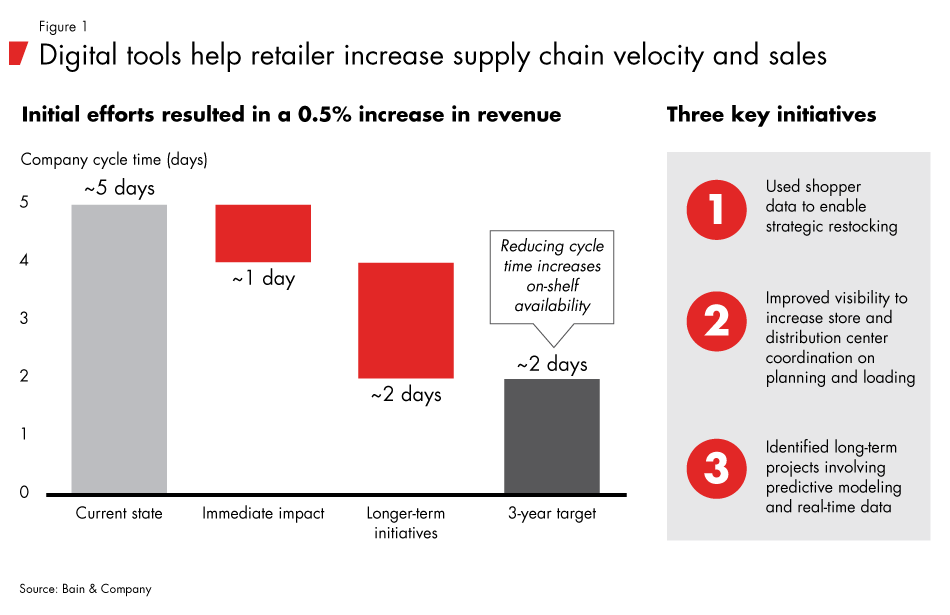
      Moving quickly, the leadership team invested in digital tools to obtain real-time data, shorten replenishment cycle times, optimize deliveries and predict future demand. As data streamed in from stores the minute shoppers purchased goods, the company rapidly restocked hot-selling items to capture sales that it previously had lost. The shift cut retail cycle times by 20%, to four days, generating a 0.5% increase in sales (see Figure 1). And that was just the first wave of improvement. Over the next 24 months, the company aims to reduce the time needed to fill store orders to two days, for a 60% total reduction in retail cycle time.

      Companies that integrate digital technologies into their supply chain can quickly improve service levels while cutting costs up to 30%. Just as important are the options that digital technologies provide to develop new business models and new strategies. For instance, leading-edge companies such as Adidas are deploying 3-D printing to move some production closer to customers, offering greater product customization and shorter lead times.

      Despite those advantages, many companies are struggling to keep pace with an onslaught of digital trends that are disrupting traditional supply chain management, slashing response times and raising customers’ expectations. The speed of change is overwhelming, especially for those that are not digital natives. Seventy percent of executives expect digital innovation to have a significant impact on their supply chains during the next five years, according to a recent Bain survey, up from just 63% in 2016.

      Digital-supply-chain-trends_fig01_embed

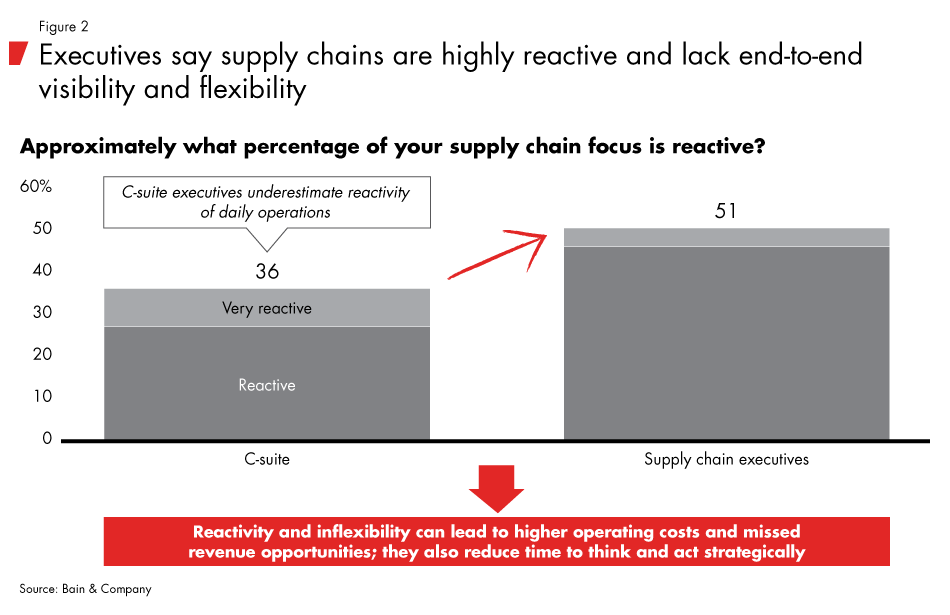
      One of the biggest challenges is building a comprehensive view of how performance standards are changing and what customers really want. Without that knowledge, companies risk being outmaneuvered. Bain research shows more than one-third of CEOs are overly confident about the ability of their supply chains to anticipate swings in demand (see Figure 2). And the risks of being blindsided are big: higher operating costs from expensive last-minute orders, a pileup of excess inventory, missed revenue opportunities and lost sales from ineffective new product rollouts.

      Digital-supply-chain-trends_fig02_embed


      Four steps to a digital supply chain

      A good place to start when shaping a digital strategy is understanding the industry context and the company’s starting point. For example, many companies start with customized legacy IT systems. Replacing these with the latest off-the-shelf digital tools can generate new revenue, improve responsiveness, increase efficiencies and reduce the total cost of ownership for IT systems.

      Leading companies develop the culture, data analytics and IT systems to support their digital strategy and business objectives. They pursue specific goals with near-term value while adopting a clear view of their digital destination. And they remain ready to pivot as their industry evolves.

      Infographic

      How Digital Is Changing Supply Chains

      A look at seven trends that are transforming supply chains.

      What’s my ideal future state? The key to building supply chains that will be competitive in 5 or even 10 years is anticipating change. Leaders evaluate where the industry is going and identify the supply chain capabilities they need to get there.

      True, anticipating change is a strategic leap into the future. But most leadership teams can gauge what their business may look like in 3, 5 and 10 years. The 3-year vision is likely to be more concrete, while the 5-year and 10-year visions will be more conceptual. For many retailers and consumer products companies, for instance, it is clear that e-commerce has raised consumer expectations and that traditional retail distribution and replenishment models are unable to meet the needs of their customers who are demanding shorter lead times.

      Successful companies avoid incremental moves by envisioning just how extreme the future might look. For example, what would happen if the entire business moved from high margin to low margin or if it shifted from standard products to custom products? These scenarios can help supply chain teams identify what the company would need to do differently and what new capabilities any such changes would demand.

      Spot the gaps. Figuring out the ideal future state for a supply chain allows leadership teams to identify missing capabilities and start building them. In our experience, companies that make the right short-term investments to improve supply chain performance generate significant savings to fund long-term investments.

      A leading specialty retailer put that technique to good use when an aging supply chain created problems for its direct-to-customer business. The company had underinvested in its supply chain for years, and its basic infrastructure was in poor shape. As a result, service was far inferior to that of digital-savvy competitors. More than 15% of the company’s orders arrived later than promised, and customer loyalty was eroding rapidly.

      The leadership team realized it needed to replace more than half of its aging distribution centers with several high-performing ones, but it couldn’t afford to make the entire investment at once. It started instead with the five largest distribution centers, investing in digital tools and establishing best-in-class distribution processes.

      The initial pilot improved service levels by 20% while decreasing costs by 20%. The company now expects to turn around its performance in these facilities within nine months, resolving many of its late-delivery problems and its reputation for poor service. Over the next three years, the leadership team plans to close additional gaps, cutting supply chain costs by 20% to 30%. Achieving that goal will create a war chest to fund future investments.

      Sam Israelit, a partner in Bain's Performance Improvement practice, outlines how leading companies develop a balanced roadmap for short- and long-term digital investments.

      Design options to close the gaps. Leading companies create a portfolio of near-term and longer-term options to help them close the gaps between their current supply chain and the future ideal state. For example, they may consider outsourcing elements of the supply chain to minimize the complexity of serving certain businesses or segments. Alternatively, they may consider closing multiple gaps through one common IT platform supporting multiple businesses, with additional specialized capabilities specific to certain business units supplementing this core shared system.

      A national food manufacturer for groceries and convenience stores used this approach to turn around declining sales. The company’s core problem was matching demand with its manufacturing plan. It lacked information about which products were selling quickly and which ones were sitting on the shelf. As a result, it was slow to produce and replace out-of-stock items. That led retailers to shrink the shelf space they allotted to the company—a vicious circle that was eroding sales.

      The company contemplated several options to improve its ability to meet consumer demand. Investing in better forecasting tools and processes could improve accuracy but would not eliminate all uncertainties. Advanced manufacturing technology could reduce its cycle time, but the company would still need to forecast item sales. The leadership team decided to invest in digital tools to connect the salesforce and delivery team with central planning and manufacturing. The new system identified products that were selling nearly in real time, giving both teams greater visibility into store demand. That, in turn, helped it manufacture the right products to quickly fill empty store shelves and increase sales.

      Build a balanced roadmap. One challenge for leadership teams contemplating a supply chain upgrade is identifying near-term steps that will help pay for future innovations. Successful companies build a short-term roadmap with concrete initiatives that will start delivering benefits quickly and provide flexibility in reaching long-term supply chain goals.

      One global technology company faced enormous supply chain challenges when it suddenly had to support five new multibillion-dollar businesses. The shift was part of a new market strategy to accelerate growth, but it wreaked havoc on the company’s highly customized supply chain.

      Management had to make sure that the new supply chain could enable an array of new business models and balance their competing demands. That meant investing in basic IT capabilities and supporting new cross-functional business processes. For example, if the salesforce agreed to customize a product for a client, the supply chain would need to be able to validate the custom configuration with design, track the lead time of internal and external parts, follow this custom product through delivery, and forecast the resulting revenue and cost.

      The leadership team’s roadmap met all these competing needs while generating quick wins and providing flexibility to accommodate future capabilities and evolving technologies. By shifting existing priorities, the roadmap helped the company fund the complex program with only a modest increase in spending beyond its baseline.

      Monday morning 8:00 am

      Companies eager to start down the path toward a digital supply chain can begin by debating three questions at the next executive team meeting.

      • What will our business look like in five years, and what supply chain capabilities do we need?
      • How could digital tools help us create powerful new business models?
      • What two or three high-value digital moves should we get started on?

      The answers to those questions will provide valuable context for shaping a supply chain that will be competitive for years to come. Successful companies set the direction for the journey and remain nimble. Flexibility and adaptability are more important than precision. After all, market conditions will change, and new competitors will emerge. Tomorrow’s winners will be those that can turn disruption into opportunity.

      Sam Israelit and Peter Hanbury are partners with Bain & Company in the San Francisco office. Rodrigo Mayo is a partner with Bain in the Mexico City office. Thomas Kwasniok is a Bain partner in the firm’s London office.


      Digital-supply-chain-trends_fig01_full

      Digital-supply-chain-trends_fig02_full
      Authors
      • Headshot of Sam Israelit
        Sam Israelit
        Chief Sustainability Officer, San Francisco
      • Headshot of Peter Hanbury
        Peter Hanbury
        Partner, San Francisco
      • Headshot of Rodrigo Mayo
        Rodrigo Mayo
        Partner, Dallas
      • Headshot of Thomas Kwasniok
        Thomas Kwasniok
        Partner, London
      Contact us
      Related Consulting Services
      • Digital
      • Operations
      • Supply Chain
      How We Can Help
      • Digital Transformation
      Utilities & Renewables
      Digital Strategy for Utilities

      Understanding the disruptive forces changing the electricity sector can help executives focus on the most promising opportunities.

      Read More
      Transformation
      Orchestrating a Successful Digital Transformation

      Few companies succeed in transforming themselves for the digital age. Here’s how the leaders beat the odds.

      Read More
      Digital Transformation
      A Smarter Approach to Digital Operations

      Stop tinkering, and focus on the digital trends that really matter.

      Read More
      Digital Transformation
      Is Türkiye Ready for Generative AI?

      A new study, in collaboration with TÜSİAD, investigates the AI readiness of Turkish business and the biggest barriers to achieving scale and maturity.

      Read More
      Digital Transformation
      The New AI Stack: Speed, Scale, and Real-World ROI

      AWS re:Invent 2025 demonstrated how agents, fine-tuned models, and custom silicon are redefining performance and productivity for enterprises.

      Read More
      Published in March 2018
      Tags
      • Digital
      • Digital Transformation
      • Digital Transformation
      • Operations
      • Supply Chain

      How We've Helped Clients

      Full Potential Transformation An Airline’s Journey from Insolvency to Profitability

      Read case study

      Digital Tata Steel Helps Home Builders Break New Ground

      Read case study

      Digital Designing a new digital sales strategy for a national broadcaster

      Read case study

      Ready to talk?

      We work with ambitious leaders who want to define the future, not hide from it. Together, we achieve extraordinary outcomes.

      Stay ahead in a rapidly changing world. Subscribe to Bain Insights, our monthly look at the critical issues facing global businesses.

      *I have read and understand Bain’s Privacy Notice.

      Please read and agree to the Privacy Policy.
      Bain & Company
      Contact us Sustainability Accessibility Terms of use Privacy Modern Slavery Act Statement Cookie Policy Sitemap Log In

      © 1996-2026 Bain & Company, Inc.

      Contact Bain

      How can we help you?

      • Business inquiry
      • Career information
      • Press relations
      • Partnership request
      • Speaker request
      See all offices