
Skip to Content
  • Offices

    Offices

    North & Latin America
    • Atlanta
    • Austin
    • Bogota
    • Boston
    • Buenos Aires
    • Chicago
    • Dallas
    • Denver
    • Houston
    • Los Angeles
    • Mexico City
    • Minneapolis
    • Monterrey
    • Montreal
    • New York
    • Rio de Janeiro
    • San Francisco
    • Santiago
    • São Paulo
    • Seattle
    • Silicon Valley
    • Toronto
    • Washington, DC
    Europe & Africa
    • Amsterdam
    • Athens
    • Berlin
    • Brussels
    • Copenhagen
    • Dusseldorf
    • Frankfurt
    • Helsinki
    • Istanbul
    • Johannesburg
    • Kyiv
    • Lisbon
    • London
    • Madrid
    • Milan
    • Munich
    • Oslo
    • Paris
    • Rome
    • Stockholm
    • Vienna
    • Warsaw
    • Zurich
    Middle East
    • Doha
    • Dubai
    • Riyadh
    Asia & Australia
    • Bangkok
    • Beijing
    • Bengaluru
    • Brisbane
    • Ho Chi Minh City
    • Hong Kong
    • Jakarta
    • Kuala Lumpur
    • Manila
    • Melbourne
    • Mumbai
    • New Delhi
    • Perth
    • Seoul
    • Shanghai
    • Singapore
    • Sydney
    • Tokyo
    See all offices
  • Alumni
  • Media Center
  • Subscribe
  • Contact
  • Global | English

    Select your region and language

    Global
    • Global (English)
    North & Latin America
    • Brazil (Português)
    • Argentina (Español)
    • Canada (Français)
    • Chile (Español)
    • Colombia (Español)
    Europe, Middle East, & Africa
    • France (Français)
    • DACH Region (Deutsch)
    • Italy (Italiano)
    • Spain (Español)
    • Greece (Elliniká)
    Asia & Australia
    • China (中文版)
    • Korea (한국어)
    • Japan (日本語)
  • Saved items (0)
    Saved items (0)

    You have no saved items.

    Bookmark content that interests you and it will be saved here for you to read or share later.

    Explore Bain Insights
  • Industries
    Main menu

    Industries

    • Aerospace & Defense
    • Agribusiness
    • Chemicals
    • Construction & Infrastructure
    • Consumer Products
    • Financial Services
    • Healthcare & Life Sciences
    • Industrial Machinery & Equipment
    • Media & Entertainment
      Industries
      Media & Entertainment
      • Media Lab
    • Metals
    • Mining
    • Oil & Gas
    • Paper & Packaging
    • Private Equity
      Industries
      Private Equity
      • Due Diligence
      • Exit Planning
      • Firm Strategy & Operations
      • Portfolio Value Creation
    • Social Impact
    • Retail
    • Technology
    • Telecommunications
      Industries
      Telecommunications
      • Capital Expenditure
      • Telco Digital Transformation
    • Transportation
    • Travel & Leisure
    • Utilities & Renewables
  • Consulting Services
    Main menu

    Consulting Services

    • Customer Experience
    • Sustainability
    • Innovation
    • M&A
    • Operations
    • People & Organization
    • Private Equity
    • Sales & Marketing
    • Strategy
    • AI, Insights, and Solutions
    • Technology
    • Transformation
  • Digital
  • Insights
    Main menu

    Insights

    • Industry Insights
    • Services Insights
    • Bain Books
    • Webinars
    • Bain Futures
    View all Insights
    Featured topics
    • Tariff Response
    • Artificial Intelligence
    • Thriving in Uncertainty
    • Executive Conversations
    • Macro Trends
    • M&A Report
    • Healthcare Private Equity Report
    • Paper & Packaging Report
    • Technology Report
    • CEO's Guide to Sustainability
    • CEO Insights
    • CFO Insights
    • COO Insights
    • CIO Insights
    • CMO Insights
    View all featured topics
  • About
    Main menu

    About

    • What We Do
    • What We Believe
    • Our People & Leadership
    • Client Results
    • Awards & Recognition
    • Global Affiliations
    Further: Our global responsibility
    • Sustainability
    • Social Impact
    • World Economic Forum
    Learn more about Further
  • Careers
    Main menu

    Careers

    • Work with Us
      Careers
      Work with Us
      • Find Your Place
      • Our Work Areas
      • Integrated Teams
      • Students
      • Internships & Programs
      • Recruiting Events
    • Life at Bain
      Careers
      Life at Bain
      • Blog: Inside Bain
      • Career Stories
      • Our People
      • Where We Work
      • Supporting Your Growth
      • Affinity Groups
      • Benefits
    • Impact Stories
    • Hiring Process
      Careers
      Hiring Process
      • What to Expect
      • Interviewing
    FIND JOBS
  • Offices
    Main menu

    Offices

    • North & Latin America
      Offices
      North & Latin America
      • Atlanta
      • Austin
      • Bogota
      • Boston
      • Buenos Aires
      • Chicago
      • Dallas
      • Denver
      • Houston
      • Los Angeles
      • Mexico City
      • Minneapolis
      • Monterrey
      • Montreal
      • New York
      • Rio de Janeiro
      • San Francisco
      • Santiago
      • São Paulo
      • Seattle
      • Silicon Valley
      • Toronto
      • Washington, DC
    • Europe & Africa
      Offices
      Europe & Africa
      • Amsterdam
      • Athens
      • Berlin
      • Brussels
      • Copenhagen
      • Dusseldorf
      • Frankfurt
      • Helsinki
      • Istanbul
      • Johannesburg
      • Kyiv
      • Lisbon
      • London
      • Madrid
      • Milan
      • Munich
      • Oslo
      • Paris
      • Rome
      • Stockholm
      • Vienna
      • Warsaw
      • Zurich
    • Middle East
      Offices
      Middle East
      • Doha
      • Dubai
      • Riyadh
    • Asia & Australia
      Offices
      Asia & Australia
      • Bangkok
      • Beijing
      • Bengaluru
      • Brisbane
      • Ho Chi Minh City
      • Hong Kong
      • Jakarta
      • Kuala Lumpur
      • Manila
      • Melbourne
      • Mumbai
      • New Delhi
      • Perth
      • Seoul
      • Shanghai
      • Singapore
      • Sydney
      • Tokyo
    See all offices
  • Alumni
  • Media Center
  • Subscribe
  • Contact
  • Global | English
    Main menu

    Select your region and language

    • Global
      Select your region and language
      Global
      • Global (English)
    • North & Latin America
      Select your region and language
      North & Latin America
      • Brazil (Português)
      • Argentina (Español)
      • Canada (Français)
      • Chile (Español)
      • Colombia (Español)
    • Europe, Middle East, & Africa
      Select your region and language
      Europe, Middle East, & Africa
      • France (Français)
      • DACH Region (Deutsch)
      • Italy (Italiano)
      • Spain (Español)
      • Greece (Elliniká)
    • Asia & Australia
      Select your region and language
      Asia & Australia
      • China (中文版)
      • Korea (한국어)
      • Japan (日本語)
  • Saved items  (0)
    Main menu
    Saved items (0)

    You have no saved items.

    Bookmark content that interests you and it will be saved here for you to read or share later.

    Explore Bain Insights
  • Industries
    • Industries

      • Aerospace & Defense
      • Agribusiness
      • Chemicals
      • Construction & Infrastructure
      • Consumer Products
      • Financial Services
      • Healthcare & Life Sciences
      • Industrial Machinery & Equipment
      • Media & Entertainment
      • Metals
      • Mining
      • Oil & Gas
      • Paper & Packaging
      • Private Equity
      • Social Impact
      • Retail
      • Technology
      • Telecommunications
      • Transportation
      • Travel & Leisure
      • Utilities & Renewables
  • Consulting Services
    • Consulting Services

      • Customer Experience
      • Sustainability
      • Innovation
      • M&A
      • Operations
      • People & Organization
      • Private Equity
      • Sales & Marketing
      • Strategy
      • AI, Insights, and Solutions
      • Technology
      • Transformation
  • Digital
  • Insights
    • Insights

      • Industry Insights
      • Services Insights
      • Bain Books
      • Webinars
      • Bain Futures
      View all Insights
      Featured topics
      • Tariff Response
      • Artificial Intelligence
      • Thriving in Uncertainty
      • Executive Conversations
      • Macro Trends
      • M&A Report
      • Healthcare Private Equity Report
      • Paper & Packaging Report
      • Technology Report
      • CEO's Guide to Sustainability
      • CEO Insights
      • CFO Insights
      • COO Insights
      • CIO Insights
      • CMO Insights
      View all featured topics
  • About
    • About

      • What We Do
      • What We Believe
      • Our People & Leadership
      • Client Results
      • Awards & Recognition
      • Global Affiliations
      Further: Our global responsibility
      • Sustainability
      • Social Impact
      • World Economic Forum
      Learn more about Further
  • Careers
    Popular Searches
    • Agile
    • Digital
    • Strategy
    Your Previous Searches
      Recently Visited Pages

      Content added to saved items

      Saved items (0)

      Removed from saved items

      Saved items (0)

      Brief

      Charting the Right Course to Procurement Maturity

      Charting the Right Course to Procurement Maturity

      Many companies are chasing the wrong things. Here’s how to determine where to invest to win.

      By Marcus Leonard, David Schannon, Maureen Sullivan, and Tony Cape

      • min read
      }

      Brief

      Charting the Right Course to Procurement Maturity
      en
      At a Glance
      • Nearly 80% of companies say their procurement organization’s capabilities aren’t consistently mature enough to meet their business requirements, a Bain survey found.
      • On average, mature procurement organizations expect to realize 1.5 times the savings of their less mature peers, while also creating value in areas such as product innovation, quality, and delivery performance.
      • Leading companies link the procurement strategy with the business’s overall strategy, ruthlessly prioritizing investments in capabilities that enable them to get ahead of the curve.

      Effective procurement organizations can make or break a company’s bottom line. While that’s always been true, business leaders are well aware that procurement has become even more crucial amid the turbulence of inflation, a global pandemic, supply chain disruptions, and changing customer demands. But what’s striking is that most companies still aren’t getting procurement right.

      Nearly 80% of companies across industries say that their procurement capabilities aren’t mature enough to meet their business requirements, according to a Bain & Company survey of 300 chief procurement officers and other procurement leaders last year (see Figure 1). Respondents self-assessed their procurement organization’s maturity across capabilities including procurement strategy, category and supplier management, and use of digital tools, as well as best practices such as closed-loop budgeting, advanced analytics, and environmental, social, and governance (ESG) management.

      Figure 1
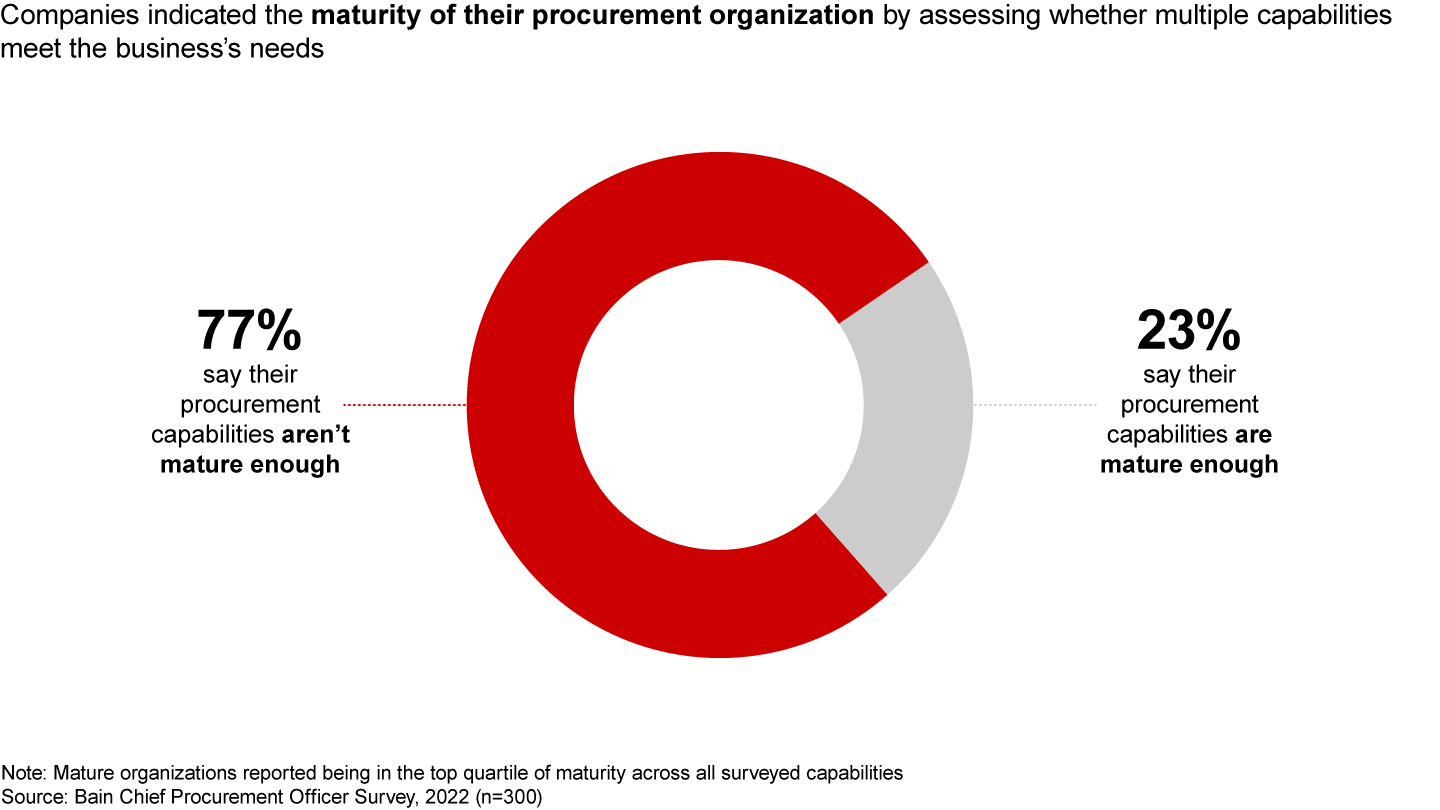
      Nearly 80% of companies say their procurement organizations aren’t living up to full potential

      While most respondents say procurement has greater visibility and importance for their companies than in the past, the figure above makes it clear that most procurement organizations are failing to deliver on what their organizations need.

      Why? Our analysis of the mature organizations points to the critical importance of a procurement strategy that links back to the company’s overall strategy. In a time of tight budgets and a challenging economy, having aligned strategies enables the procurement team to invest its limited resources in the right capabilities that will deliver what the company truly needs to meet its business objectives—and not waste time developing capabilities that don’t matter. The result is procurement can create more value than would otherwise be possible.

      It will come as no surprise to chief procurement officers and the rest of the C-suite, but the survey found that, on average, mature procurement organizations expect to realize 1.5 times the savings of their less mature peers (see Figure 2). And, increasingly, mature procurement organizations are creating value beyond savings, in areas such as product innovation, quality, and delivery performance.

      Figure 2
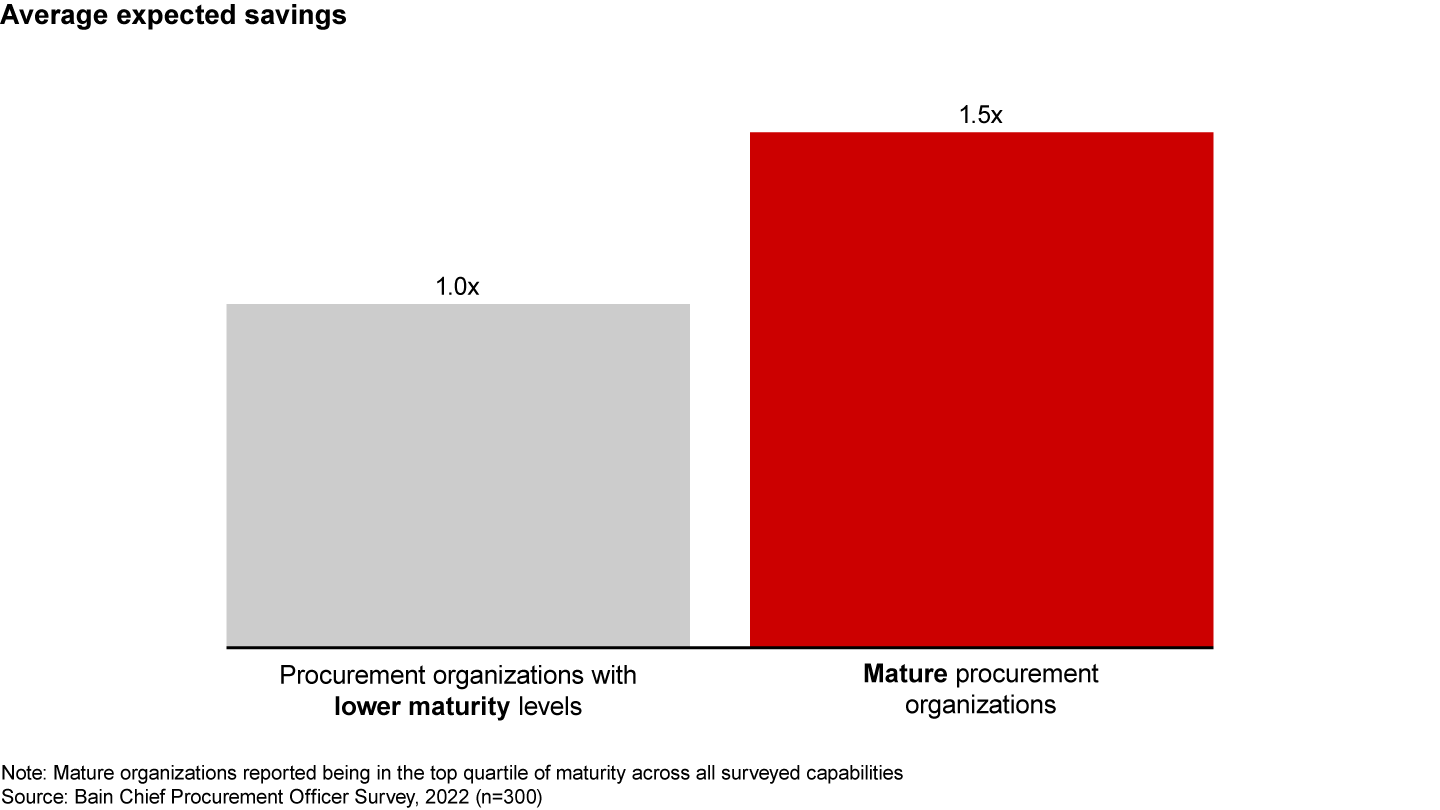
      Mature procurement organizations expect to realize 1.5 times the savings of their less mature peers

      As companies look to enhance their procurement maturity, these leaders hold lessons in how to set the right strategy, identify sources of value to pursue, and prioritize capabilities in which to invest.

      Archetypes guide the way

      In our experience, many procurement organizations are chasing the wrong things. They either haven’t developed a cohesive strategy, or they haven’t sufficiently tailored it to the company’s overall strategy.

      The survey results underscore how leading procurement organizations use their business characteristics and market position to guide the procurement strategy and inform which sources of value to pursue. Based on our analysis of the survey, three archetypes of strategic procurement organizations emerged: “margin expander,” “value manager,” and “growth enabler.” Although there’s some overlap among the three, and most companies won’t fit cleanly into a single category, these archetypes can be a helpful starting point for procurement teams to decide where to focus their investments.

      Margin expander. Managing costs is a primary objective of these companies’ overall strategy, driven by industry dynamics, their market position, or the nature of their products (e.g., a low-margin, commoditized product portfolio). For margin expanders, winning in the market depends in large part on having highly efficient procurement operations, effective category management, and an efficient approach to managing working capital. These companies focus on securing competitive pricing from third-party vendors, with right-sized inventory throughout the supply chain. When successful, these combined efforts shore up the company’s bottom line and enable price competitiveness in the marketplace. Lower on the priority list for these companies are more advanced procurement capabilities like new product innovation.

      Value manager. Providing high-quality, often specialized products is the name of the game for these companies. They typically compete in moderate-growth industries and create value through preserving or expanding market share. In this context, beyond table-stakes category management capabilities, it’s critical that procurement build best-in-class supplier management skills that minimize supply disruption, place a premium on product quality, and explore product innovation opportunities alongside commercial teams. Relentless focus on cost is much less important for these procurement organizations, both with respect to third-party spending and internal operational efficiency.

      Growth enabler. Companies with healthy product profitability and a strong growth trajectory focus on maximizing top-line financial performance, with cost savings less of a concern. The leading procurement teams in this archetype emphasize forming strong supplier relationships that foster innovation, supporting the company’s speed to market and market expansion, and unlocking incremental value via next-generation capabilities—such as digital tools—that underpin a profitable growth agenda. Often, these companies have a stronger focus on ESG as part of their corporate strategy; in this context, procurement can play a pivotal role, enabling progress on environmental and supplier diversity targets.

      It’s worth noting one capability all mature organizations excel at, regardless of archetype: closed-loop budgeting. These companies rigorously connect both procurement targets and performance outcomes to company financial performance and install the necessary governance and systems to track value to the bottom line—or reinvest in growth. This “closed loop” creates a direct bridge between procurement savings and the parts of the business that benefit from those savings to help achieve their financial goals. This increases the accountability of both the procurement department and business stakeholders, ultimately shaping spending behaviors to build a culture of cost management.

      Key takeaways

      The survey generated plenty of interesting takeaways, but four stood out as most useful for procurement leaders.

      Know what’s required to win. One size doesn’t fit all when it comes to procurement. For a company with multiple business lines that have different product characteristics and market dynamics, linking the procurement strategy to the company’s overall strategy may mean deploying a different procurement strategy for each business unit. In reality, this will be quite common, given that many companies have multifaceted businesses that require juggling multiple procurement approaches.

      Pick your differentiators. A key lesson from mature procurement organizations is they don’t try to be great at all capabilities. The procurement archetypes framing is a tool that can be used to prioritize and sequence an overall procurement capability transformation.

      Keep it fresh. Leading companies continuously update their procurement strategy as the business evolves and markets change. This points to the critical importance of having a constant feedback loop between the business and the procurement team.

      Tell your story. The survey results suggest that many procurement organizations are overlooking opportunities to create value for the company. To be fair, they often don’t have the influence to pull those value levers, in many cases because they haven’t told a clear, compelling story about how they can support and partner with the rest of the business. Having a well-developed procurement strategy enables the function to tell its story and earn a seat at the table. Being able to clearly articulate the value procurement can deliver ensures stakeholders are aligned and that procurement is brought into the right discussions.

      In our work with clients worldwide, we’ve seen how companies can successfully apply these principles to chart the right course for the procurement organization. One global chemicals firm embarked on a procurement transformation project to support the company at a critical time. Its total revenue and third-party spending were each on pace to double within a short period, while requirements from customers, investors, and employees were evolving radically.

      Company leaders recognized that a uniform procurement approach across business units was bound to fail, given their distinct strategic objectives, long-term growth profiles, and market dynamics. They identified the core sources of value for each business unit, some overlapping and some not, and used that to create a customized roadmap, prioritizing which procurement capabilities to invest in now and which to pursue over a longer period. This has already helped the company shave tens of millions of dollars off its annual procurement costs, while positioning procurement to deliver additional value in areas such as sustainability and innovation.

      Meanwhile, after decades of prioritizing revenue growth above all else, one global technology company responded to the recent economic downturn by more heavily emphasizing its profit margin and efficiency. The procurement team shifted its approach accordingly, bringing cost savings to the fore. More than that, procurement’s mandate was broadened to take a more strategic, proactive stance toward category management and the business as a whole—wielding influence rather than simply providing support. The procurement team identified a list of savings opportunities, including consolidating marketing and facilities services spending and implementing more controls on hiring external labor. The team also established closer collaboration with finance to ensure procurement savings are not only tracked but also applied more strategically to either improve the bottom line or reinvest in firmwide priority initiatives. The company aims to capture at least 15% savings on procured spending over the next three years as a result of these moves.

      Jump-starting the discussion

      As procurement leaders and the C-suite assess the future of their procurement organization, a few key questions can help guide the conversation:

      • Do we have a clear understanding of our company’s strategy? How does that strategy translate into specific, actionable goals for procurement (particularly beyond savings)?
      • What are the critical capabilities required to achieve these goals? Where do we currently fall short?
      • Have we put sufficient resources behind our procurement priorities, with the right skills and capacity needed to execute?
      Authors
      • Headshot of Marcus Leonard
        Marcus Leonard
        Partner, Chicago
      • Headshot of David Schannon
        David Schannon
        Alumni, Silicon Valley
      • Headshot of Maureen Sullivan
        Maureen Sullivan
        Partner, Los Angeles
      • Headshot of Tony Cape
        Tony Cape
        Partner, Chicago
      Contact us
      Related Consulting Services
      • Operations
      • Procurement
      • Supply Chain
      Operations
      Tariff Turbulence: What Consumer Goods Companies Need to Know

      How leaders will turn tariff risk into strategic advantage.

      Read More
      Operations
      Tariff Response: What You Need to Know

      Bain's Karen Harris and Hernan Saenz discuss the lasting impact of tariffs, what leading companies are doing to adapt, and the strategic moves to make for success.

      Read More
      Operations
      Beyond Tariffs: The Supply Chain Reinvention Imperative

      Tariffs are accelerating businesses’ operations overhaul. Winning in today’s disrupted world demands bold trade-offs and strategic transformation.

      Read More
      Operations
      Tariffs: The Costs of Inaction

      Trade levies are more than a headline. As tariffs tighten their grip on global commerce, companies must act decisively to mitigate risks and seize opportunities.

      Read More
      Operations
      AI Is Revolutionizing Industrial Operations

      Supply chain planning, procurement enhancements, manufacturing optimization, and engineering augmentation are emerging AI opportunities.

      Read More
      Tags
      • Operations
      • Procurement
      • Supply Chain

      How We've Helped Clients

      Full Potential Transformation An Airline’s Journey from Insolvency to Profitability

      Read case study

      Operations New sourcing plan lowers costs

      Read case study

      Performance Improvement Turning bottlenecks into growth opportunities

      Read case study

      Ready to talk?

      We work with ambitious leaders who want to define the future, not hide from it. Together, we achieve extraordinary outcomes.

      Stay ahead in a rapidly changing world. Subscribe to Bain Insights, our monthly look at the critical issues facing global businesses.

      *I have read and understand Bain’s Privacy Notice.

      Please read and agree to the Privacy Policy.
      Bain & Company
      Contact us Sustainability Accessibility Terms of use Privacy Modern Slavery Act Statement Cookie Policy Sitemap Log In

      © 1996-2026 Bain & Company, Inc.

      Contact Bain

      How can we help you?

      • Business inquiry
      • Career information
      • Press relations
      • Partnership request
      • Speaker request
      See all offices