
Skip to Content
  • Offices

    Offices

    North & Latin America
    • Atlanta
    • Austin
    • Bogota
    • Boston
    • Buenos Aires
    • Chicago
    • Dallas
    • Denver
    • Houston
    • Los Angeles
    • Mexico City
    • Minneapolis
    • Monterrey
    • Montreal
    • New York
    • Rio de Janeiro
    • San Francisco
    • Santiago
    • São Paulo
    • Seattle
    • Silicon Valley
    • Toronto
    • Washington, DC
    Europe & Africa
    • Amsterdam
    • Athens
    • Berlin
    • Brussels
    • Copenhagen
    • Dusseldorf
    • Frankfurt
    • Helsinki
    • Istanbul
    • Johannesburg
    • Kyiv
    • Lisbon
    • London
    • Madrid
    • Milan
    • Munich
    • Oslo
    • Paris
    • Rome
    • Stockholm
    • Vienna
    • Warsaw
    • Zurich
    Middle East
    • Doha
    • Dubai
    • Riyadh
    Asia & Australia
    • Bangkok
    • Beijing
    • Bengaluru
    • Brisbane
    • Ho Chi Minh City
    • Hong Kong
    • Jakarta
    • Kuala Lumpur
    • Manila
    • Melbourne
    • Mumbai
    • New Delhi
    • Perth
    • Seoul
    • Shanghai
    • Singapore
    • Sydney
    • Tokyo
    See all offices
  • Alumni
  • Media Center
  • Subscribe
  • Contact
  • Global | English

    Select your region and language

    Global
    • Global (English)
    North & Latin America
    • Brazil (Português)
    • Argentina (Español)
    • Canada (Français)
    • Chile (Español)
    • Colombia (Español)
    Europe, Middle East, & Africa
    • France (Français)
    • DACH Region (Deutsch)
    • Italy (Italiano)
    • Spain (Español)
    • Greece (Elliniká)
    Asia & Australia
    • China (中文版)
    • Korea (한국어)
    • Japan (日本語)
  • Saved items (0)
    Saved items (0)

    You have no saved items.

    Bookmark content that interests you and it will be saved here for you to read or share later.

    Explore Bain Insights
  • Industries
    Main menu

    Industries

    • Aerospace & Defense
    • Agribusiness
    • Chemicals
    • Construction & Infrastructure
    • Consumer Products
    • Financial Services
    • Healthcare & Life Sciences
    • Industrial Machinery & Equipment
    • Media & Entertainment
      Industries
      Media & Entertainment
      • Media Lab
    • Metals
    • Mining
    • Oil & Gas
    • Paper & Packaging
    • Private Equity
      Industries
      Private Equity
      • Due Diligence
      • Exit Planning
      • Firm Strategy & Operations
      • Portfolio Value Creation
    • Social Impact
    • Retail
    • Technology
    • Telecommunications
      Industries
      Telecommunications
      • Capital Expenditure
      • Telco Digital Transformation
    • Transportation
    • Travel & Leisure
    • Utilities & Renewables
  • Consulting Services
    Main menu

    Consulting Services

    • Customer Experience
    • Sustainability
    • Innovation
    • M&A
    • Operations
    • People & Organization
    • Private Equity
    • Sales & Marketing
    • Strategy
    • AI, Insights, and Solutions
    • Technology
    • Transformation
  • Digital
  • Insights
    Main menu

    Insights

    • Industry Insights
    • Services Insights
    • Bain Books
    • Webinars
    • Bain Futures
    View all Insights
    Featured topics
    • Tariff Response
    • Artificial Intelligence
    • Thriving in Uncertainty
    • Executive Conversations
    • Macro Trends
    • M&A Report
    • Healthcare Private Equity Report
    • Paper & Packaging Report
    • Technology Report
    • CEO's Guide to Sustainability
    • CEO Insights
    • CFO Insights
    • COO Insights
    • CIO Insights
    • CMO Insights
    View all featured topics
  • About
    Main menu

    About

    • What We Do
    • What We Believe
    • Our People & Leadership
    • Client Results
    • Awards & Recognition
    • Global Affiliations
    Further: Our global responsibility
    • Sustainability
    • Social Impact
    • World Economic Forum
    Learn more about Further
  • Careers
    Main menu

    Careers

    • Work with Us
      Careers
      Work with Us
      • Find Your Place
      • Our Work Areas
      • Integrated Teams
      • Students
      • Internships & Programs
      • Recruiting Events
    • Life at Bain
      Careers
      Life at Bain
      • Blog: Inside Bain
      • Career Stories
      • Our People
      • Where We Work
      • Supporting Your Growth
      • Affinity Groups
      • Benefits
    • Impact Stories
    • Hiring Process
      Careers
      Hiring Process
      • What to Expect
      • Interviewing
    FIND JOBS
  • Offices
    Main menu

    Offices

    • North & Latin America
      Offices
      North & Latin America
      • Atlanta
      • Austin
      • Bogota
      • Boston
      • Buenos Aires
      • Chicago
      • Dallas
      • Denver
      • Houston
      • Los Angeles
      • Mexico City
      • Minneapolis
      • Monterrey
      • Montreal
      • New York
      • Rio de Janeiro
      • San Francisco
      • Santiago
      • São Paulo
      • Seattle
      • Silicon Valley
      • Toronto
      • Washington, DC
    • Europe & Africa
      Offices
      Europe & Africa
      • Amsterdam
      • Athens
      • Berlin
      • Brussels
      • Copenhagen
      • Dusseldorf
      • Frankfurt
      • Helsinki
      • Istanbul
      • Johannesburg
      • Kyiv
      • Lisbon
      • London
      • Madrid
      • Milan
      • Munich
      • Oslo
      • Paris
      • Rome
      • Stockholm
      • Vienna
      • Warsaw
      • Zurich
    • Middle East
      Offices
      Middle East
      • Doha
      • Dubai
      • Riyadh
    • Asia & Australia
      Offices
      Asia & Australia
      • Bangkok
      • Beijing
      • Bengaluru
      • Brisbane
      • Ho Chi Minh City
      • Hong Kong
      • Jakarta
      • Kuala Lumpur
      • Manila
      • Melbourne
      • Mumbai
      • New Delhi
      • Perth
      • Seoul
      • Shanghai
      • Singapore
      • Sydney
      • Tokyo
    See all offices
  • Alumni
  • Media Center
  • Subscribe
  • Contact
  • Global | English
    Main menu

    Select your region and language

    • Global
      Select your region and language
      Global
      • Global (English)
    • North & Latin America
      Select your region and language
      North & Latin America
      • Brazil (Português)
      • Argentina (Español)
      • Canada (Français)
      • Chile (Español)
      • Colombia (Español)
    • Europe, Middle East, & Africa
      Select your region and language
      Europe, Middle East, & Africa
      • France (Français)
      • DACH Region (Deutsch)
      • Italy (Italiano)
      • Spain (Español)
      • Greece (Elliniká)
    • Asia & Australia
      Select your region and language
      Asia & Australia
      • China (中文版)
      • Korea (한국어)
      • Japan (日本語)
  • Saved items  (0)
    Main menu
    Saved items (0)

    You have no saved items.

    Bookmark content that interests you and it will be saved here for you to read or share later.

    Explore Bain Insights
  • Industries
    • Industries

      • Aerospace & Defense
      • Agribusiness
      • Chemicals
      • Construction & Infrastructure
      • Consumer Products
      • Financial Services
      • Healthcare & Life Sciences
      • Industrial Machinery & Equipment
      • Media & Entertainment
      • Metals
      • Mining
      • Oil & Gas
      • Paper & Packaging
      • Private Equity
      • Social Impact
      • Retail
      • Technology
      • Telecommunications
      • Transportation
      • Travel & Leisure
      • Utilities & Renewables
  • Consulting Services
    • Consulting Services

      • Customer Experience
      • Sustainability
      • Innovation
      • M&A
      • Operations
      • People & Organization
      • Private Equity
      • Sales & Marketing
      • Strategy
      • AI, Insights, and Solutions
      • Technology
      • Transformation
  • Digital
  • Insights
    • Insights

      • Industry Insights
      • Services Insights
      • Bain Books
      • Webinars
      • Bain Futures
      View all Insights
      Featured topics
      • Tariff Response
      • Artificial Intelligence
      • Thriving in Uncertainty
      • Executive Conversations
      • Macro Trends
      • M&A Report
      • Healthcare Private Equity Report
      • Paper & Packaging Report
      • Technology Report
      • CEO's Guide to Sustainability
      • CEO Insights
      • CFO Insights
      • COO Insights
      • CIO Insights
      • CMO Insights
      View all featured topics
  • About
    • About

      • What We Do
      • What We Believe
      • Our People & Leadership
      • Client Results
      • Awards & Recognition
      • Global Affiliations
      Further: Our global responsibility
      • Sustainability
      • Social Impact
      • World Economic Forum
      Learn more about Further
  • Careers
    Popular Searches
    • Agile
    • Digital
    • Strategy
    Your Previous Searches
      Recently Visited Pages

      Content added to saved items

      Saved items (0)

      Removed from saved items

      Saved items (0)

      M&A Report

      Looking Ahead to 2025: Preparing for What Comes Next

      Looking Ahead to 2025: Preparing for What Comes Next

      As the M&A market regains footing, it will be defined by those that can adapt to a new game.

      By Dale Stafford, Kai Grass, David Harding, and Suzanne Kumar

      • Published on February 04, 2025
      • min read
      }

      Report

      Looking Ahead to 2025: Preparing for What Comes Next
      en
      At a Glance
      • We expect that the two biggest inhibitors to deals in 2024—namely, interest rates and regulatory challenges—will ease in 2025.
      • Tech disruption, post-globalization, and shifting profit pools are enduring forces leading companies to consider M&A in various forms.
      • To make the new deal economics work, the most successful companies will take a more aggressive approach to value creation.
      • A company’s ability to move down the generative AI experience curve in M&A processes may become just as important as deal frequency as a predictor of deal success.

      This article is part of Bain's 2025 M&A Report.

      EXPLORE THE REPORT

      After three years of underwhelming M&A activity, 2025 may finally be the year that the M&A market breaks through. During that slow time, the best companies persisted, learning how to navigate unfavorable market realities to deliver inorganic growth. For many, there wasn’t an option. Foundational shifts in technology, sector profit pools, and the broader global economy demanded a strategic response.

      Now, any easing of the two fiercest M&A headwinds—namely, the cost of capital and regulatory scrutiny—will only fuel further momentum for dealmakers. As the twin pressures become less acute, more companies will join those that have learned how to adjust. So, we believe that over time, M&A will return to historic levels of activity.

      In “Looking Back at M&A in 2024: Dealmakers Adapt as the Market Idles” (published in December), we explored how we got here and the many wrinkles of the 2024 market, including the pendulum swinging back to scale deals, which now represent 59% of all M&A; the fact that tech deal activity, generally a bellwether for all M&A, fell well below historic averages; and how the all-important gap between strategic M&A valuations and public market valuations continued to widen. Strategic deal valuations are historically low while public market valuations reached all-time highs in 2024.

      Over the past three years, global M&A as a percentage of nominal GDP has lingered at nearly 30-year lows, even when considering the cyclicality of the market’s peaks and troughs (see Figure 1). The total M&A market in 2024 ended slightly up year over year (13% in value, 9% in volume) for the second-lowest level of value and volume in more than a decade.

      Figure 1
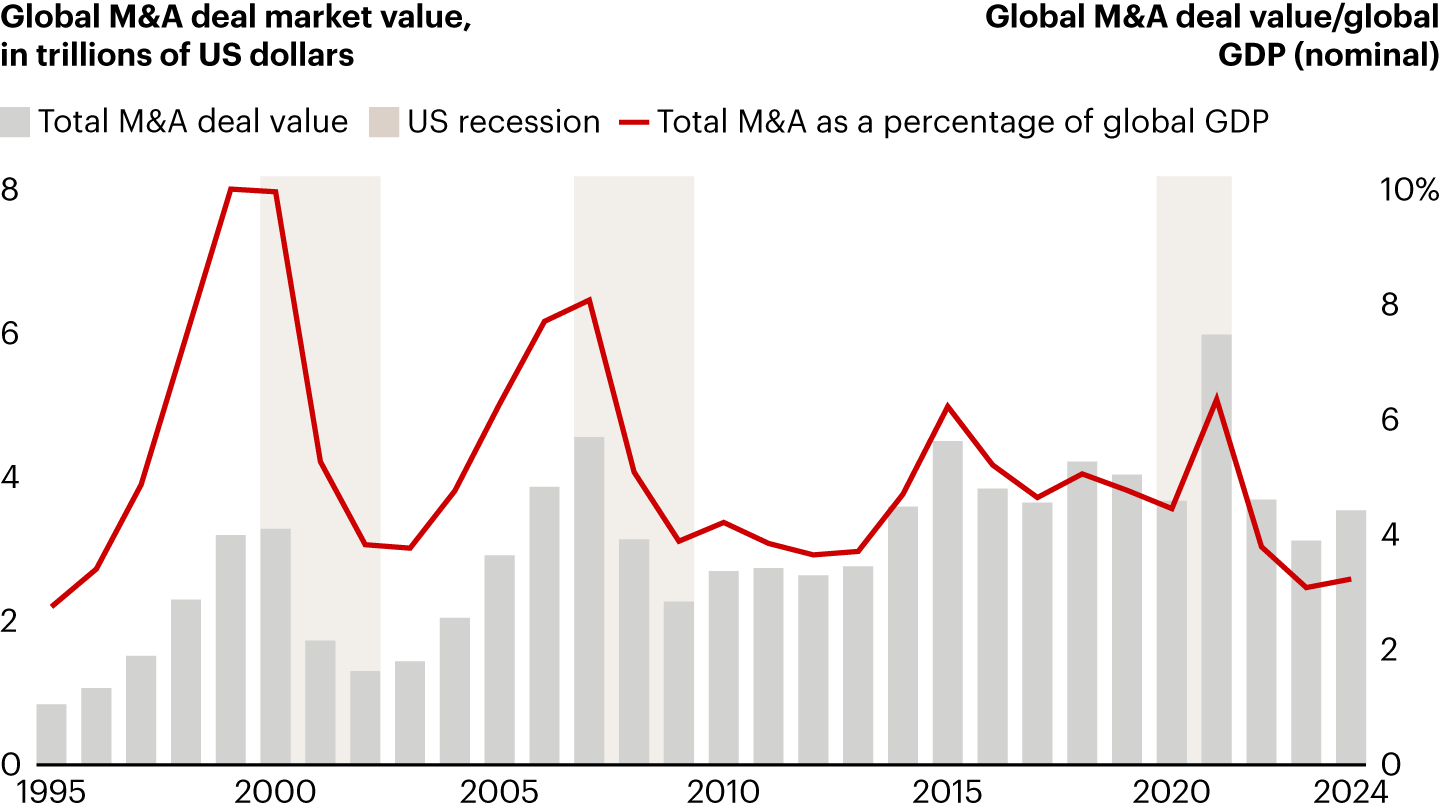
      Global M&A value as a percentage of nominal GDP is the lowest since 1995

      Note: Total M&A deal value includes strategic M&A (which includes corporate buyers, sponsor exits, and private equity add-ons) and nonstrategic M&A (which includes financial investors, venture capital/corporate venture capital, and special purpose acquisition companies)

      Sources: Dealogic; S&P Capital IQ

      What happens now? And how can savvy dealmakers make the best use of M&A to deliver on their strategies?

      Let’s start by talking about why we see an upswing. The most important reason is that intrinsic demand for deals remains high, even if activity is still muted today. M&A is central to business strategy as companies seek pathways to grow amid tremendous transformative forces and as they struggle to balance risk and reward during a period of uneven economic outlooks, supply chain disruptions, geopolitical tensions, and more. Many have learned that M&A can reshape portfolios more quickly, efficiently, and often at a lower cost than homegrown, organic options. And financial sponsors are eager to put money to work, too.

      Moreover, the pipeline of supply has been building. Everyone, from corporates refocusing their strategies to private equity and venture capital firms pressured to provide liquidity, seems to have at least a few assets that they wish to sell once the market comes back and valuations rise.

      Related Infographic

      Ten Takeaways from Our M&A Executive Survey

      We asked over 300 practitioners across the globe about their dealmaking efforts in today’s market. Here’s what they said.

      While the jury is still out on how low interest rates will drop (if at all) in 2025, if one looks across the globe, it’s possible to see signs of hope in the regulatory department. New administrations in the EU and US are ushering more openness to M&A. Europe has signaled a desire for more pan-European industry champions (although national interests may still prevail). In the US, the Trump administration is likely to use remedies and settlements, in contrast to a litigation-focused approach. The UK Competition and Market Authority recently said it would favor behavioral remedies and revise its merger assessment process. India clarified merger guidelines and aimed to reduce approval timelines in 2024.

      In 2025, strategic dealmakers will look beyond near-term swings in market momentum to find the right deals to be competitive, profitable, and enable sustainable growth.

      M&A’s big three: Technology disruption, post-globalization, and shifting profit pools

      Let’s look at the three most important and enduring pressures that will keep companies turning to M&A.

      Technology disruption. It’s the long-term shift that will result in the most strategic transformation and M&A in the years ahead. Generative AI/AI, automation, renewable energy, and quantum computing are just a few of the technologies that companies will need to build or buy to maintain competitive offerings and cost positions. Tech and non-tech companies alike will continue to have voracious appetites for tech deals to retool their businesses.

      Over the past six years, non-tech companies were the buyers in one in every three strategic tech deals worth more than $100 million. It is why Visa acquired Featurespace, an AI-native transaction monitoring company that will enable cutting-edge fraud and financial crime prevention. And it is why Emerson is acquiring the remaining shares of AspenTech, a portfolio transformation move that will enable Emerson to deliver robust software automation solutions. A telling sign of the times is that 70% of private equity companies have killed a deal when a likely negative impact of generative AI on the target’s business model became clear (see the infographic “Creating Value with AI: The Race Is On in Private Equity”).

      Given the rapidly evolving technological and competitive landscape, deals for generative AI assets are overwhelmingly early stage, minority stake, or a partnership rather than direct acquisition. Looking ahead, capital demands for generative AI could force companies to make portfolio moves that free up cash to invest in large language model partnerships and equity stakes.

      Post-globalization. The global economic landscape is realigning, and M&A will continue to be a big part of the response. National economic interests are being reasserted through reviews of foreign direct investment and M&A activity on national interest grounds—and tariff policies, too. To prepare for the second Trump administration’s proposed move to stiffen tariffs, executives are reevaluating global footprints to ensure access to attractive end markets and security of supply, which could prompt both acquisition and divestiture activity.

      In parallel, the world is moving from a bipolar (transatlantic/China) to multipolar (US/EU/China) dynamic. As China charts a more self-reliant economic path, new issues arise for multinationals evaluating potential in-market deals. In Europe, geopolitical uncertainty remains top of mind for executives. National political challenges in France and Germany increase an appetite for domestic companies to pursue outbound M&A for growth. Conversely, in a weakened local economy, domestic companies could be an attractive value play.

      National economic interests are being reasserted through reviews of foreign direct investment and M&A activity on national interest grounds—and tariff policies, too.

      Shifting profit pools. Beyond technology and global economic shifts, M&A enables companies to adapt their strategies toward shifting profit pools of all types. For example, media companies are reaching across sectors, acquiring to build up evergreen content libraries to compete against technology mega-platforms (see “M&A in Media and Entertainment: Own the Consumer, Own the IP, or Own Nothing”). In consolidated sectors such as consumer products, the largest players reshape and focus on their parenting advantage by shedding assets. That’s the reason a record number of them are re-sorting brand portfolios to find the best owner (see “M&A in Consumer Products: Carving Out to Grow”). In fragmented sectors such as building products, leaders are building local scale even as they enhance their portfolios with new capabilities to achieve faster and more sustainable and cost-effective construction (see “M&A in Building Products and Technology: Deals to Shape the Future”).

      Gameplan for the year ahead

      As we’ve learned from our decades-long analysis of M&A, the companies that successfully navigate these tricky waters will be those that can best adapt their approaches. What follows are five important ways to do so.

      Pressure test the link between your strategy and M&A roadmap. In today’s market, dealmakers need to create their own luck. Now is the time to revisit and revise M&A strategy and pressure test it against the realities of the market. Given the overall strategic ambition, clearly articulate the types of assets and deals required to deliver success. Will it be viable to find the appropriate assets at the appropriate price to advance this strategy? M&A roadmaps should provide strategic and financial guardrails to be practical and executable by management, and to align the board and senior executives. Long-term portfolio strategies often take years to implement and execute—and they can shift in unexpected ways as each deal is completed. (For a look at how some of the best industrial companies have pulled off strategic portfolio reinvention, see “M&A in Machinery and Equipment: Learning from the Best.”)

      As you update your M&A roadmap for the long-term vision, know that your M&A capability will need to evolve, too. That means devising an approach for the long term and rigorously assessing what you need to get there based on what’s worked (and what hasn’t worked) in the past. Was your biggest challenge in sourcing? Aligning internal stakeholders? Capturing value post-acquisition? And critically, do you have strong enough M&A capabilities to deliver on a multiyear strategy?

      Affirm your geographic footprint and the implications for your M&A roadmap. As national industrial policy and tariffs shift around the globe, now is the time to proactively evaluate the appropriate response to plausible scenarios. The questions to answer for each possibility: What is the right asset footprint to support growth ambitions and strategic priorities in both the near term and long term? What geographies should we be prepared to double down on or exit? Where do we require direct, local control of channel, supply chain, or sales? Where can we utilize alternative transactions such as joint ventures or partnerships to gain access and mitigate risks?

      As national industrial policy and tariffs shift around the globe, now is the time to proactively evaluate the appropriate response to plausible scenarios.

      Maintain a relentless focus on concrete value creation. A relatively higher cost of capital will continue to give an advantage to the near-in returns that drove scale dealmaking in 2024. To get to yes on a deal, companies will need a sharper proprietary view on value creation earlier in the deal process. They’ll need confidence in their ability to deliver concrete, rapid cost and revenue synergies alike. Consider how the new deal economics forces tech companies to pursue revenue and cost synergies in tandem (see “M&A in Technology: Revenue and Cost Synergies in Tandem”) and requires energy and natural resources companies to dramatically speed up the pace with which they generate synergies (see “M&A in Energy and Natural Resources: Making Deal Economics Work in a Record Year”). In our experience, assured value capture begins with faster, deeper, and more focused diligence that considers integration implications (timeline, costs, stakeholders) during diligence, not after—and that aligns the leadership team on the financial ambitions earlier in the planning (see the Bain Brief “The Three Most Important Steps in M&A Due Diligence”).

      Use generative AI to improve M&A outcomes. Generative AI is already transforming M&A work. The benefits are accruing to early adopters and frequent acquirers, and the value gained from AI tools grows with user sophistication. As we explain in “Generative AI in M&A: You’re Not Behind—Yet,” M&A teams that leverage generative AI tell us that they are faster to develop insights and decisions and that AI sharpens their views on target assets. Acquirers that can combine proprietary insights with generative AI execution could gain an advantage that’s just as important as overall deal frequency as a predictor of success. The learning curve is real; get started soon.

      Mitigate risk and costs through alternative deal types. When an outright acquisition isn’t justified, more companies are hedging their bets by taking minority stakes or engaging in joint ventures, partnerships, or licensing arrangements. The moves are most attractive during times of high cost and high uncertainty, such as an emerging technology without a defined standard—that applies to everything from generative AI to electric vehicle batteries.

      The combination of economic weakness, changes in geopolitics and national industrial policies, tech disruptions, and valuation gaps between buyers and sellers all contribute to the uncertainty and indecision that may make alternative deal types more attractive for leadership teams that can't get aligned on what the future holds.

      But whether companies pursue alternative deals or traditional M&A, those that have been less active in recent years face a double challenge. They may need to revive atrophied M&A capabilities while also trying to catch up to the frequent acquirers that (as history has shown us) always outperform.

      Read on to learn more about the future of M&A across industries and how companies can adapt.

      • Acknowledgments (click to expand)

        This report was prepared by the leadership team of Bain & Company’s Global M&A and Divestitures practice, with special direction from Les Baird, partner; David Harding, advisory partner; Dale Stafford, partner; Kai Grass, partner; Suzanne Kumar, practice executive vice president; Rebecca Telzak, senior manager; and an editorial team led by David Diamond. The authors wish to thank the many members of the Bain leadership team who contributed articles to this year’s report.

        Additionally, we wish to thank the following colleagues for their help with this report: Bain Partners Harshveer Singh, Peter Horsley, and Colleen von Eckartsberg; Practice Senior Analyst Amol Mathur; Consultants Fiona Bowen and Noah Plaue; Senior Associate Consultants Yuan Cai and Tiffany Chen; Associate Consultants Matthew Griff and Gabriel Moscoso; and the editorial team including Steven Anderson, Brooke Dunn, Shahnaz Islam, Jesse Nunes, Daniel Robinson, Martyna Uziallo, and Kirti Yadav. This work additionally benefited from the support of Bain Capability Network’s Abhishek Jain, Roopam Kalra, Chhavi Khandelwal, Mohit Gupta, Yashovardhan Dey, Vishaal S, and Bain Capability Network Labs’ Arko Chatterjee and Suprakash Gosh.

      Read the Next Chapter

      Looking Back at M&A in 2024: Dealmakers Adapt as the Market Idles

      Read our 2025 M&A Report

      Download the PDF EXPLORE THE REPORT

      Overview

      • Looking Ahead to 2025: Preparing for What Comes Next

      • Looking Back at M&A in 2024: Dealmakers Adapt as the Market Idles

      • Generative AI in M&A: You’re Not Behind—Yet

      • Where the Deals Are: 2024’s Top M&A Markets

      • Ten Takeaways from Our M&A Executive Survey

      Industry Views

      • Aerospace & Defense M&A

      • Automotive & Mobility M&A

      • Building Products & Technology M&A

      • Consumer Products M&A

      • Energy & Natural Resources M&A

      • Financial Services M&A

      • Healthcare & Life Sciences M&A

      • Machinery & Equipment M&A

      • Media & Entertainment M&A

      • Retail M&A

      • Technology M&A

      • Telecommunications M&A

      Authors
      • Headshot of Dale Stafford
        Dale Stafford
        Partner, New York
      • Headshot of Kai Grass
        Kai Grass
        Partner, Dusseldorf
      • Headshot of David Harding
        David Harding
        Advisory Partner, Boston
      • Headshot of Suzanne Kumar
        Suzanne Kumar
        Practice Executive Vice President, New York
      Contact us
      Related Consulting Services
      • Mergers and Acquisitions
      How We Can Help
      • Finance Function Advantage
      • M&A Strategy
      Mergers and Acquisitions
      How Companies Got So Good at M&A

      What 20 years in the trenches have taught us about deal success

      Read More
      M&A Report
      Where the Deals Are: 2024’s Top M&A Markets

      Explore our interactive map for strategic M&A data by region and key takeaways from selected markets around the world.

      Read More
      M&A Report
      Banking M&A

      As conditions shift, leading banks are fusing scale with scope to create future-ready organizations.

      Read More
      M&A Report
      Media M&A

      AI and other tech tools can boost bidding confidence in this highly competitive environment.

      Read More
      M&A Report
      Ten Takeaways from Our M&A Executive Survey

      We asked over 300 practitioners across the globe about their dealmaking efforts in today’s market. Here’s what they said.

      Read More
      Tags
      • CFO Insights
      • Finance Function Advantage
      • M&A Report
      • M&A Strategy
      • Mergers and Acquisitions

      How We've Helped Clients

      Accelerated Performance Transformation An EPC Leader Transforms Itself Amid Intense Volatility

      Read case study

      Divestitures and Spin-offs A holding company lets go to grow

      Read case study

      Performance Improvement Strategic G&A approach cooks up savings

      Read case study

      Ready to talk?

      We work with ambitious leaders who want to define the future, not hide from it. Together, we achieve extraordinary outcomes.

      Stay ahead in a rapidly changing world. Subscribe to Bain Insights, our monthly look at the critical issues facing global businesses.

      *I have read and understand Bain’s Privacy Notice.

      Please read and agree to the Privacy Policy.
      Bain & Company
      Contact us Sustainability Accessibility Terms of use Privacy Modern Slavery Act Statement Cookie Policy Sitemap Log In

      © 1996-2026 Bain & Company, Inc.

      Contact Bain

      How can we help you?

      • Business inquiry
      • Career information
      • Press relations
      • Partnership request
      • Speaker request
      See all offices