

Brief


|
At a Glance
China’s story is often told as two separate chapters: one about manufacturing scale and another about innovation. In reality, the two are closely connected. Over the past four decades, China has built one of the world’s deepest industrial bases. Along the way, it has accumulated the engineering talent, end-to-end supply chain depth, and execution capabilities needed to industrialize innovation. China’s innovation leadership exists on two distinct levels:
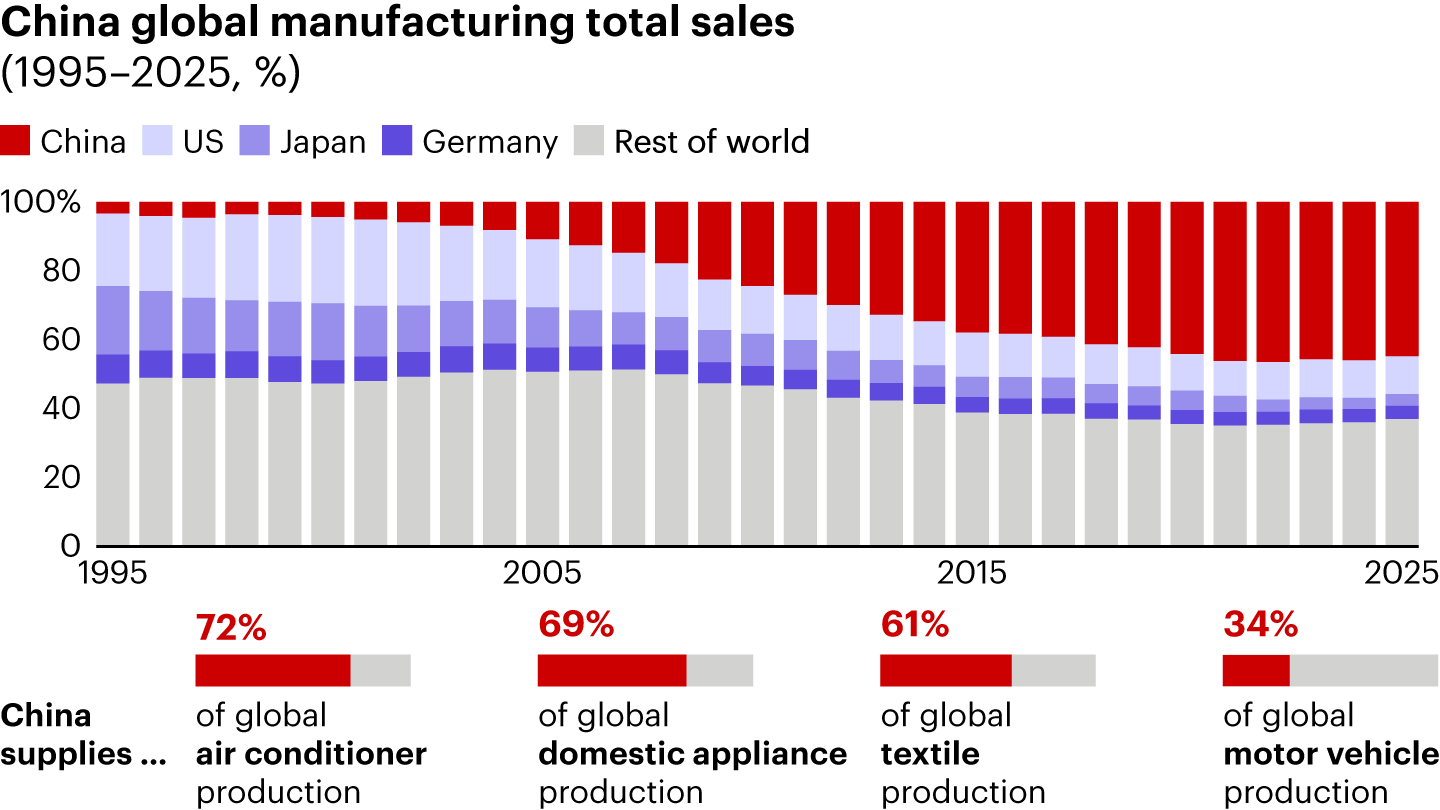
In several industries, the standards defining winning products, business models, and operating models are increasingly shaped in China first—and, in some cases, exported globally. China’s evolution is reshaping the worldChina’s industrial rise is clear. It captures about 40% of global manufacturing sales (see Figure 1) and dominates production in several categories, such as air conditioners, domestic appliances, and textiles. Even in globally diversified sectors like motor vehicles, China has become a major production and innovation hub. It has become a leading producer in several Fourth Industrial Revolution sectors, including civilian drones, lithium batteries, high-speed trains, and industrial robots.
Figure 1

More importantly, China has turned scale into a learning and capacity-building engine, turning “Made in China” into “Invented, industrialized, and scaled in China.” In this environment, competitive advantage increasingly comes from Founder’s Mentality capabilities, such as entrepreneurial urgency, scale, and speed. China is both home to scale insurgents and, in some sectors, operates like one—combining start-up energy with core assets to move rapidly from idea to commercialization at scale. Scaling is one of the most challenging and valuable phases of business building, and China is a unique market where scaling capabilities can be built, tested, and institutionalized. These advantages are strategic choices rather than system inevitabilities. WeChat, for example, extended beyond messaging into payments, commerce, and government services, while WhatsApp largely remained a messaging tool. The contrast illustrates the strategic value of owning the customer relationship from end to end. Manufacturing is China’s school for innovationChina did not become an innovation leader despite its manufacturing strength; it became one because of it. China’s manufacturing foundation created several enduring advantages, including:
Combined with immense domestic market scale, these advantages create a self-reinforcing flywheel: The enablers powering China’s manufacturing engine also propel its innovation engine (see Figure 2).
Figure 2
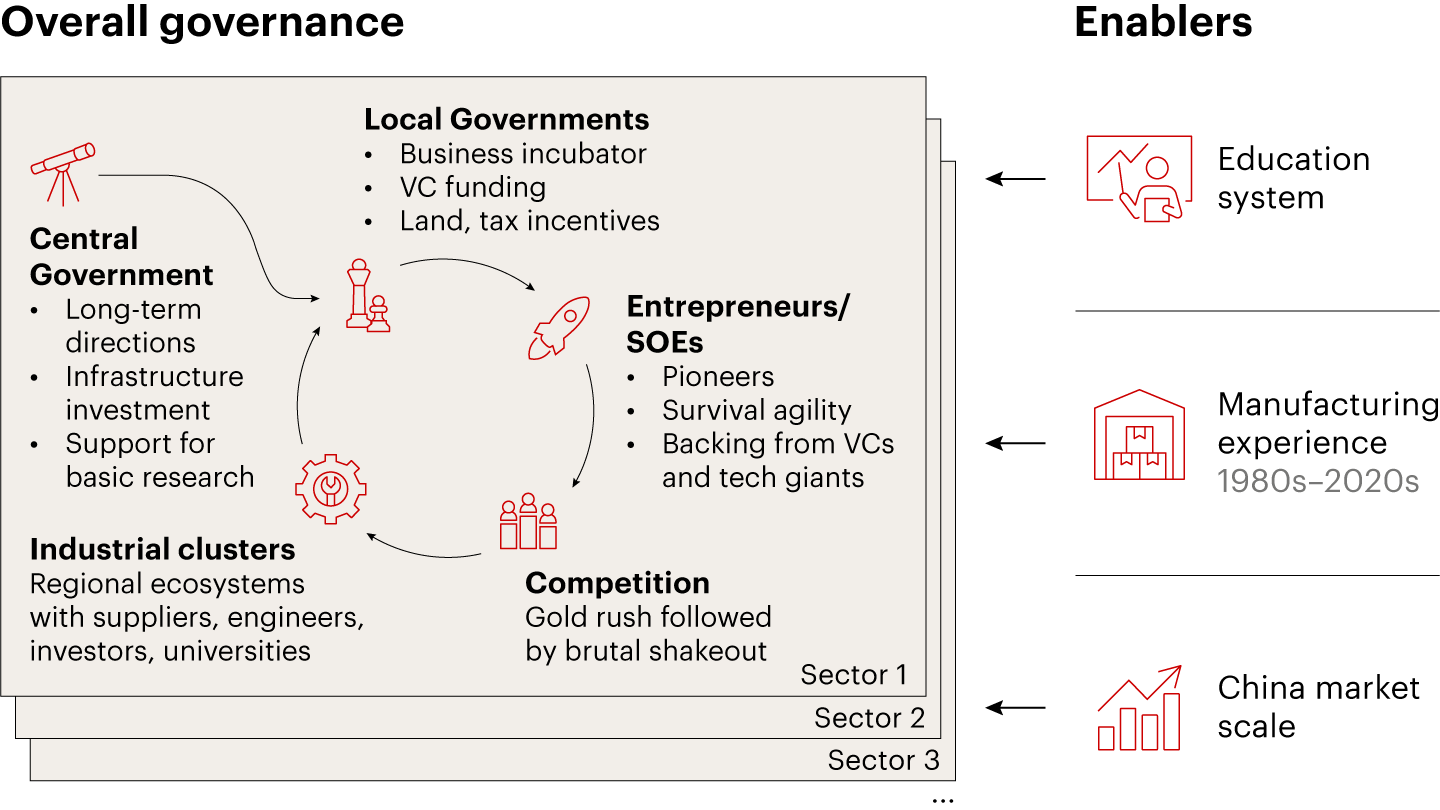

Notes: VC is venture capital; SOEs are state-owned enterprises Source: Bain & CompanyChina’s innovation flywheel gains momentum when specific conditions align. However, the components that drive it are not equally portable or replicable across markets. Key drivers include:
Success in each area compounds, creating denser supply networks, a larger talent pool, stronger investor confidence, and faster follow-on investments. Over time, the system can become self-reinforcing, increasing the likelihood of scale success where demand, industrial capability, and entrepreneurial energy intersect. Public policy alone cannot reliably produce these outcomes, nor is every element globally transferable. Directed capital, subsidies, and coordinated industrial policy are context-dependent and difficult to replicate elsewhere, while speed, ecosystem density, and execution discipline are more broadly deployable. This self-reinforcing momentum is evident in key innovation metrics: China now leads its global peers in both resident patent applications and total science, technology, engineering, and mathematics (STEM) graduates (see Figure 3).
Figure 3
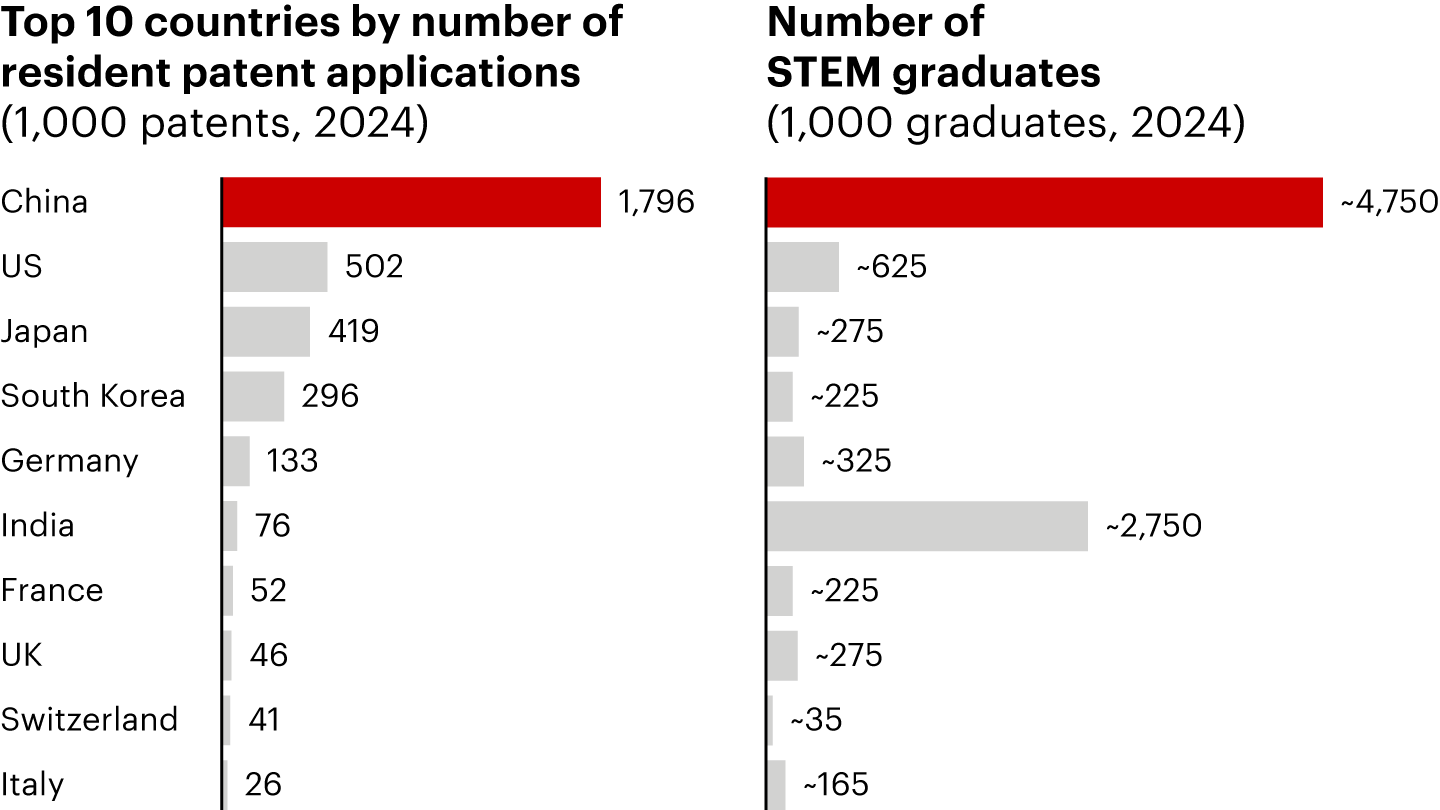

Note: STEM includes degrees in science, technology, engineering, and mathematics Sources: World Intellectual Property Organization (WIPO); UNESCO Institute for Statistics; Euromonitor; Eurostat; Organisation for Economic Co-operation and Development (OECD); Bain analysisAn ecosystem example: The “Hefei Model”Hefei offers an example of local ecosystem-building. The city has leveraged VC funding, infrastructure development, industrial clustering, talent cultivation, and corporate and research partnerships to build capabilities across six pillar industries: next-generation IT, new energy vehicles, photovoltaics, biopharma, smart appliances, and high-end equipment. EV manufacturer NIO and memory-chip maker ChangXin Memory Technologies (CXMT) are examples of companies nurtured through this framework. As of 2025, Hefei’s R&D intensity reached 4.11%, well above the national average, while its GDP had grown nearly 43-fold since 2000 to approximately RMB 1.42 trillion. Strategic industries now account for more than half of the city’s industrial output, propelling Anhui into a top 10 province by GDP in the first half of 2026. The flywheel at work: How China reshaped EV competitionThe EV industry offers one of the clearest examples of China’s shift from a manufacturing powerhouse into an engine for industrializing, commercializing, and scaling innovation. Since the early 2000s, three forces have driven this flywheel:
China’s EV value chain is engineered for rapid scale-up. Within a decade, the country became the world’s largest EV market and a leading supplier across much of the value chain. Chinese players now hold significant positions across that value chain and in the two of its highest-value layers: batteries and electric powertrains. China has raised the global standards for EV performance, in some cases even creating new categories, such as software-defined vehicles and advanced electrical/electronic architectures, while raising the bar on battery technology and cost discipline. Additionally, Chinese EV OEMs operate on 18-month product cycles—compared to four to five years for many incumbents. China is no longer only a place where EVs are manufactured efficiently; in several areas, it is also where the category is evolving fastest. The biopharma flywheelBiopharma offers another example of China’s innovation flywheel in action. China has transformed into an important source of biopharma innovation by building on regulatory reforms, talent development, CRO and contract development and manufacturing organization (CDMO) infrastructure, and capital-market access. China now produces more clinical trial starts than the US, and its first-in-class approvals grew at approximately 25% annually from 2019 to 2024. China-originated assets could account for more than two-thirds of global biopharma licensing deal value in 2026, up from approximately 50% in 2025 and less than 5% five years earlier. This momentum is reflected in transactions such as Merck’s collaboration with Kelun-Biotech, which included USD $175 million up front and up to USD $9.3 billion in potential milestone payments. Similarly, Bristol Myers Squibb’s collaboration with SystImmune included USD $800 million up front and up to USD $8.4 billion in total potential consideration. This transformation was decades in the making. Since the 1990s, deep chemistry talent and globally trained returnees have helped China build a world-class CRO/CDMO ecosystem. Regulatory reforms started in 2015, strengthening clinical data standards, accelerating innovative drug reviews, and introducing the Marketing Authorization Holder system. China’s accession to the International Council for Harmonisation in 2017 further aligned its development standards with global norms. Since 2018, volume-based procurement has compressed generic drug economics, while Chapter 18A in Hong Kong and expanding VC/private equity (PE) funding have provided capital for innovative biotech. Together, these forces have helped shift China from a largely generics- and manufacturing-led pharmaceutical base toward innovative drug development. In EVs, competitive advantages span product development, manufacturing, and commercialization. However, success in biopharma ultimately depends on clinical effectiveness, development speed, and cost efficiency. Today, China’s strongest biopharma advantages lie in ecosystem competitiveness and the country’s ability to develop drugs faster and at lower cost. Compressing the drug development cycle has become an important reason why multinational pharmaceutical companies seek Chinese R&D partnerships. Looking ahead, AI could reinforce these advantages in deployment as much as discovery. Embedding AI across China’s laboratory, CRO, and clinical infrastructure could accelerate drug discovery and development and help validate promising candidates. More broadly, China may be well positioned to embed AI in industrial and physical-world applications, where manufacturing depth, supply chain strength, and engineering talent can turn models into deployed solutions. The costs and limits of the flywheelThe same flywheel that creates China’s advantages also creates meaningful costs and limits. When local incentives, infrastructure investment, venture funding, and entrepreneurial energy align, industries can build capacity ahead of demand, particularly in fast-growing sectors. This can create intense pricing competition and margin pressure. This dynamic is visible in the EV and lithium battery markets, where rapid capacity expansion has sometimes outpaced demand. Scale does not automatically translate into healthy returns; over time, competitive pressure can drive capacity rebalancing and industry consolidation. Two strategic paths for multinational companiesFor the past two to three decades, most MNCs have focused on a “China for China” agenda—and for many, it has worked well. That approach may remain appropriate for companies whose primary objective is to serve the Chinese market; others may benefit from assessing whether China offers relevant capabilities or partnerships to advance their global strategy. China is reshaping the economics, speed, and innovation trajectory of several sectors. Sector by sector, MNCs should address whether a “China for the world” agenda is relevant to their position. Some may focus on serving China; some may selectively source capabilities from China; others may choose limited or no operational integration. The objective is not to replicate China’s system but to identify which capabilities, if any, are relevant, transferable, and consistent with the company’s risk appetite and strategic intent. The “China for China” pathA “China for China” strategy may require local autonomy on product definition and technical approvals, localized technology stacks, and China-paced development cycles. In EVs, “China for China” can involve local partnerships, localized electronic architectures, and faster development cycles. For example, Bosch’s recent agreement with NIO is focused on “in-depth collaboration across core smart EV technologies, including drive-by-wire chassis and battery management systems, as well as key systems and components, such as braking, steering, powertrain, body electronics, and sensing modules.” In biopharma, “China for China” can mean embedding in China’s innovation ecosystem and adapting development and commercial models to improve market access. Leading global pharma companies have built R&D capabilities in China, partnering with Chinese organizations and running a growing share of trials there. In Bain’s Clinical Trials Voice of the Customer survey of 80 US-based CROs and sponsors (roughly 45% of which are MNCs), 45% of respondents reported partnering with China-based medical centers or site networks, and 43% with China-based CROs. A “China for China” approach may also require restructuring legacy low-margin businesses, separating data and intellectual property (IP) where necessary, and using partnerships or joint ventures to access local supply chains and capabilities. Ultimately, the right model will depend on IP, data, regulatory requirements, trade rules, and supply chain risk. The “China for the world” pathA “China for the world” strategy leverages China’s innovation and operational excellence. Chinese manufacturing networks become sandboxes for automation and agile production, with relevant technologies embedded into global supply chains. In some cases, Chinese capital or strategic investors may be involved. In this approach, the emphasis is on capabilities that can be deployed globally—for example, manufacturing excellence, speed, supplier integration, and innovation. It should not assume that every feature of China’s operating environment is transferable. Furthermore, this path is an option, not a requirement, and its relevance varies by industry, company position, and risk appetite. The EV sector illustrates this dynamic. Chinese OEMs are expanding abroad and, in some cases, developing new collaboration models with European incumbents seeking access to China’s EV architecture, software, cost engineering, and speed to market. For example, Stellantis bought 20% of Leapmotor and created a 51/49 joint venture called Leapmotor International. The joint venture initially focused on sales and distribution, allowing Leapmotor to expand its footprint beyond China; however, the partnership has expanded to include joint production capabilities in Spain and a new EV that combines Leapmotor’s electric architecture and battery technology with Stellantis’ design and chassis engineering. Tesla’s China operations demonstrate how a high-efficiency, low-cost plant and highly innovative market can support global exports and strengthen global competitiveness. Likewise, Apple’s manufacturing partnerships with Foxconn and Luxshare illustrate a broader “China for the world” model: Apple’s global products leverage China’s scale, supplier density, and operational excellence. Together, these examples show how companies can use China as a market as well as a manufacturing platform and learning environment. These companies have gained innovation capabilities that improve their performance around the world. Biopharma is moving in a similar direction, though through a different mechanism. By asset count, nearly one-third of innovative pipeline assets licensed by large pharmaceutical companies now originate in China, and most of the top 10 global pharma MNCs have established at least one recent licensing deal with a Chinese biotech firm. As markets evolve, some partnerships may selectively bridge both paths—helping a company serve the Chinese market while sourcing technology, speed, cost advantages, or innovation capabilities from China for global deployment (where opportunity and risk profiles permit). China’s next chapterThe old view was that China made things for the world. Today, China is increasingly a place where industries are built, standards are shaped, and operating models are forged. This does not mean China will lead every frontier, nor that global competitors will stand still. China’s combination of manufacturing depth, innovation capability, entrepreneurial energy, and market scale has created a powerful innovation engine. China has a unique ability to industrialize, commercialize, and scale concepts—especially where market scale, industrial capability, and ecosystem coordination reinforce one another. For leaders, the implication is straightforward: China should no longer be viewed solely through the lenses of cost, capacity, or market access. In select sectors, it can be a potential capability engine. Companies that tap into that engine, maintaining clear guardrails, may strengthen their competitiveness globally; companies with limited relevance or higher risk may reasonably choose a different path. Leaders should assess their company’s exposure to China’s transformation, evaluating how quickly the basis of competition is shifting in their industry and whether the current strategy fits the company’s objectives, risk appetite, and China exposure. A second article will address these questions directly, providing a sector-by-sector overview detailing which industries are most exposed to China’s transformation—and how that exposure affects portfolio, operating model, and partnership decisions. The answers will shape how companies think about global competitiveness. The opportunity—and the challenge—is to understand where China’s capabilities matter, how they can be accessed, and where they cannot be transferred. The authors would like to thank Fergie Chen, Parijat Ghosh, Richard Fleming, Vikram Kapur, Brittany Rodriguez, and Kristin Moneyron for their contributions to this brief. |