

M&A Report

At a Glance
- Increasingly, deals are not only about taking out costs but also about adding new capabilities. Also, fiercer competition, broader regulatory scrutiny, and other considerations have made deals more complex so that even the best acquirers must revisit their M&A capabilities.
- Companies need to reevaluate M&A’s link to strategy; embrace alternative participation models; bring expertise into the process early; know the battlefield, and be ready to move quickly; add new lenses to diligence.
- Leaders recognize that proactively and systematically building new M&A muscles requires updated perspectives on the people, processes, and tools that support the entire M&A and divestiture life cycle.
The new challenge: M&A has changed, forcing a capability rethink
Over the past few years, M&A has gone from something akin to chess, in which players can pick a strategy and plan many moves ahead, to an open battlefield video game, with players entering and exiting in a constantly shifting landscape. Three major changes are afoot.
First, Covid-19 has hastened preexisting disruptive trends across industries, providing an even clearer view of the business models that will win in the future as well as those that will be outmoded. Deal rationales have evolved from creating scale and cost synergies within an industry to expanding the business scope and adding new capabilities. These capabilities often involve technology, proprietary data, or scarce talent.
The number of capability deals has grown steadily in recent years. In 2020, we saw US telecom major Verizon’s acquisition of BlueJeans in the videoconferencing space, US retailer Target’s acquisition of Deliv as a follow-on to its earlier purchase of Shipt in the home delivery space, and global food and beverage major Nestlé’s acquisition of Freshly in healthy meals delivery. All of these deals are aimed at serving rapidly growing consumer needs, and they involved the acquisition of capabilities that likely were not even on the radar a couple of years ago. The acquirers are betting on the value of bringing these capabilities in-house, not on potential cost synergies. No longer something to handle at the back end of an integration, technology has become both an enabler of deals as well as a source of opportunities and value creation. To make these deals succeed, acquirers need a tailored approach to screening, diligence, and integration.
Second, the M&A process has become faster and more complex. While corporate acquirers have an advantage in that they can create proprietary deal flow, they often face stiffer competition from private equity (PE) players. Every deal is now an auction process. And PE funds, sitting on $2.8 trillion of dry powder, look a lot like corporate acquirers. They are starting to hold their assets longer and use buy-and-build strategies. As we mentioned earlier in this report, access to debt capital has been a nonissue during this crisis, so the premium and the competition for attractive high-growth assets are higher than ever. Among the consequences of these trends: M&A may not be the best participation model, so M&A teams need to consider the broader option space of partnerships (with or without equity), joint ventures (JVs), and corporate venture capital, depending on their situation.
Evaluating the environmental, social, and governance (ESG) impact of targets is fast becoming an integral part of the diligence process.
Add to this mix data access, the broadening regulatory scrutiny of deals on grounds of national interest, and the abundance of major technology players. Consider the involvement of Amnesty International in the Google and Fitbit deal. The organization wrote a letter to EU regulators, arguing that the acquirer must address human rights issues more expansively via remedies—the human rights in question being the right to privacy and nondiscrimination. Evaluating the environmental, social, and governance (ESG) impact of targets is fast becoming an integral part of the diligence process as there are both risks and opportunities related to ESG. For many acquirers, this is all brand-new territory to navigate.
Finally, Covid-19 brought new challenges to the deal process. In our 2020 M&A practitioners’ survey, 70% of respondents reported that diligence was more challenging during Covid-19, and more than 50% found it harder to close deals. Digitalization of the M&A process has been building gradually over the past few years, but similar to other trends, Covid-19 has hastened it. Companies that adapted quickly, developing capabilities in areas such as virtual diligence and virtual integration, made great strides even during the toughest phase of the Covid-19 crisis. The use of data in the M&A process is another emerging differentiator. Leaders are harnessing data (and sometimes artificial intelligence) to screen for targets and create profiles, often before they come to market. In diligence, companies are using digital platforms for risk analytics and to generate customer insights and other differentiated insights to get an edge.
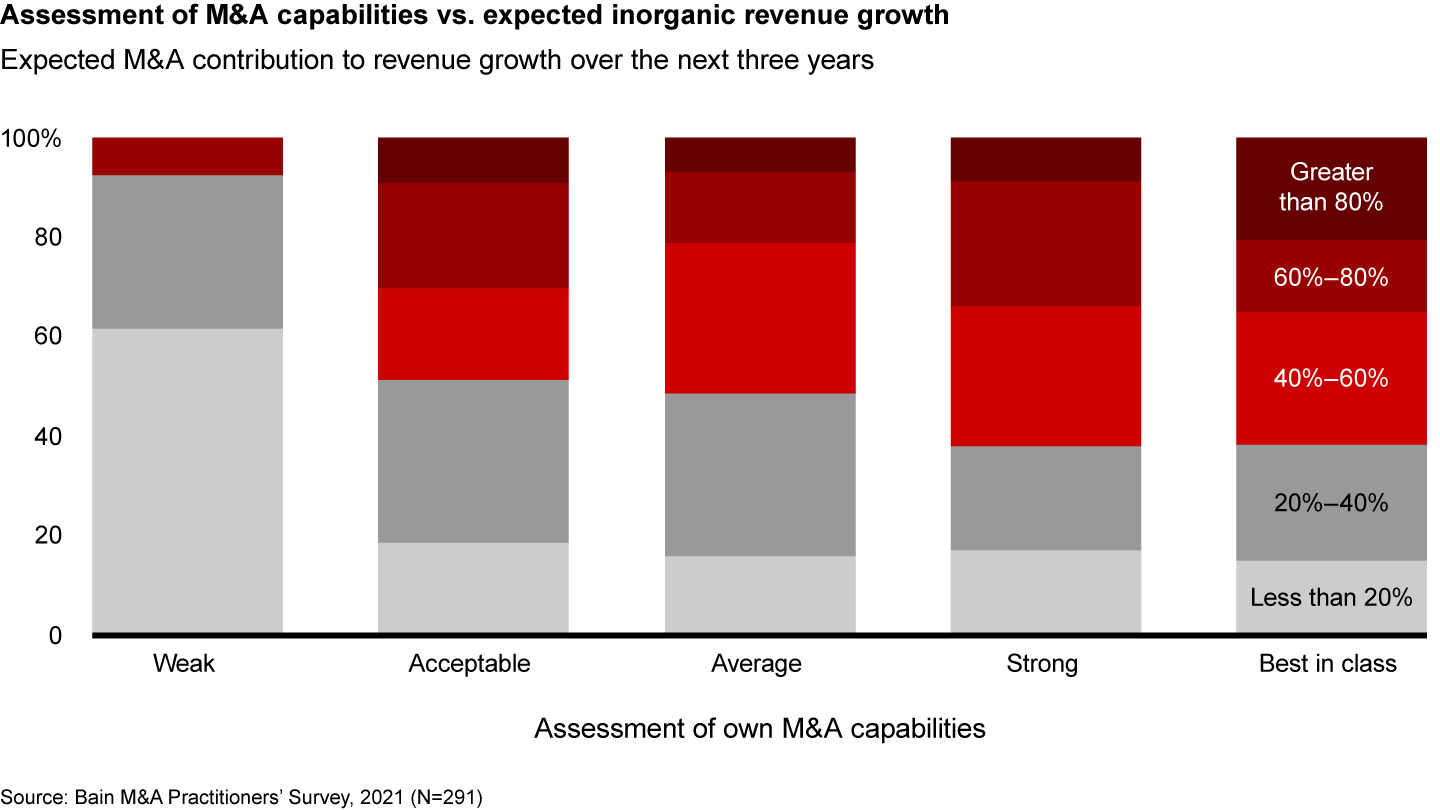
As companies rewrite their corporate strategies for the post–Covid-19 world, M&A will gain further prominence. In fact, the M&A practitioners we surveyed expect M&A to account for nearly half of revenue growth over the next three years—that’s up from 30% over the past three years. What’s more telling is that practitioners with higher confidence in their firms’ M&A capabilities expect M&A to contribute to a higher share of revenue growth (see Figure 1).
Figure 1

Some of the time-tested principles of what good M&A looks like still hold true. The best players have a clear M&A mandate aligned to the corporate strategy. They focus on creating value and reducing risk through every step of the M&A value chain, tailoring their approach by deal type. They also proactively divest. Yet, with the broader changes afoot, even the most astute M&A teams are busy refreshing and rebuilding capabilities. Otherwise, they risk losing deal opportunities and finding themselves leapfrogged by the competition.
What to do now: Five imperatives to equip your capability for the future
We see five things that companies need to do to respond to today’s challenges.
Reevaluate M&A’s link to strategy. As business models change and companies revise their top-level corporate strategies, the M&A team’s mandate should be updated. Among the biggest issues: With evolving ecosystems and digitalization redefining industries, companies need to take a new tack on where to buy vs. build to remain competitive in the years ahead.
Embrace nontraditional M&A. The best companies will expand their options beyond outright M&A and divestitures. Leaders will use JVs, partnerships (with or without equity, with or without financial sponsor partners), and corporate venture capital to deliver value in ways that are easier on the balance sheet and company cultures, tailoring integration to the deal type. Most M&A practitioners surveyed expect to see more partnerships, JVs, and corporate venture capital in the coming year, but expectations differ by industry.
Companies can take an ecosystem approach by partnering with other companies to explore new opportunities, reserving the option to accelerate if the promising trend takes off. This increases the likelihood of selecting the right deals. For example, a major financial services company has built a portfolio of ecosystem partners aligned with emerging trends. It monitors market developments and regularly reevaluates these partnerships to decide in which areas the company should become more active through either additional investment or full acquisition. This approach will become increasingly necessary in a future defined by ecosystems, especially for those industries that have already started facing rapidly evolving ecosystems.
Bain's annual M&A report explores how companies can win with M&A as they emerge from the crisis.
Bring expertise into the process early. Given the growth in scope and capability deals, specialized expertise is required early on to understand the business fit. This often means making a deeper connection to the business unit during the diligence process or expanding the set of external partners to bring in the appropriate expertise. While this can be especially challenging in a world of virtual meetings, it also broadens the opportunity to match up experts from any company location. As we explain later, virtual collaboration tools now are more essential than ever.
Know the battlefield, and be ready to move quickly. Given the fierce competition for deals, companies can no longer wait for bankers to come to them or rely on just one source of deal intelligence. Firms must constantly track the industry landscape and how it evolves, and know how to focus very quickly when opportunities arise. To move with speed, leaders establish an ecosystem of external partners (namely, bankers, tax and legal advisers, PE players in the industry, and so on) for swift access to the appropriate data sources and connections.
Add new lenses to diligence. In capability deals, it is not sufficient just to understand the standalone value of a target and joint value creation potential; dimensions such as culture, sustainability, and consumer sentiment should also be evaluated at the diligence stage. And, as we mentioned in last year’s report, sources of value creation and risk are less predictable in scope deals. We also see consumers and regulators alike presenting new challenges to getting deals approved. One example is ESG, which has been brought to the fore by both consumers and investors. ESG was the driving force for several deals over the past year, and the initiative will influence many more in the future.
How to do it: Set up an operating model to deliver on these new imperatives
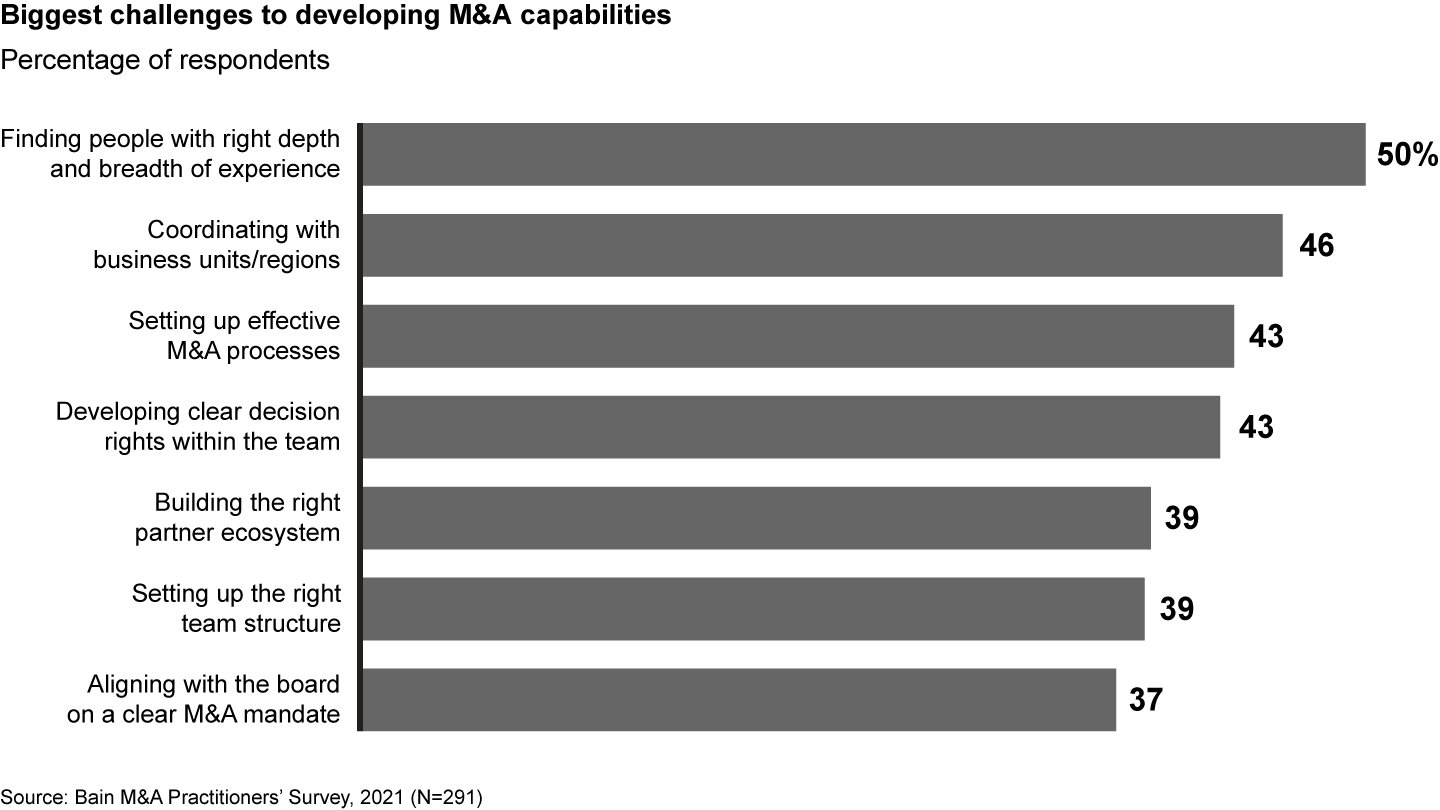
Building these M&A capabilities requires the appropriate operating model, and even the most successful acquirers need to ensure that theirs is up to the new task. In addition, such operating models need to evolve over time, quickly reflecting changing requirements, which demands constant and accurate observation as well as a solid understanding of market developments and related competitor movements. Many companies struggle to get this correct. In our survey, executives cited finding the right people, coordinating with business units, setting up effective processes, and establishing clear decision rights as top challenges to building M&A capabilities (see Figure 2).
Figure 2

Here’s how M&A leaders are revamping their approach to people, processes, and tech to meet the challenges of today’s rapidly evolving landscape.
People: The best acquirers are rethinking roles across the M&A process. As scope and capability deals gain share, companies are bringing in more expertise from internal networks (business units) and partner ecosystems. One e-commerce firm uses a central M&A team to source a pipeline of deals, business unit leadership to assess attractiveness, and a team of internal and external experts to evaluate technical intellectual property. This mix of a core team, business unit leadership, and technical experts ensures that opportunities are evaluated from transaction, business need, and technical standpoints before they even go to diligence. Companies also are finding that experts on other deal structures (such as JVs, partnerships, licensing, divestitures) are essential to articulate the trade-offs of each and to help with execution.
Processes: The rapidly evolving landscape calls for more frequent and better-defined interactions and decision forums. In some ways, acquirers need to operate more like a PE fund. Well-defined decision rights and regular forums for updates (for instance, to the investment committee) are key, especially during the beginning of the process. For example, a leader in grocery has developed an M&A guidebook to articulate decision rights and processes at each stage of the M&A life cycle and under a host of scenarios, such as different deal types and sizes. This company regularly deploys a complete portfolio and market scan process that identifies markets for M&A, limited investment, or divestitures. Companies also need specific processes in place to actively manage JVs, alliances, and other partnership models. This is particularly important as failed JVs, alliances, or partnerships have the potential to reduce a company’s reputation within its ecosystem, damaging its ability to attract new partners down the road.
While defined procedures are essential, it pays to be agile in parts of the process. That’s especially the case in sourcing and screening; the best companies have teams available to swarm on potential targets as soon as there is a chance that they will be up for grabs. The same is true for integration. Although most integration is a well-outlined process, we see lots of value in leaving some capacity to cover the inevitable unplanned issues that arise in the integration management office.
Technology and tools: Companies need to invest in the right technology to mine the gold that is data. It is essential. Harnessing new insights from data not only provides a better view of risks but also a cleaner picture of the deal’s upside potential. For example, one medtech provider developed a tool to perform a market data scan of thousands of targets on a regular basis. The M&A team then builds one-page models of short-listed targets for quick decision making when they come to market. Leaders are combining alternative data via web scraping and other techniques to build insights that give them differentiated results in screening and diligence. In the new virtual environment, picking and rapidly adopting the appropriate collaboration tools can spell the difference between maintaining a deal’s momentum or losing it.
Published in February 2021