

Brief

Retail executives tell us they need more from their CIOs. Yes, IT needs to keep the online store running and cyberattackers at bay—but that’s table stakes. The retail industry is changing quickly, and what executives need most in a technology partner is someone who understands social, mobile, analytics, cloud (sometimes called SMAC) and all the other technologies spurring rapid change in their industry. They need partners who can help them discover and build new business capabilities that will set them ahead of the competition.
Few retailers say they are getting this today from their IT function; until recently, most had not asked for it. Across the industry, CIOs are busy maintaining their decades-old legacy systems while locked in an arms race against increasingly sophisticated cyberattacks and a shifting stream of new technology requests from the business. One week the business asks to explore in-store mobile payments; the next week, the priority shifts to aggregating customer data across channels.
As they explore these technologies, executives are getting a better picture of what they need to deliver a true omnichannel experience—that is, a seamless, integrated shopping experience, whether the customers are in the store or on their mobiles. To deliver against that promise, executives are looking for CIOs who can build IT organizations that are more nimble, collaborative, agile and responsive.
These CIOs and the IT organizations they run will need to build these new digital capabilities in ways that play nicely with the legacy environments that run the business. Just as important, technology executives are going to have to change more significantly than they ever have before, as their insights and capabilities become increasingly vital to success. The business, to get what it needs in a technology partner, will need to support those changes, not only with appropriate investments but, just as critically, with engagement to help set priorities and make decisions.
To bring together all of this technology effectively and execute against strategic priorities, retailers’ IT organizations will need to develop new ways of working, says Partner Will Poindexter in this short video.
Omnichannel is different
The changes that retailers are moving through today are greater than any the industry has seen in half a century. In the 1960s and 1970s, interstate distribution, integrated information systems and large-format stores combined to permanently change supply logistics, cost structures, pricing and consumer expectations. IT remained a back-office function, focused on inventory management, logistics and green-screen point-of-sale terminals until the 1990s. At that point, IT moved to the forefront and became more of a customer-facing function as retailers built websites and developed e-commerce capabilities out of their traditional direct-to-consumer catalog businesses.
Today, technology no longer plays just a supporting role; it is also essential to strategic decision making. Customer expectations are rising, in part thanks to the strides made by new competitors, whose business models were built on technology, and pure-play retailers like Amazon, which are not encumbered by legacy environments and physical retail footprints. What’s more, about half of in-store purchases are influenced by online research, according to Forrester.
Retailers now need world-class IT capabilities to execute the strategies that will separate the winners from the losers. But the IT organizations at most retail companies were not built to deliver these capabilities. The biggest challenges fall into three areas:
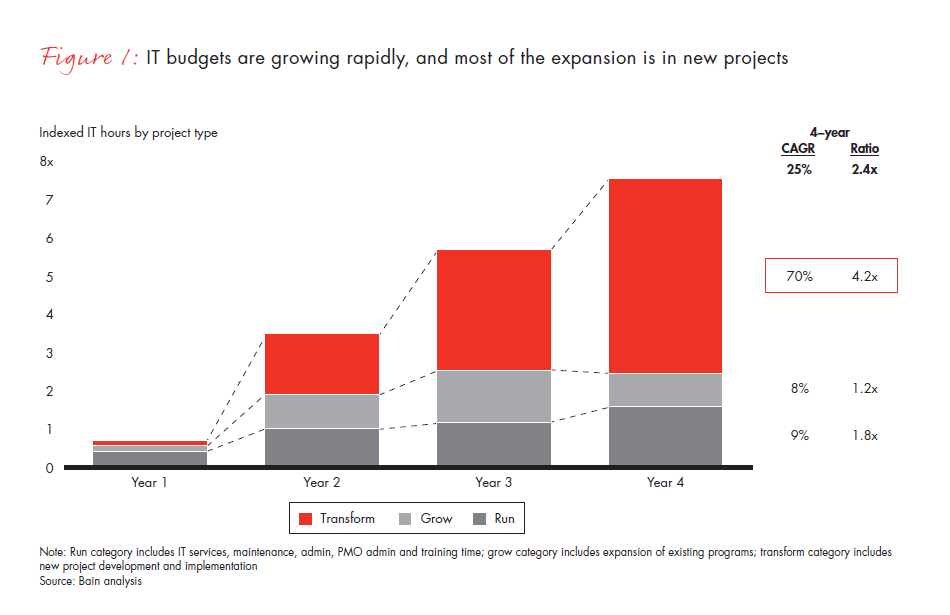
Prioritizing opportunities. New technologies create new opportunities. But having too many choices makes prioritizing them difficult. This is particularly true when companies need to make decisions across functions— which is frequently the case in omnichannel initiatives like flexible fulfillment (buying online and picking up in the store or having it shipped from a local store), which involves merchandise planning, supply chain, marketing, store operations, e-commerce and IT. Few companies excel at cross-functional collaboration, particularly when it involves creating something new. But IT leaders can and should play a more strategic role in prioritization, helping the business understand the potential of new technologies and leading the way through innovation and adoption. Many IT organizations don’t have the resources to meet the demands of this broader role. At one retailer, as the organization moved toward an omnichannel model, the demand for IT development and implementation services grew fourfold, stressing the capabilities of its technology group (see Figure 1). A broad IT transformation was necessary to extend IT’s capabilities and create an organization that was better able to respond to new opportunities.
Keeping up with technology. Retail technologies are evolving rapidly, and executive teams have more at stake than ever before as they place bets on new initiatives. Some of these technologies can be extremely disruptive for retailers—for example, smartphones, which changed forever the way customers compare prices and brought the online competition right into the store alongside a retailer’s displayed goods.
Adopting flexible, modular technologies will allow retailers to respond to opportunities with a rapid-paced product delivery model, rather than the traditional long-term project model. This is important because it’s not always clear when an innovation will cross the tipping point from experimental to essential, and a product model allows organizations to move incrementally. For example, at some point in the not-so-distant future, hardware and auto parts stores may have 3D printers to fabricate parts not in stock. Modular technologies that allow integration with new technologies and pilot programs are two ways that retailers can be ready for full-scale rollout when they need to be.
New ways of working. The rapid changes in retail technology will force IT and the business to find better ways of working together to get the most out of technology investments. This means breaking down old ways of working and revamping the way they make decisions. IT will need to build up new skills like Agile development so it can deliver product enhancements more frequently. The business will need to work closely with IT, responding to its frequent releases with feedback and new requirements, to continually improve products. Most important, omnichannel initiatives require more cross-functional cooperation, so retailers will have to improve the way they make decisions and trace accountabilities across functions.
Three ways to enable omnichannel capabilities
Addressing these challenges requires significant transformations in three areas of IT: the way it prioritizes investments, the technology it employs and the way it operates.
Prioritization
It’s not just that the business and IT need to get better at prioritizing opportunities; that’s almost always true. It’s that now, as the industry responds to new technologies and consumer demands, executives are confronted by an expanding array of possibilities. They will need to work more closely than ever to assign resources where they will have the best effect on the business. One way to discover the most potent opportunities is to trace the customer experience: Where are they dissatisfied, and where could technology investments delight them? Linking technology investments back to these opportunities helps sharpen the focus on what matters most for consumers and eliminates distractions from the latest “next big thing.”
Executives also need to clarify decision rights: Who advises and who decides? How are decisions made across functions, and how does IT balance requests from various business leaders? A decision-making framework can clarify roles and speed up decision making. (For more, read “RAPID®: Bain’s tool to clarify decision accountability.”)
Finally, most IT organizations already have in place some type of demand management, but most retailers could improve their processes for managing the needs and expectations of the business. While business success may depend on new products and features, IT obviously cannot forsake the care and feeding of the existing technology that keeps the business running, activities that still consume 60% to 80% of IT operating expenses.
Investing in technology
CIOs and business leaders need to cut through the hype surrounding many emerging technologies and focus on the ones that can generate real value. Studying customer experiences can help identify the most promising places to invest to make a difference. Frequently, the results point to four technology building blocks that are essential to omnichannel strategies.
- Integrated supply chain and logistics. Flexible fulfillment requires transparency into inventory across channels. Some retailers have led the way in flexible fulfillment, including Dick’s Sporting Goods (which ships items from stores and lets customers buy online and pick up in the store) and Macy’s (which says it considers all its stores as fulfillment centers for its online channel). These changes put products in customers’ hands faster and at lower costs by applying location-based business rules that route orders to nearby stores, when feasible.
- In-store customer experience. Home-improvement retailer Lowe’s distributed 42,000 iPhones to store associates so they could quickly access product information, inventory and pricing. It also released an app that lets customers see their purchase history, locate products in stores and watch how-to videos. To spur in-store usage, Lowe’s rolled out free Wi-Fi in more than 1,700 stores.
- Customer data analytics and marketing. Aggregating data from customer browsing, transactions and social interactions opens new possibilities to market more effectively before a purchase, personalize the shopping experience and offer better support after the sale. Some retailers have been doing this for years, but most are just getting started. One department store had seven different ways to identify customers across loyalty programs, credit cards, online and in-store transactions, and catalog purchases— none of them integrated. Pulling these data streams together would produce a more comprehensive view of the customer and create new marketing opportunities based on advanced analytics.
- Enhanced website and mobile functionality. Customers expect their online transactions to be increasingly personalized. Features like being able to check whether the product is in stock at a local store are quickly becoming standard. Apparel retailers are trying to crack the code on fit by using services that cross-reference sizes across brands, like Running Warehouse’s use of Shoefitr to compare the fit of new shoes with those that customers own. Online product reviews and ties to social media offer value to new and existing customers and over the long term can feed analytics initiatives.
IT’s new operating model
To bring together all of this technology effectively and execute against strategic priorities, retailers’ IT organizations will need to develop new ways of working. One way to view a transformation of this scope is to consider the five elements of an operating model.
Strategy and alignment. When the business is clear on its priorities, IT leaders can define the implications for the technology capabilities required to meet them. Describing the customer’s journey, including any pain points or opportunities to delight, can help executives see where technology investment can make a significant improvement to the business and thus link execution to strategy.
Roles and structure. The cross-functional and cross-channel nature of omnichannel demands clear roles for critical IT decisions and simple, cost-effective structures that support value creation. IT departments need to shift away from organizing around traditional technology-specific domains (such as networks, servers and applications) and instead organize around retail functions (for example, merchandising or digital commerce) or services (application development or IT support). These two models allow IT to be more accountable to the business function or the service it supports. We see many companies reorganizing along a hybrid model that mixes functions and services.
Processes and information. To deliver on retail’s omnichannel promise, IT executives know they need good information at the right time and a robust decision-making process. Many are also turning to a product-delivery approach—quick, iterative builds using Agile development principles, with rapid feedback from internal and external customers—to complement their traditional waterfall approach to longer-term projects. This approach speeds time to market, reduces rework and lowers delivery cost by reducing dependence on business analysis and project-management roles and by making better use of people and time.
People and performance. Talent gaps may be the greatest barrier faced by retail CIOs as they restructure the IT operating model. For many retailers, building the new IT bench often means moving beyond traditional industry recruiting grounds and realigning incentives, goals and metrics to omnichannel priorities and results.
Leadership and culture. Change of this magnitude is difficult and can be achieved and sustained only with a committed, aligned leadership team that reinforces new behaviors. Even with top-level support, it can succeed only if embraced by employees throughout the company, from the front line to the executive suite. The most successful transformations set up delivery teams that prepare the organization for change and “sponsorship spines” that connect advocates throughout the organization with positive reinforcement and clear accountability for the success of the transformation.
To deliver on the promise of omnichannel, IT leaders will need to transform and improve not only how they work within their function, but also how they collaborate with the rest of the business. Change of this magnitude is not easy, but IT leaders must avoid analysis paralysis— or worse, taking on too much, too fast. Instead, they should pilot new processes and services in limited environments, learn rapidly, rack up some early wins and build momentum for the big changes ahead.
Will Poindexter is a partner with Bain & Company in Chicago, where he works with the Global IT practice. Coleman Mark is a Bain partner in Boston and a leader in the Global Retail practice. The authors would like to acknowledge the contributions of Jonathan Stern, a partner with Bain & Company in San Francisco.
Published in August 2014