
Skip to Content
  • Offices

    Offices

    North & Latin America
    • Atlanta
    • Austin
    • Bogota
    • Boston
    • Buenos Aires
    • Chicago
    • Dallas
    • Denver
    • Houston
    • Los Angeles
    • Mexico City
    • Minneapolis
    • Monterrey
    • Montreal
    • New York
    • Rio de Janeiro
    • San Francisco
    • Santiago
    • São Paulo
    • Seattle
    • Silicon Valley
    • Toronto
    • Washington, DC
    Europe & Africa
    • Amsterdam
    • Athens
    • Berlin
    • Brussels
    • Copenhagen
    • Dusseldorf
    • Frankfurt
    • Helsinki
    • Istanbul
    • Johannesburg
    • Kyiv
    • Lisbon
    • London
    • Madrid
    • Milan
    • Munich
    • Oslo
    • Paris
    • Rome
    • Stockholm
    • Vienna
    • Warsaw
    • Zurich
    Middle East
    • Doha
    • Dubai
    • Riyadh
    Asia & Australia
    • Bangkok
    • Beijing
    • Bengaluru
    • Brisbane
    • Ho Chi Minh City
    • Hong Kong
    • Jakarta
    • Kuala Lumpur
    • Manila
    • Melbourne
    • Mumbai
    • New Delhi
    • Perth
    • Seoul
    • Shanghai
    • Singapore
    • Sydney
    • Tokyo
    See all offices
  • Alumni
  • Media Center
  • Subscribe
  • Contact
  • Global | English

    Select your region and language

    Global
    • Global (English)
    North & Latin America
    • Brazil (Português)
    • Argentina (Español)
    • Canada (Français)
    • Chile (Español)
    • Colombia (Español)
    Europe, Middle East, & Africa
    • France (Français)
    • DACH Region (Deutsch)
    • Italy (Italiano)
    • Spain (Español)
    • Greece (Elliniká)
    Asia & Australia
    • China (中文版)
    • Korea (한국어)
    • Japan (日本語)
  • Saved items (0)
    Saved items (0)

    You have no saved items.

    Bookmark content that interests you and it will be saved here for you to read or share later.

    Explore Bain Insights
  • Industries
    Main menu

    Industries

    • Aerospace & Defense
    • Agribusiness
    • Chemicals
    • Construction & Infrastructure
    • Consumer Products
    • Financial Services
    • Healthcare & Life Sciences
    • Industrial Machinery & Equipment
    • Media & Entertainment
      Industries
      Media & Entertainment
      • Media Lab
    • Metals
    • Mining
    • Oil & Gas
    • Paper & Packaging
    • Private Equity
      Industries
      Private Equity
      • Due Diligence
      • Exit Planning
      • Firm Strategy & Operations
      • Portfolio Value Creation
    • Social Impact
    • Retail
    • Technology
    • Telecommunications
      Industries
      Telecommunications
      • Capital Expenditure
      • Telco Digital Transformation
    • Transportation
    • Travel & Leisure
    • Utilities & Renewables
  • Consulting Services
    Main menu

    Consulting Services

    • Customer Experience
    • Sustainability
    • Innovation
    • M&A
    • Operations
    • People & Organization
    • Private Equity
    • Sales & Marketing
    • Strategy
    • AI, Insights, and Solutions
    • Technology
    • Transformation
  • Digital
  • Insights
    Main menu

    Insights

    • Industry Insights
    • Services Insights
    • Bain Books
    • Webinars
    • Bain Futures
    View all Insights
    Featured topics
    • Tariff Response
    • Artificial Intelligence
    • Thriving in Uncertainty
    • Executive Conversations
    • Macro Trends
    • M&A Report
    • Healthcare Private Equity Report
    • Paper & Packaging Report
    • Technology Report
    • CEO's Guide to Sustainability
    • CEO Insights
    • CFO Insights
    • COO Insights
    • CIO Insights
    • CMO Insights
    View all featured topics
  • About
    Main menu

    About

    • What We Do
    • What We Believe
    • Our People & Leadership
    • Client Results
    • Awards & Recognition
    • Global Affiliations
    Further: Our global responsibility
    • Sustainability
    • Social Impact
    • World Economic Forum
    Learn more about Further
  • Careers
    Main menu

    Careers

    • Work with Us
      Careers
      Work with Us
      • Find Your Place
      • Our Work Areas
      • Integrated Teams
      • Students
      • Internships & Programs
      • Recruiting Events
    • Life at Bain
      Careers
      Life at Bain
      • Blog: Inside Bain
      • Career Stories
      • Our People
      • Where We Work
      • Supporting Your Growth
      • Affinity Groups
      • Benefits
    • Impact Stories
    • Hiring Process
      Careers
      Hiring Process
      • What to Expect
      • Interviewing
    FIND JOBS
  • Offices
    Main menu

    Offices

    • North & Latin America
      Offices
      North & Latin America
      • Atlanta
      • Austin
      • Bogota
      • Boston
      • Buenos Aires
      • Chicago
      • Dallas
      • Denver
      • Houston
      • Los Angeles
      • Mexico City
      • Minneapolis
      • Monterrey
      • Montreal
      • New York
      • Rio de Janeiro
      • San Francisco
      • Santiago
      • São Paulo
      • Seattle
      • Silicon Valley
      • Toronto
      • Washington, DC
    • Europe & Africa
      Offices
      Europe & Africa
      • Amsterdam
      • Athens
      • Berlin
      • Brussels
      • Copenhagen
      • Dusseldorf
      • Frankfurt
      • Helsinki
      • Istanbul
      • Johannesburg
      • Kyiv
      • Lisbon
      • London
      • Madrid
      • Milan
      • Munich
      • Oslo
      • Paris
      • Rome
      • Stockholm
      • Vienna
      • Warsaw
      • Zurich
    • Middle East
      Offices
      Middle East
      • Doha
      • Dubai
      • Riyadh
    • Asia & Australia
      Offices
      Asia & Australia
      • Bangkok
      • Beijing
      • Bengaluru
      • Brisbane
      • Ho Chi Minh City
      • Hong Kong
      • Jakarta
      • Kuala Lumpur
      • Manila
      • Melbourne
      • Mumbai
      • New Delhi
      • Perth
      • Seoul
      • Shanghai
      • Singapore
      • Sydney
      • Tokyo
    See all offices
  • Alumni
  • Media Center
  • Subscribe
  • Contact
  • Global | English
    Main menu

    Select your region and language

    • Global
      Select your region and language
      Global
      • Global (English)
    • North & Latin America
      Select your region and language
      North & Latin America
      • Brazil (Português)
      • Argentina (Español)
      • Canada (Français)
      • Chile (Español)
      • Colombia (Español)
    • Europe, Middle East, & Africa
      Select your region and language
      Europe, Middle East, & Africa
      • France (Français)
      • DACH Region (Deutsch)
      • Italy (Italiano)
      • Spain (Español)
      • Greece (Elliniká)
    • Asia & Australia
      Select your region and language
      Asia & Australia
      • China (中文版)
      • Korea (한국어)
      • Japan (日本語)
  • Saved items  (0)
    Main menu
    Saved items (0)

    You have no saved items.

    Bookmark content that interests you and it will be saved here for you to read or share later.

    Explore Bain Insights
  • Industries
    • Industries

      • Aerospace & Defense
      • Agribusiness
      • Chemicals
      • Construction & Infrastructure
      • Consumer Products
      • Financial Services
      • Healthcare & Life Sciences
      • Industrial Machinery & Equipment
      • Media & Entertainment
      • Metals
      • Mining
      • Oil & Gas
      • Paper & Packaging
      • Private Equity
      • Social Impact
      • Retail
      • Technology
      • Telecommunications
      • Transportation
      • Travel & Leisure
      • Utilities & Renewables
  • Consulting Services
    • Consulting Services

      • Customer Experience
      • Sustainability
      • Innovation
      • M&A
      • Operations
      • People & Organization
      • Private Equity
      • Sales & Marketing
      • Strategy
      • AI, Insights, and Solutions
      • Technology
      • Transformation
  • Digital
  • Insights
    • Insights

      • Industry Insights
      • Services Insights
      • Bain Books
      • Webinars
      • Bain Futures
      View all Insights
      Featured topics
      • Tariff Response
      • Artificial Intelligence
      • Thriving in Uncertainty
      • Executive Conversations
      • Macro Trends
      • M&A Report
      • Healthcare Private Equity Report
      • Paper & Packaging Report
      • Technology Report
      • CEO's Guide to Sustainability
      • CEO Insights
      • CFO Insights
      • COO Insights
      • CIO Insights
      • CMO Insights
      View all featured topics
  • About
    • About

      • What We Do
      • What We Believe
      • Our People & Leadership
      • Client Results
      • Awards & Recognition
      • Global Affiliations
      Further: Our global responsibility
      • Sustainability
      • Social Impact
      • World Economic Forum
      Learn more about Further
  • Careers
    Popular Searches
    • Agile
    • Digital
    • Strategy
    Your Previous Searches
      Recently Visited Pages

      Content added to saved items

      Saved items (0)

      Removed from saved items

      Saved items (0)

      Brief

      Retail Efficiency Rewritten: New AI Tools Demand a Second Look at Your Costs

      Retail Efficiency Rewritten: New AI Tools Demand a Second Look at Your Costs

      Tech-enabled cost transformation can ease the mounting pressure on retailer profits.

      By Kurt Grichel, Christian Fenner, Carla Nasr, Will Poindexter, and François Vayleux

      • min read
      }

      Brief

      Retail Efficiency Rewritten: New AI Tools Demand a Second Look at Your Costs
      en
      At a Glance
      • Advances in technology offer retailers the opportunity to unlock savings that weren’t available in prior cost programs, even relatively recent ones.
      • Generative AI could cut the cost of some support functions by as much as 20% and lower cost of goods sold by 1–2 percentage points.
      • To benefit fully, retailers should plan with a bold ambition, embrace zero-based redesign, get more from data, collaborate across functions, and master change management.

      After five extraordinarily demanding years, the challenges just keep on coming for the retail industry. Even before April 2, costs were still increasing for retailers, due to rising wages, further input cost increases, supply chain imbalances, and other complications. Then tariff turbulence shook the world.

      As costs climb, the heightened pressure on consumer spending means that retailers have little room to increase prices to preserve their margins. Many executive teams also feel they have already done what they can with productivity initiatives, leaving no additional savings available in the current cost structure, either.

      It might seem like retailers, having skillfully navigated the obstacles created by the Covid pandemic and the rampant inflation that followed, are finally trapped between a rock and a hard place.

      There’s no doubt that the fragility of consumer spending in many countries makes further price increases tricky. But retailers have more room to cut costs than they might think, thanks to recent advances in technology that are making new efficiencies possible.

      AI is starting to unlock big savings. In a recent Bain & Company cross-sector survey of generative AI adoption, companies said they were boosting productivity by 15% on average across eight key functions, leading to a bottom-line gain—from decreased cost or increased revenue—of 9% (see Figure 1). As AI accelerates tasks further, the prize will only get bigger, especially if retailers can convert more of their time savings into either cost savings (through leaner structures) or top-line gains (through the redeployment of freed-up staff to higher-value activities).

      Figure 1
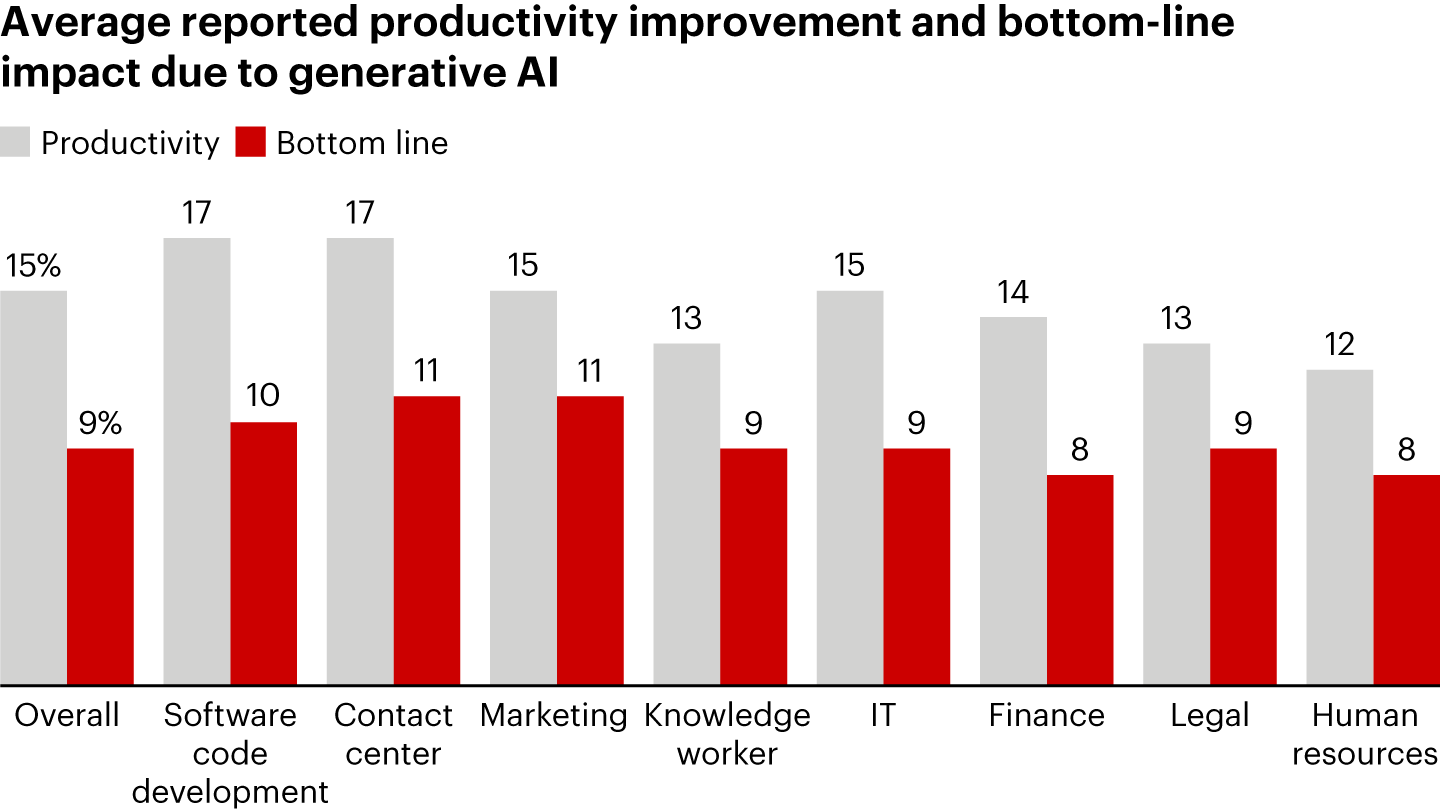
      Companies on average have seen 15% productivity gains and 9% bottom-line impact from generative AI across eight key functions

      Note: Bottom-line impact defined as increased revenue or decreased cost

      Source: Bain Generative AI Survey, July 2024 (n=184)

      With such opportunities emerging, cost transformation in retail is entering a new tech-enabled era. However, to exploit these digital advances fully, retailers must also succeed in the very human task of overhauling the way that they work—fixing the underlying inefficiencies, ingrown processes, and data-management failings that have been holding them back for years, or even decades.  

      AI is rapidly transforming cost transformation

      Executive teams often feel it’s not the right time for concerted action on costs. “We already did a cost program,” is a common refrain.

      The reality is that most retailers are sitting on substantial opportunities to release funds through efficiency gains, regardless of whether they’ve done a cost transformation push in the last few years. And the savings hiding in plain sight are only getting bigger thanks to digital advances that are starting to unlock productivity improvements that would have been implausible only a few quarters ago.

      Consider just one part of a retailer’s cost bar: support functions. These teams have been adopting digital solutions for years, whether that be digitizing supplier invoices, automating payment processing, or embracing traditional AI/machine learning through the likes of enhanced revenue forecasting and anomaly detection in financial data.

      Generative AI has made it possible to automate many additional tasks in support functions, such as legal contract drafting, the translation of recruiting materials, and the personalization of training (see Figure 2). Agentic AI—which uses proactive intelligent agents to complete more complex, multistep tasks—is poised to extend these automation options even further.

      Figure 2
      Contact centers and administrative work are among the highest-potential areas for generative AI in retail

      Notes: Efficiency/productivity gains are not directly tied to head count and vary by function; use case examples are nonexhaustive

      Source: Bain & Company

      Some generative AI deployment brings benefits across functions. When one retailer created an AI copilot to advise on procedural queries, store associates no longer had to locate and scour user manuals for answers, freeing up time for them to carry out higher-value activities, such as interacting with customers. Even better, their managers weren’t asked for explanations so much, either, which meant the most senior people in the store also had more time to focus on the things that mattered most to the retailer.

      Less obviously, the support needed from HR and contact center teams fell. AI tools also have huge potential to reduce maintenance team calls by empowering store associates to resolve more problems themselves. The promise of wide-ranging benefits such as these across multiple projects is one reason we think the available generative AI–related efficiency gains across many functions could amount to as much as 20% at some retailers.

      Generative AI will also revolutionize merchandising—as early adopters can attest. At one retailer, quantifying the value of a supplier’s offer now takes only about 15 minutes, compared with 45 minutes before the introduction of AI automation, while the time needed to prepare an email giving tailored feedback on an early offer (requesting improvements where necessary) has fallen from an hour to 20 minutes.

      When likely gains from optimizing promotions are also factored in, we think AI tools can improve a retailer’s bottom line by 1–2 percentage points across cost of goods sold (COGS) and the expense of running a merchandising function, in large part from allowing thinly spread buyers and category managers to focus on the most critical suppliers, while using technology to inject more rigor into long-tail supplier negotiations.

      Crucially, this AI-enabled opportunity to cut COGS and merchandising expense is in addition to savings achievable through techniques that were established before the generative AI era erupted. It’s a similar story across the retail landscape: Generative AI is an unmissable innovation, but it isn’t the only way to release funds today. For instance, there’s lots of other technology that hasn’t yet been exploited fully, such as robotic process automation, machine learning, and traditional AI.

      Five principles for tech-enabled cost transformation

      Retailers don’t need to break the bank to do all of this. AI tools aren’t as expensive or difficult to deploy as some might fear; the recurring cost can be as little as tens of thousands of dollars a year for AI-led innovations, and most deployments generate a positive return on investment in less than a year (see the Bain Brief “Retail and Gen AI: Now Scale Those Terrific Early Returns”).

      However, the possibilities created by AI make it even more urgent that retailers overhaul broken processes and address the fragmentation and poor quality of much of their data as they search for additional savings.

      Imagine a forecasting process encumbered by myriad ways of compiling data. A finance team wastes time each week standardizing the incoming information. Once, that structural inefficiency might have been tolerated because the gain from fixing it would have been relatively small. Now, the available upside will have soared, given how AI can use standardized data to automate forecasting.

      In cases such as this, cost leaders in retail won’t need a second invitation. They will mend the process, liberate extra funds, and compete harder against rivals that haven’t done the same remedial work.

      So, what does a structural overhaul of cost and process look like in the generative AI era? We think the most successful tech-enabled cost transformation programs will tend to get five things right. They will plan with a bold ambition, embrace zero-based redesign, get more from data, collaborate across functions, and master change management.

      Plan with a bold ambition. Retailers need to anchor their cost transformation in a bold ambition rather than basing it narrowly on their current situation. That’ll involve some probing questions. Could this process or activity achieve similar or better results at 30%, 40%, or even 50% less cost? If so, what would it look like in that streamlined form? And would it be possible to secure those savings while improving effectiveness?

      Embrace zero-based redesign. Across industries, productivity improvements from the rollout of technology frequently aren’t being translated into similar bottom-line gains. That’s putting companies and CFOs in a difficult position, given investor impatience to see early P&L impact. Zero-based redesign can align productivity improvements and cost reduction by radically simplifying end-to-end processes, removing complexity from high-value activities, eliminating or streamlining low-value activities, and removing duplicative work (see the Bain Brief “Zero-Based Redesign: The Key to Realizing Gen AI’s Cost Savings Potential”).

      Get more from data. Executive teams can sharpen cost initiatives by systematically maximizing the usefulness of their data—for instance, by optimizing collection and cleaning of data for use in generative AI tools. To stay lean, retailers also need the right processes, governance, and operating model to maintain data quality. A good data strategy will keep yielding quick wins in support of these goals, balancing value-creating, short-term use cases with more foundational changes (see the Bain article “Data Strategy in Retail: The Gen AI Tipping Point”). 

      Collaborate across functions. The days are gone when efficiency drives could succeed by optimizing cost at the level of a single function. Most of these straightforward gains have been exhausted. Instead, retailers need more cross-functional collaboration in their cost management efforts. That’s the only way to streamline end-to-end processes and harness zero-based redesign fully. The collaboration push might also need to include third-party technology partnerships.

      Master change management. The benefits of the latest technology and zero-based redesign will be short-lived if new ways of working aren’t embedded within the organization. Persuading employees and suppliers to use new digital tools is one part of this challenge; nurturing a mindset that continually reimagines how work can be done is another. Steering this change will require skillful program sponsorship and ownership, effective training, clear and consistent communication, and close alignment of incentives and desired outcomes, among other things.

      With its keen operational focus, retail can point to a strong record of productivity gains relative to many other industries. But most retail cost programs have tended to leave money on the table all the same. Now, retailers have a chance to be more efficient than ever—by embracing new technology and honing their overall approach to cost control. That opportunity couldn’t have come at a better time.  

      Authors
      • Headshot of Kurt Grichel
        Kurt Grichel
        Partner, Seattle
      • Headshot of Christian Fenner
        Christian Fenner
        Partner, Munich
      • Headshot of Carla Nasr
        Carla Nasr
        Partner, New York
      • Headshot of Will Poindexter
        Will Poindexter
        Partner, Denver
      • François Vayleux
        Practice Director, Paris
      Contact us
      Related Industries
      • Retail
      Related Consulting Services
      • Performance Improvement
      How We Can Help
      • Accelerated Revenue Transformation
      Future of Retail
      Overcoming the Existential Crisis in Consumer Goods

      Leading brands need to fight today's battles and the even bigger ones hitting them tomorrow.

      Read More
      Cost
      Big Brands Confront Big Changes at US Grocers

      Large brands can take five steps to thrive in the shifting grocery landscape.

      Read More
      Retail
      The 2026 Retail Executive Agenda

      Here are letters to the C-suite to help strengthen strategy, catalyze collaboration, and expand value creation in the AI age.

      Read More
      Accelerated Revenue Transformation
      Revving Up Sales ROI for a Downturn

      Members of Bain’s B2B Commercial Excellence group discuss the four pillars of every company's commercial base and how they should be structured for medium-term growth.

      Read More
      Performance Improvement
      Transforming Maintenance with Artificial Intelligence

      With little to no capex, companies can turn maintenance into an engine of cash flow.

      Read More
      Published in April 2025
      Tags
      • Accelerated Revenue Transformation
      • Cost
      • Future of Retail
      • Performance Improvement
      • Retail

      How We've Helped Clients

      Sales and Marketing Inspiring retail employees to think and act like owners

      Read case study

      Performance Improvement Retailer's performance improvement boosts shareholder value

      Read case study

      Digital Omnichannel strategy boosts fashion company

      Read case study

      Ready to talk?

      We work with ambitious leaders who want to define the future, not hide from it. Together, we achieve extraordinary outcomes.

      Stay ahead in a rapidly changing world. Subscribe to Bain Insights, our monthly look at the critical issues facing global businesses.

      *I have read and understand Bain’s Privacy Notice.

      Please read and agree to the Privacy Policy.
      Bain & Company
      Contact us Sustainability Accessibility Terms of use Privacy Modern Slavery Act Statement Cookie Policy Sitemap Log In

      © 1996-2026 Bain & Company, Inc.

      Contact Bain

      How can we help you?

      • Business inquiry
      • Career information
      • Press relations
      • Partnership request
      • Speaker request
      See all offices