

Brief
There’s a good reason why the overstretched supply chains in the Asia-Pacific region are keeping executives around the world up at night: These supply chains won’t help companies support the next wave of global growth in a vastly different cost environment.
Whether they are part of a global or regional operation, many of these supply chains were designed for a low-cost model that has eroded and for a time when fewer new products were introduced at a much slower pace. These supply chains also came into being when technology options for helping companies with forecasting and demand planning were less robust than they are today. For these reasons, many supply chains in the region are holding companies back from delivering on business strategy.
Given the disruptions of the past decade and the effects of the region’s growth spurt, we wanted to know what business leaders in Asia-Pacific countries think of their supply chain capabilities, where they would like to improve and what they see as the obstacles getting in their way. Our research helped us obtain a clear picture of multinational and domestic companies’ supply chain performance throughout the region. The bottom line: Executives know that their supply chains must meet higher requirements. They know where they fall short and what the priorities are for improvement. But for many, the challenge is determining how to get started.
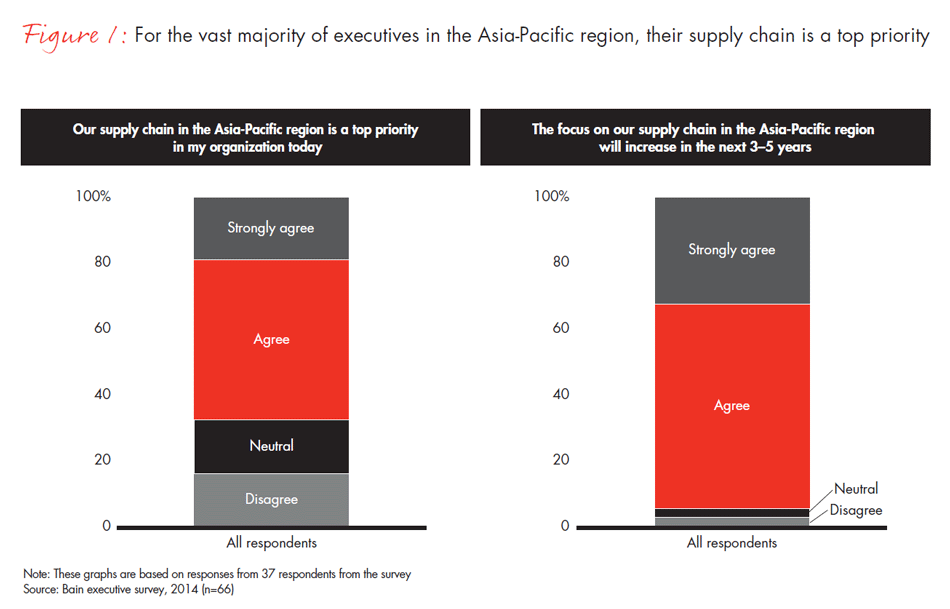
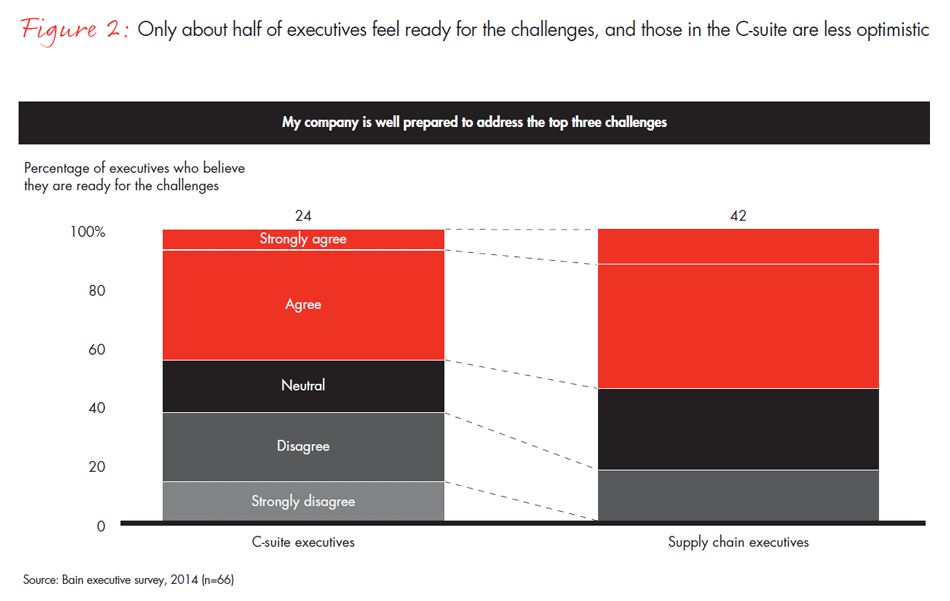
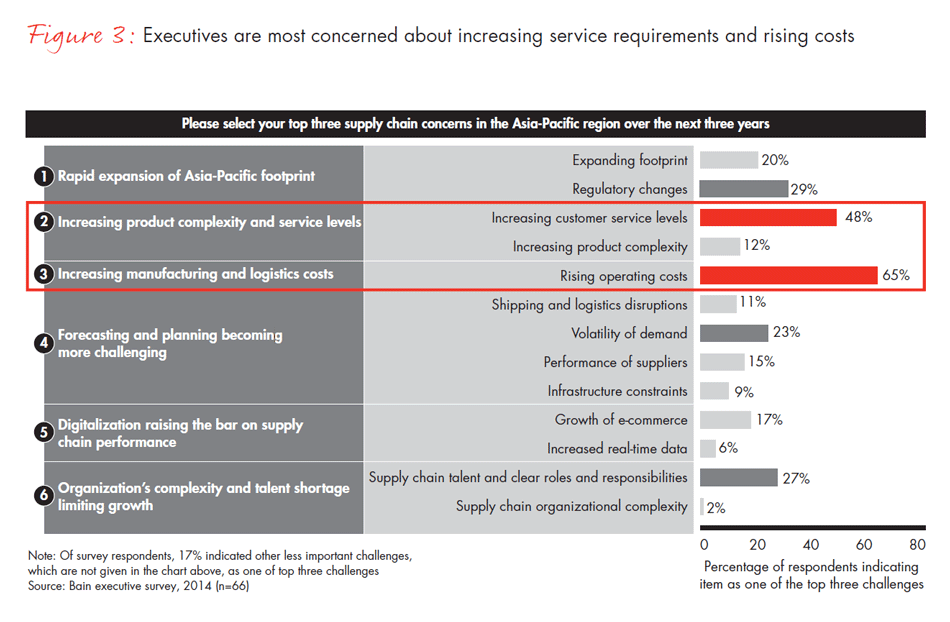
We interviewed 66 senior supply chain executives across a broad range of industries. Fully 70% said their supply chain is now a top management priority, but only half believe their organization is ready to address the many issues facing them (see Figures 1 and 2). Their biggest worries are dealing with rising costs and getting a handle on diversified products and increasing service levels. They are also concerned about customer satisfaction and making their supply chains more flexible and agile (see Figure 3). And they struggle with misaligned organizations and a shortage of talent.
Participants were able to assess where they stand compared with best-in-class performance on a range of key supply chain dimensions. In their view, the widest gaps are in the areas of strategic alignment (a company’s ability to use supply chain to support its growth ambitions), customer centricity (customer service levels and complexity management), digitalization, and organization and talent. Local champions are more likely than multinationals to feel they trail the best in class in complexity management. The area with the smallest gap between local champions and multinationals is organization and talent.
However, even in such a thorny environment, some companies are getting it right—redefining their supply chains as a strategic asset for competitive advantage. These companies take the first big step of translating their company’s unique growth strategy into specific objectives for their supply chain, such as improved cost competitiveness; increased capital efficiency; and better ways to manage complexity, demand uncertainty and shortened time to market for new products. Amid the region’s dramatic changes, these leaders are setting up the next-generation supply chain. As they design the full network—spanning procurement, manufacturing and distribution—to deliver these new supply chain objectives, they’re positioning themselves to grow revenues over the long term while improving margins and capital efficiency.
A deeper look at the disruptions
Some of the influences on supply chains have been simmering for years (see Figure 4). For example, countries like China supported their dynamic growth with low-cost manufacturing. But that advantage has steadily eroded. Consider that wages per hour have jumped by an annual 9% in China during the five-year period ending in 2012. As they lose their low-cost edge, companies manufacturing in China need to reassess their entire footprint, the role of each plant and their future capacity investments.
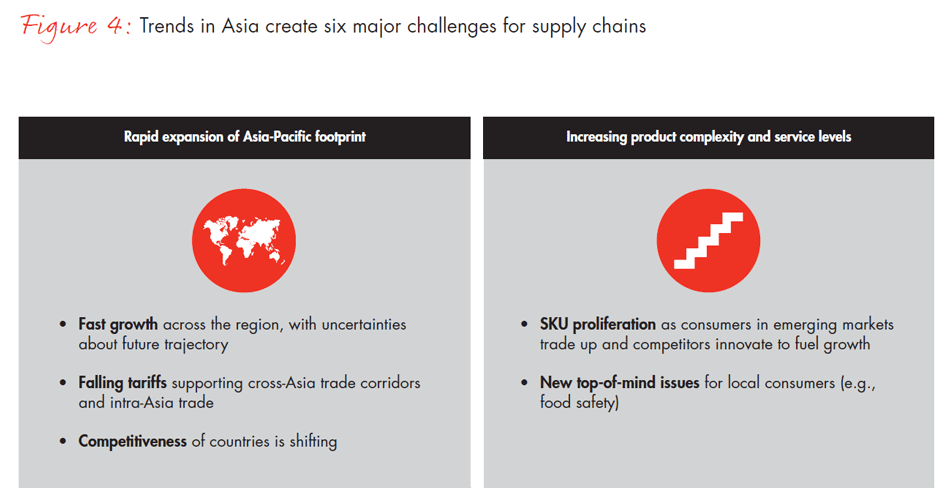
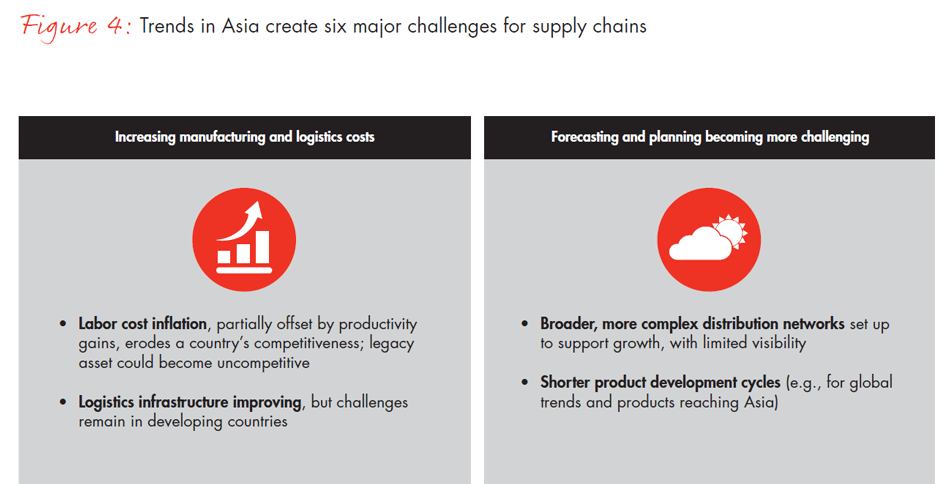
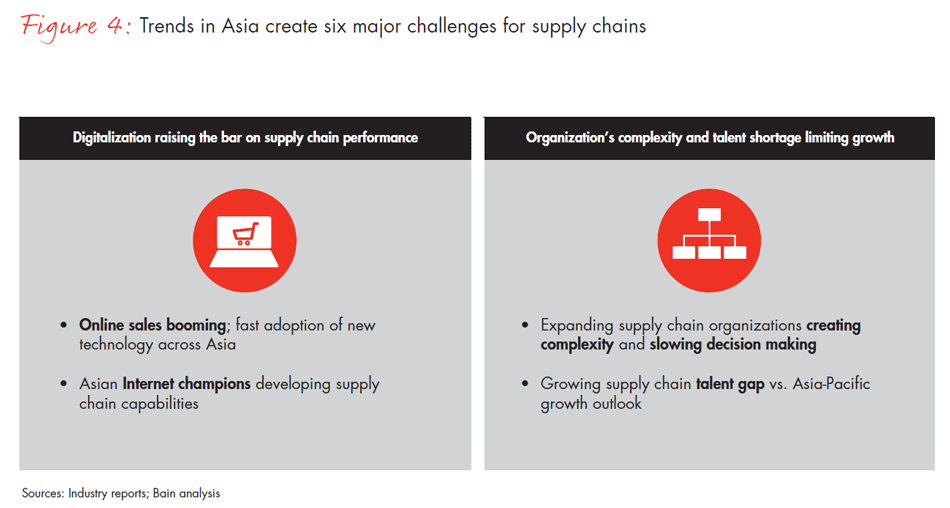
Both multinational and local companies spurred growth by introducing many new SKUs in recent years, but it’s a move that brought complexity to supply chains. Look at consumer electronics, with its mounting pressure to quickly launch new products. After Apple introduced the iPhone 4 in the US, the company took three months to roll out the phone in China and Thailand, and 11 months to release it in India. But in 2014, Apple launched iPhone 6 in all four markets within a mere six weeks. Companies hoping to compete in this environment need a supply chain that can ramp up capacity quickly and manage complexity for local products without building too much inventory. This boosts the requirements on suppliers and also creates the need for a more effective planning process. Indeed, with shortened product cycles in an expanding geographic footprint, supply chains need to be much more responsive.
Companies also face the challenges created by growing e-commerce activity. More than one-quarter of all orders in China are now placed online. This movement to e-commerce raises the bar on fulfillment options to customers, as well as time and costs for both online and brick-and-mortar businesses. That’s why leading companies are investing in digitalization of supply chain processes to achieve real-time visibility into inventories, suppliers and suppliers’ networks to optimize planning. Digitalization is becoming a top-of-mind issue for supply chain executives and has the potential to help companies build leaner, more flexible and responsive supply chains.
Meanwhile, managing supply chain organizations has become much more difficult. For most companies, growing their business over the past decade required growing their supply chain in size and complexity. Many became less efficient: harder to control and troubled by slow decision making. The typical organization now covers many more countries, product lines and channels, with multiple plants and distribution centers. As decision-making complexity increases, it becomes more important for companies to have quick access to the right supply chain performance information and for their organizations to be tightly aligned. Compounding the situation, companies tell us that it is still difficult to attract, develop and retain top talent at the management, skilled worker and technical staff levels.
While all of these trends take a toll on supply chains throughout the Asia-Pacific region, the effects of each are different in different regions. All, however, converge in China, India and Southeast Asia, where we see the biggest consequences of such developments as increasing supply chain costs and customer demand for more product variety and higher service levels.
The impact of these trends also varies between multinational and domestic companies. Multinational companies in the Asia-Pacific region must make decisions about product localization and choose among local, regional or global supply chain models. Local companies face a different form of complexity: They must continue to innovate with new products to grow in their home markets while building a broader supply chain to serve export markets.
Bain Partner Pierre-Henri Boutot shares key themes for executives rethinking their supply chains.
Learning from the best
Still, the supply chain winners are making themselves known. Benchmarks show just how far some companies in the region surpass their counterparts. For instance, based on benchmark data from SAP Value Management Center, we found that top-quartile performers can reduce their order-to-shipment cycle by up to 10 days or boost forecast accuracy by up to 10 percentage points compared with average performers. From our experience working with companies to improve their supply chains, becoming best in class starts by looking for gaps in the existing supply chain and targeting areas to improve (see Figures 5 and 6).
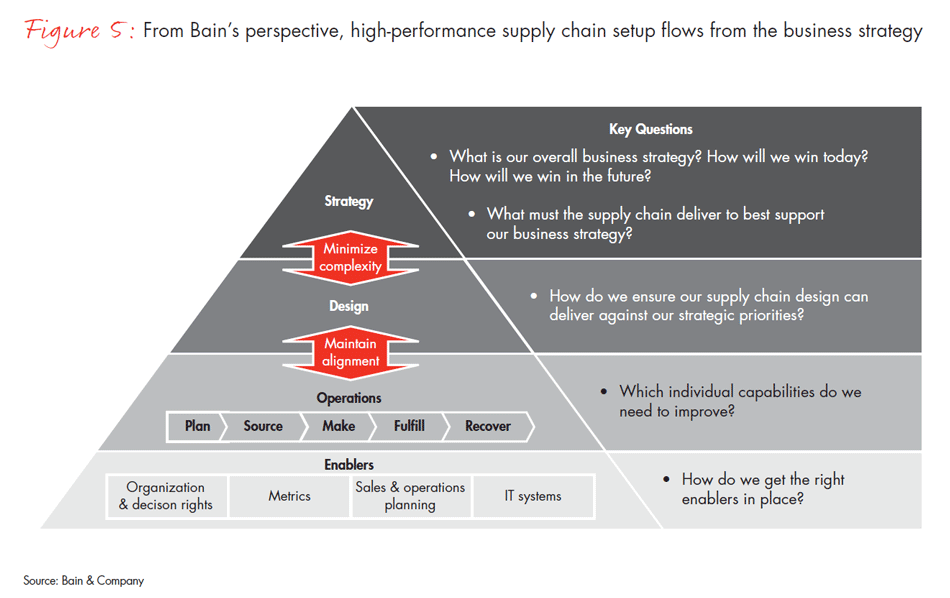
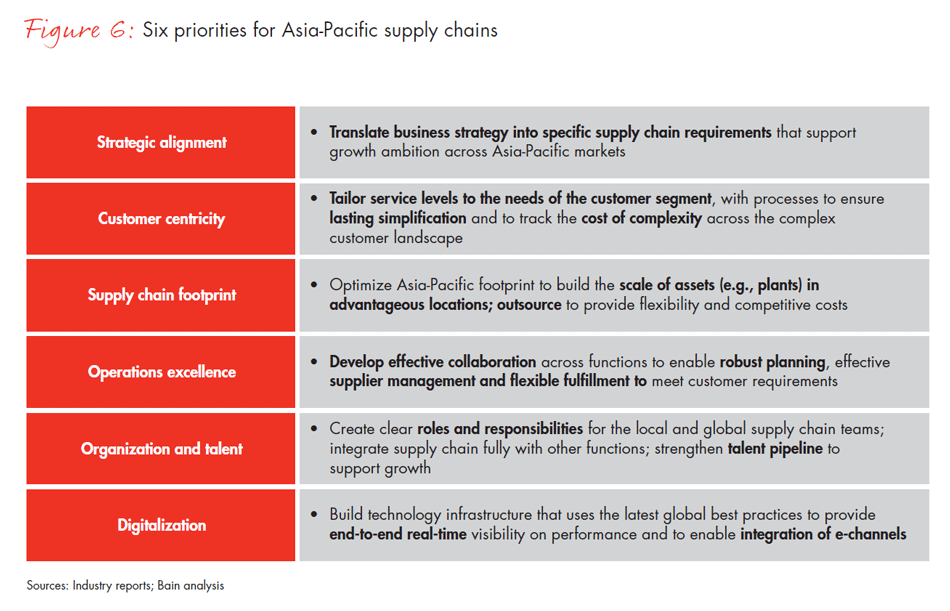
We asked executives to prioritize the areas that are most important to tackle first. Their responses helped us focus on the four biggest questions companies must ask and answer if they want to pull ahead of the pack.
Is your supply chain aligned with your strategy? The best companies are clear on how they will win today and in the future, and they translate that strategy into equally clear requirements for their supply chain, designing the footprint and operations to meet those requirements. Consider the widely different approaches taken by the two leading players in China e-commerce, Alibaba and JD.com: The former designed its supply chain to accelerate expansion and the latter to optimize the customer experience. Alibaba’s strategy to quickly expand across different businesses required a flexible model, so the company relied heavily on third parties from the start, joining forces with 14 strategic partners with more than 1,700 distribution centers and 100,000 delivery stations. Compare that with No. 2 player JD.com. For its part, JD.com maintained a different strategy: Focus on customer service. Because its strategy emphasized controlling the customer experience, JD.com opted to handle all logistics in-house, maintaining its own network of 118 warehouses and more than 2,000 delivery stations, providing same-day delivery to 130 cities and districts in China and three-hour delivery in six major cities.
Is your supply chain designed to serve your most valued customers? Supply chain leaders in the Asia-Pacific market strive to meet the service levels required to win with their top customers and to optimize the cost to serve. It is no surprise that surveyed executives see customer satisfaction as the biggest contributor to their supply chain’s value. Customer needs are changing, and it’s not easy to catch up. “Good service levels mean different things across Asia-Pacific countries. The key challenge for us is to address diverse requirements,” said one Japanese supply chain executive.
Companies can gain an edge by tailoring their supply chain to better serve high-value customers. Samsung Electronics, for example, successfully configured parts of its supply chain to better serve B2B customers. The company uses shared resources for its B2B and B2C customers, but it prioritizes critical B2B orders, providing those customers with products that are made to order and delivering industry-leading order-fill rates. This approach helped the company grow its B2B business to 6% of revenues in 2013 and has put it on track to achieve nearly a quarter of 2020 revenues. A key element of Samsung’s supply chain: The company invested in a demand-planning process that is integrated with partners, giving Samsung forecast accuracy in the top-quartile of its industry. Also, the company’s IT infrastructure provides real-time visibility across the supply chain to support fast decisions.
Is your organization supporting your supply chain? Winners design supply chain organizations to ensure effective collaboration, with clear roles across functions. They also build a talent pipeline to support future growth. Haier excels at both. As the company grew from a single product line in home appliances to multiple product categories and solutions, Haier evolved its supply chain organization. It established a dedicated supply chain management department to coordinate all supply chain functions. This department helps deliver economies of scale through central sourcing and provides increased oversight. The company established a solid system for acquiring talent by closely monitoring competitors’ talent movements and by on-campus recruiting at targeted universities. Its emphasis on organization and talent has contributed to Haier’s 25% annual growth over the past 14 years, helping it become one of the world’s largest home appliance manufacturer based on sales volume.
Is your supply chain winning or losing in the digital race? Finally, the best companies surpass rivals by investing to capture their share of the booming e-channel growth while improving supply chain visibility and performance. In 2010, Chinese home appliance retailer Suning saw the opportunity to compensate for declining growth in its physical stores by investing in online capabilities. It laid out an omnichannel strategy, positioning its online platform as a multicategory e-commerce site to feature third-party offerings and established a cross-border e-commerce business. It focused its offline efforts on growing in China’s lower-tier cities. The supply chain it built to support this two-pronged strategy included centralized sourcing for products offered both online and offline and shared distribution facilities. Suning gave supply chain priority to its online channel, including a separate sourcing process for online-only products. This approach helped Suning grow overall revenues by nearly 6% from 2011 to 2013, despite declining sales in physical stores.
We learn from these companies that, even with slowing growth, the Asia-Pacific region abounds with opportunities. The prospects there remain unmatched for selling, sourcing and manufacturing. And given the magnitude of changes in the region, many companies have discovered that now is the best time to reinvent their supply chain footprint in Asia. Whether a company relies on Asia to support its global operations or its local business, there’s a distinct path forward. When companies ask us where to begin, we typically tell them that the first big step is to translate their strategy into specific supply chain requirements and equally clear objectives, by customer segment and channel, and to use these objectives to design the supply chain footprint of the future. Left unchanged, the supply chain capabilities that helped companies in the past will only hold them back in the years ahead.
Raymond Tsang is a Bain & Company partner based in Shanghai. Pierre-Henri Boutot is a partner based in Hong Kong. Peter Guarraia is a partner based in Chicago, and Miltiadis Athanassiou is a partner based in Zurich. All are leaders in Bain’s Performance Improvement practice.
Published in April 2015