

Brief

At a Glance
- Unsure of the overall payback from 5G, some operators are rolling it out cautiously, missing riskier opening moves that could yield a compelling return on investment.
- Four options to target stronger ROI are a micro-focused “land grab”; taking the hard road in home installation; piggybacking on managed Wi-Fi; and network sharing.
- These bolder moves fit a proven strategy for managing in uncertainty; as 5G matures, they can help build the overall investment case that is so elusive today.
The breathless marketing for the rollout of 5G masks a hesitancy on the part of mobile network operators. Amid the talk of “router bursting” speeds that will “change how we live, work and play,” many leaders are skeptical about making additional billion-dollar investments without clear near-term payback.
With the most dazzling applications of 5G—such as autonomous vehicles and virtual reality—still in their infancy, it’s not surprising that in a Bain & Company poll of industry executives more than half said the biggest brake on their 5G deployment was the lack of compelling use cases (see Figure 1). Doing nothing, however, is likely to mean falling behind rivals, perhaps irrevocably. It’s just not an option.
Figure 1


Leadership teams in other industries have faced similar challenges formulating strategy amid extreme uncertainty. Yet as telecom executives try to chart their 5G path, we see signs that some are being too conservative and insufficiently nimble. This creates the risk of competitive stalemate.
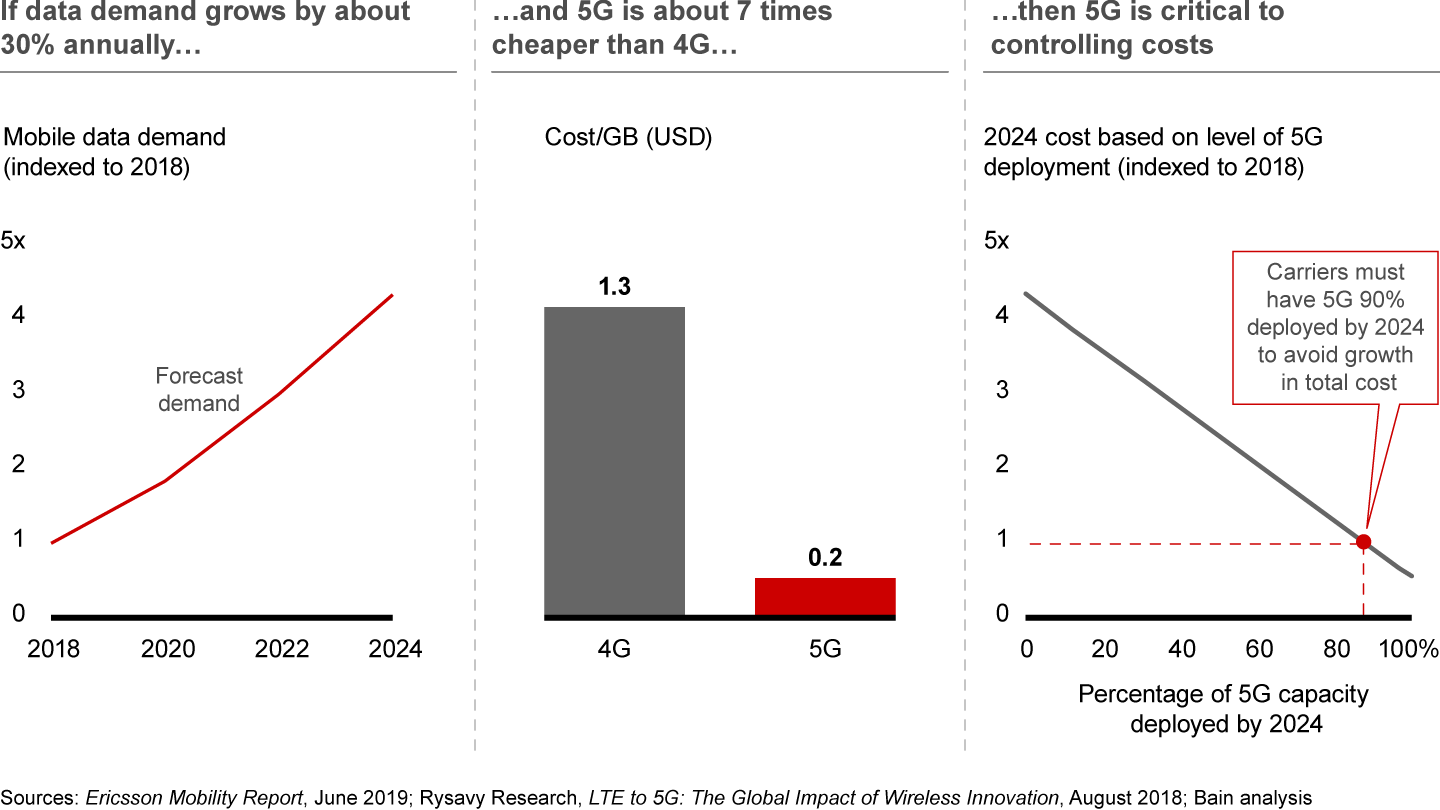
Consider the trend for carriers to focus on outdoor deployment, starting with upgrading existing sites and then adding new sites where congestion is greatest. On one level, that’s sensible. Demand for mobile data is predicted to grow by 30% or more annually for the next few years. Offering materially lower “cost per bit” capacity upgrades, 5G will be critical to keeping operators’ costs under control (see Figure 2). But it’s also a bare-minimum strategy, one that is geared to keeping existing subscribers happy, not creating the competitive differentiation that can yield a punchier return.
Figure 2

The rollout of 5G doesn’t have to be so defensive. In our view, meaningful returns can be found at a more tactical level if executives take a bolder approach that focuses relentlessly on ROI. The goal is to screen out the macro-level noise and identify the commercial and technological risks that are most worth taking.

Why the 5G Pessimists Are Wrong
Network operators that listen to the naysayers run the risk of missing out on the true benefits of this step-change technology.
We believe that four options in particular are capable of delivering a strong ROI from a differentiated 5G position. These actions—described below in ascending order of risk—won’t fit every company. The right deployment strategy will depend on many factors, such as market position, technological prowess and spectrum assets. But a fresh approach could offer carriers a means of standing out profitably in the evolving 5G market—and gradually building the overall investment case that seems so elusive today.
A micro-focused land grab
Carriers that strike innovative deals with municipal authorities and other partners can get more traction when rolling out small cell equipment. In Denver, for instance, Verizon is working with Xcel Energy, a regional utility, to install new streetlights that incorporate a 5G antenna; the innovative design blends into the urban scenery.
The nimblest carriers will be able to identify the critical micro-locations in a given city (both for themselves and for their rivals), using pinpoint demand modeling and competitor scenario analysis. They will then go after these sites with a must-win attitude. First-mover status is crucial. For a start, installing ahead of others can reduce the risk that local residents will object to “clutter” on sidewalks. Carriers that try to add poles or towers in areas already covered by a rival may face more opposition.
Speed and hyperlocal capabilities are not the only factors in a successful “land grab.” Network operators are likely to find the most powerful ROI where they are the exclusive provider of 5G. Exclusivity can enable them to differentiate their offering or charge competitors for wholesale access. Prime targets include subway systems, shopping malls, office buildings, historic sites and other locations within which 5G provision can be controlled and rival services limited.
Early land grab examples include the rollout of 5G to select sports venues—not only in the US, where Verizon and AT&T have got their foot in the door at NFL stadiums, but also in South Korea, where local network operator KT owns its own baseball team and has turned the stadium into a 5G showcase. It’s not just about the marketing halo earned by demonstrating the new technology in a controlled environment; the people who work and spend time in these locations are likely to be valuable potential customers too.
To strike the exclusive deals that will reap the most compelling returns, network operators will obviously need to be first in line. But when they sit down at the negotiating table with a city authority or similar asset owner, they will also need to think creatively about ways they can offer greater value to this potential partner. Solutions might involve revenue sharing or some form of benefit in kind, such as the supply of 5G-enabled body cameras to police officers (already the subject of a partnership between Verizon and Axon, the maker of Tasers). Carriers that employ skilled, flexible negotiators are likely to fare best.
Taking the hard road in home installation
For many households facing poor Internet speeds—particularly those with no access to fiber broadband—5G is a godsend. Some operators, such as Three in the UK, are capitalizing by rolling out urban 5G services focused on home broadband. Part of the attraction of these offers can be the no-fuss setup. Instead of waiting for a technician, customers often just plug in a router and begin. The convenience is a powerful draw. But it might not be the best near- or medium-term approach, nor is it likely to be optimal for all customers in a region.
Operators might well gain an edge by bringing technicians back off the bench. Instead of an internal antenna, they could connect a household via an external elevated antenna (such as a satellite dish on the roof, or a smaller device mounted in the eaves). This would allow each cell to cover a much larger area. Sure, the cost to connect a customer goes up since a technician “truck roll” is required, but this can be more than offset by the advantages (in capital expenditure and time to market) of using fewer, larger cells.
External antennas would also make it easier to introduce innovative architecture, such as integrated access and backhaul (IAB) solutions, in which select customers would provide additional coverage to their neighbors. This would avoid significant fiber costs and free the operator from a potentially lengthy wait for permits from a municipal authority.
The reach and resilience of this kind of IAB approach would be impossible for a competitor to match with exclusively fiber-fed cell sites. Operators would need to be comfortable working with bleeding-edge technology, but they needn’t do it alone. One approach would be to partner with vendors to pilot and deploy technologies in advance of ratification by standards groups such as 3GPP.
Piggybacking on managed Wi-Fi
With more than 80% of mobile data traffic originating or terminating indoors, you’d think that office buildings would be a key battleground for 5G. Yet many operators are more focused on outdoor deployment, as it offers a quicker and cheaper rollout. The outdoor bias also mostly avoids the technical obstacle presented by walls blocking high-frequency 5G signals.
However, the high-hanging fruit of indoor deployment is likely to generate superior ROI for operators in the medium to long term. Some carriers have already seized the opportunity. In South Korea, one of the world leaders in 5G adoption, operators have been developing solutions such as repeaters and innovative antennas to improve indoor speeds.
One indoor approach offering significant opportunity for innovation involves focusing first on the provision of managed Wi-Fi services to corporate customers. While nurturing those customer relationships, the operator could upgrade the Wi-Fi access points in these offices to take 5G equipment as well.
Is there a touch of “Trojan horse” about such a tactic? Not really: It is more a case of piggybacking. Within offices, 5G is unlikely to displace Wi-Fi, but many workers and businesses will come to expect access to both. Office landlords that can meet that need will have gone a long way toward future-proofing their digital infrastructure.
Carriers that want to blend managed Wi-Fi with an indoor rollout of 5G will need to ensure their 5G infrastructure teams are talking to their colleagues in enterprise services. That will often involve breaking down organizational silos that plague companies in all industries. But executives might well find that investment of time worthwhile: The prize could be a years-long head start on competitors, given that such contracts can run for a term of 48 to 60 months.
Network sharing
Operators have traditionally sought to charge a premium by advertising the superiority of their networks over their rivals’ infrastructure. It’s hard to think of a more capital-intensive way of standing out from the crowd. But as we approach an age in which 1-gigabit-per-second networks cease to be an emerging reality and become the norm, will there continue to be any competitive advantage from speed and coverage?
Carriers that believe the answer to this question is “no” might want to consider our fourth (and riskiest) option: sharing the onerous cost of building and maintaining a 5G network with one or more rivals. Clearly, such a move would go way beyond tactics and into the realm of fundamental strategic adjustment; the whole basis of competition would shift to value proposition and customer service.
That’s daunting, but operators able to pull it off could transform their ROI. After all, they would be cutting their capital investment in the 5G network by half, two-thirds or even three-quarters. At the same time, they would be switching their focus to capabilities that offer effective differentiation for a fraction of the capital.
Network sharers will need new skills in retail and distribution innovation, and in ensuring the reliability of an ecosystem of partners. They will also have to handle regulators deftly, understanding regulatory priorities and tailoring their behavior accordingly. An operator seeking permission to share a 5G network might emphasize how this approach could extend national 5G coverage more effectively than two or three overlapping networks. The existing network sharing between Bell Canada and Telus shows how such agreements can cover vast territories, broadly splitting Canada into east (Bell) and west (Telus).
Sharing 5G networks would encourage operators to extend their customer service to more sophisticated work than the bill inquiries and other low-level chores that often tie up call centers today. Think of an operator supplying 5G services to a police force for monitoring of body cameras: The impact of poor customer service would be immense. The same would be true for contracts to support self-driving cars and other weighty uses.
Operators can avoid gaps in customer service by carefully structuring relationships with hardware vendors. Those that work with many vendors at arm’s length risk being slow to respond to glitches; they can get bogged down in back-and-forth over who should fix them. This can be averted by deeper vendor relationships in the mold of Verizon’s body camera tie-up with Axon or its mixed-reality glasses partnership with ThirdEye Gen. Another benefit of this approach: It can minimize the number of hardware platforms that need support.
A differentiated path to future opportunity
Amid extreme uncertainty, it’s natural to play it safe. But digital natives have shown that companies can make startling progress even when the endgame is clouded. It’s a case of advancing with the most pragmatic opening move available, assessing options for the next step, pivoting if needed, then repeating. The trick is to accept that all options for move two might not be visible until you’ve made move one. Ditto for the third, fourth and fifth moves.
For 5G, all future strategic options won’t emerge until the technology matures. More moves might be apparent when consumers get used to cheap, superfast mobile streaming, say; or when multi-access edge computing goes mainstream, processing more and more data with lower latency closer to the consumer; or when augmented reality finally realizes its potential.
That’s all fluid, but the distinctive actions outlined above show that executives don’t need to wait for certainty to target high ROI from 5G, if they are willing to accept more risk and act decisively. When those exciting use cases for 5G finally emerge, the spoils are likely to go to the operators with the largest networks—the ones that began boldly while others hedged their bets.
Herbert Blum leads Bain & Company’s Telecommunications practice. Darryn Lowe is a partner with the Telecommunications practice. Both are based in Toronto. Alex Dahlke and Michael Verhoeven are partners with the Telecommunications practice, based in Frankfurt and Melbourne respectively.
Published in December 2019