

Brief

At a Glance
- Today’s integrated telco model is evolving into four distinct competitive arenas: infrastructure, services (for both consumers and enterprises), platforms, and “customer intimacy” plays focused on specific industry verticals or customer needs.
- The boundaries between each of the competitive arenas aren’t set, and where they meet is generating a lot of competitive friction.
- Some leading telco executives are quickly developing arena-by-arena strategies that require new partnerships, capabilities, and ways of working.
- Change is underway and will accelerate, so “wait and see” isn’t an option.
As the saying goes, “no rest for the weary.” Telecommunications executives have faced enormous challenges in recent years, from the increased network demands of pandemic lockdowns to the macroeconomic pressures that followed to the rapid improvements in artificial intelligence (AI). And yet the pace of change is only going to accelerate.
The traditional integrated telco model has started evolving into four distinct competitive arenas, each with diverse business model options: infrastructure, services (for both consumers and enterprises), platforms, and “customer intimacy” plays (nimble businesses that are focused on specific industry verticals or customer needs and leverage capabilities that can be sourced from platform companies) (see Figure 1).
Figure 1
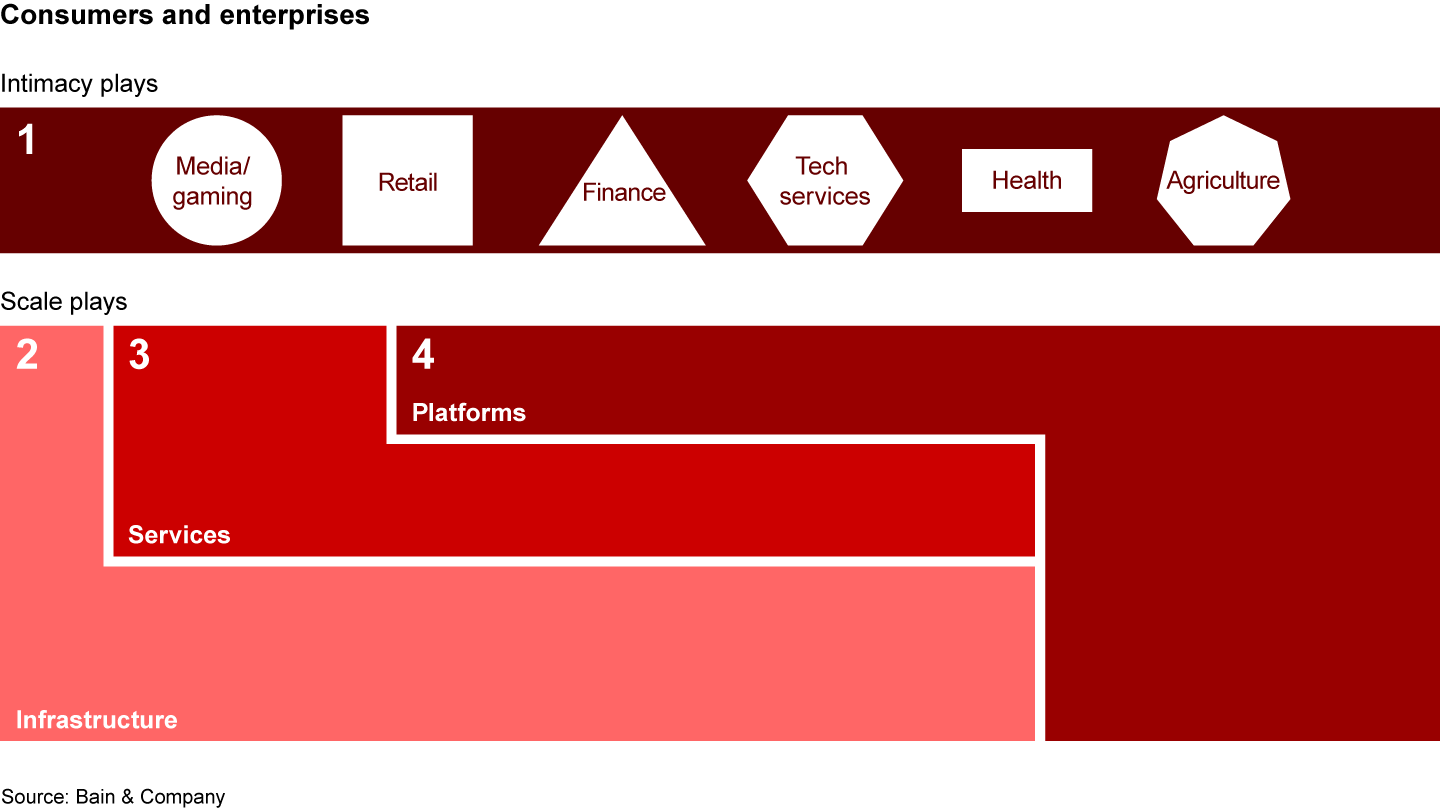

Integrated telcos often already participate in multiple arenas, but they need to recognize that each will increasingly have a distinct set of rules, strategic assets and capabilities, investor expectations, and regulatory environments. Perhaps even more significantly, each arena will have focused, built-for-purpose competitors. Hence, traditional integrated telcos likely need to unlearn some old habits to win in these new spaces—and they’ll need to take a hard look at their existing assets. Divestitures, acquisitions, and strategic overhauls may be in the cards for some.
Friction at the boundaries
Despite having distinct characteristics, the boundaries between each of the competitive arenas aren’t set, and where they meet is generating a lot of competitive friction.
Infrastructure, platform technology, and business-to-business (B2B) services companies will all come at the network-as-a-service capability from different angles. Who will first develop the most complete solution and learn how to best monetize it remains unresolved.
Enterprise services has a crowded field of competition, with traditional telcos, technology hyperscalers, smaller platform players, enterprise tech companies, equipment manufacturers, and software start-ups all jostling for market share. What’s most noteworthy is just how far the new competitive reality of delayering has taken hold in the B2B arena. Each of the providers mentioned earlier is now positioned to offer connectivity services to enterprise chief technology and information officers without the need to own the network itself.
In consumer connectivity, “asset-light” mobile virtual network operators (MVNOs) will increasingly challenge traditional telco retail arms. At the same time, hyperscalers are weighing whether to follow Google Fi Wireless into the fray and watching whether Google’s connectivity offering will move beyond the test-and-learn stage. Bloomberg reported that Amazon has had discussions with mobile carriers about potentially offering low-cost or perhaps free wireless service to its Prime members via resale. Meanwhile, US cable operators’ hybrid networks (a combination of their owned spectrum, cable infrastructure, and MVNO agreements) are also shifting the competitive balance in the consumer services space. We view this as only the beginning; many different kinds of asset-lights will rise in the coming years.
The embedding of connectivity in various industry solutions creates new vertical opportunities for traditional telcos, industry specialists (e.g., John Deere in agriculture), and platform players.
Where to play
Today’s integrated telcos will need to decide, arena by arena, where and how they will participate in this evolving industry paradigm. Few telcos have this all figured out and are executing across all arenas in parallel. However, some have made significant moves to align themselves with the new competitive reality. In Europe, TDC formally separated its network and services businesses. India-based Jio is one of the few telcos that has structured its businesses differently in each of the four arenas and brought in different types of investors for each, in recognition that each arena requires its own financial and operating models and that external funding can be a crucial accelerant.
All of these decisions involve revisiting historical norms for how a telco operates.
Infrastructure owners: Consolidate or sell?
While the pace of the shift may vary by market, there’s a reasonable argument that regulators will eventually allow more consolidation at the infrastructure level, particularly since they’ll be able to continue to ensure robust competition at the service level.
Infrastructure owners that intend to be one of the remaining players will need to ensure they continue to have sufficient capex flexibility to plant the flag today in the most valuable areas. That may mean partnering with financial investors for rapid access to additional capital, as AT&T has done in the US, creating a joint venture with BlackRock to fund accelerated construction of its Gigapower wholesale fiber network.
Other capabilities that will likely prove critical are having the data and AI tools to make rapid, hyperlocal decisions about where to deploy that incremental capital; having a best-in-class commercial motion to spur utilization of those assets; and continually raising operating performance to stay competitive on costs. Leading infrastructure companies will keep their mergers and acquisitions team sharp and alert to consolidation opportunities, particularly as volatile interest rates may pressure smaller competitors to exit the market.
Those that don’t intend to make the significant, ongoing investments required to lead in infrastructure have a different set of considerations: when and how (not if) to sell their assets to a competitor, either cashing out entirely or maintaining a minority stake.
Consumer services: How to differentiate beyond price?
As infrastructure players are more open to wholesale deals to expand utilization of their network assets, competition will increase from asset-light telcos that bring a different, leaner cost structure and more competitive pricing. For integrated telcos, accelerating their transition to digital customer interfaces and internal processes (to both enhance the customer experience and lower costs) is table stakes to compete. Rather, how will integrated telcos differentiate themselves in the eyes of consumers? What additional elements of value can they offer to increase customer acquisition, loyalty, and advocacy?
Enterprise services: Harvest or transform?
Significant technology migrations are underway that threaten existing telco profit pools. Legacy infrastructure—based services with 60% to 80% gross margins are almost certain to be replaced by resale services with much lower margins. Leading telcos recognize the need to proactively manage this transition or face a steep revenue and profitability cliff. Avoiding the cliff will require building capabilities that add value beyond connectivity, such as professional and managed services. This, in turn, means transforming the enterprise business units to adopt more best practices from the IT services industry, ultimately operating in specialized units centered on infrastructure services, with value-added services across categories of information and communications technology. Some telcos, such as Cincinnati Bell, have successfully navigated this transition. (For more detail, read the recent brief “Enterprise ICT Services: The Next Growth Engine for Telcos.”)
Platforms: Rent, partner, or build?
As with all industries, technology platforms are reshaping telecommunications. Leading telco operators recognize that, at a minimum, their platform strategy needs to account for two elements: How can their company leverage hyperscalers’ scale and technology to lower costs and speed up innovation, and where can telcos’ assets (e.g., last-mile infrastructure and their customer base) add value in partnerships with technology platforms? At the same time, telcos that choose to stay in the enterprise services game will need to shore up their defenses against competing hyperscaler offerings.
Indeed, leading telcos are broadening the scope of their collaboration with hyperscalers. Amazon Web Services is running much of Dish’s core network and is the underlying computing platform for Verizon’s Connect business. Microsoft has acquired AT&T’s in-house cloud network technology and incorporated it into its Azure for Operators offering, of which AT&T is an anchor client. Google Cloud is partnering with Vodafone as the latter overhauls its technology and data capabilities and with Orange on AI, edge computing, and data initiatives. In France, Orange is also working with Capgemini to build a sovereign cloud on Microsoft Azure’s technology.
Lastly, a small number of telco operators may be able to add a third component to their platform strategy: building their own. Creating a successful in-house platform is a high hurdle that requires deep technical skills, deeper pockets, a keen sense for ecosystem management, and access to a large national or regional market, preferably where global platforms are underpenetrated or hampered by regulatory issues. Asia has proven to be a particularly active region for these efforts, as demonstrated by the increasingly bold experiments of telcos such as Jio, Telkomsel, and SK Telecom.
Intimacy plays: How to expand services into full-fledged businesses?
Despite traditional telcos’ poor track record of expansions into adjacent services and markets, experimenting with new service lines has never been easier. Access to hyperscaler platforms as well as competitively priced network infrastructure and communications services has dramatically shrunk initial capital outlays, and the modular technology landscape allows telcos to buy solutions to most other technical requirements. This paradigm allows entrepreneurs to focus on creating new ways to meet underserved customer needs.
These entrepreneurs can flourish within larger corporate structures if—and it’s a big if—the organization’s operating model affords them an environment conducive to experimenting and reacting quickly to customer feedback while still offering access to the organization’s capabilities, customers, and capital. This is easier said than done but more necessary than ever in telcos’ low-growth environment.
While many telcos’ attempts at intimacy plays have faltered over the years, there are strong counterexamples. Telus has built an impressive health and wellness business; Verizon’s acquisitions of a few years ago created a sustainable telematics and fleet management business; and Orange’s financial services play with its dedicated subsidiary in Africa is showing promise. The Orange Money story is particularly instructive as it illustrates the tenacity and flexibility required in building robust intimacy plays. Launched in 2008, Orange Money has nearly 30 million active users across 17 countries. Success brought more competition, of course, with venture-backed Wave entering the market at a lower price point and taking share in a subset of countries a few years ago. Rather than limiting its response to matching price cuts in a race to the bottom, Orange has responded by building out a broader service proposition that will be available to all consumers, not just those who choose Orange for mobile connectivity services.
Don’t forget the “how”
Even with a clear strategic point of arrival for each of these competitive arenas, telcos are left with the arguably harder question of how to transform their organization, culture, and investor base to position the company for success. Based on our experience working with telcos worldwide on organizational transformations, enduring ones typically involve adjustments to the operating model, talent management, sustainability, modern IT architecture and data governance policies, and ecosystem management, along with building new capabilities in areas such as AI.
That’s a lot of balls to keep in the air, but each one plays a critical role. Keeping it all moving at a pace that the workforce can absorb requires a robust roadmap, clear progress signposts, and the ability to course correct quickly.
Start moving faster
Telcos don’t need to have it all figured out right now. But if executives aren’t investing significant time thinking arena by arena about new partnerships, capabilities, and ways of working, they will fall behind their peers. They can also expect more questions from board members and investors, including activist ones, on topics such as AI adoption rates, partnership strategies, and countering a new breed of competitors. A good starting point is an honest self-assessment of the company’s progress to date in adapting to the new competitive landscape (see Figure 2).
Figure 2
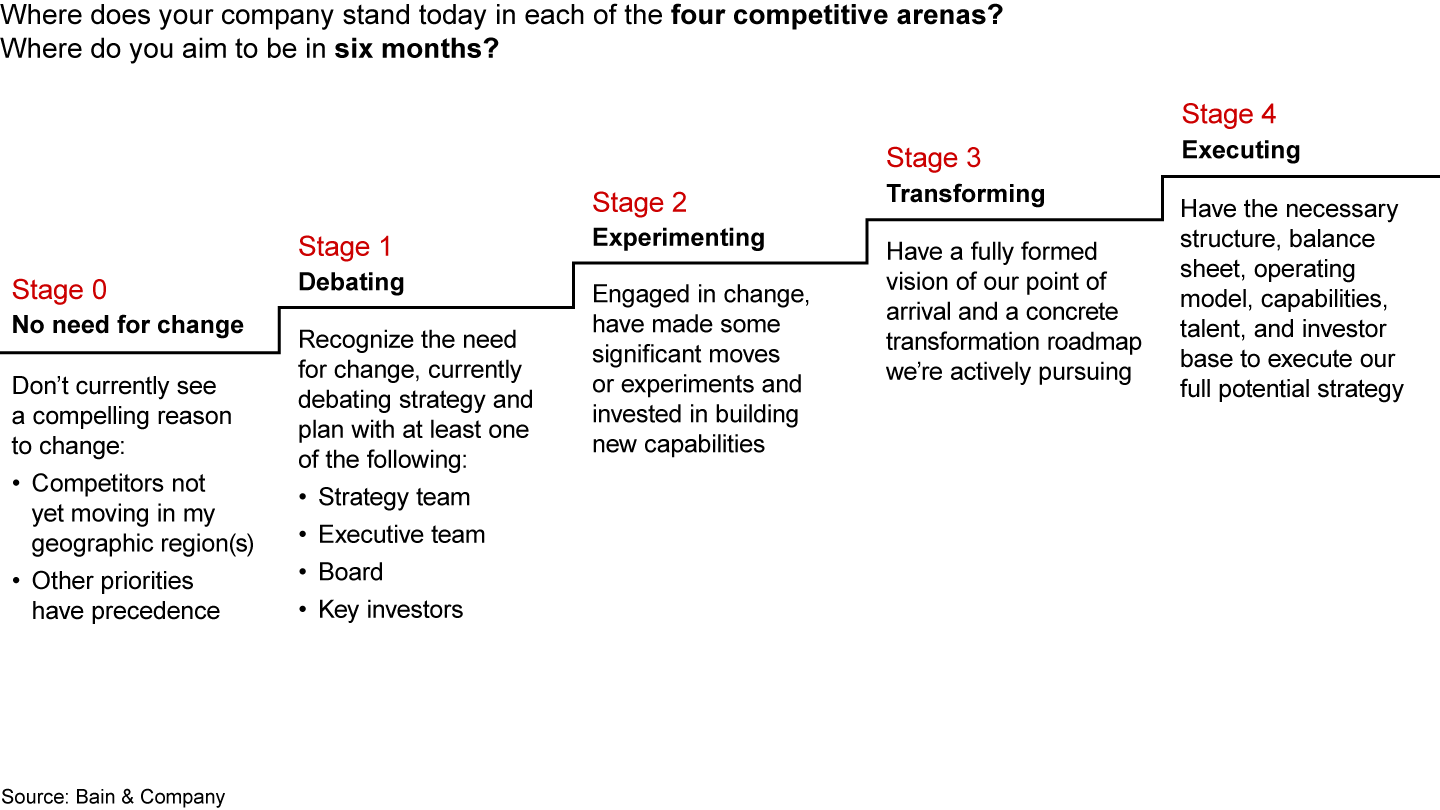

Massive changes are underway that will transform telcos’ competitive reality and the rules by which they generate profits. Leading telcos are quickly stepping up and getting ahead of their peers. Today, no executive can afford a wait-and-see posture.
Published in August 2023