
Skip to Content
  • Offices

    Offices

    North & Latin America
    • Atlanta
    • Austin
    • Bogota
    • Boston
    • Buenos Aires
    • Chicago
    • Dallas
    • Denver
    • Houston
    • Los Angeles
    • Mexico City
    • Minneapolis
    • Monterrey
    • Montreal
    • New York
    • Rio de Janeiro
    • San Francisco
    • Santiago
    • São Paulo
    • Seattle
    • Silicon Valley
    • Toronto
    • Washington, DC
    Europe & Africa
    • Amsterdam
    • Athens
    • Berlin
    • Brussels
    • Copenhagen
    • Dusseldorf
    • Frankfurt
    • Helsinki
    • Istanbul
    • Johannesburg
    • Kyiv
    • Lisbon
    • London
    • Madrid
    • Milan
    • Munich
    • Oslo
    • Paris
    • Rome
    • Stockholm
    • Vienna
    • Warsaw
    • Zurich
    Middle East
    • Doha
    • Dubai
    • Riyadh
    Asia & Australia
    • Bangkok
    • Beijing
    • Bengaluru
    • Brisbane
    • Ho Chi Minh City
    • Hong Kong
    • Jakarta
    • Kuala Lumpur
    • Manila
    • Melbourne
    • Mumbai
    • New Delhi
    • Perth
    • Seoul
    • Shanghai
    • Singapore
    • Sydney
    • Tokyo
    See all offices
  • Alumni
  • Media Center
  • Subscribe
  • Contact
  • Global | English

    Select your region and language

    Global
    • Global (English)
    North & Latin America
    • Brazil (Português)
    • Argentina (Español)
    • Canada (Français)
    • Chile (Español)
    • Colombia (Español)
    Europe, Middle East, & Africa
    • France (Français)
    • DACH Region (Deutsch)
    • Italy (Italiano)
    • Spain (Español)
    • Greece (Elliniká)
    Asia & Australia
    • China (中文版)
    • Korea (한국어)
    • Japan (日本語)
  • Saved items (0)
    Saved items (0)

    You have no saved items.

    Bookmark content that interests you and it will be saved here for you to read or share later.

    Explore Bain Insights
  • Industries
    Main menu

    Industries

    • Aerospace & Defense
    • Agribusiness
    • Chemicals
    • Construction & Infrastructure
    • Consumer Products
    • Financial Services
    • Healthcare & Life Sciences
    • Industrial Machinery & Equipment
    • Media & Entertainment
      Industries
      Media & Entertainment
      • Media Lab
    • Metals
    • Mining
    • Oil & Gas
    • Paper & Packaging
    • Private Equity
      Industries
      Private Equity
      • Due Diligence
      • Exit Planning
      • Firm Strategy & Operations
      • Portfolio Value Creation
    • Social Impact
    • Retail
    • Technology
    • Telecommunications
      Industries
      Telecommunications
      • Capital Expenditure
      • Telco Digital Transformation
    • Transportation
    • Travel & Leisure
    • Utilities & Renewables
  • Consulting Services
    Main menu

    Consulting Services

    • Customer Experience
    • Sustainability
    • Innovation
    • M&A
    • Operations
    • People & Organization
    • Private Equity
    • Sales & Marketing
    • Strategy
    • AI, Insights, and Solutions
    • Technology
    • Transformation
  • Digital
  • Insights
    Main menu

    Insights

    • Industry Insights
    • Services Insights
    • Bain Books
    • Webinars
    • Bain Futures
    View all Insights
    Featured topics
    • Tariff Response
    • Artificial Intelligence
    • Thriving in Uncertainty
    • Executive Conversations
    • Macro Trends
    • M&A Report
    • Healthcare Private Equity Report
    • Paper & Packaging Report
    • Technology Report
    • CEO's Guide to Sustainability
    • CEO Insights
    • CFO Insights
    • COO Insights
    • CIO Insights
    • CMO Insights
    View all featured topics
  • About
    Main menu

    About

    • What We Do
    • What We Believe
    • Our People & Leadership
    • Client Results
    • Awards & Recognition
    • Global Affiliations
    Further: Our global responsibility
    • Sustainability
    • Social Impact
    • World Economic Forum
    Learn more about Further
  • Careers
    Main menu

    Careers

    • Work with Us
      Careers
      Work with Us
      • Find Your Place
      • Our Work Areas
      • Integrated Teams
      • Students
      • Internships & Programs
      • Recruiting Events
    • Life at Bain
      Careers
      Life at Bain
      • Blog: Inside Bain
      • Career Stories
      • Our People
      • Where We Work
      • Supporting Your Growth
      • Affinity Groups
      • Benefits
    • Impact Stories
    • Hiring Process
      Careers
      Hiring Process
      • What to Expect
      • Interviewing
    FIND JOBS
  • Offices
    Main menu

    Offices

    • North & Latin America
      Offices
      North & Latin America
      • Atlanta
      • Austin
      • Bogota
      • Boston
      • Buenos Aires
      • Chicago
      • Dallas
      • Denver
      • Houston
      • Los Angeles
      • Mexico City
      • Minneapolis
      • Monterrey
      • Montreal
      • New York
      • Rio de Janeiro
      • San Francisco
      • Santiago
      • São Paulo
      • Seattle
      • Silicon Valley
      • Toronto
      • Washington, DC
    • Europe & Africa
      Offices
      Europe & Africa
      • Amsterdam
      • Athens
      • Berlin
      • Brussels
      • Copenhagen
      • Dusseldorf
      • Frankfurt
      • Helsinki
      • Istanbul
      • Johannesburg
      • Kyiv
      • Lisbon
      • London
      • Madrid
      • Milan
      • Munich
      • Oslo
      • Paris
      • Rome
      • Stockholm
      • Vienna
      • Warsaw
      • Zurich
    • Middle East
      Offices
      Middle East
      • Doha
      • Dubai
      • Riyadh
    • Asia & Australia
      Offices
      Asia & Australia
      • Bangkok
      • Beijing
      • Bengaluru
      • Brisbane
      • Ho Chi Minh City
      • Hong Kong
      • Jakarta
      • Kuala Lumpur
      • Manila
      • Melbourne
      • Mumbai
      • New Delhi
      • Perth
      • Seoul
      • Shanghai
      • Singapore
      • Sydney
      • Tokyo
    See all offices
  • Alumni
  • Media Center
  • Subscribe
  • Contact
  • Global | English
    Main menu

    Select your region and language

    • Global
      Select your region and language
      Global
      • Global (English)
    • North & Latin America
      Select your region and language
      North & Latin America
      • Brazil (Português)
      • Argentina (Español)
      • Canada (Français)
      • Chile (Español)
      • Colombia (Español)
    • Europe, Middle East, & Africa
      Select your region and language
      Europe, Middle East, & Africa
      • France (Français)
      • DACH Region (Deutsch)
      • Italy (Italiano)
      • Spain (Español)
      • Greece (Elliniká)
    • Asia & Australia
      Select your region and language
      Asia & Australia
      • China (中文版)
      • Korea (한국어)
      • Japan (日本語)
  • Saved items  (0)
    Main menu
    Saved items (0)

    You have no saved items.

    Bookmark content that interests you and it will be saved here for you to read or share later.

    Explore Bain Insights
  • Industries
    • Industries

      • Aerospace & Defense
      • Agribusiness
      • Chemicals
      • Construction & Infrastructure
      • Consumer Products
      • Financial Services
      • Healthcare & Life Sciences
      • Industrial Machinery & Equipment
      • Media & Entertainment
      • Metals
      • Mining
      • Oil & Gas
      • Paper & Packaging
      • Private Equity
      • Social Impact
      • Retail
      • Technology
      • Telecommunications
      • Transportation
      • Travel & Leisure
      • Utilities & Renewables
  • Consulting Services
    • Consulting Services

      • Customer Experience
      • Sustainability
      • Innovation
      • M&A
      • Operations
      • People & Organization
      • Private Equity
      • Sales & Marketing
      • Strategy
      • AI, Insights, and Solutions
      • Technology
      • Transformation
  • Digital
  • Insights
    • Insights

      • Industry Insights
      • Services Insights
      • Bain Books
      • Webinars
      • Bain Futures
      View all Insights
      Featured topics
      • Tariff Response
      • Artificial Intelligence
      • Thriving in Uncertainty
      • Executive Conversations
      • Macro Trends
      • M&A Report
      • Healthcare Private Equity Report
      • Paper & Packaging Report
      • Technology Report
      • CEO's Guide to Sustainability
      • CEO Insights
      • CFO Insights
      • COO Insights
      • CIO Insights
      • CMO Insights
      View all featured topics
  • About
    • About

      • What We Do
      • What We Believe
      • Our People & Leadership
      • Client Results
      • Awards & Recognition
      • Global Affiliations
      Further: Our global responsibility
      • Sustainability
      • Social Impact
      • World Economic Forum
      Learn more about Further
  • Careers
    Popular Searches
    • Agile
    • Digital
    • Strategy
    Your Previous Searches
      Recently Visited Pages

      Content added to saved items

      Saved items (0)

      Removed from saved items

      Saved items (0)

      Brief

      The Benefits of a Competitive Benchmark Net Promoter Score®

      The Benefits of a Competitive Benchmark Net Promoter Score®

      Learn how you are faring against the competition.

      By Rob Markey

      • min read

      Brief

      The Benefits of a Competitive Benchmark Net Promoter Score®
      en

      It’s not unusual for a company to crow about a high Net Promoter ScoreSM. You may have seen a company—maybe a competitor—issue a press release touting a score as high as 75% or more. Often, the company will compare its Net Promoter Score to scores we published in The Ultimate Question 2.0, where we show loyalty-leading companies like Apple or USAA achieving 75% to 85%.

      High Net Promoter Scores are certainly better than low ones. They indicate that a company has earned more promoters than detractors. But how do we interpret the scores these companies are reporting? What is a good score? How should we set goals and targets for improvement?

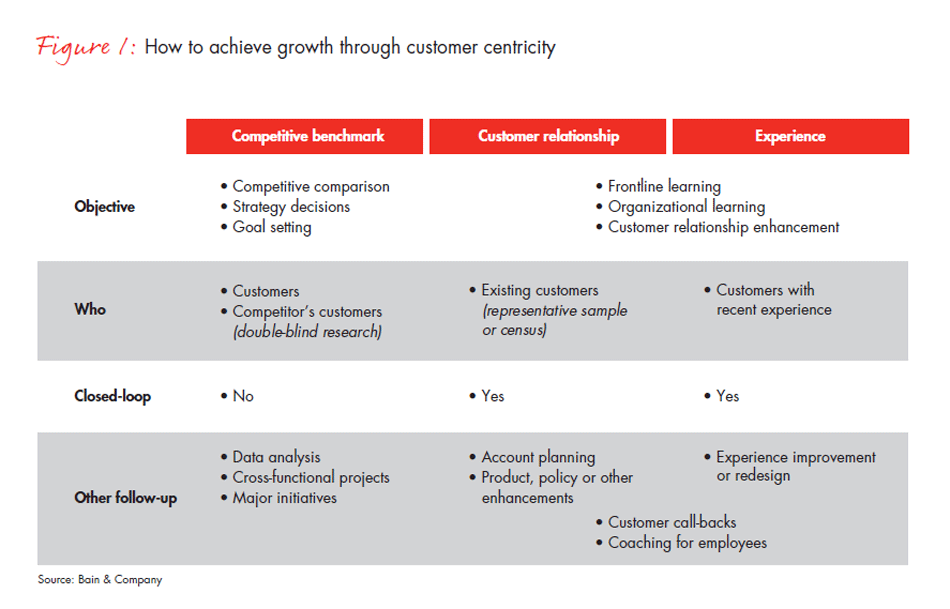
      To begin, we should make sure we look at the right sort of Net Promoter Score—one that allows us to compare apples to apples (pun intended). Seasoned practitioners of the Net Promoter SystemSM gather feedback from their customers in three different ways (see Figure 1):

      the-benefits-of-a-competitive-benchmark-nps-fig-01_embed
      • Experience. Net Promoter System practitioners ask for feedback from their own customers after selected experiences, transactions or episodes. For example, they might do so after the purchase of a product or an interaction over the phone. This type of feedback focuses on understanding how customers’ experiences at those moments influenced their overall loyalty so you can figure out ways to improve those experiences.
      • Relationship. Net Promoter System companies regularly contact a sample of their own customers, asking them how likely they would be to recommend the company to friends or colleagues, and why. Feedback like this provides an overall assessment of the relationship between company and customer. It provides input to account teams, relationship managers and others so they can make decisions and take actions to improve selling, servicing, product design, pricing or other policies, based on what they learn.
      • Competitive benchmark. Finally, leading practitioners of the Net Promoter System sample all target customers for their products or services. They seek feedback not only from their own customers but also from their competitors’ customers. Competitive benchmark Net Promoter Scores provide an objective and fair basis for comparing your company’s feedback to the feedback your competitors earn. Done right, they can provide the basis for goal setting and prioritization at the highest levels of a company.

      That third method, competitive benchmark Net Promoter Score, is often overlooked or undervalued. Yet it adds an important level of information the other two are likely to miss. It allows a company to learn what respondents think about an entire value proposition, not just their relationship with one particular company. Ms. Johnson and Mr. Jones might have been highly satisfied customers of Blockbuster in its heyday. They might even have told researchers that some of Blockbuster’s innovations and improvements increased their satisfaction with the chain. But that wouldn't have stopped them from ditching Blockbuster when Netflix appeared on the scene. If you were running Blockbuster at the time, you would have wanted to learn how many of your target customers’ heads were turning in Netflix’s direction, and why.

      Experience and relationship Net Promoter Scores fuel continuous improvement. Competitive benchmark scores inform a different set of decisions. They tell a company how it is doing, not just against direct competitors but against every competing alternative in the marketplace. That knowledge helps leaders know where the major threats and opportunities lie. It helps them determine strategic priorities, such as where and how aggressively to invest. The feedback can also provide valuable specifics. For example, you may find that competitor X has suddenly become popular with customers because of a new product or pricing system. Then you can ask whether it makes sense to try emulating or leapfrogging the innovation.

      NPS Prism℠

      Our unique customer experience benchmarking service provides actionable insights and analysis that guide your creation of game-changing customer experiences.

      Learn more

      Methodology

      Competitive benchmark surveys are a form of traditional market research. Researchers, usually from a third-party firm, ask respondents which companies in a given category they patronize. They ask how likely the respondents would be to recommend each one, and they probe for the reasons. In most cases, they gather data about the respondents’ purchases so they can estimate their economic value as customers. They also ask demographic or psychographic questions to locate the respondent in a particular customer segment. The methodology is almost always double-blind: the respondents don’t know which company is asking the questions, and the customers remain anonymous to the company. As with most market research, the surveys can take 15 or 20 minutes and are designed to provide true comparisons between a company and its competitors. A higher score than the competition, even if it seems low in absolute terms, is a reliable indicator of future growth. The opposite is true as well.

      Competitive benchmarking eliminates the responder bias that’s likely to crop up when you survey only your own customers. In your own surveys, people who don’t like doing business with you may decide that it isn't worth their time to participate. With a third party doing the asking, you’re equally likely to hear from everyone on the love-you/hate-you spectrum.

      Competitive benchmarking also eliminates the built-in difficulty of comparing absolute Net Promoter Scores from one geographical region with another. Say your operations in Asia score lower on the Net Promoter zero-to-10 scale than your other operations. A third-party survey will help you establish your performance relative to other companies operating in the same market, eliminating the worry about whether Asian customers are less likely to hand out 9s and 10s than customers in other regions. When you look at your performance relative to competitors in the same market, cultural bias becomes irrelevant.

      Rob Markey, global practice leader of Bain's Customer Strategy and Marketing practice, discusses how competitive benchmark Net Promoter Scores provide an objective and fair basis for comparing your company’s feedback to the feedback your competitors earn.

      Key issues in benchmark design

      Any survey, of course, requires a series of decisions about whom to survey, what to ask and how often to conduct it (see the sidebar, “How often should we survey?”). Here are some of the major issues that companies typically confront:

      • Who are our primary competitors? Some executives at a major credit-card issuer claimed that their company competed only against certain types of card issuers—those with a similar business model—and not others. Maybe that was true in their minds, but it was almost certainly not true in the customers’ minds. You’ll want feedback on all the alternatives available to your target customers, not just the ones that make your company look good.
      • What other alternatives should we consider? When Intuit was collecting competitive benchmark data for its TurboTax product, it compared TurboTax not just with other tax software but with every relevant alternative, such as using tax preparation services. If Blockbuster were alive today, it wouldn’t want to compare itself only with other storefront video-rental stores.
      • Should we survey all the customers in the marketplace, or target segments only? And if the latter, do we agree on the definition of our target segments? In banking or investment management, for instance, it may be especially important to seek feedback from wealthy individuals. To get enough of them in the data, you’ll almost certainly need to over-sample for them. In B2B companies, it may take some deliberate effort to determine the individuals from whom you should solicit feedback. Is it just the decision makers? Or should the group also include influencers, recommenders, purchasing agents, finance folks and shop-floor employees?
      • How do we link responses to economic value? Researchers can ask respondents to report their buying and usage behaviors, but that information has to be calibrated against known customer data. Customers often inflate self-reported buying behavior, and the degree to which customers underestimate or overestimate their behavior varies by segment, so comparing what customers say with actual purchasing data provides an important reality check.
      • How deep should we go? Getting actionable insights from competitive benchmark research can be tricky. On the one hand, there’s a limit to how much detail you can glean from customers about their experiences with a company. On the other hand, broad and sweeping statements about why a customer likes or dislikes doing business with a company—“price,” “convenience,” “service” and so on—don’t easily lead to action. So some companies are finding ways to uncover insights about a handful of “moments of truth” that can be compared across competitors to yield more meaningful insights about product design, service delivery, pricing and other issues.

      This is challenging work, because the details matter, and because some less-than-obvious factors can influence the utility of the comparisons. Companies in certain businesses may need to make sampling or other analytic adjustments to get accurate, useful data. Lenders, for instance, almost always find that likelihood to recommend doesn’t line up with the behaviors that create economic value until they adjust for credit risk.

      Resources

      Bain Certified Net Promoter Score Benchmarks

      Learn more about Bain's exclusive NPS benchmark partners, J.D. Power and ROI Rocket, and how they deliver the highest quality benchmarks available across a wide range of industries and categories.

      Some companies forgo Net Promoter–style competitive benchmarking, relying instead on other published indexes from established market research houses. That kind of data can be helpful, especially in situations where it is not practical to collect your own benchmarking data. In a company that has adopted the Net Promoter System, however, these alternative metrics provide less bang for the buck because they don’t link to the cultural, inspirational and intuitive elements of the system. Because Net Promoter competitive benchmarks use a transparent methodology, they produce an easily understood number that ties in with the company’s internal language and closed-loop system. Frontline employees “get” Net Promoter Scores, and, in most cases, they are highly motivated to improve. An opaque customer-satisfaction rating from a third party has nowhere near the same motivational payoff.

      Competitive benchmarking research is easy to put off, particularly if your company is just getting started on the Net Promoter System. But don’t put it off too long. You will gain insights about your customers and your strategic priorities that you can’t learn any other way—and it will reinforce what you are doing internally.

      How often should we survey?

      How often you commission competitive benchmarking research depends a lot on how fast your industry is changing. If you are in the carbon black business and your chief customers are the handful of tire manufacturers around the world, you know that your industry doesn’t vary much from year to year. A competitive benchmark survey every two or three years will be sufficient. If you are in the wireless handset business, it’s the exact opposite: rivals are probably coming out with new models or offers several times a year. To keep up with the constant change, one handset maker conducts a relatively small competitive benchmark survey every month. It then aggregates that data with the previous 11 months’ worth to provide a large enough sample size for detailed analysis.


      Rob Markey is a partner and director in Bain & Company’s New York office and leads the firm’s Global Customer Strategy and Marketing practice. He is coauthor of the bestseller The Ultimate Question 2.0: How Net Promoter Companies Thrive in a Customer-Driven World.

      Net Promoter® and NPS® are registered trademarks of Bain & Company, Inc., Fred Reichheld and Satmetrix Systems, Inc.
      Net Promoter SystemSM and Net Promoter ScoreSM are trademarks of Bain & Company, Inc., Fred Reichheld and Satmetrix Systems, Inc.

      the-benefits-of-a-competitive-benchmark-nps-fig-01_full
      Authors
      • Headshot of Rob Markey
        Rob Markey
        Advisory Partner, Boston
      Contact us
      Related Consulting Services
      • Net Promoter System®
      • Sales and Marketing
      How We Can Help
      • Customer Insights & Segmentation
      • NPS Prism®
      Sales and Marketing
      Loyalty Insights: Assessing Your Net Promoter System®

      Is your company achieving the full benefits of its customer advocacy effort?

      Read More
      Sales and Marketing
      Jason Barro: How to Use a Competitive Benchmark Net Promoter Score®

      To perform a customer experience transformation, it is important to get a clean competitive read on your Net Promoter Score®.

      Read More
      Sales and Marketing
      Your best employees work for love, not money

      Tying customer feedback to incentive pay often encourages the wrong behaviors.

      Read More
      Loyalty
      As Banks’ Retention Efforts Stall, Focus On High-Value Customers

      By using advanced analytics guided by five principles, banks can activate targeted customers to improve their economics and strengthen relationships.

      Read More
      Loyalty
      After Years of Customer Loyalty Programs in Insurance, What Works, and What’s Next?

      Based on Bain’s 10 years of research, five themes describe the progress and challenges of earning customers’ advocacy in an increasingly digital experience.

      Read More
      Published in February 2014
      Tags
      • Customer Insights & Segmentation
      • Loyalty
      • Net Promoter System®
      • NPS Prism®
      • Sales and Marketing

      How We've Helped Clients

      Agile Enterprise A Digital-First Bank Finds a Customer-Driven Path to Profitability

      Read case study

      Customer Experience An Automaker Reinvents Customer Experience with a Focus on Key Episodes

      Read case study

      Sales and Marketing Customer segmentation aligns TelecomCo's growth strategy with consumers' needs

      Read case study

      Ready to talk?

      We work with ambitious leaders who want to define the future, not hide from it. Together, we achieve extraordinary outcomes.

      Stay ahead in a rapidly changing world. Subscribe to Bain Insights, our monthly look at the critical issues facing global businesses.

      *I have read and understand Bain’s Privacy Notice.

      Please read and agree to the Privacy Policy.
      Bain & Company
      Contact us Sustainability Accessibility Terms of use Privacy Modern Slavery Act Statement Cookie Policy Sitemap Log In

      © 1996-2026 Bain & Company, Inc.

      Contact Bain

      How can we help you?

      • Business inquiry
      • Career information
      • Press relations
      • Partnership request
      • Speaker request
      See all offices