

Brief
Arthur Smith* is a customer service rep for a US property and casualty insurer. Based in a large call center near Phoenix, he handles address changes and billing inquiries and answers general questions about coverage. His employer monitors Arthur’s performance. At any point in time, Arthur and his supervisor know the average time he requires to handle calls, how much of his day he is “available” and a couple of other metrics.
A few times a month, Arthur’s supervisor listens to a recent call, then discusses with Arthur how the call went and what he might do better. Arthur also gets feedback from a central quality monitoring team, which is responsible for compliance with policies and regulations. Last month, he learned that he had failed to mention some caveats about the company’s coverage to one customer, thereby exposing the company to risk.
Arthur also gets a monthly report from his company’s “voice of the customer” monitoring system. It includes an overall satisfaction score along with scores on certain “drivers” that compare him with other reps. Arthur’s satisfaction score last month was 8.3, just off the 8.4 goal. The report flagged a couple of areas where he was better and a few where he was worse than the others. Arthur’s scores, like those of other reps, were based on just one or two pieces of feedback for the month.
Jose Segura* has an automobile policy from Arthur’s company. A few weeks ago, Jose called in because he wanted to get the right coverage for his newly licensed teenager. When he called the company’s toll-free number, he was unsurprised to encounter a voice response system, and he selected the option to speak to a representative. While the wait wasn’t long, he was disappointed by the vague responses the rep gave him. After a few minutes, he ended the call rather abruptly.
Days later, Jose received an email asking for feedback. He decided to respond, completing the online survey in about 15 minutes. The last 10 questions, which asked him about his income, ethnicity, gender and so on, seemed typical, but he thought the company should already have all that information from his insurance application. As he closed out the browser window, he realized that the multiple-choice questions hadn’t given him the opportunity to explain the real reasons why he found his recent call unsatisfying.
Frontline employees like Arthur often labor in the dark. They know their work has a direct bearing on how customers feel about their employer. But the only feedback they hear, typically, is the occasional suggestion or pat on the back from a supervisor, often backed by statistics and averages from customer surveys.
So it is for the many other employees who have an impact on customers. Product engineers or pricing analysts may toil deep inside the organization, seemingly far removed from the people the company serves. But the decisions they make—the engineer’s choice of features, the analyst’s pricing model—affect customers’ experiences as much as any direct interaction. Such employees often are even more in the dark than sales or service reps. Their line of sight to what customers think and feel is at best obscure, at worst nonexistent.
What happens when people work like this? They can’t learn how to improve. They can’t undertake the kind of deliberate, repeated practice that leads to true and satisfying mastery. After a while, many lose interest in their job. They may experience a kind of alienation, feeling distant from customers and lacking understanding of customers’ situations. The feedback employees do receive—average satisfaction scores, performance reviews and so on—feels like a grade or an evaluation. They rarely, if ever, see the human outcomes of their actions, the delight or the discontent on the faces of the real people they serve.
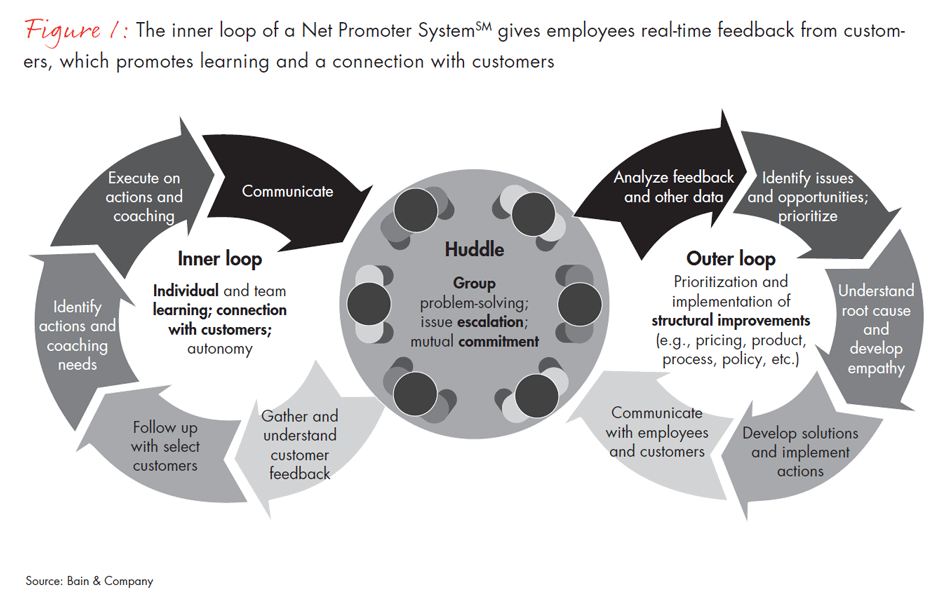
The Net Promoter SystemSM transforms this unhappy dynamic. It creates a mechanism for employees of all kinds to get real-time feedback directly from customers. The feedback is usually positive—most employees do their job pretty well—so people typically become more engaged and enthusiastic. The occasional criticism or complaint about a specific interaction or decision can help individual employees and the organization learn to do their jobs better.
We call this mechanism the inner loop (see Figure 1). The challenge is to set it up in the right way, so that it reinforces learning rather than undermining it.
Designing an effective inner loop
Net Promoter® companies ask their customers for feedback regularly. They may do so after an individual transaction, after a series of interactions or simply once every so often, to assess the quality of their relationship with a customer. They ask not only how likely the customer would be to recommend the company or its products but also that all-important second question: Why? The feedback thus provides both quantitative ratings and qualitative comments.
As the first step in the inner loop, companies channel the feedback to every employee who affected a given customer’s experience. It may go to the call-center rep or warehouse worker who served that customer. It may also go to product designers, pricing analysts and anybody else whose decisions and actions are relevant. This part of the inner loop must be designed right: The feedback has to be both granular and timely, and it has to lead to effective follow-up.
Granularity. Much of the system’s feedback focuses on individual events, such as particular transactions or specific parts of the customer’s experience. The granularity allows employees to learn from what they did, to try something different and to observe the outcome. Much of the learning happens at an individual level, which is why ratings and comments need to flow to individuals wherever possible. True, some situations don’t permit that kind of specificity. A retailer, for instance, might know who was on the floor when a given customer was served but not which sales reps actually interacted with the customer. The feedback should go to the smallest group practical, so that individual employees can discern whether their actions were the focus of the customer’s comments.
In a warehouse, for instance, the feedback an individual employee receives would go well beyond aggregated statistics about her unit’s error rate. It would include direct feedback about her own work or the work of her team, and it would be personal. “I ordered a sweat suit for my son’s birthday, and you sent me a frying pan.” Or: “Your team went the extra mile to get my new shoes to me in time for graduation. Thanks!” If the employee had something to do with either transaction, she might well recognize it. If not, she would at least see the value of helping team members serve customers well.
Timeliness. If a company is asking for feedback about an interaction or transaction, the request has to go out right away, while the experience is still fresh in the customer’s mind. The feedback that comes in must flow to the relevant employees immediately, so that they will remember that customer. Managers should resist the temptation to screen, edit or summarize the feedback. That takes time—and anyway, employees need to see exactly what the customers had to say, uncensored and unabridged.
Immediacy is crucial because it supports the way people learn. Individuals act. They observe the consequences, think about how their actions created those consequences and then try again, repeating the cycle. Delaying feedback by several weeks blocks the opportunity to learn and improve. With immediate feedback, call-center workers can learn why some customers feel upset; they can then try out different approaches for calming them until they find one that feels reliable. A product designer can hear exactly what buyers are saying about his team’s latest model and can begin experimenting with potential improvements.
Timeliness, of course, depends on the nature of the feedback request. A company might ask for “relationship” feedback only once every six months. Even so, a high-velocity process is essential: Once the feedback begins to come in, it must flow quickly to the appropriate employees so that they can take action as soon as possible.
Follow-up. The inner loop is a closed loop. Customers provide feedback. It goes straight to the employees who can learn from it, closing the loop between customer and employee. Then the employee or supervisor takes the next step: closing the loop between company and customer by calling the customer back. The art of the follow-up deserves an article of its own (and we will write one soon). But it’s worth spelling out which customers must be called back:
- Any customer who signals that he or she has an unresolved issue;
- Anyone who takes the time to provide meaningful, constructive feedback—ideas, suggestions, questions;
- Anyone who is clearly so angry that the company needs to defuse the anger and repair the relationship.
The follow-up call always begins with some nonjudgmental probing about the customer’s experience with the company. It typically includes a thank-you and a commitment to fix the customer’s problem wherever possible. But it isn’t a scripted call; it’s an informal human interaction, which is why it can’t be delegated to a third party or some central corporate group. Customers must come away feeling better about the company than they did before, and the company must learn more about customers’ needs, desires and experiences. Note, however, that the call rarely includes a commitment to resolve a systemic issue or policy. Since the follow-up happens quickly, the caller is unlikely to know all the costs and other considerations involved in making such a change (see below, “Inner-loop design: Five misconceptions”).
Coaching
Employees who hear feedback may want to improve but may not know how to. They may find the customer feedback frustrating or even unfair. That’s where coaching comes in. Supervisors or knowledgeable peers review the feedback a team member receives. They serve as a sounding board for the employee’s interpretation of the feedback and ideas about what to do differently. They broaden the list of alternatives under consideration and describe practices that have worked for others in similar situations. Employees can then try out new behaviors or new ways of doing things and report the results back to their coaches and fellow team members. Again, that’s how people learn.
One of a coach’s tasks is to help employees respond appropriately, separating the vast majority of customers who offer constructive feedback from the small minority who should really be encouraged to take their business elsewhere. The objective of the Net Promoter System’s inner loop isn’t to satisfy the customer at all costs; the objective is to create profitable promoters.
If you’re a shopkeeper, you can see the expressions on the faces of your customers. You can read their body language, hear their feedback and figure out whether they’re delighted or discontented. Large-scale businesses don’t permit that kind of direct contact for most employees. But the Net Promoter System gives employees the next best thing: verbal or written feedback in the customer’s own words about recent interactions, all of it clarified and reinforced by a follow-up call. Suddenly customers are no longer nameless, faceless individuals— they are real people.
That’s why the inner loop is such an essential part of the system. It creates relationships, boosting engagement and morale. It reminds everybody why the company exists in the first place. It illuminates the darkness that people like Arthur labor in, thereby laying the groundwork for learning and improvement.
Rob Markey, a global leader in the Customer Strategy & Marketing practice, discusses how the system's "inner loop" offers powerful motivation for employees.
Inner-loop design: Five misconceptions
It’s easy to lose your way when you’re designing an inner loop. Here are five misconceptions that often lead companies astray:
- We need to protect our employees from angry customers. Some companies edit the feedback to tone down angry or cruel responses. It’s a mistake. Employees are grown-ups. They know when the people they serve are upset, and they need to learn exactly why.
- Customers won’t give honest feedback unless they can be anonymous. That’s just not the case. Many Net Promoter companies hear blunt responses from people who don’t mind being named.
- We need to aggregate the feedback to ensure statistical validity. Companies sometimes provide employees with average scores or percentages, often rank ordering them in the process. But averages hide the detail that is most instructive. The primary goal of the inner loop is not to rank employees. It’s to help people learn and improve.
- You should follow up only with customers who are angry. Definitely not so. Plenty of happy customers will still have unresolved issues. And some of the most constructive suggestions come from promoters.
- Employees won’t focus on learning and improvement unless it affects their compensation. Motivation experts, such as Daniel H. Pink, have shown that external rewards are often counterproductive. Most employees want to do a great job for customers, just for the intrinsic satisfaction of helping people and doing good work.
Rob Markey is a partner and director with Bain & Company’s New York office and leads the firm’s Global Customer Strategy & Marketing practice. He is coauthor of the best seller The Ultimate Question 2.0: How Net Promoter Companies Thrive in a Customer-Driven World.
* Not their real names
Net Promoter® and NPS® are registered trademarks of Bain & Company, Inc., Fred Reichheld and Satmetrix Systems, Inc. Net Promoter SystemSM and Net Promoter ScoreSM are trademarks of Bain & Company, Inc., Fred Reichheld and Satmetrix Systems, Inc.
Published in April 2015