

Brief

At a Glance
- Canada has a deep bench of AI and scientific talent but only claims a fraction of its potential AI venture creation and innovation value.
- Canada is well positioned to unlock generational value from its scientific edge by empowering venture scientists—technology leaders who translate research breakthroughs into venture-scale companies.
- Scalable, pan-Canadian innovation pathways designed to systematically turn frontier AI research and expertise into companies could increase VC investment fivefold, accelerating both venture creation and long-term value building.
- Canada can achieve lasting AI potential by engaging its research, investment, policy, and industry ecosystem around a focused strategy that aligns capital, talent, and execution.
AI-driven change is accelerating at a pace without historical precedent, reshaping both the global economy and society. For its part, Canada faces a decisive window of opportunity to become a destination where the world’s best minds choose not only to research AI but to build the next generation of AI-native companies.
Written in collaboration with
Written in collaboration with

Canada’s untapped potential—and its paradox
Canada boasts a sizeable concentration of AI researchers and scientific talent but has yet to translate that advantage into enduring economic value.
Canada is widely credited with pioneering key breakthroughs in AI—a view echoed by Nvidia’s CEO, Jensen Huang, who has called the country the birthplace of modern AI. The country also claims 10% of the world’s top AI researchers (vs. 0.5% of the global population). It is home to multiple A.M. Turing Award-winning pioneers—including Yoshua Bengio, Geoffrey Hinton, and Richard Sutton—and benefits from a dense scientific landscape, with a number of leading universities (McGill University, Université de Montréal, the University of Toronto, the University of Waterloo, the University of Alberta) and national AI research centers (CIFAR, Amii, the Vector Institute). Mila alone has 1,400 advanced AI researchers and professors.
Yet Canada captures only a fraction of the value created by its breakthroughs. In 2024, Canada deployed $2 billion in venture capital (VC) toward AI start-ups, accounting for less than 2% of global AI VC investment—a stark contrast to its share of global AI talent. Canada also relies heavily on foreign participation, accelerating further outflow of talent and value. In 2024, two-thirds of high-potential Canadian-led start-ups (those that have raised more than $1 million) were headquartered outside Canada. Additionally, nearly 40% of Canadian VC investment comes from the US, and two-thirds of Canadian start-ups are backed by American venture capital.
A window of opportunity to realize this potential
Canada’s higher education ecosystem is increasingly well positioned to supply the high-tier talent needed for AI’s fast-emerging models by building the right on-ramps and bridges from research to venture creation. Global talent dynamics, such as US visa constraints, further strengthen this opportunity. In 2023, Canada’s special open-work-permit program for American H-1B workers reached capacity within two days of its introduction.
These academic talents are being drawn in greater numbers to entrepreneurial opportunities. In a recent survey of the Mila community, nearly 95% of respondents expressed interest in entrepreneurship.
They benefit from Canada’s growing national commitment to reinforcing its scientific position—recent initiatives include $2 billion dedicated to AI compute infrastructure in 2024 and the appointment of a new Minister of AI and Digital Innovation.
This momentum is further reinforced by the current depth of capital available to support venture formation. Canada’s venture ecosystem currently holds an estimated $11.5 billion in dry powder. While still subscale, the share of capital directed toward AI opportunities is growing rapidly. In 2024, AI represented 30% of Canadian VC investment—nearly double its 2022 share of 16%.
Despite these improving conditions, Canada’s output of AI start-ups remains below its potential. The limiting factor is not the availability of individual building blocks, but the absence of coordinated mechanisms that can rapidly align capital, talent, and execution when founders are ready to build and scale.
Bridging this gap requires individuals who can operate fluently across research, venture formation, and early execution—capabilities that are increasingly embodied in the role of the venture scientist.
The age of the venture scientist
Venture scientists are researchers equipped to translate frontier ideas into companies, thus initiating reinforcing cycles of talent attraction, capital development, and impact acceleration. They sit at the intersection of frontier research and company building, combining deep technical expertise with a drive for real-world impact and entrepreneurial and go-to-market talent. In short, they bridge the lab, the start-up, and the corporation.
Venture scientists have already shaped and influenced several of the world’s largest companies, including OpenAI and Moderna. It is becoming increasingly clear that tomorrow’s unicorns and decacorns will require a venture scientist as a core founding member.
When research is translated into ventures that generate capital, data, compute access, and real-world feedback, it feeds the next wave of discovery. Venture scientists are central to this flywheel, creating self-reinforcing cycles that accelerate innovation and anchor talent domestically (see Figure 1).
Figure 1
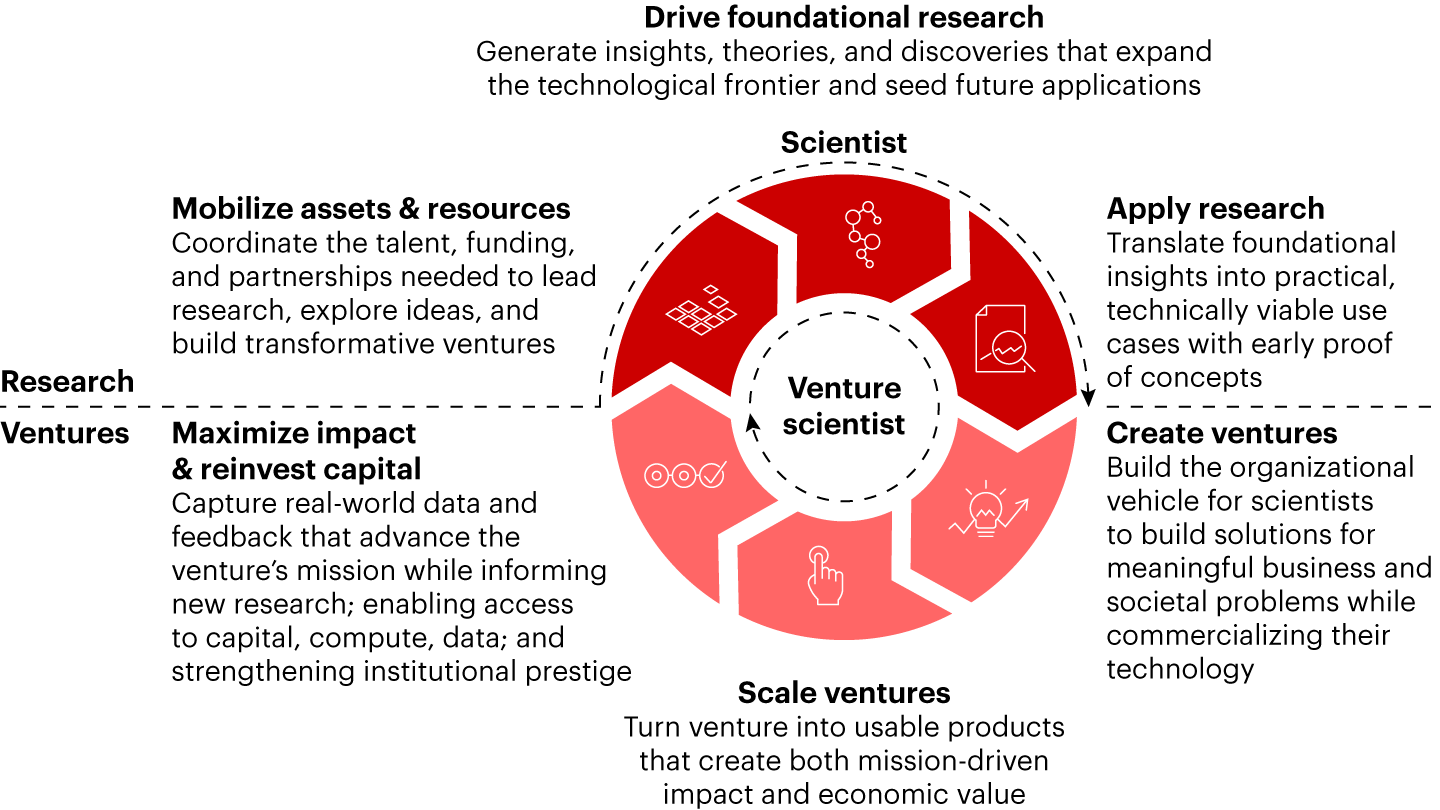

In many fields, and especially in the AI sciences, research excellence and venture creation do not compete for time or talent; instead, they reinforce one another. Leading ecosystems embraced this model well before the current AI moment. As examples, consider academic institutions such as Stanford (StartX) and MIT (The Engine); frontier labs like DeepMind, OpenAI, and Thinking Machines Lab; and venture platforms such as Y Combinator, Waterloo’s Velocity, and Mila’s recently launched AI Ventures.
The flywheel is even more critical for Canada. Without a dense base of domestic hyperscale technology corporations capable of absorbing and commercializing frontier research at scale, Canada’s start-ups are the primary vehicle for innovation-driven value creation. Canada needs its start-ups to build a sustainable, diversified, and competitive economy.
Canadian corporations have a role to play
Large Canadian corporations can take advantage of and accelerate the flywheel.
To increase competitiveness, they must play a role in fostering AI venture activity. Rather than relying solely on inward-looking AI pilots and initiatives, leading companies can differentiate themselves by cocreating start-ups with researchers and academic institutions, acting as early customers, partners, and investors.
AI is not simply another wave of digital transformation. A fundamental shift is underway, altering how work is designed, decisions are made, and value is created—in some cases requiring a larger corporate rewrite. New AI-first models will increasingly emerge outside the core organization, where they can be built from the ground up, tested at speed, and then selectively reintegrated.
Such models range from typical corporate venture capital structures to newer forms of structured cocreation, such as venture studios and shared innovation platforms. These models—seen in initiatives like the AI Fund in the US, Founders Factory in the UK, and Highline Beta and Koru Labs in Canada—allow corporations to actively cobuild AI-native companies, shape use cases, and develop strategic AI-first solutions that would be difficult to incubate internally.
A bold, all-hands-on-deck moment
Activating the venture scientist flywheel can deliver substantial economic and societal impact. By offering compelling domestic venture-building pathways, Canada could halve founder outflows, effectively doubling the share of entrepreneurs who build locally from one third to two thirds, returning to 2015–19 levels.
Aligning venture creation with Canada’s 10% share of global AI talent would require more than incremental change. It would require a fivefold increase in AI VC investment, from about $2 billion to about $10 billion annually (2%–10% of global AI VC investment).
To meet this ambition, Canada’s venture scientists need an empowering and supportive ecosystem that goes beyond research alone. Building it would require:
- Establishing programs within academic institutions to develop venture-building skills and tool kits
- Pairing scientists with experienced entrepreneurs and VC
- Facilitating corporate partnerships as real-world testing grounds and early customers of frontier AI start-ups
- Providing deep tech and AI start-ups with easier and deeper access to capital at the earliest stages
Mila’s recent community survey identified funding as a primary barrier to venture creation. In response, Mila AI Ventures is evaluating dedicated funding mechanisms to support AI ventures emerging from its ecosystem and how privileged deal flow and the researcher community could provide differentiated support.
Realizing this shift requires not only conviction, decisive action, and meaningful change management, but also scale. In the US, AI hyperscalers are expected to invest over $500 billion in 2026. The US Genesis Mission aims to maximize impact by coordinating AI discovery across 24 organizations, 17 innovation labs, and 40,000 engineers and scientists.
Canada currently operates at a different scale—but a compelling pan-Canadian platform opportunity exists. While academic institutions, organizations, and scientists are already taking meaningful steps across the country, the efforts remain largely fragmented. The building blocks are present. The challenge now is to align and mobilize them.
A call to action for Canadian stakeholders
Canada must align around a focused, breakaway venture scientist strategy before this opportunity escapes. Every sector can play a role in cultivating and expanding Canada’s AI environment:
- AI and science, technology, engineering, and mathematics (STEM) researchers: Expand your horizons and look for big problems to solve. Consider becoming venture scientists.
- VC investors: Back frontier innovation with conviction.
- Private equity and pension funds: Rapidly allocate a material portion of your portfolio to support early-stage funds in deep tech and AI.
- Policymakers: Accelerate compute infrastructure development and ease pathways for global talent to study, build, and stay in Canada. Support venture scientist development across the country.
- Corporations: Engage as long-term innovation partners, customers, and investors.
- Academic institutions: Empower venture scientists and collaborate at scale to amplify collective impact.
Canada does not need further proof of its unique foundational assets. It needs conviction and execution to translate cutting-edge research into companies, capital, and sustained national advantage. Now is the time to mobilize around venture scientists to strengthen Canada’s economy, sovereignty, and long-term prosperity.

Published in January 2026