
Skip to Content
  • Offices

    Offices

    North & Latin America
    • Atlanta
    • Austin
    • Bogota
    • Boston
    • Buenos Aires
    • Chicago
    • Dallas
    • Denver
    • Houston
    • Los Angeles
    • Mexico City
    • Minneapolis
    • Monterrey
    • Montreal
    • New York
    • Rio de Janeiro
    • San Francisco
    • Santiago
    • São Paulo
    • Seattle
    • Silicon Valley
    • Toronto
    • Washington, DC
    Europe & Africa
    • Amsterdam
    • Athens
    • Berlin
    • Brussels
    • Copenhagen
    • Dusseldorf
    • Frankfurt
    • Helsinki
    • Istanbul
    • Johannesburg
    • Kyiv
    • Lisbon
    • London
    • Madrid
    • Milan
    • Munich
    • Oslo
    • Paris
    • Rome
    • Stockholm
    • Vienna
    • Warsaw
    • Zurich
    Middle East
    • Doha
    • Dubai
    • Riyadh
    Asia & Australia
    • Bangkok
    • Beijing
    • Bengaluru
    • Brisbane
    • Ho Chi Minh City
    • Hong Kong
    • Jakarta
    • Kuala Lumpur
    • Manila
    • Melbourne
    • Mumbai
    • New Delhi
    • Perth
    • Seoul
    • Shanghai
    • Singapore
    • Sydney
    • Tokyo
    See all offices
  • Alumni
  • Media Center
  • Subscribe
  • Contact
  • Global | English

    Select your region and language

    Global
    • Global (English)
    North & Latin America
    • Brazil (Português)
    • Argentina (Español)
    • Canada (Français)
    • Chile (Español)
    • Colombia (Español)
    Europe, Middle East, & Africa
    • France (Français)
    • DACH Region (Deutsch)
    • Italy (Italiano)
    • Spain (Español)
    • Greece (Elliniká)
    Asia & Australia
    • China (中文版)
    • Korea (한국어)
    • Japan (日本語)
  • Saved items (0)
    Saved items (0)

    You have no saved items.

    Bookmark content that interests you and it will be saved here for you to read or share later.

    Explore Bain Insights
  • Industries
    Main menu

    Industries

    • Aerospace & Defense
    • Agribusiness
    • Chemicals
    • Construction & Infrastructure
    • Consumer Products
    • Financial Services
    • Healthcare & Life Sciences
    • Industrial Machinery & Equipment
    • Media & Entertainment
      Industries
      Media & Entertainment
      • Media Lab
    • Metals
    • Mining
    • Oil & Gas
    • Paper & Packaging
    • Private Equity
      Industries
      Private Equity
      • Due Diligence
      • Exit Planning
      • Firm Strategy & Operations
      • Portfolio Value Creation
    • Social Impact
    • Retail
    • Technology
    • Telecommunications
      Industries
      Telecommunications
      • Capital Expenditure
      • Telco Digital Transformation
    • Transportation
    • Travel & Leisure
    • Utilities & Renewables
  • Consulting Services
    Main menu

    Consulting Services

    • Customer Experience
    • Sustainability
    • Innovation
    • M&A
    • Operations
    • People & Organization
    • Private Equity
    • Sales & Marketing
    • Strategy
    • AI, Insights, and Solutions
    • Technology
    • Transformation
  • Digital
  • Insights
    Main menu

    Insights

    • Industry Insights
    • Services Insights
    • Bain Books
    • Webinars
    • Bain Futures
    View all Insights
    Featured topics
    • Tariff Response
    • Artificial Intelligence
    • Thriving in Uncertainty
    • Executive Conversations
    • Macro Trends
    • M&A Report
    • Healthcare Private Equity Report
    • Paper & Packaging Report
    • Technology Report
    • CEO's Guide to Sustainability
    • CEO Insights
    • CFO Insights
    • COO Insights
    • CIO Insights
    • CMO Insights
    View all featured topics
  • About
    Main menu

    About

    • What We Do
    • What We Believe
    • Our People & Leadership
    • Client Results
    • Awards & Recognition
    • Global Affiliations
    Further: Our global responsibility
    • Sustainability
    • Social Impact
    • World Economic Forum
    Learn more about Further
  • Careers
    Main menu

    Careers

    • Work with Us
      Careers
      Work with Us
      • Find Your Place
      • Our Work Areas
      • Integrated Teams
      • Students
      • Internships & Programs
      • Recruiting Events
    • Life at Bain
      Careers
      Life at Bain
      • Blog: Inside Bain
      • Career Stories
      • Our People
      • Where We Work
      • Supporting Your Growth
      • Affinity Groups
      • Benefits
    • Impact Stories
    • Hiring Process
      Careers
      Hiring Process
      • What to Expect
      • Interviewing
    FIND JOBS
  • Offices
    Main menu

    Offices

    • North & Latin America
      Offices
      North & Latin America
      • Atlanta
      • Austin
      • Bogota
      • Boston
      • Buenos Aires
      • Chicago
      • Dallas
      • Denver
      • Houston
      • Los Angeles
      • Mexico City
      • Minneapolis
      • Monterrey
      • Montreal
      • New York
      • Rio de Janeiro
      • San Francisco
      • Santiago
      • São Paulo
      • Seattle
      • Silicon Valley
      • Toronto
      • Washington, DC
    • Europe & Africa
      Offices
      Europe & Africa
      • Amsterdam
      • Athens
      • Berlin
      • Brussels
      • Copenhagen
      • Dusseldorf
      • Frankfurt
      • Helsinki
      • Istanbul
      • Johannesburg
      • Kyiv
      • Lisbon
      • London
      • Madrid
      • Milan
      • Munich
      • Oslo
      • Paris
      • Rome
      • Stockholm
      • Vienna
      • Warsaw
      • Zurich
    • Middle East
      Offices
      Middle East
      • Doha
      • Dubai
      • Riyadh
    • Asia & Australia
      Offices
      Asia & Australia
      • Bangkok
      • Beijing
      • Bengaluru
      • Brisbane
      • Ho Chi Minh City
      • Hong Kong
      • Jakarta
      • Kuala Lumpur
      • Manila
      • Melbourne
      • Mumbai
      • New Delhi
      • Perth
      • Seoul
      • Shanghai
      • Singapore
      • Sydney
      • Tokyo
    See all offices
  • Alumni
  • Media Center
  • Subscribe
  • Contact
  • Global | English
    Main menu

    Select your region and language

    • Global
      Select your region and language
      Global
      • Global (English)
    • North & Latin America
      Select your region and language
      North & Latin America
      • Brazil (Português)
      • Argentina (Español)
      • Canada (Français)
      • Chile (Español)
      • Colombia (Español)
    • Europe, Middle East, & Africa
      Select your region and language
      Europe, Middle East, & Africa
      • France (Français)
      • DACH Region (Deutsch)
      • Italy (Italiano)
      • Spain (Español)
      • Greece (Elliniká)
    • Asia & Australia
      Select your region and language
      Asia & Australia
      • China (中文版)
      • Korea (한국어)
      • Japan (日本語)
  • Saved items  (0)
    Main menu
    Saved items (0)

    You have no saved items.

    Bookmark content that interests you and it will be saved here for you to read or share later.

    Explore Bain Insights
  • Industries
    • Industries

      • Aerospace & Defense
      • Agribusiness
      • Chemicals
      • Construction & Infrastructure
      • Consumer Products
      • Financial Services
      • Healthcare & Life Sciences
      • Industrial Machinery & Equipment
      • Media & Entertainment
      • Metals
      • Mining
      • Oil & Gas
      • Paper & Packaging
      • Private Equity
      • Social Impact
      • Retail
      • Technology
      • Telecommunications
      • Transportation
      • Travel & Leisure
      • Utilities & Renewables
  • Consulting Services
    • Consulting Services

      • Customer Experience
      • Sustainability
      • Innovation
      • M&A
      • Operations
      • People & Organization
      • Private Equity
      • Sales & Marketing
      • Strategy
      • AI, Insights, and Solutions
      • Technology
      • Transformation
  • Digital
  • Insights
    • Insights

      • Industry Insights
      • Services Insights
      • Bain Books
      • Webinars
      • Bain Futures
      View all Insights
      Featured topics
      • Tariff Response
      • Artificial Intelligence
      • Thriving in Uncertainty
      • Executive Conversations
      • Macro Trends
      • M&A Report
      • Healthcare Private Equity Report
      • Paper & Packaging Report
      • Technology Report
      • CEO's Guide to Sustainability
      • CEO Insights
      • CFO Insights
      • COO Insights
      • CIO Insights
      • CMO Insights
      View all featured topics
  • About
    • About

      • What We Do
      • What We Believe
      • Our People & Leadership
      • Client Results
      • Awards & Recognition
      • Global Affiliations
      Further: Our global responsibility
      • Sustainability
      • Social Impact
      • World Economic Forum
      Learn more about Further
  • Careers
    Popular Searches
    • Agile
    • Digital
    • Strategy
    Your Previous Searches
      Recently Visited Pages

      Content added to saved items

      Saved items (0)

      Removed from saved items

      Saved items (0)

      Report

      The US and China Are Decoupling, and Other Countries Are Following

      The US and China Are Decoupling, and Other Countries Are Following

      Governments are doubling down on breaking up.

      By Anne Hoecker, Karen Harris, and Jue Wang

      • min read
      }

      Report

      The US and China Are Decoupling, and Other Countries Are Following
      en

      This article is part of Bain's 2021 Technology Report.

      Explore the report

      Several major countries are investing more than ever in technology and supply chain independence. And yet the global technology industry will continue to be codependent for the foreseeable future, as many barriers to self-reliance will take years to break down. These two opposing dynamics have forced technology executives into a high-wire balancing act: How can they step toward the decoupled era while simultaneously keeping the other foot stable in today’s codependent reality? And how long will they be required to maintain this balancing act?

      Decoupling will define the future

      The US and China pushed the world in this direction, and the decoupling of their economies and technology ecosystems has been gaining momentum for several years. Consider this: Technology-related foreign direct investment between the two countries dropped by 96% from 2016 to 2020 (see Figure 1).

      Figure 1
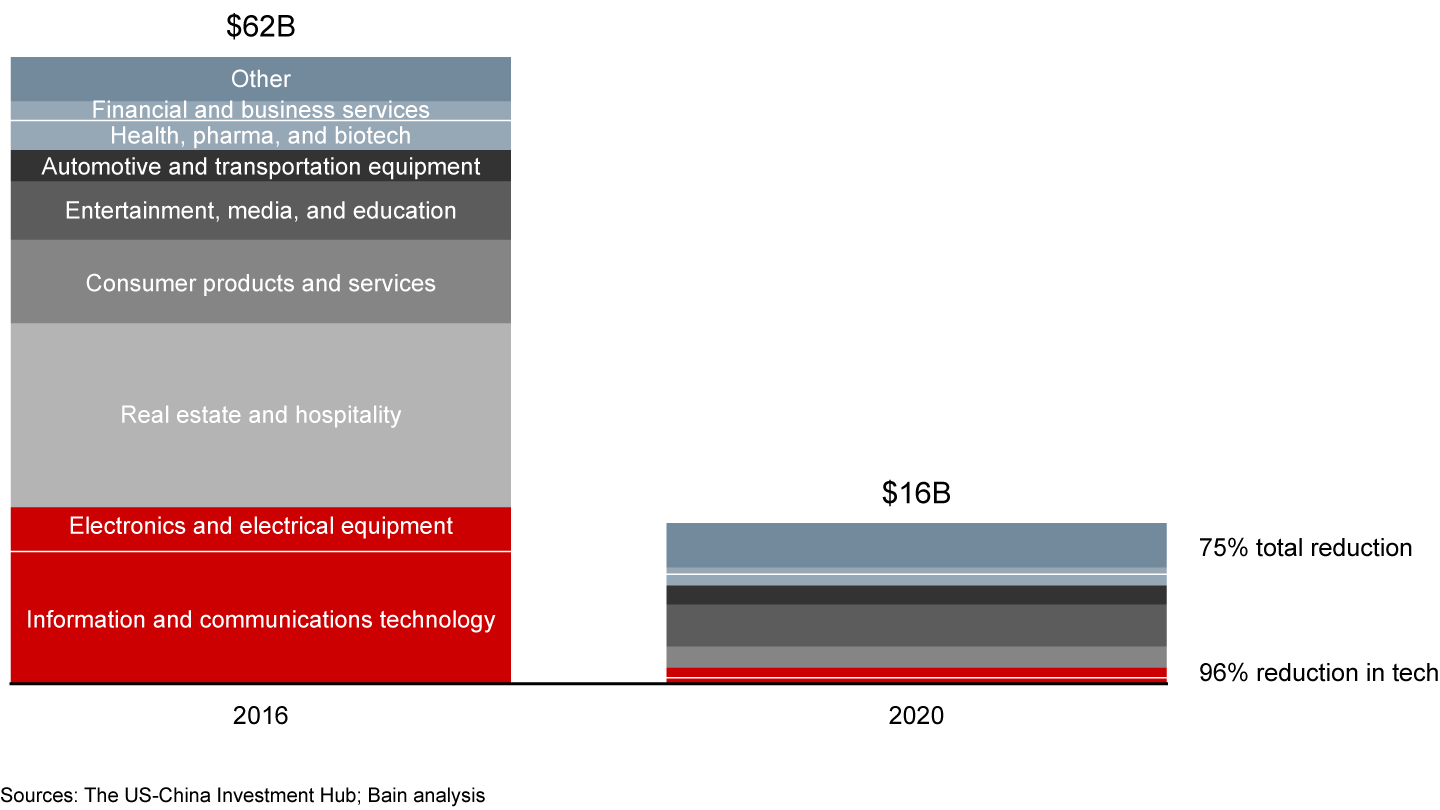
      Foreign direct investment between the US and China has declined significantly, especially in technology

      Now, the US and China are upping their bids for technology and supply chain independence with massive domestic investments. In June, the US Senate approved the $250 billion US Innovation and Competition Act, which would provide $52 billion for domestic semiconductor research and manufacturing, a 30% funding boost for the National Science Foundation, and $29 billion to fund a new applied sciences directorate. Meanwhile, China’s annual spending on R&D climbed to more than $350 billion in 2020, and the country is spending $1.4 trillion over the next few years in infrastructure technologies such as artificial intelligence (AI), semiconductors, and 5G networks. The two nations’ recent moves signal that decoupling will be a defining feature of the technology landscape for years to come, even with one of its most prominent contributors—former US President Donald Trump—no longer in office.  

      Although the US and China put the world on the decoupling path, other leading countries and regions aren’t trying to reverse course; they’re embracing it. South Korea announced a $450 billion investment in May to establish itself as the world's largest chip-manufacturing base by 2030. The European Union in March pledged a $150 billion investment in “digital sovereignty,” with the goal of doubling its share of global semiconductor production to 20% by 2030.

      The unprecedented scale and pace of investments in decoupling around the world has technology companies scrambling to update their short- and long-term strategies. But although decoupling appears all but inevitable, multiple chokepoints assure the global technology industry will remain codependent—for now.

      Despite significant investments, mainland China has been unable to ramp up domestic semiconductor manufacturing because it lacks key process technology and critical equipment.

      Over the past year, as tightening US export controls highlighted these vulnerabilities, China showed signs of shifting to a more friendly approach to multinational corporations. That has led to a surprising development: Many multinational technology companies have found doing business in China is arguably getting easier, at least for the time being. Additionally, China is trying to alleviate chokepoints from multiple angles, from investing in open-source, homegrown alternatives across the technology stack (e.g., RISC-V chip design architecture), to setting a national agenda for next-generation AI standards.

      On the other hand, the US relies mostly on Asia for access to leading-edge semiconductor foundries, original equipment and design manufacturers, and component makers. Recent supply chain disruptions, such as the global chip shortage, have only exacerbated these challenges and compounded the desire for self-reliance.

      While China’s hard-tech chokepoint could require decades to overcome, the US’s semiconductor capacity chokepoint could be alleviated in the next decade. But it would take significant investments to construct factories and develop talent. Investments announced by leading chip makers and the US government could help address the problem.

      Uncertainties remain

      As both the US and China try to secure their domestic technology bases and supply chains, several key uncertainties are clouding the picture for technology executives.

      US. America is trying to urge a coalition to present a united front against China. If successful, this could make it easier to limit or block the sale of critical technologies to China. 

      Europe. Its willingness to join such a coalition isn’t yet clear. Will it use its scale to attempt self-reliance, join a US-led alliance against China, or get picked apart by the US and China?

      Taiwan. The future direction of Taiwan and its relationship with mainland China has entered the spotlight for technology companies around the world. Can Taiwan walk the tightrope to remain the top global supplier of semiconductors? 

      China. Technology executives are closely watching China’s next steps toward supply chain security. Its effectiveness could hinge on whether its next-generation technology standards and open-source technologies gain traction in the rest of the world.

      Worldwide. An important unanswered question surrounding countries’ growing domestic technology investments is the level of subsidies for companies headquartered in other countries, particularly those from nations that may be less strategically aligned with the subsidizing country.

      How to adapt

      The ongoing uncertainty makes it challenging for tech companies to adjust their strategy and feel confident in their choices. Here are several no-regrets moves that executives can make to adapt to the changing environment.

      Play the long game. Recognizing that decoupling will take years to play out, technology executives are starting to run scenario-planning exercises projecting the next decade or more. They’re preparing for a range of outcomes, hedging their downside risk and exploiting potential upside.

      Strengthen government relations. As governments pour vast sums of money into their technology ecosystems, doing business as an international technology company requires an effective public partnership strategy and strong government affairs and global trade teams. Tech executives will find themselves spending more time in Washington, DC; Beijing; and capitals around the world.

      Make difficult market choices. Technology executives recognize they need to constantly evolve their thinking on which markets to invest in, given the fragile state of geopolitical and technology ecosystem relationships. Two years ago, many US tech executives were looking at bold moves to maintain access to the Chinese market. Now, the situation on the ground appears to be changing. Ultimately, the answer boils down to where the company can differentiate itself and make itself indispensable for as long as possible.

      Support operational linchpins. Technology executives are quickly evolving their long-term supply chain strategy. The key is to evaluate risks to the linchpins across their supply chain and make investments to diversify and get ahead of potential bottlenecks and disruptions.

      Plan for talent shortages. These will become more frequent as competing nations try to replicate capabilities and ramp up domestic technology sectors. Companies will need to build new muscles. An important one is the ability to hire from other countries within a network of allied nations. For example, US companies are shifting talent hubs from China to more neutral countries. Companies such as Taiwan Semiconductor Manufacturing Co. are also investing in training programs at their headquarters for new hires based at overseas facilities.

      The bottom line is that flourishing in this policy-led era of the technology industry will require executives to be comfortable with constant adaptation. The nimblest ones will step confidently onto stable ground in the decoupled future.

      Read the Next Chapter

      The Tech Talent War Expands

      More from the report

      • Welcome to the New Tech Economy

      • Tech-tonic Equity Shifts

      • The Case for Big Tech M&A

      • Tech Venture Capital Surges

      • SaaS Spurs Software Superperformance

      • Bringing Order to the Hybrid Cloud

      • Winning Europe’s Cloud Market

      • Shifting Semiconductor Equilibrium

      • Leading AI’s Next Era

      • US, China, and the Decoupling Push

      • The Tech Talent War Expands

      • Scaling DevOps

      • The Go-to-Market Orchestra

      • Chip Shortage Lessons

      Read our 2021 Technology Report

      Download the PDF Explore the report
      Authors
      • Headshot of Anne Hoecker
        Anne Hoecker
        Partner, Silicon Valley
      • Headshot of Karen Harris
        Karen Harris
        Managing Director, Macro Trends Group, New York
      • Headshot of Jue Wang
        Jue Wang
        Partner, Silicon Valley
      Contact us
      Related Industries
      • Semiconductors
      • Technology
      Related Consulting Services
      • Leadership & Talent
      • Supply Chain
      Technology
      Prepare for the Coming AI Chip Shortage

      While businesses couldn’t predict the pandemic, they can guard against the next big threat to semiconductor supply chains.

      Read More
      Technology
      Humanoid Robots: How Early Commercial Exploration Can Lead to Large-Scale Use

      Although early uses exist, core technologies are years away from offering human-level capability.

      Read More
      Supply Chain
      How AI Is Starting to Transform Circular Packaging

      There are 15 AI use cases companies across the value chain can use today to accelerate circularity.

      Read More
      Technology
      Will AI Disrupt Tech’s Most Valuable Companies?

      Hyperscalers and other market leaders have adapted well to technology shifts, but generative AI poses new challenges.

      Read More
      Leadership & Talent
      Leading with Dynamism: AI and the Future of Top Teams

      In the age of AI, dynamic leadership—not just digital tools—is a true competitive advantage.

      Read More
      Published in September 2021
      Tags
      • Leadership & Talent
      • Semiconductors
      • Supply Chain
      • Technology

      How We've Helped Clients

      Sustainability Can Microchips Turbocharge Sustainability Improvement?

      Read case study

      Helping a Midsize ERP Player Compete against the Giants

      Read case study

      Performance Improvement Aggressively growing an IT service provider with a high-performance culture

      Read case study

      Ready to talk?

      We work with ambitious leaders who want to define the future, not hide from it. Together, we achieve extraordinary outcomes.

      Stay ahead in a rapidly changing world. Subscribe to Bain Insights, our monthly look at the critical issues facing global businesses.

      *I have read and understand Bain’s Privacy Notice.

      Please read and agree to the Privacy Policy.
      Bain & Company
      Contact us Sustainability Accessibility Terms of use Privacy Modern Slavery Act Statement Cookie Policy Sitemap Log In

      © 1996-2026 Bain & Company, Inc.

      Contact Bain

      How can we help you?

      • Business inquiry
      • Career information
      • Press relations
      • Partnership request
      • Speaker request
      See all offices