
Skip to Content
  • Offices

    Offices

    North & Latin America
    • Atlanta
    • Austin
    • Bogota
    • Boston
    • Buenos Aires
    • Chicago
    • Dallas
    • Denver
    • Houston
    • Los Angeles
    • Mexico City
    • Minneapolis
    • Monterrey
    • Montreal
    • New York
    • Rio de Janeiro
    • San Francisco
    • Santiago
    • São Paulo
    • Seattle
    • Silicon Valley
    • Toronto
    • Washington, DC
    Europe & Africa
    • Amsterdam
    • Athens
    • Berlin
    • Brussels
    • Copenhagen
    • Dusseldorf
    • Frankfurt
    • Helsinki
    • Istanbul
    • Johannesburg
    • Kyiv
    • Lisbon
    • London
    • Madrid
    • Milan
    • Munich
    • Oslo
    • Paris
    • Rome
    • Stockholm
    • Vienna
    • Warsaw
    • Zurich
    Middle East
    • Doha
    • Dubai
    • Riyadh
    Asia & Australia
    • Bangkok
    • Beijing
    • Bengaluru
    • Brisbane
    • Ho Chi Minh City
    • Hong Kong
    • Jakarta
    • Kuala Lumpur
    • Manila
    • Melbourne
    • Mumbai
    • New Delhi
    • Perth
    • Seoul
    • Shanghai
    • Singapore
    • Sydney
    • Tokyo
    See all offices
  • Alumni
  • Media Center
  • Subscribe
  • Contact
  • Global | English

    Select your region and language

    Global
    • Global (English)
    North & Latin America
    • Brazil (Português)
    • Argentina (Español)
    • Canada (Français)
    • Chile (Español)
    • Colombia (Español)
    Europe, Middle East, & Africa
    • France (Français)
    • DACH Region (Deutsch)
    • Italy (Italiano)
    • Spain (Español)
    • Greece (Elliniká)
    Asia & Australia
    • China (中文版)
    • Korea (한국어)
    • Japan (日本語)
  • Saved items (0)
    Saved items (0)

    You have no saved items.

    Bookmark content that interests you and it will be saved here for you to read or share later.

    Explore Bain Insights
  • Industries
    Main menu

    Industries

    • Aerospace & Defense
    • Agribusiness
    • Chemicals
    • Construction & Infrastructure
    • Consumer Products
    • Financial Services
    • Healthcare & Life Sciences
    • Industrial Machinery & Equipment
    • Media & Entertainment
      Industries
      Media & Entertainment
      • Media Lab
    • Metals
    • Mining
    • Oil & Gas
    • Paper & Packaging
    • Private Equity
      Industries
      Private Equity
      • Due Diligence
      • Exit Planning
      • Firm Strategy & Operations
      • Portfolio Value Creation
    • Social Impact
    • Retail
    • Technology
    • Telecommunications
      Industries
      Telecommunications
      • Capital Expenditure
      • Telco Digital Transformation
    • Transportation
    • Travel & Leisure
    • Utilities & Renewables
  • Consulting Services
    Main menu

    Consulting Services

    • Customer Experience
    • Sustainability
    • Innovation
    • M&A
    • Operations
    • People & Organization
    • Private Equity
    • Sales & Marketing
    • Strategy
    • AI, Insights, and Solutions
    • Technology
    • Transformation
  • Digital
  • Insights
    Main menu

    Insights

    • Industry Insights
    • Services Insights
    • Bain Books
    • Webinars
    • Bain Futures
    View all Insights
    Featured topics
    • Tariff Response
    • Artificial Intelligence
    • Thriving in Uncertainty
    • Executive Conversations
    • Macro Trends
    • Private Equity Report
    • M&A Report
    • Healthcare Private Equity Report
    • Paper & Packaging Report
    • Technology Report
    • CEO Insights
    • CFO Insights
    • COO Insights
    • CIO Insights
    • CMO Insights
    View all featured topics
  • About
    Main menu

    About

    • What We Do
    • What We Believe
    • Our People & Leadership
    • Client Results
    • Awards & Recognition
    • Global Affiliations
    Further: Our global responsibility
    • Sustainability
    • Social Impact
    • World Economic Forum
    Learn more about Further
  • Careers
    Main menu

    Careers

    • Work with Us
      Careers
      Work with Us
      • Find Your Place
      • Our Work Areas
      • Integrated Teams
      • Students
      • Internships & Programs
      • Recruiting Events
    • Life at Bain
      Careers
      Life at Bain
      • Blog: Inside Bain
      • Career Stories
      • Our People
      • Where We Work
      • Supporting Your Growth
      • Affinity Groups
      • Benefits
    • Impact Stories
    • Hiring Process
      Careers
      Hiring Process
      • What to Expect
      • Interviewing
    FIND JOBS
  • Offices
    Main menu

    Offices

    • North & Latin America
      Offices
      North & Latin America
      • Atlanta
      • Austin
      • Bogota
      • Boston
      • Buenos Aires
      • Chicago
      • Dallas
      • Denver
      • Houston
      • Los Angeles
      • Mexico City
      • Minneapolis
      • Monterrey
      • Montreal
      • New York
      • Rio de Janeiro
      • San Francisco
      • Santiago
      • São Paulo
      • Seattle
      • Silicon Valley
      • Toronto
      • Washington, DC
    • Europe & Africa
      Offices
      Europe & Africa
      • Amsterdam
      • Athens
      • Berlin
      • Brussels
      • Copenhagen
      • Dusseldorf
      • Frankfurt
      • Helsinki
      • Istanbul
      • Johannesburg
      • Kyiv
      • Lisbon
      • London
      • Madrid
      • Milan
      • Munich
      • Oslo
      • Paris
      • Rome
      • Stockholm
      • Vienna
      • Warsaw
      • Zurich
    • Middle East
      Offices
      Middle East
      • Doha
      • Dubai
      • Riyadh
    • Asia & Australia
      Offices
      Asia & Australia
      • Bangkok
      • Beijing
      • Bengaluru
      • Brisbane
      • Ho Chi Minh City
      • Hong Kong
      • Jakarta
      • Kuala Lumpur
      • Manila
      • Melbourne
      • Mumbai
      • New Delhi
      • Perth
      • Seoul
      • Shanghai
      • Singapore
      • Sydney
      • Tokyo
    See all offices
  • Alumni
  • Media Center
  • Subscribe
  • Contact
  • Global | English
    Main menu

    Select your region and language

    • Global
      Select your region and language
      Global
      • Global (English)
    • North & Latin America
      Select your region and language
      North & Latin America
      • Brazil (Português)
      • Argentina (Español)
      • Canada (Français)
      • Chile (Español)
      • Colombia (Español)
    • Europe, Middle East, & Africa
      Select your region and language
      Europe, Middle East, & Africa
      • France (Français)
      • DACH Region (Deutsch)
      • Italy (Italiano)
      • Spain (Español)
      • Greece (Elliniká)
    • Asia & Australia
      Select your region and language
      Asia & Australia
      • China (中文版)
      • Korea (한국어)
      • Japan (日本語)
  • Saved items  (0)
    Main menu
    Saved items (0)

    You have no saved items.

    Bookmark content that interests you and it will be saved here for you to read or share later.

    Explore Bain Insights
  • Industries
    • Industries

      • Aerospace & Defense
      • Agribusiness
      • Chemicals
      • Construction & Infrastructure
      • Consumer Products
      • Financial Services
      • Healthcare & Life Sciences
      • Industrial Machinery & Equipment
      • Media & Entertainment
      • Metals
      • Mining
      • Oil & Gas
      • Paper & Packaging
      • Private Equity
      • Social Impact
      • Retail
      • Technology
      • Telecommunications
      • Transportation
      • Travel & Leisure
      • Utilities & Renewables
  • Consulting Services
    • Consulting Services

      • Customer Experience
      • Sustainability
      • Innovation
      • M&A
      • Operations
      • People & Organization
      • Private Equity
      • Sales & Marketing
      • Strategy
      • AI, Insights, and Solutions
      • Technology
      • Transformation
  • Digital
  • Insights
    • Insights

      • Industry Insights
      • Services Insights
      • Bain Books
      • Webinars
      • Bain Futures
      View all Insights
      Featured topics
      • Tariff Response
      • Artificial Intelligence
      • Thriving in Uncertainty
      • Executive Conversations
      • Macro Trends
      • Private Equity Report
      • M&A Report
      • Healthcare Private Equity Report
      • Paper & Packaging Report
      • Technology Report
      • CEO Insights
      • CFO Insights
      • COO Insights
      • CIO Insights
      • CMO Insights
      View all featured topics
  • About
    • About

      • What We Do
      • What We Believe
      • Our People & Leadership
      • Client Results
      • Awards & Recognition
      • Global Affiliations
      Further: Our global responsibility
      • Sustainability
      • Social Impact
      • World Economic Forum
      Learn more about Further
  • Careers
    Popular Searches
    • Agile
    • Digital
    • Strategy
    Your Previous Searches
      Recently Visited Pages

      Content added to saved items

      Saved items (0)

      Removed from saved items

      Saved items (0)

      Article

      What lies beyond the financial crisis for UK retail banks?

      What lies beyond the financial crisis for UK retail banks?

      The financial crisis aside, UK retail banks now face a fundamentally different market.

      By Tim Cochrane, Herman Spruit and Glen Williams

      • min read

      Article

      What lies beyond the financial crisis for UK retail banks?
      en

      For the past five years, UK retail banks have had their heads down in a bunker, fending off fallout from the financial crisis, trying to mitigate the impact of the latest scandal and dealing with the latest government mandate. As such, they’ve barely had a moment to look up and notice how the market has changed in fundamental ways.

      Profit pools, for instance, have shifted toward more affluent customer segments and regions. At many banks, the wealthiest 10% of the customer base generates virtually all of the profits.

      Given that shift, London and southeast England have become increasingly important battlegrounds, while regions that rely heavily on public-sector employment, such as areas in the north of England, may grow less attractive. Nevertheless, within each region there will be pockets of more attractive customers, so banks do need to take a microview of regional markets.

      Both incumbent players, such as HSBC and Barclays, and relatively new players, such as Metro Bank, M&S Bank and Virgin Money, are targeting affluent households. Meanwhile, other new entrants are taking advantage of online tools to reach mass-market customers who want more convenience and transparency. At the same time, they’re also capturing share with more affluent customers who appreciate simplicity and ease of use. Some of the upstarts, such as peer-to-peer money exchange Zopa, position themselves as “anti-bank” innovators. They appeal to customers dissatisfied with banks and who seek a fairer and more digital offering.

      These shifts in the competitive field come as the combination of a weak economy and more stringent regulation is squeezing profits and putting more pressure on costs.

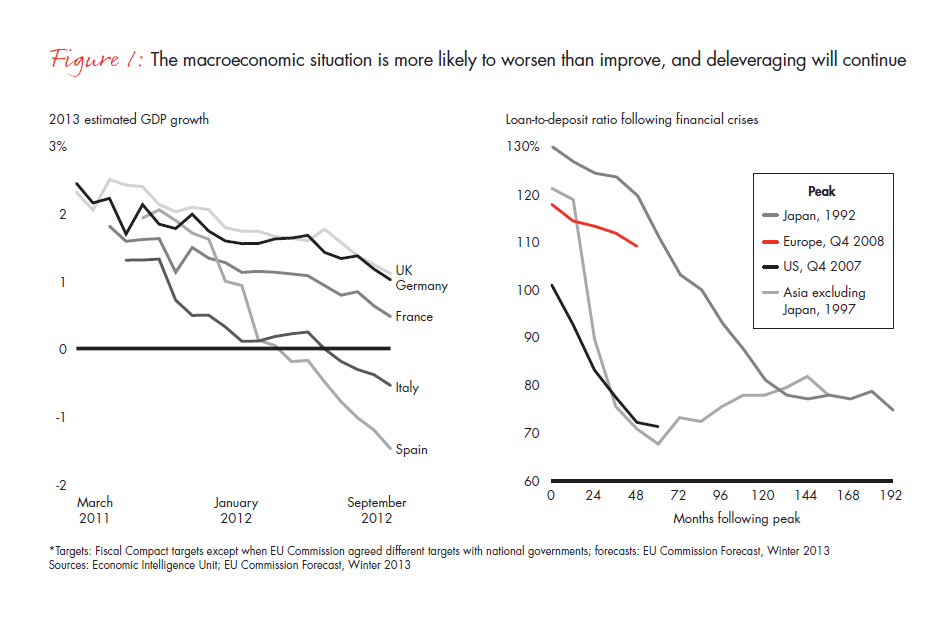
      Despite recent optimistic economic forecasts, we think it’s more likely that Eurozone growth will be weak over the next five years (see Figure 1). And regulation is intensifying, from Basel III regulations, to the Independent Commission on Banking’s proposed ring-fencing around retail bank operations to separate them from investment banking arms, to potential new rules that would limit cross-subsidised products. The combined impact of new regulations could reduce UK retail banks’ return on equity by seven to 13 points from the 2012 average of 17%.

      what-lies-beyond-the-financial-crisis-fig-01_embed

      Forward-thinking banks will come out of the bunker and develop a plan to survive on this new battlefield. They need to take out a substantial amount of cost while at the same time generating higher sales from a loyal customer base—a dual challenge that many banks have struggled with.

      Our work with UK and global retail banks suggests that this joint challenge can be addressed by focusing on three interconnected areas: offering simple products with transparent pricing; acting quickly on feedback from customers in order to build loyalty and lift sales; and fully embracing the opportunity provided by digital technologies to lower costs, improve service and support sales.

      Offering simple products with transparent pricing

      Generally only a few products account for the great majority of profits at a retail bank, yet the long-tail products require expensive systems and processes to maintain, as they often sit on legacy platforms. Large UK banks typically offer between 30 and 40 front-book products and have two to three times that number in their back book. Reducing the range and complexity caused by product proliferation thus lowers costs, including the costs of conduct risk associated with a large product portfolio.

      At the same time, product simplification makes choices easier for customers and for frontline sales and service employees. It promotes the growth of digital channels because there are fewer items to migrate to a website or mobile application, and simplicity makes for a better online experience. New players understand that dynamic and tend to have a simplified product range. M&S, for instance, has just one premium current account.

      Transparent pricing addresses a different concern, namely the widespread public perception of unfairness—an underlying theme of recent Financial Conduct Authority regulations prohibiting cross-subsidies in fund platform services. High introductory interest rates for newdeposit customers, for example, are viewed as unfairly subsidised by existing depositors, and recently, there have been growing complaints around existing insurance customers being given significantly higher quotes than new customers.

      Several retail lenders have benefited from more fair or transparent pricing. In mortgages, Nationwide has gained market share in part through a campaign pledging that a significant proportion of existing mortgage members have access to an interest rate capped at 2% above the Bank of England base rate. In short-term money lending, online provider Wonga charges high fees but still remains successful because of its transparent presentation and simple proposition.

      Acting quickly on customer feedback

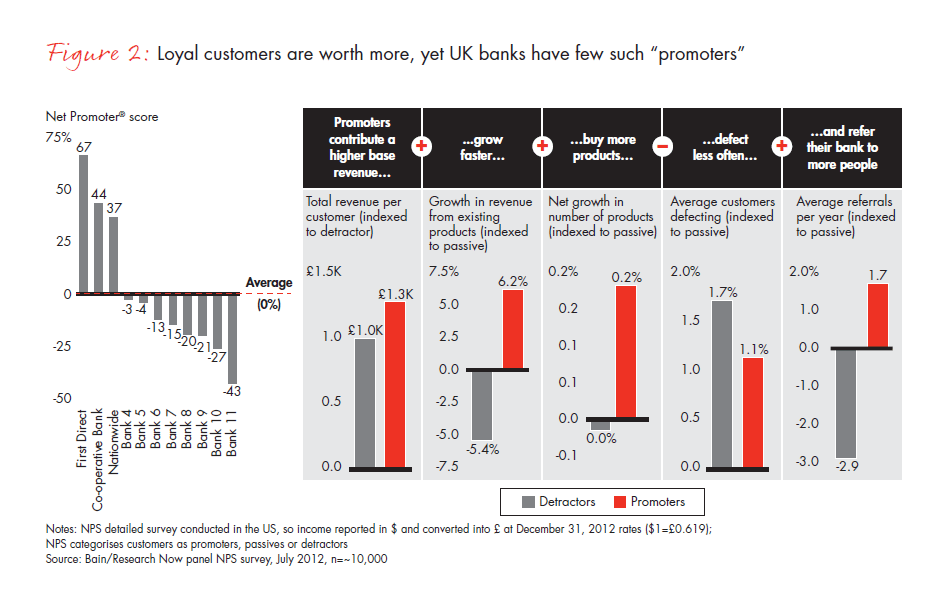
      Banks looking to return to organic growth need to focus on retaining and delighting the most profitable customers. Loyal customers buy more banking products, stay longer, cost less to serve and urge friends to become customers. Gaining share of a customer’s spending is particularly important to a retail bank’s economics (see Figure 2).

      what-lies-beyond-the-financial-crisis-fig-02_embed

      While many UK banks talk about improving the customer’s experience, few have managed to do so—and none would be considered loyalty leaders by global standards. Loyalty leaders have built a great experience by developing processes for short-cycle, closed-loop feedback, learning and action. “Closing the loop” involves sharing feedback from a customer, as soon as possible after it is received, with the employees most responsible for creating that customer’s experience. The feedback can then be used to remedy individual problems and systemic issues. It also serves to find out what a bank is doing right—what sorts of experiences are wowing customers and turning them into promoters—so the bank can do more of it.

      The trick is to focus on the small set of actions that will yield the greatest improvements. Leading banks identify the highest-value customers and invest differentially in them, rather than taking an overly democratic approach. Metro is expanding in high-end London neighborhoods through features such as extended branch hours and the ability to open a working current account in just 15 minutes.

      Embracing the digital opportunity

      Digital channels can be a powerful means of building loyalty—when those channels emphasise the right features and transactions, and when they dovetail tightly with phone centers and other ways that banks touch their customers. UK customers increasingly expect to be able to choose the channel most convenient for them, whether digital or physical, and they want all channels to work together harmoniously.

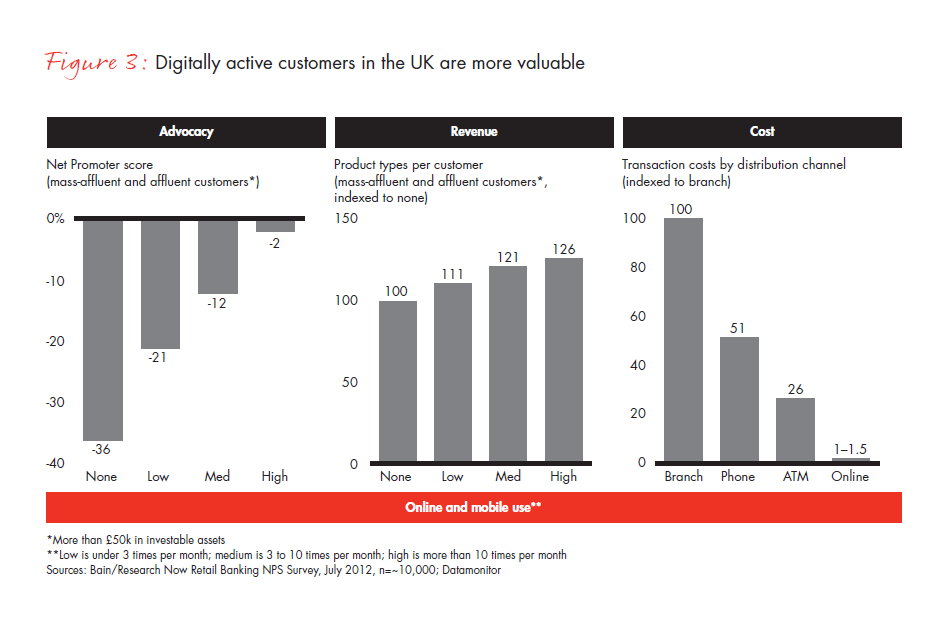
      A 2012 survey of UK bank customers by Bain & Company found that digital channels are delighting consumers much more than branch services. People value advanced digital features like remote bill paying, and they also value the convenience of mobile devices for straightforward tasks, such as checking their account balance. Moreover, online customers have proven to be more valuable in their level of loyalty, the revenue they generate and their cost to serve (see Figure 3).

      what-lies-beyond-the-financial-crisis-fig-03_embed

      While many UK banks have only recently come to appreciate the level of digital disruption sweeping through their industry, the leaders are already starting to change in three areas.

      They integrate distribution channels. A seamless “omnichannel” approach allows the customer to do business with a bank whenever, wherever and however she chooses. But how a bank prices products and services across all its channels needs to be transparent and uniform. Multitier pricing that does not convincingly demonstrate a distinct value proposition risks alienating customers.

      They redesign the branch network. Mobile and online channels, if executed well, also can divert volumes from higher-cost brick-and-mortar channels at a fraction of the cost. That’s why Barclays introduced its secure Web chat with advisers.

      Some banks are starting to close underperforming branches. More broadly, the network will evolve to a different shape, such as a lighter yet sturdier hub-and-spoke system. Branches are becoming more important as product showrooms and as places where customers seek expert financial advice.

      Success with a more economical network will hinge on an investment in hiring, training and developing qualified financial advisers and multitalented customer service representatives. Value-added advice and peerless customer service, not mere convenience, will be the hard currency of the digitally powered bank.

      They protect their franchise. Potential rivals can encroach from any direction, whether Internet powerhouses like Google, online payment systems like PayPal or new entrants like Hello Bank, launched by BNP Paribas; each offers some mix of greater speed, convenience and lower cost. With barriers of entry crumbling, leading banks have sharpened their market intelligence to scan for emerging competitive threats.

      These banks scrutinise each link of their value chain to assess potential vulnerabilities and erect defences to reinforce their higher-profit-margin businesses and their grip on their most valuable customers. They take measures to know their customers better than any potential rival can. They innovate to increase customer convenience. And they invest in building a stronger brand that earns customer trust and loyalty.

      They harness the power of Big Data. Leading banks have started to use their customer data to target specific offers based on customers’ demographic profiles, spending patterns and current product holdings. Large UK retailers have more experience in using customer data this way, so it’s not surprising that Sainsbury’s Bank announced plans to double or triple the number of customers by analysing data it has on customers of Sainsbury’s supermarkets. Some banks also are drawing on customer- spending data to make better credit decisions.

      Can the incumbents bounce back?

      Focusing on these three interconnected areas will help UK banks to improve the customer’s experience and generate sustainable economics. Simplification makes going digital easier and reduces errors, which improves customer loyalty. And visibly acting on customer feedback leads to greater loyalty and higher spending.

      Each move will help to position a bank favourably for the tough economic environment that may persist in the medium term. Outside disruptors have taken advantage of the financial crisis to make inroads in the UK through top service to affluent customers or great convenience to the mass market. With the acceleration of digital technologies throughout all aspects of banking, UK banks have a once-in-a-generation opportunity to do the same.


      what-lies-beyond-the-financial-crisis-fig-01_full

      what-lies-beyond-the-financial-crisis-fig-02_full

      what-lies-beyond-the-financial-crisis-fig-03_full
      Authors
      • Tim Cochrane
        Former Partner, London
      • Headshot of Herman Spruit
        Herman Spruit
        Advisory Partner, London
      • Headshot of Glen Williams
        Glen Williams
        Advisory Partner, London
      Contact us
      Related Industries
      • Financial Services
      Financial Services
      Wolf in Sheep's Clothing: Disruption Ahead for Transaction Banking

      The field is getting crowded and technology-intensive. How can banks stand out?

      Read More
      Financial Services
      Beyond Payments, the Real Prize in SME Commerce Is Ecosystem Control

      Choices on integration are reshaping how European commerce platforms and payments providers will thrive.

      Read More
      Financial Services
      Six Threats Demand a New Playbook for Banks in Wealth and Asset Management

      AI, direct-to-consumer models, and the return of local priorities are redrawing industry lines.

      Read More
      Financial Services
      Stay Relevant, Spark Energy: Pedro Arnt, CEO dLocal

      How can a hyperscaler grow at lightning speed without losing its soul? 

      Read More
      Financial Services
      Rethinking Transformation: Lawrence Lam on Leading Change at Prudential

      Frankie Leung speaks with Lawrence Lam, CEO of Prudential Hong Kong, about organizational transformation and sustaining change through a people-led approach.

      Read More
      Published in July 2013
      Tags
      • Financial Services

      How We've Helped Clients

      Digital A European Banking Giant Rises to the Fintech Challenge

      Read case study

      Strategy A financial services leader gains market confidence

      Read case study

      Change Management The change process unlocks potential and profits

      Read case study

      Ready to talk?

      We work with ambitious leaders who want to define the future, not hide from it. Together, we achieve extraordinary outcomes.

      Stay ahead in a rapidly changing world. Subscribe to Bain Insights, our monthly look at the critical issues facing global businesses.

      *I have read and understand Bain’s Privacy Notice.

      Please read and agree to the Privacy Policy.
      Bain & Company
      Contact us Sustainability Accessibility Terms of use Privacy Modern Slavery Act Statement Cookie Policy Sitemap Log In

      © 1996-2026 Bain & Company, Inc.

      Contact Bain

      How can we help you?

      • Business inquiry
      • Career information
      • Press relations
      • Partnership request
      • Speaker request
      See all offices