

Brief

한눈에 보기
- Leading AI providers have repositioned AI from a tool to an enterprise operating system. The signal is clear: We’re moving from narrow task automation to an integrated enterprise layer of functionally specific AI agents embedded in joint human-agent teams.
- This shift raises four questions every executive must answer: How will AI reshape your industry and strategy? What tasks should AI do, and where can distinctive human capabilities still support competitive advantage? How do you industrialize the way AI agents are built and governed? And how do you scale AI across the enterprise?
- The companies pulling ahead are redefining strategy under new AI economics, redesigning workforces around agent-led workflows, building repeatable “agent factories,” and applying deliberate scaling patterns matched to the boldness and urgency their situation demands.
AI is no longer just a productivity tool; it is shifting how work gets done, how businesses operate, and how companies create value. Winners will reshape around the new competitive dynamics, redesign how work is done, industrialize agent development, and find repeatable patterns to scale AI.
The catalyst: AI platforms shift from copilot to operating system
The past two months have marked a step change in AI’s trajectory from productivity tool to enterprise operating system—and capital markets have taken notice.
Leading AI providers have repositioned their platforms from productivity tools to active enterprise infrastructure. New offerings now enable multistep, goal-directed execution across core business systems, with agent orchestration, governance, and embedded AI becoming standard features. The signal is consistent across providers: AI is no longer a feature bolted onto existing software. It is the operating system for how work gets done.
Markets have responded sharply. Software indexes fell significantly in just a few trading sessions between late January and early February 2026—the worst start to a year in recent memory for the sector—while broader equity indexes remained roughly flat. The repricing reflects investor conclusions that agentic AI can automate the knowledge work that per-seat SaaS models were built to support. While data and software stocks were particularly exposed, the impact was also felt across marketplace businesses, financial services, and advisory businesses. Hardest hit were those with competitive moats resting on legacy software, nonproprietary data assets, automatable human advice, or marketplaces that could be disintermediated by AI agents.
The new competitive landscape
Competitive strategy has been shaped by successive waves of technology disruption—and AI is the next (see Figure 1). The information era rewarded scale and switching costs. The platform era rewarded network effects and lock-in. Competition in the AI era will be defined by something different: the declining marginal cost of intelligence.
Figure 1
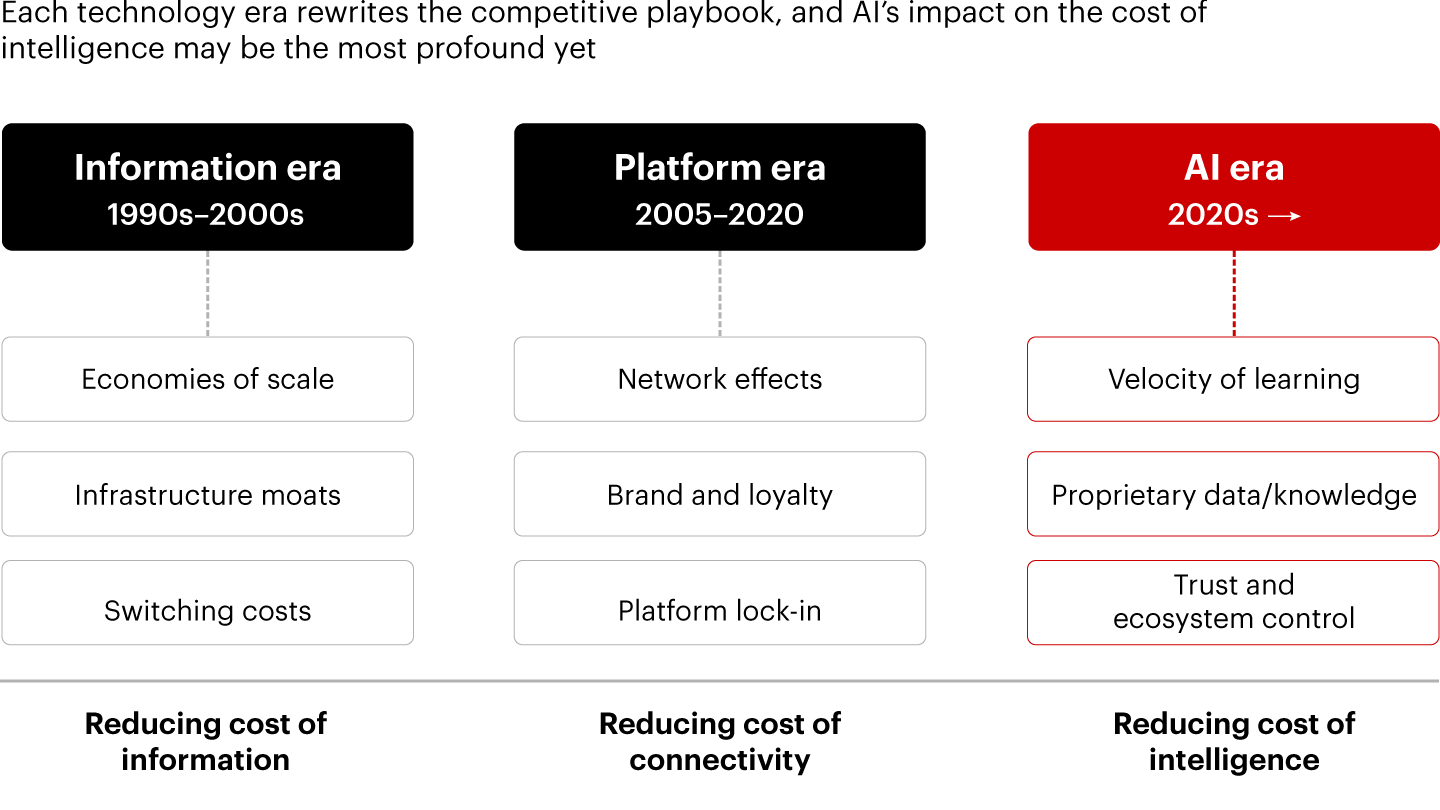

In most functions, we predict 30%–50% productivity gains from deploying AI agents to augment or automate knowledge work, comparable in magnitude to the globalization and offshoring wave of the 20th century. Ubiquitous access to cheaper intelligence will compress returns to scale, allowing smaller, faster-moving players to compete. Early movers in the AI market itself have already demonstrated that velocity of learning can trump raw scale.
Three dynamics are reshaping competition.
Cost and experience curves are being rewritten by AI. Position on these curves is no longer determined by enterprise scale—it is determined by the cumulative duration and velocity of learning. Getting on the new AI experience curve early can create a once-in-a-generation opportunity to build cost and scale advantage. Ecosystem partnerships provide the scale and experience needed to compete, while keeping enterprises lean, focused, and fast.
Customer differentiation is shifting. AI will enable hyperpersonalization and faster innovation cycles at scale for everyone. In most industries, differentiation will then come from building a proprietary data or knowledge base, being focused enough to better integrate AI into personalized workflows and journeys, and/or cultivating a community that is passionate about helping you continuously improve your proposition.
Industry control points are moving. As consumers begin more journeys with AI agents—in retail, financial services, travel, and beyond—the question of who “owns” the customer is wide open. The emerging factor determining who wins this control is trust: This is the basis on which an AI agent is permitted to orchestrate a consumer’s or enterprise’s digital life. Trust must be earned, via good governance, transparency, fairness, and reliability.
Enterprises must rapidly build new strategic assets to compete in the AI era: velocity of learning, proprietary data and knowledge, and trust-based ecosystem control.
Redesigning work for human-agent teams
AI transformation requires workflow redesign and workforce modernization in parallel (see Figure 2). One without the other produces either elegant process maps with no capability to deliver or skilled people trapped in obsolete workflows.
Figure 2
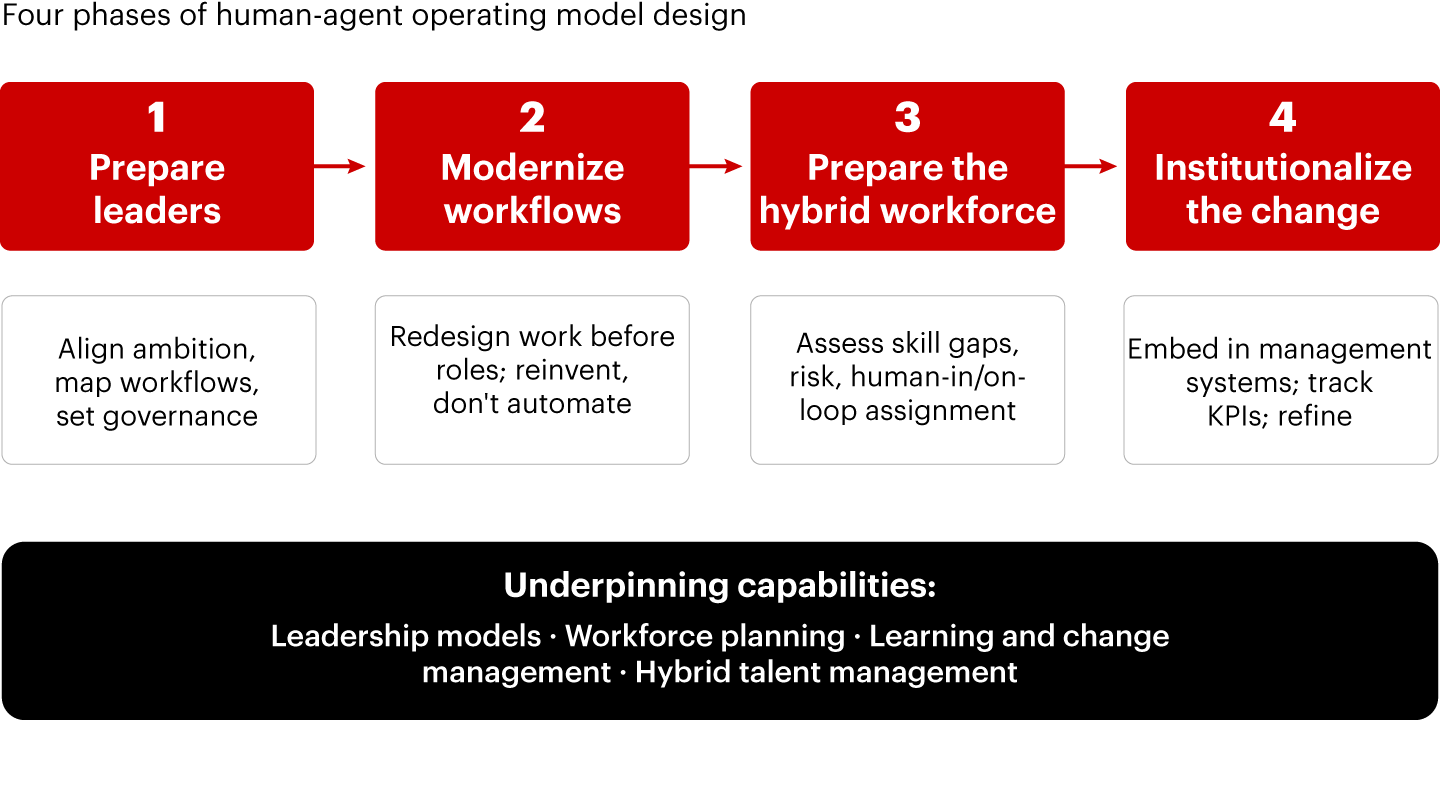

The work moves through four phases:
Prepare leaders. Align on the breadth, speed, and ambition of the transformation. Map priority workflows—high value, high cost, or mission critical—and identify pools of value, bottlenecks, and failure modes. Set governance, decision rights, and a clear sponsorship spine.
Modernize the workflow. Redesign the work before redefining roles. Standardize and simplify fragmented processes. Reimagine them with a view of today’s AI capabilities and what will be possible in 6 to 12 months. The key principle: Do not automate yesterday’s process—reinvent it end to end.
Prepare the hybrid workforce. Assess skill gaps and transition risks. Define where humans remain accountable and where agents execute, distinguishing between “human in the loop” (full supervision) and “human on the loop” (managed oversight). Build targeted reskilling programs and recruit for new roles in workflow engineering, orchestration, and AI governance.
Institutionalize the change. Embed new workflows in management systems. Track performance for both human and AI execution against defined KPIs. Continuously refine process design and agent autonomy as AI capabilities evolve.
Over time, the organizational unit of advantage will no longer reside in functions. It will sit in the tightly integrated system of redesigned workflows and a modernized hybrid workforce with continuous feedback loops of human and machine learning.
Leaders must be thoughtful about how they engage people across the organization. No agentic AI transformation will succeed if the goal appears to be replacing jobs without providing a path to a more fulfilling career. The most effective transformations frame AI as an elevation of people’s work—freeing them from repetitive execution and repositioning them as supervisors, designers, and improvers of agent-led systems.
Industrializing AI: the agent factory
Scaling AI across the enterprise demands more than upgrading data science teams or bolting AI onto existing IT capabilities. It requires what we call an agent factory—a repeatable, industrial process for building, testing, deploying, and governing AI agents (see Figure 3).
Figure 3
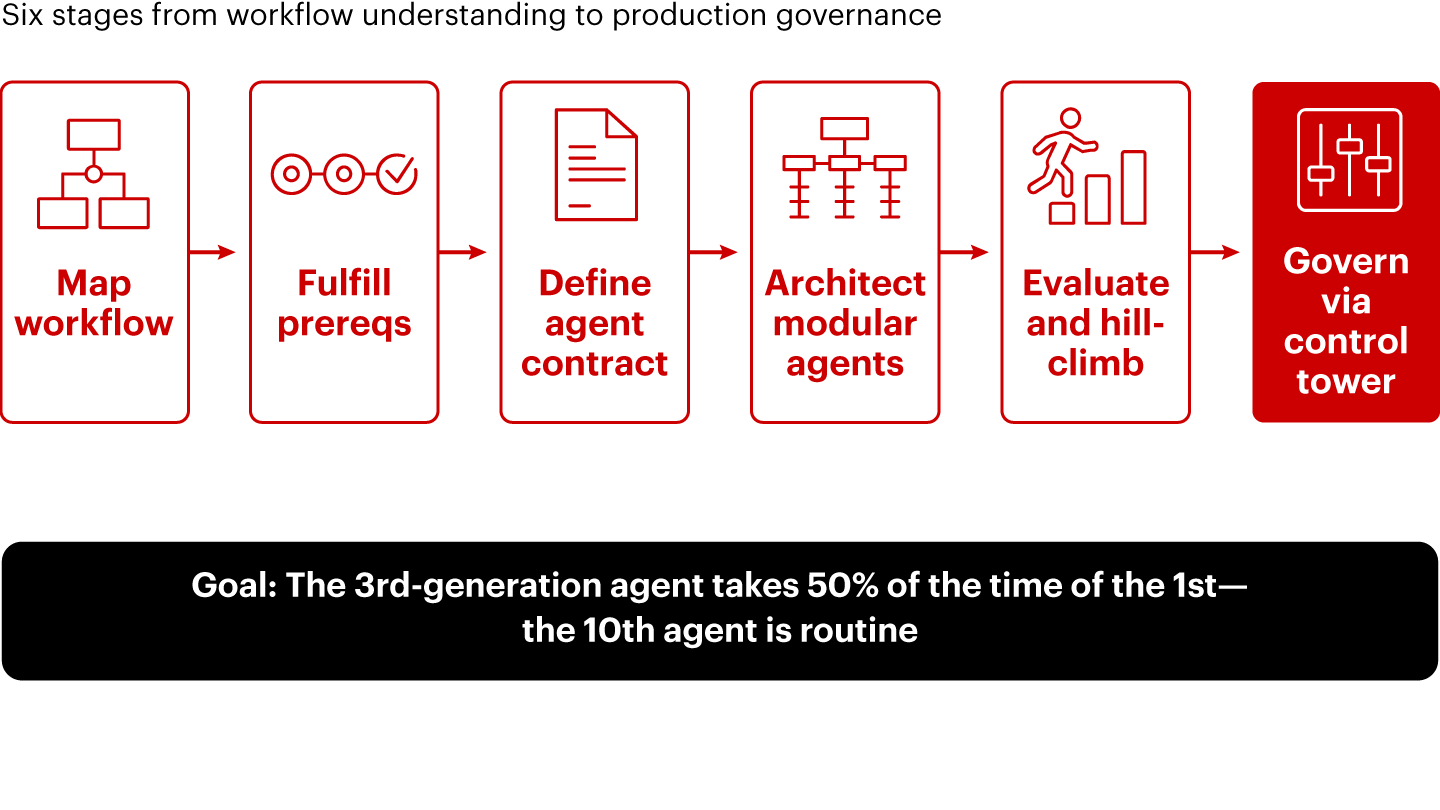

The factory follows a clear sequence.
Start with the workflow, not the model. Codify process maps—steps, handoffs, decisions, systems. Catalog edge cases and failure modes. The quality of any AI agent is bounded by workflow understanding.
Fulfill hard prerequisites before development begins. Operational readiness matters more than technical readiness. Secure named subject matter experts and committed business leaders who will own scaling and results.
Define the agent contract. Each agent must have clear trigger conditions, typed input/output schemas, explicit autonomy boundaries, tool access permissions, quantified performance targets, and defined escalation modes. If the contract cannot be written, the agent is not ready to be built.
Architect modular, orchestrated systems. Decompose agents into specialized subagents with typed outputs whenever a handoff feeds tools, code, or downstream automation. Prefer deterministic orchestration and validation; use LLM reasoning where flexibility is required.
Build a rigorous evaluation process. Establish a human-calibrated baseline and a living evaluation set (ground truth where applicable). Run offline testing until minimum performance thresholds are met, then shadow alongside human agents or safe rollout before full deployment.
Govern via a control tower. Maintain full trace logging, real-time visibility into outcomes, continuous automated evaluation against agent contracts, kill switches for inappropriate actions, and progressive rollout as performance is proven.
Scaling AI: six deliberate patterns
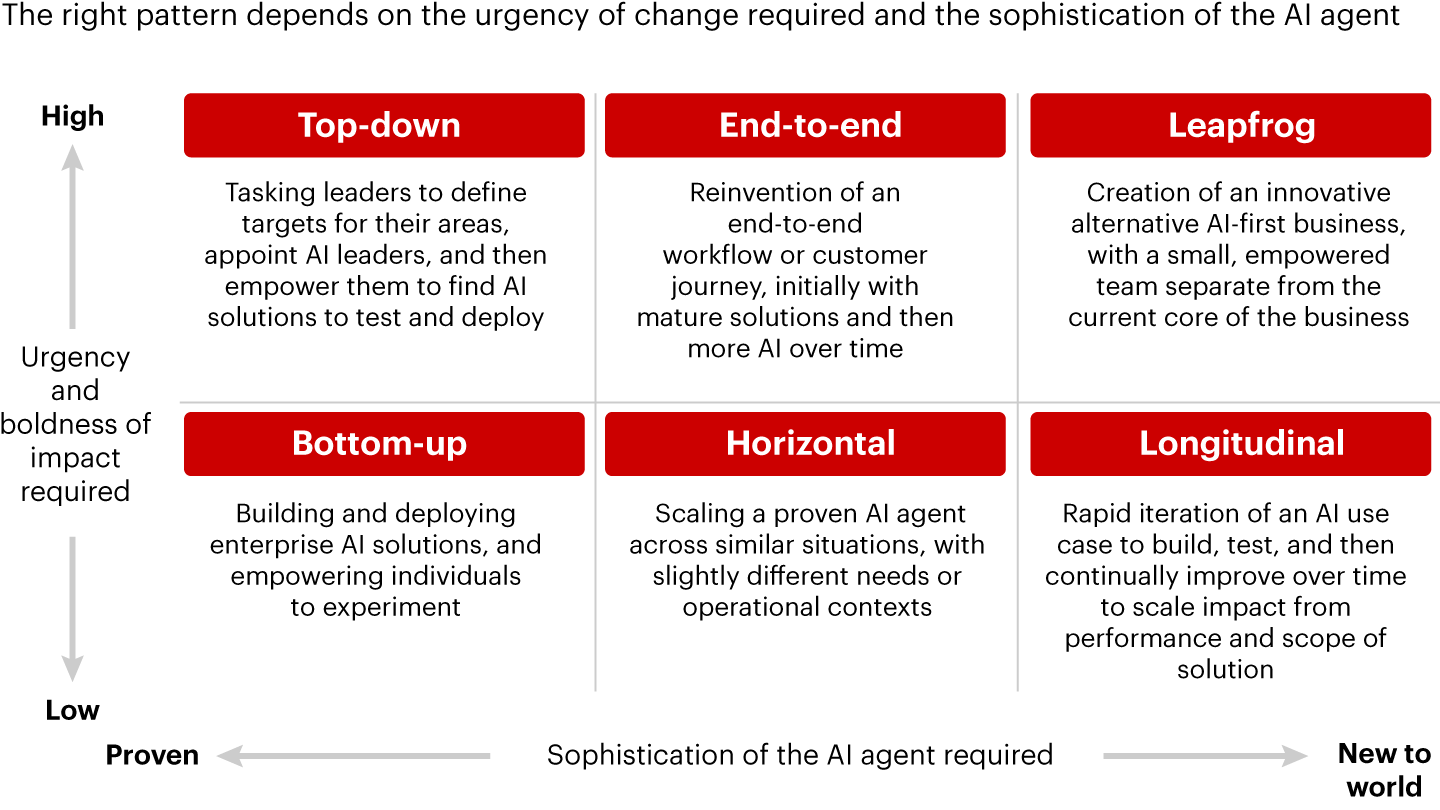
Most enterprises are experimenting with AI but failing to scale. The difference between experimentation and impact is a deliberate scaling pattern matched to context. We see six patterns emerging across enterprises:
- Bottom-up. Deploy general-purpose AI broadly and let teams innovate. (Good for momentum and culture but rarely moves the needle on productivity alone.)
- Top-down. Focus on 5–10 critical domains, set explicit targets with business owners, and track through stage gates. (Often triggered by frustration with bottom-up results.)
- Horizontal. Take a proven AI agent or use case and replicate it across similar domains, segments, or geographies; prioritize highest value first, not highest complexity.
- End-to-end. Zero-base a process and rebuild it with AI embedded. We’ve seen this shorten major workflow cycles from weeks to days. (Best where potential is high but inertia blocks progress.)
- Longitudinal. Small teams hill-climb performance on high-value use cases through tight iterative cycles. Autonomy increases as results improve.
- Leapfrog. Small, empowered teams reinvent the business from scratch. (For industries and functions at risk of complete transformation, where incremental moves won’t suffice.)
The right pattern depends on urgency and the maturity of the AI agent required (see Figure 4). Companies in stable industries can perhaps take the risk of being more incremental. Those facing fundamental disruption must move urgently and bet boldly.
Figure 4

Whatever scaling approach you choose, certain foundational investments are nonnegotiable: getting core data and knowledge in order so AI agents can actually use it, making key business systems accessible to AI, and putting security and governance guardrails in place. These don’t need to be finished before you start, but without them, no amount of ambition will translate into impact at scale.
What winners will do
The developments of the past months signal the beginning of the AI enterprise era. Organizations that win will redefine strategy under new AI economics, redesign workforces around agent-led workflows, industrialize how AI is built and governed, and apply deliberate scaling patterns matched to their competitive reality.
AI is not a technology program. It is a redesign of how work gets done and how enterprises compete. The success of an AI strategy is not what you plan to do—it is how you execute the transformation.
First published in 2월 2026