
Skip to Content
  • 오피스

    오피스

    미주
    • Atlanta
    • Austin
    • Bogota
    • Boston
    • Buenos Aires
    • Chicago
    • Dallas
    • Denver
    • Houston
    • Los Angeles
    • Mexico City
    • Minneapolis
    • Monterrey
    • Montreal
    • New York
    • Rio de Janeiro
    • San Francisco
    • Santiago
    • São Paulo
    • Seattle
    • Silicon Valley
    • Toronto
    • Washington, DC
    유럽, 중동, 아프리카
    • Amsterdam
    • Athens
    • Berlin
    • Brussels
    • Copenhagen
    • Doha
    • Dubai
    • Dusseldorf
    • Frankfurt
    • Helsinki
    • Istanbul
    • Johannesburg
    • Kyiv
    • Lisbon
    • London
    • Madrid
    • Milan
    • Munich
    • Oslo
    • Paris
    • Riyadh
    • Rome
    • Stockholm
    • Vienna
    • Warsaw
    • Zurich
    아시아, 호주
    • Bangkok
    • Beijing
    • Bengaluru
    • Brisbane
    • Ho Chi Minh City
    • Hong Kong
    • Jakarta
    • Kuala Lumpur
    • Manila
    • Melbourne
    • Mumbai
    • New Delhi
    • Perth
    • Seoul
    • Shanghai
    • Singapore
    • Sydney
    • Tokyo
    오피스 전체보기
  • 얼럼나이
  • 미디어 센터
  • 구독
  • 연락처
  • Korea | 한국어

    지역 및 언어 선택

    글로벌
    • Global (English)
    미주
    • Brazil (Português)
    • Argentina (Español)
    • Canada (Français)
    • Chile (Español)
    • Colombia (Español)
    유럽, 중동, 아프리카
    • France (Français)
    • DACH Region (Deutsch)
    • Italy (Italiano)
    • Spain (Español)
    • Greece (Elliniká)
    아시아, 호주
    • China (中文版)
    • Korea (한국어)
    • Japan (日本語)
  • Saved items (0)
    Saved items (0)

    You have no saved items.

    관심 있는 내용을 북마크하여 Red 폴더에 저장할 수 있습니다. Red 폴더 에서 저장된 내용을 읽거나 공유해보세요.

    Explore Bain Insights
  • 산업
    메인 메뉴

    산업

    • 우주항공, 방산 및 정부 서비스
    • 농업 관련 산업
    • 화학
    • 인프라, 건설 및 건축 자재
    • 소비재
    • 금융 서비스
    • 헬스케어
    • 산업용 기계 및 장비
    • 미디어 및 엔터테인먼트
    • 금속
    • 광업
    • 석유 및 가스
    • 제지 및 패키징 산업
    • 사모펀드
    • 사회 및 공공 부문
    • 유통
    • 기술
    • 텔레콤
    • 운송
    • 여행·여가
    • 유틸리티 및 재생가능 에너지
  • 컨설팅 서비스
    메인 메뉴

    컨설팅 서비스

    • Customer Experience
    • ESG
    • Innovation
    • M&A
    • 운영
    • 조직
    • 사모펀드
    • 고객 전략 및 마케팅
    • 전략
    • AI, 인사이트 및 솔루션
    • Technology
    • 변화 혁신
  • Digital
  • 인사이트
  • 베인 소개
    메인 메뉴

    베인 소개

    • 업무 소개
    • 베인의 신념
    • 구성원 및 리더십 소개
    • 고객 성과
    • 주요 수상 경력
    • 글로벌 파트너사
    Further: Our global responsibility
    • 다양성과 포용
    • 사회 공헌 활동
    • Sustainability
    • World Economic Forum
    Learn more about Further
  • Careers
    메인 메뉴

    Careers

    • Work with Us
      Careers
      Work with Us
      • Find Your Place
      • Our Work Areas
      • Integrated Teams
      • Students
      • Internships & Programs
      • Recruiting Events
    • Life at Bain
      Careers
      Life at Bain
      • Blog: Inside Bain
      • Career Stories
      • Our People
      • Where We Work
      • Supporting Your Growth
      • Affinity Groups
      • Benefits
    • Impact Stories
    • Hiring Process
      Careers
      Hiring Process
      • What to Expect
      • Interviewing
    FIND JOBS
  • 오피스
    메인 메뉴

    오피스

    • 미주
      오피스
      미주
      • Atlanta
      • Austin
      • Bogota
      • Boston
      • Buenos Aires
      • Chicago
      • Dallas
      • Denver
      • Houston
      • Los Angeles
      • Mexico City
      • Minneapolis
      • Monterrey
      • Montreal
      • New York
      • Rio de Janeiro
      • San Francisco
      • Santiago
      • São Paulo
      • Seattle
      • Silicon Valley
      • Toronto
      • Washington, DC
    • 유럽, 중동, 아프리카
      오피스
      유럽, 중동, 아프리카
      • Amsterdam
      • Athens
      • Berlin
      • Brussels
      • Copenhagen
      • Doha
      • Dubai
      • Dusseldorf
      • Frankfurt
      • Helsinki
      • Istanbul
      • Johannesburg
      • Kyiv
      • Lisbon
      • London
      • Madrid
      • Milan
      • Munich
      • Oslo
      • Paris
      • Riyadh
      • Rome
      • Stockholm
      • Vienna
      • Warsaw
      • Zurich
    • 아시아, 호주
      오피스
      아시아, 호주
      • Bangkok
      • Beijing
      • Bengaluru
      • Brisbane
      • Ho Chi Minh City
      • Hong Kong
      • Jakarta
      • Kuala Lumpur
      • Manila
      • Melbourne
      • Mumbai
      • New Delhi
      • Perth
      • Seoul
      • Shanghai
      • Singapore
      • Sydney
      • Tokyo
    오피스 전체보기
  • 얼럼나이
  • 미디어 센터
  • 구독
  • 연락처
  • Korea | 한국어
    메인 메뉴

    지역 및 언어 선택

    • 글로벌
      지역 및 언어 선택
      글로벌
      • Global (English)
    • 미주
      지역 및 언어 선택
      미주
      • Brazil (Português)
      • Argentina (Español)
      • Canada (Français)
      • Chile (Español)
      • Colombia (Español)
    • 유럽, 중동, 아프리카
      지역 및 언어 선택
      유럽, 중동, 아프리카
      • France (Français)
      • DACH Region (Deutsch)
      • Italy (Italiano)
      • Spain (Español)
      • Greece (Elliniká)
    • 아시아, 호주
      지역 및 언어 선택
      아시아, 호주
      • China (中文版)
      • Korea (한국어)
      • Japan (日本語)
  • Saved items  (0)
    메인 메뉴
    Saved items (0)

    You have no saved items.

    관심 있는 내용을 북마크하여 Red 폴더에 저장할 수 있습니다. Red 폴더 에서 저장된 내용을 읽거나 공유해보세요.

    Explore Bain Insights
  • 산업
    • 산업

      • 우주항공, 방산 및 정부 서비스
      • 농업 관련 산업
      • 화학
      • 인프라, 건설 및 건축 자재
      • 소비재
      • 금융 서비스
      • 헬스케어
      • 산업용 기계 및 장비
      • 미디어 및 엔터테인먼트
      • 금속
      • 광업
      • 석유 및 가스
      • 제지 및 패키징 산업
      • 사모펀드
      • 사회 및 공공 부문
      • 유통
      • 기술
      • 텔레콤
      • 운송
      • 여행·여가
      • 유틸리티 및 재생가능 에너지
  • 컨설팅 서비스
    • 컨설팅 서비스

      • Customer Experience
      • ESG
      • Innovation
      • M&A
      • 운영
      • 조직
      • 사모펀드
      • 고객 전략 및 마케팅
      • 전략
      • AI, 인사이트 및 솔루션
      • Technology
      • 변화 혁신
  • Digital
  • 인사이트
  • 베인 소개
    • 베인 소개

      • 업무 소개
      • 베인의 신념
      • 구성원 및 리더십 소개
      • 고객 성과
      • 주요 수상 경력
      • 글로벌 파트너사
      Further: Our global responsibility
      • 다양성과 포용
      • 사회 공헌 활동
      • Sustainability
      • World Economic Forum
      Learn more about Further
  • Careers
    최근 검색어
      최근 방문 페이지

      Content added to saved items

      Saved items (0)

      Removed from saved items

      Saved items (0)

      Brief

      Asia-Pacific Healthcare Delivery: Operational Excellence in the Digital Age

      Asia-Pacific Healthcare Delivery: Operational Excellence in the Digital Age

      Zero-based redesign and digital technologies can help invigorate profit margins and spur growth.

      글 Vikram Kapur, Satyam Mehra, Arunava Dalal, and James Viles

      • 읽기 소요시간
      }

      Brief

      Asia-Pacific Healthcare Delivery: Operational Excellence in the Digital Age
      en
      한눈에 보기
      • Many hospital groups and healthcare providers in the Asia-Pacific region delivered negative total shareholder returns from 2016 to 2018.
      • Sixty percent of providers have launched ambitious performance improvement efforts, but fewer than 5% say they are producing benefits.
      • Zero-based redesign programs can increase provider profitability by as much as 15 to 20 percentage points.

      Healthcare systems in the Asia-Pacific region vary widely from country to country, but face a common challenge: lackluster financial performance in an environment of unprecedented healthcare demand. Rising costs, evolving regulations and reimbursement pressure have eroded profits. From 2016 to 2018, major hospital groups in Australia, India, South Asia and Southeast Asia significantly underperformed their respective markets, and many leading providers delivered negative total shareholder returns (see Figure 1).

      Figure 1
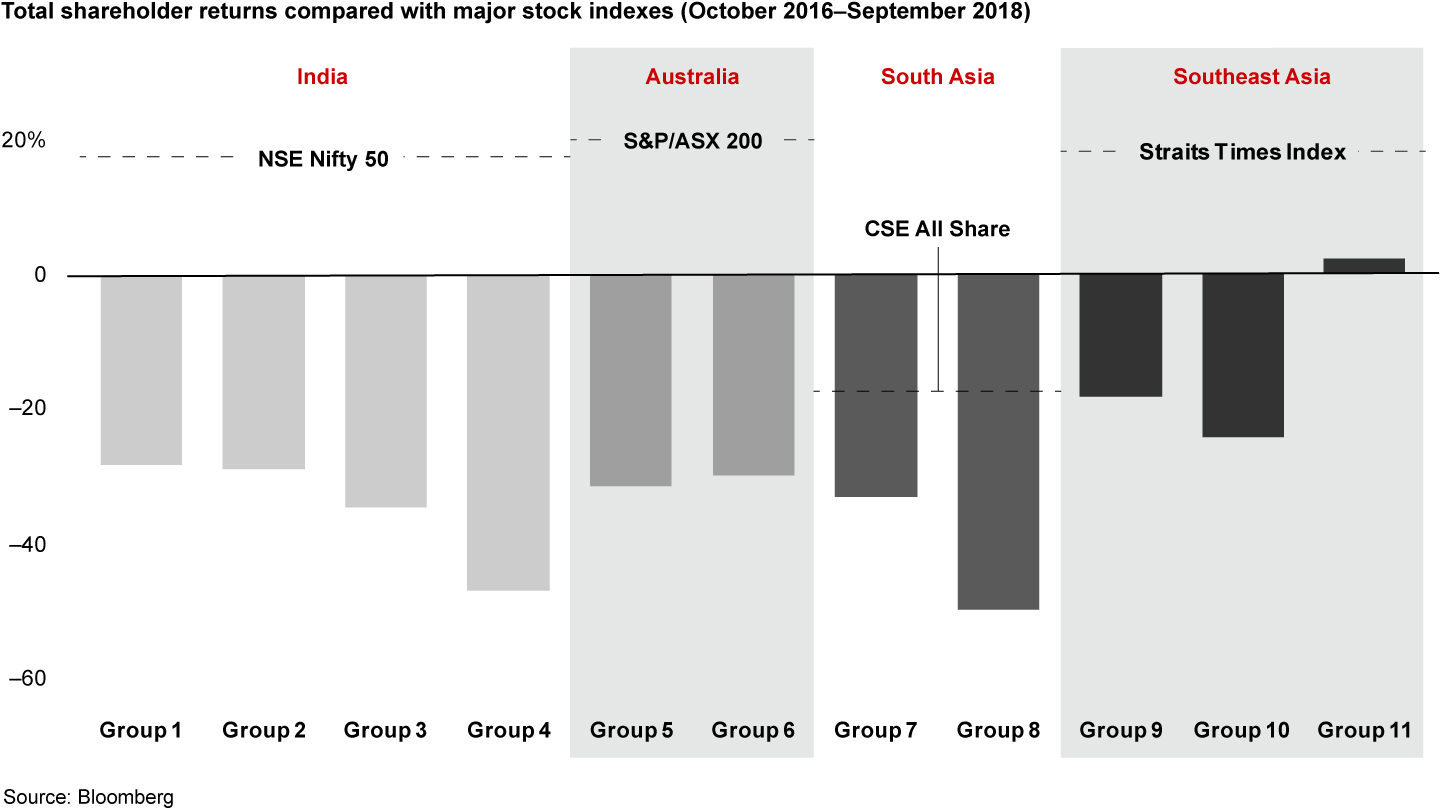
      Asia-Pacific hospital groups performed poorly from 2016–18
      Asia-Pacific hospital groups performed poorly from 2016–18
      Asia-Pacific hospital groups performed poorly from 2016–18

      For leadership teams, it’s a frustrating dilemma. Ninety percent of providers in the region pursued performance improvement initiatives over the past two years, according to a recent Bain survey, and 60% of respondents targeted ambitious margin improvement of three percentage points or more. But fewer than 5% say they are getting benefits from their efforts (see Figure 2). Seventy percent say they expect to fall short of achieving their target.

      Figure 2
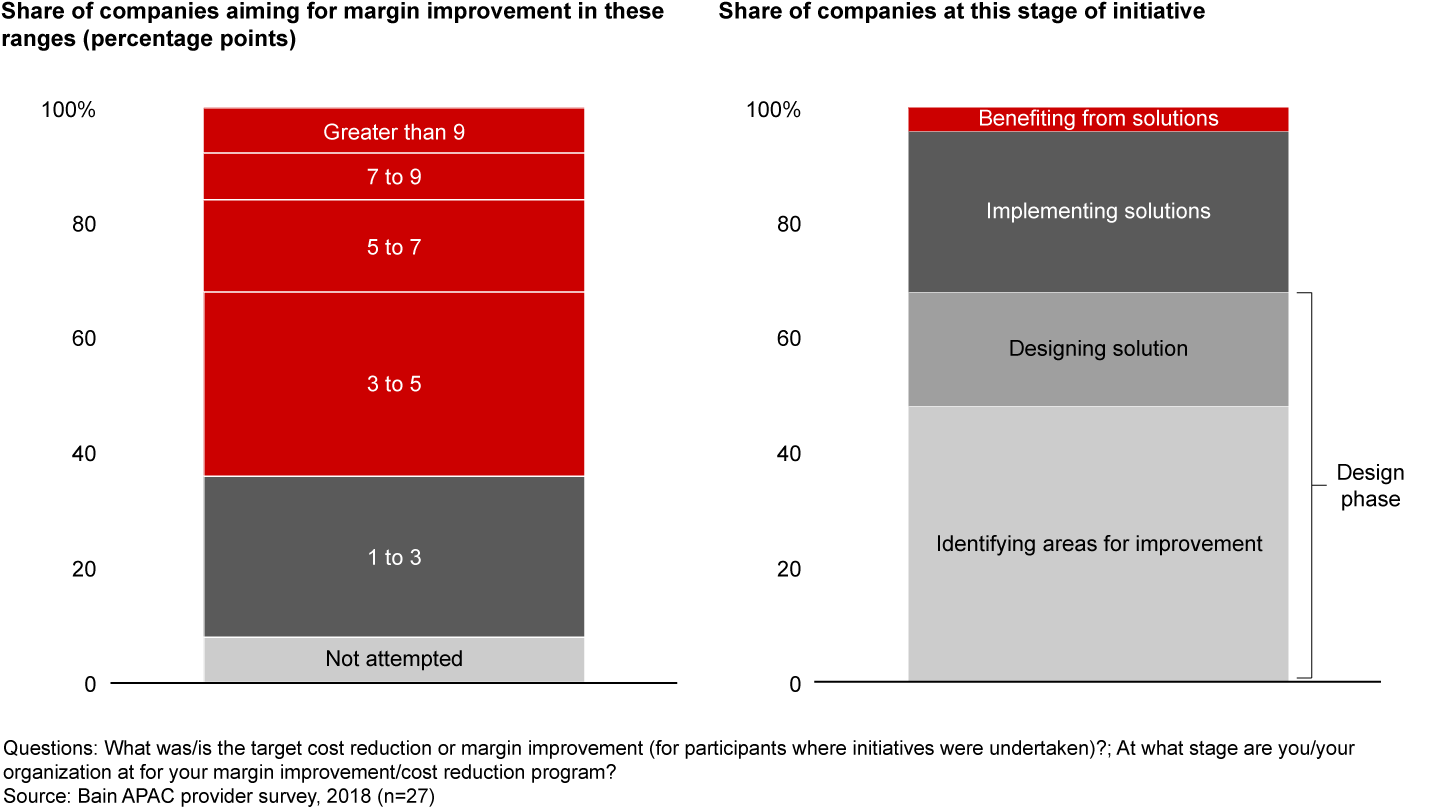
      About 60% of Asia-Pacific providers want to improve margins 3 percentage points or more, but fewer that 5% are seeing benefits
      About 60% of Asia-Pacific providers want to improve margins 3 percentage points or more, but fewer that 5% are seeing benefits
      About 60% of Asia-Pacific providers want to improve margins 3 percentage points or more, but fewer that 5% are seeing benefits

      A few providers, however, are outperforming by taking a more radical approach to operational excellence through zero-based redesign (ZBR). Companies using ZBR start with a blank sheet to completely rethink processes and workflows and realign their operating model. They use digital technologies to either eliminate or streamline activities and data analytics to unearth additional gains. Bain research shows ZBR can increase providers’ EBITDA growth by as much as 15 to 20 percentage points (see Figure 3).

      Figure 3
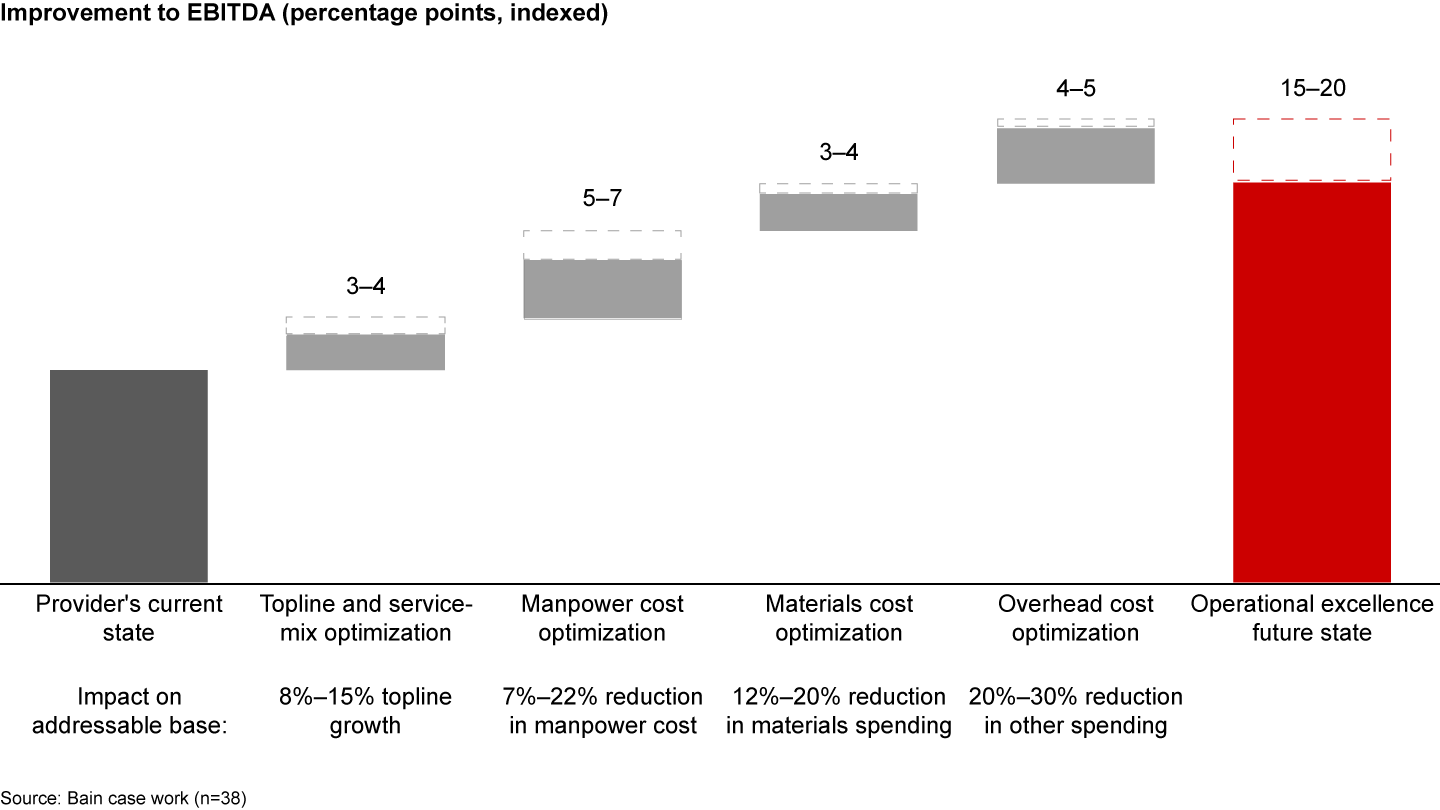
      Zero-based redesign programs can improve provider earnings growth by 15 to 20 percentage points
      Zero-based redesign programs can improve provider earnings growth by 15 to 20 percentage points
      Zero-based redesign programs can improve provider earnings growth by 15 to 20 percentage points

      A new approach to cost savings

      Many Asia-Pacific providers have realized that short-term cost cutting is ineffective. In most cases, the costs creep back in a couple of years. Worse, such moves often jeopardize vital services, undermining clinical quality and patient experience, while weakening processes and accountability. Providers in our survey identified four risks to significantly improving performance: Failure to engage the entire organization, adverse effects from cutting costs, inability to sustain change, and an incremental approach.

      ZBR’s blank-sheet approach helps companies overcome those risks and achieve operational excellence. Leadership teams that deliver the biggest gains through ZBR understand it isn’t a cost-cutting tool, but a major shift in cost-management philosophy. ZBR aligns processes and resources with the organization’s mission. It starts with setting a clear vision that includes aspirational cost and revenue targets. Next comes a bottom-up redesign of all processes, disregarding how the company did things in the past.

      To do that, the leadership team answers two key questions. First, what activities should the company perform? That includes identifying wasteful activities to eliminate and assessing risk. Second, how should we perform those activities? Could reengineering and digitalization improve performance? In many cases, simple, inexpensive digital solutions that were unavailable a few years ago can turbocharge ZBR results. Automating tasks and processes in specific functions, for example, typically reduces costs by 25% to 50%, and in some cases as much as 65%.

      Companies that focus on these two questions uncover new sources of savings that traditional approaches miss. By probing which activities should be performed, a leading provider in India discovered nonessential and duplicative documents were creating a lot of unnecessary work for nurses. The leadership team eliminated excess documentation and redesigned forms for simplicity and digitization. Those actions reduced the time nurses spent on documentation by 65%.

      Digitalization also makes it easier to reduce errors and speed customer-response time. It enables companies to gather and organize data quickly, helping them optimize processes. A leading hospital chain reduced discharge time by 40% by enabling multiple departments to see pending workflow items and implementing early notifications. Another major hospital chain cut costs 20% for specific surgical items by studying the variations in costs across its network and standardizing usage.

      A few leaders are discovering how quickly digital technologies can deliver results. Take the case of an Australian provider that rapidly expanded from its strong, local base, but found its new clinics were missing revenue and profit targets. The leadership team used digitally enabled process redesign to reduce high fixed costs. It then introduced micromarket and customer-based pricing, and profits quickly rose by 35%. An Agile approach to new business development at all sites allowed the leadership team to benchmark and improve performance throughout the network. A year later, the provider’s profit had tripled.

      Providers are also using a blank-sheet approach to achieve breakthrough results. A hospital chain in Asia struggling with margin pressure used zero-based redesign to rethink its pricing strategy and improve profitability. The leadership team scrapped the hospital’s cost-plus-margin pricing approach and developed a more holistic system based on the medical team’s experience and the complexity of the procedure. The new pricing system, rolled out across major hospitals in the chain, increased revenue growth by roughly 8 percentage points.

      In another case, a standalone secondary hospital in the region launched a wide-ranging ZBR program to stem rising costs and reverse growing losses. Key changes at the hospital, which serves company employees and the surrounding region, included a shift to value-based pricing; reduced admission, diagnostic and discharge turnaround times; and lower staff costs through improved use of physicians and outsourced nursing staff. The program improved earnings before interest and taxes by 6% in 2017, and the hospital expects to reduce its losses 30% to 40% by 2022.

      Getting ZBR right

      Despite the potential gains, many healthcare providers have been slow to adopt ZBR. One reason is that leadership teams often misunderstand it. The companies that succeed with zero-based redesign follow four guidelines:

      Make it a top management priority. Leadership teams align on the bold mission first and make the case for change. They build deep commitment at all levels of the organization before launching a ZBR program. The CEO, CFO and senior executives make it clear to all that ZBR isn’t a mechanical cost-cutting tool. It’s a new approach that changes the way the organization views spending and creates a high-performance culture.

      Focus on strategic costs vs. nonstrategic costs. Many associate ZBR with across-the-board cutting. That’s a misconception and the wrong starting point. Zero-based redesign helps a company distin­guish between strategic and nonstrategic costs. The goal isn’t to slash spending, but to rethink and rebalance how the company spends every dollar so it supports investment priorities.

      Link savings to growth. Too often, companies overlook the most strategic aspect of zero-based redesign—rechanneling savings to fuel growth. That kindles employee engagement and an ownership mindset, which both help ensure a ZBR program’s success. Ultimately, a well-designed zero-based redesign program simplifies the organization and eliminates the clutter that makes it hard for employees to do their jobs, liberating high performers.

      Pave the way for behavior change. Even when companies strive to craft an effective ZBR program, they may stumble in executing it. One common pitfall is focusing on the tools, benchmarking and pace of the rollout, instead of training people in a new set of behaviors. Tools improve financial performance only if managers and the front line use them to change the way they manage costs.

      Over the next decade, with its rapidly aging population and increasing prevalence of chronic disease, the Asia-Pacific region will account for half of the growth in global healthcare spending. That will put pressure on hospital groups and other providers to make healthcare services more efficient and affordable. What separates the winners from the losers will be management teams that put operational excellence on the top of their strategic agenda. Harnessing a ZBR approach to managing hospital systems will over time become a source of distinct competitive advantage for these winning leadership teams.

      Vikram Kapur is a partner with Bain & Company and leads the firm’s Healthcare practice in Asia-Pacific. He is based in Singapore. Satyam Mehra and James Viles are partners in Bain & Company’s Healthcare practice. Satyam is located in the New Delhi office, and James is based in Sydney. Arunava Dalal is a principal in Bain’s Healthcare practice and is based in Bain’s New Delhi office.

      저자
      • Headshot of Vikram Kapur
        Vikram Kapur
        파트너, Singapore
      • Headshot of Satyam Mehra
        Satyam Mehra
        Former Partner, New Delhi
      • Headshot of Arunava Dalal
        Arunava Dalal
        파트너, New Delhi
      • Headshot of James Viles
        James Viles
        파트너, Sydney
      문의하기
      관련 산업
      • 헬스케어
      • 헬스케어 납부자 및 전달체계
      관련 컨설팅 서비스
      • 성과 개선
      최적의 솔루션 찾기
      • Zero-based Redesign
      헬스케어
      Asia-Pacific Healthcare Providers Suffer Eroding Profits

      Leaders use zero-based redesign to revive margins.

      자세히 보기
      헬스케어
      A New Prescription for US Pharmacy

      As drug store retail chains rightsize, mass merchants and grocers are best positioned to pick up the scripts.

      자세히 보기
      Zero-based Redesign
      Wealth Management Firms Can Take Out Costs While Reducing Risk and Improving Client Loyalty

      Six tactics allow firms to reduce operating costs by 17% to 38%.

      자세히 보기
      성과 개선
      Want More Out of Your AI Investments? Think People First

      To unlock AI’s exponential productivity potential, companies must modernize workflow and workforce in tandem.

      자세히 보기
      헬스케어
      The Healthcare AI Adoption Index

      A survey of more than 400 healthcare buyers reveals what’s fueling their AI experimentation and pinpoints opportunities for innovation partners.

      자세히 보기
      First published in 9월 2019
      태그
      • 성과 개선
      • 헬스케어
      • 헬스케어 납부자 및 전달체계
      • Zero-based Redesign

      프로젝트 사례

      성과 개선 Zero-based Redesign Puts a MedTech Leader on a Path to Sustainable Growth

      See more related case studies

      전략 A healthcare payer sets its own long-term health strategy

      See more related case studies

      M&A A healthcare giant overcomes merger risks for global growth

      See more related case studies

      베인에 궁금하신 점이 있으신가요?

      베인은 주저 없이 변화를 마주할 줄 아는 용감한 리더들과 함께합니다. 그리고, 이들의 담대한 용기는 고객사의 성공으로 이어집니다.

      급변하는 비즈니스 환경에서 살아남기 위한 선도자의 시각. 월간 Bain Insights에서 글로벌 비즈니스의 핵심 이슈를 확인하십시오.

      *개인정보 정책을 읽었으며 그 내용에 동의합니다.

      Privacy Policy를 읽고 동의해주십시오.
      Bain & Company
      문의하기 환경정책 Accessibility 이용약관 개인정보 보호 쿠키 사용 정책 Sitemap Log In

      © 1996-2026 Bain & Company, Inc.

      문의하기

      무엇을 도와드릴까요?

      • 프로젝트 문의
      • 채용 정보
      • 언론
      • 제휴 문의
      • 연사 초청
      오피스 전체보기