

Brief

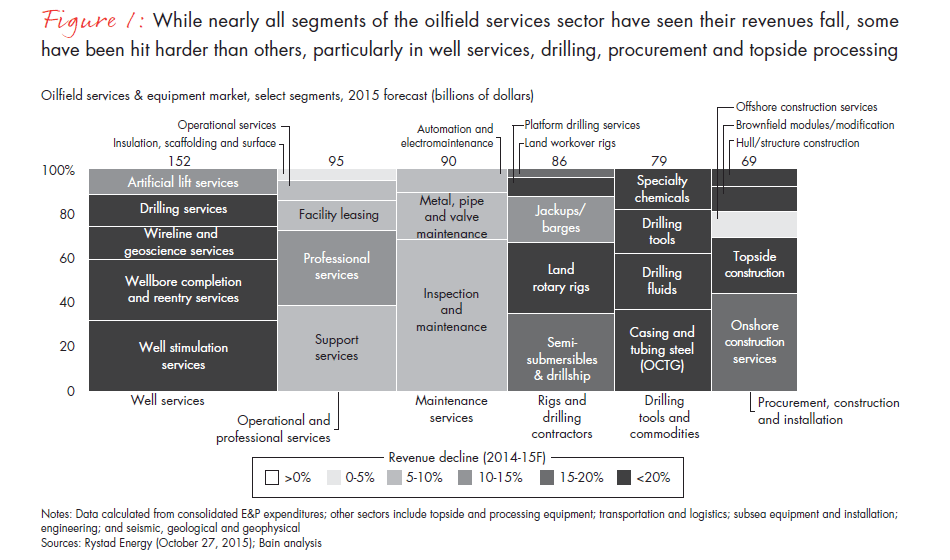
Upstream oilfield services and equipment (OFSE) companies have been among the hardest hit in the energy sector since the start of the most recent oil price decline in mid-2014. Their revenues have fallen significantly as exploration and production (E&P) customers have slashed Capex and activity levels and pressured suppliers to cut pricing. In fact, the leading OFSE companies saw a collective 25% drop in revenue from the second quarter of 2014 to the same quarter in 2015. Margins have also declined, though they have started to rebound in some subsectors as service providers have reduced costs. In total, the sector lost more than $130 billion in market capitalization, with some segments hit harder than others (see Figure 1).
Until the recent price decline, the OFSE sector had experienced a relatively smooth trajectory over the past decade: Upstream operators outsourced much of the work across a growing industry, and operators paid a premium for availability as activity levels outpaced capacity. As a result, prices for equipment and services soared, and OFSE returns—though cyclical—were above normal. Despite this, many OFSE providers left themselves poorly positioned by allowing costs to rise along with pricing and orienting themselves to higher-cost, technically challenging applications—profit pools that may disappear for years in a low-price environment.
When prices fell, OFSE executives followed their tried-and-true downturn playbooks. They cut capacity, reduced headcount and overhead, and tightened capital budgets as they waited for a recovery. But many have started to awaken to the fact that the industry is at a once-in-a-generation strategic crossroads that demands conscious and careful decisions about the future. The current downturn could well rival that of the 1980s in duration, and oil prices are likely to remain low for some time—well into 2016 and perhaps beyond.
Ethan Phillips, a partner in Bain's Oil & Gas practice, explains how oilfield services and equipment providers can thrive in this changing oil and gas industry by focusing on efficiency.
The industry that emerges from this low-price environment will look quite different from the one that entered it. Lower-cost volumes, particularly from the Middle East, may continue to be strong, and North American tight oil, while challenged at current prices, will remain a significant part of new production growth. Deepwater developments, however, are being radically reworked for the new price environment. And frontier plays such as arctic and ultra-deepwater—viewed as the industry’s next wave of growth just a few short years ago—are unlikely to be economical for quite some time, if ever.
For OFSE providers, the imperative now shifts away from pushing technical boundaries at the frontiers to creating efficiencies that allow them to operate sustainably over the long term. Executives are looking beyond simple cost-cutting to determine what to do next to thrive in a prolonged period of price weakness. They are also looking beyond their own organizations to find novel ways to lower their customers’ costs through more efficient technologies and processes, and they are refocusing their portfolios to reduce their exposure to high-cost sources and reposition themselves at the lower end of the cost curve.
These are inherently challenging moves to make in the best of times. But they are all the more challenging in the face of falling revenues and industry uncertainty. What’s more, many firms have a narrow window to act—while their balance sheets are robust enough to allow for some flexibility.
Indiscriminate cost-cutting can diminish a firm’s capabilities and hamper its ability to grow as activity recovers. Pursuing the wrong technologies wastes scarce resources and can put a company at a serious competitive disadvantage. The right acquisitions and portfolio moves could create a tremendous growth platform, but the wrong ones could be a millstone around a company’s neck.
Surveying the landscape
The price drop that began in the middle of 2014 resulted from an oversupply of crude oil as the resurgence of production from Iraq, Libya and Iran—combined with sustained production from the US and Canada—contributed to a growing surplus in the face of weakening demand. Low-cost barrels from the Middle East and Russia will continue to be the biggest factors affecting price and production mix, and predicting those outputs with any certainty is notoriously challenging given security and geopolitical instabilities.
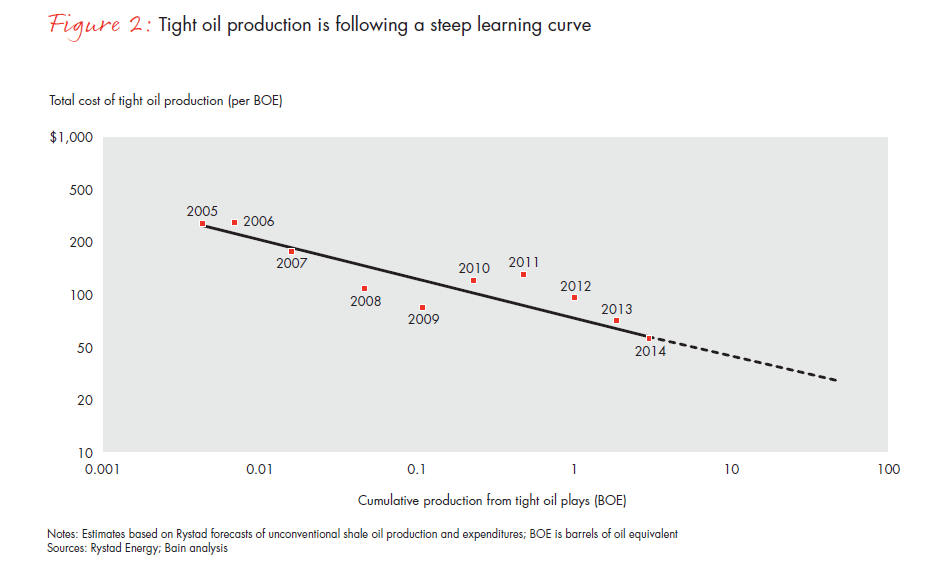
Efficiency gains in North American tight oil and offshore developments will also affect the price and production mix. Many were surprised by the resiliency of North American shale drilling as oil prices fell over the past year. Some of this resiliency was due to hedging, high-grading and other factors. But the fact remains that breakeven prices for North American tight oil declined steadily as operators gained experience and technologies improved (see Figure 2). While the year-over-year gains will slow, the downward trend in Eagle Ford looks similar to the one seen by shale gas operators in the Marcellus, and our experience working with leading E&P companies suggests it has more room to run. Projecting forward and combining with the lower onshore services costs in the market (even assuming some cost increase from current levels), acreage that required a price point of $75 per barrel to earn a return in 2014 could be economical at $55 or less. With prices hovering below $50, North American tight oil drilling has declined significantly and is unlikely to return to 2014 levels for the foreseeable future (if ever), but this will remain an attractive source and will be one of the first to see renewed activity once demand catches back up with supply.
The outlook of offshore is less certain. There have been some high-profile delays and cancellations, but most projects that were already sanctioned continue to move forward and offshore production volumes will continue to rise. Over time, unfavorable economics and smaller capital budgets will delay some projects, though lower day rates and input costs will keep some running. Operators are working to radically simplify their designs and engineer cost to make the economics work at $50 per barrel. The industry will watch closely for signs of success as operators go through their capital planning processes next year.
Three imperatives for OFSE companies
While they wait, OFSE leaders can look at three broad, strategic imperatives (see Figure 3).
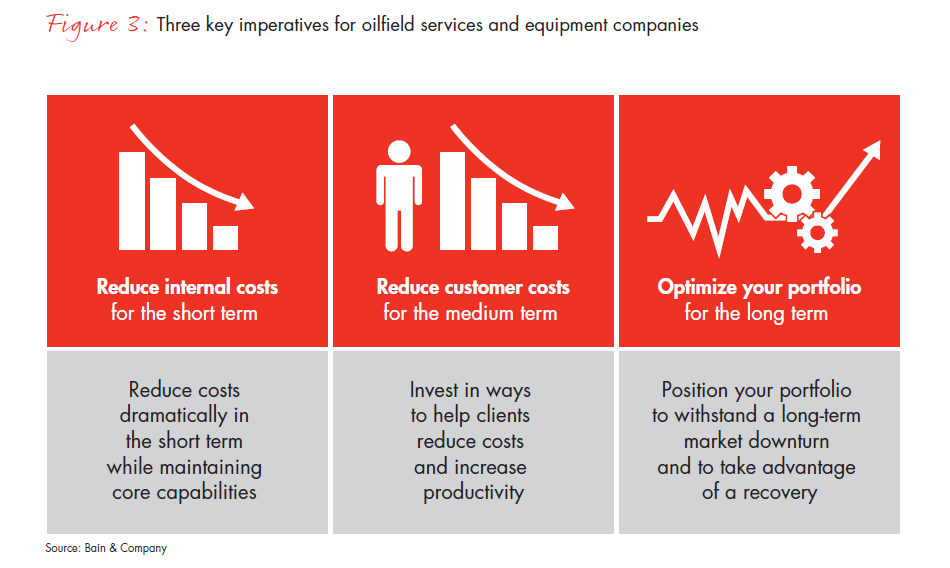
Most executives are already well into the first imperative, the short-term need to reduce costs by cutting discretionary spending. Many are now looking for more ways to simplify their operations and generate more sustainable efficiencies. Their goal is to create a leaner organization that can thrive in a low-price environment for years, coming out into a recovery in a stronger position. Among the options:
- zero-base budgets to ensure costs are aligned with the most critical and valuable activities;
- radically simplify their operational footprint, supply chain and logistics and ensure alignment with new activity outlook;
- properly integrate acquisitions taken during the recent growth period; and
- create a core set of standardized and modularized products.
Executives also need to reduce customer costs in a more sustainable way, going beyond price reductions or trading margins for the duration. They should collaborate closely with customers on a range of moves that radically restructure the cost base of the industry by engineering out cost, developing more efficient products and processes, and seeking novel business models to better align with incentives. These tactics can include:
- developing integrated, just-in-time supply chains to reduce total cost of operations;
- exploring design-to-cost and value-engineering approaches to engineer out costs;
- identifying areas where customers’ standards are driving significant costs and constructively challenge them to find ways to achieve the same objectives at lower cost;
- looking for selective areas where technology can push costs down, as with condition-based maintenance;
- searching for ways to collaborate with customers and explore novel business models that better align incentives with customers; and
- using advanced analytics to identify opportunities to optimize equipment maintenance spend while maintaining strict health, safety and environmental (HSE) standards.
Finally, they should evaluate their business portfolio to look for opportunities to reduce their exposure to price volatility, fill key gaps in their offerings and create optionality to be able to respond effectively as the sector eventually recovers. They may choose to reorient their product and geographic portfolios toward the lower end of the cost curve, building on reduced costs of engineering and manufacturing. Or they may proactively identify potential M&A targets to build scale and scope and move lower on the production cost curve. Some equipment manufacturers, those for whom oil and gas is only one market among many, may consider exiting the market entirely.
All of these moves require bold thinking, strong, collaborative customer relationships and impeccable execution. As with any serious disruption, the winners will be the players who can spot opportunities and act quickly to capture them. The current downturn will test oilfield services and equipment executives, but those that take the opportunity to maneuver into a better position will thrive in the eventual recovery.
Ethan Phillips is a Bain partner in Houston, and Peter Jackson is a partner with Bain & Company in London. Both work with the firm’s Global Oil & Gas practice.
First published in 12월 2015