
Skip to Content
  • 오피스

    오피스

    미주
    • Atlanta
    • Austin
    • Bogota
    • Boston
    • Buenos Aires
    • Chicago
    • Dallas
    • Denver
    • Houston
    • Los Angeles
    • Mexico City
    • Minneapolis
    • Monterrey
    • Montreal
    • New York
    • Rio de Janeiro
    • San Francisco
    • Santiago
    • São Paulo
    • Seattle
    • Silicon Valley
    • Toronto
    • Washington, DC
    유럽, 중동, 아프리카
    • Amsterdam
    • Athens
    • Berlin
    • Brussels
    • Copenhagen
    • Doha
    • Dubai
    • Dusseldorf
    • Frankfurt
    • Helsinki
    • Istanbul
    • Johannesburg
    • Kyiv
    • Lisbon
    • London
    • Madrid
    • Milan
    • Munich
    • Oslo
    • Paris
    • Riyadh
    • Rome
    • Stockholm
    • Vienna
    • Warsaw
    • Zurich
    아시아, 호주
    • Bangkok
    • Beijing
    • Bengaluru
    • Brisbane
    • Ho Chi Minh City
    • Hong Kong
    • Jakarta
    • Kuala Lumpur
    • Manila
    • Melbourne
    • Mumbai
    • New Delhi
    • Perth
    • Seoul
    • Shanghai
    • Singapore
    • Sydney
    • Tokyo
    오피스 전체보기
  • 얼럼나이
  • 미디어 센터
  • 구독
  • 연락처
  • Korea | 한국어

    지역 및 언어 선택

    글로벌
    • Global (English)
    미주
    • Brazil (Português)
    • Argentina (Español)
    • Canada (Français)
    • Chile (Español)
    • Colombia (Español)
    유럽, 중동, 아프리카
    • France (Français)
    • DACH Region (Deutsch)
    • Italy (Italiano)
    • Spain (Español)
    • Greece (Elliniká)
    아시아, 호주
    • China (中文版)
    • Korea (한국어)
    • Japan (日本語)
  • Saved items (0)
    Saved items (0)

    You have no saved items.

    관심 있는 내용을 북마크하여 Red 폴더에 저장할 수 있습니다. Red 폴더 에서 저장된 내용을 읽거나 공유해보세요.

    Explore Bain Insights
  • 산업
    메인 메뉴

    산업

    • 우주항공, 방산 및 정부 서비스
    • 농업 관련 산업
    • 화학
    • 인프라, 건설 및 건축 자재
    • 소비재
    • 금융 서비스
    • 헬스케어
    • 산업용 기계 및 장비
    • 미디어 및 엔터테인먼트
    • 금속
    • 광업
    • 석유 및 가스
    • 제지 및 패키징 산업
    • 사모펀드
    • 사회 및 공공 부문
    • 유통
    • 기술
    • 텔레콤
    • 운송
    • 여행·여가
    • 유틸리티 및 재생가능 에너지
  • 컨설팅 서비스
    메인 메뉴

    컨설팅 서비스

    • Customer Experience
    • ESG
    • Innovation
    • M&A
    • 운영
    • 조직
    • 사모펀드
    • 고객 전략 및 마케팅
    • 전략
    • AI, 인사이트 및 솔루션
    • Technology
    • 변화 혁신
  • Digital
  • 인사이트
  • 베인 소개
    메인 메뉴

    베인 소개

    • 업무 소개
    • 베인의 신념
    • 구성원 및 리더십 소개
    • 고객 성과
    • 주요 수상 경력
    • 글로벌 파트너사
    Further: Our global responsibility
    • 다양성과 포용
    • 사회 공헌 활동
    • Sustainability
    • World Economic Forum
    Learn more about Further
  • Careers
    메인 메뉴

    Careers

    • Work with Us
      Careers
      Work with Us
      • Find Your Place
      • Our Work Areas
      • Integrated Teams
      • Students
      • Internships & Programs
      • Recruiting Events
    • Life at Bain
      Careers
      Life at Bain
      • Blog: Inside Bain
      • Career Stories
      • Our People
      • Where We Work
      • Supporting Your Growth
      • Affinity Groups
      • Benefits
    • Impact Stories
    • Hiring Process
      Careers
      Hiring Process
      • What to Expect
      • Interviewing
    FIND JOBS
  • 오피스
    메인 메뉴

    오피스

    • 미주
      오피스
      미주
      • Atlanta
      • Austin
      • Bogota
      • Boston
      • Buenos Aires
      • Chicago
      • Dallas
      • Denver
      • Houston
      • Los Angeles
      • Mexico City
      • Minneapolis
      • Monterrey
      • Montreal
      • New York
      • Rio de Janeiro
      • San Francisco
      • Santiago
      • São Paulo
      • Seattle
      • Silicon Valley
      • Toronto
      • Washington, DC
    • 유럽, 중동, 아프리카
      오피스
      유럽, 중동, 아프리카
      • Amsterdam
      • Athens
      • Berlin
      • Brussels
      • Copenhagen
      • Doha
      • Dubai
      • Dusseldorf
      • Frankfurt
      • Helsinki
      • Istanbul
      • Johannesburg
      • Kyiv
      • Lisbon
      • London
      • Madrid
      • Milan
      • Munich
      • Oslo
      • Paris
      • Riyadh
      • Rome
      • Stockholm
      • Vienna
      • Warsaw
      • Zurich
    • 아시아, 호주
      오피스
      아시아, 호주
      • Bangkok
      • Beijing
      • Bengaluru
      • Brisbane
      • Ho Chi Minh City
      • Hong Kong
      • Jakarta
      • Kuala Lumpur
      • Manila
      • Melbourne
      • Mumbai
      • New Delhi
      • Perth
      • Seoul
      • Shanghai
      • Singapore
      • Sydney
      • Tokyo
    오피스 전체보기
  • 얼럼나이
  • 미디어 센터
  • 구독
  • 연락처
  • Korea | 한국어
    메인 메뉴

    지역 및 언어 선택

    • 글로벌
      지역 및 언어 선택
      글로벌
      • Global (English)
    • 미주
      지역 및 언어 선택
      미주
      • Brazil (Português)
      • Argentina (Español)
      • Canada (Français)
      • Chile (Español)
      • Colombia (Español)
    • 유럽, 중동, 아프리카
      지역 및 언어 선택
      유럽, 중동, 아프리카
      • France (Français)
      • DACH Region (Deutsch)
      • Italy (Italiano)
      • Spain (Español)
      • Greece (Elliniká)
    • 아시아, 호주
      지역 및 언어 선택
      아시아, 호주
      • China (中文版)
      • Korea (한국어)
      • Japan (日本語)
  • Saved items  (0)
    메인 메뉴
    Saved items (0)

    You have no saved items.

    관심 있는 내용을 북마크하여 Red 폴더에 저장할 수 있습니다. Red 폴더 에서 저장된 내용을 읽거나 공유해보세요.

    Explore Bain Insights
  • 산업
    • 산업

      • 우주항공, 방산 및 정부 서비스
      • 농업 관련 산업
      • 화학
      • 인프라, 건설 및 건축 자재
      • 소비재
      • 금융 서비스
      • 헬스케어
      • 산업용 기계 및 장비
      • 미디어 및 엔터테인먼트
      • 금속
      • 광업
      • 석유 및 가스
      • 제지 및 패키징 산업
      • 사모펀드
      • 사회 및 공공 부문
      • 유통
      • 기술
      • 텔레콤
      • 운송
      • 여행·여가
      • 유틸리티 및 재생가능 에너지
  • 컨설팅 서비스
    • 컨설팅 서비스

      • Customer Experience
      • ESG
      • Innovation
      • M&A
      • 운영
      • 조직
      • 사모펀드
      • 고객 전략 및 마케팅
      • 전략
      • AI, 인사이트 및 솔루션
      • Technology
      • 변화 혁신
  • Digital
  • 인사이트
  • 베인 소개
    • 베인 소개

      • 업무 소개
      • 베인의 신념
      • 구성원 및 리더십 소개
      • 고객 성과
      • 주요 수상 경력
      • 글로벌 파트너사
      Further: Our global responsibility
      • 다양성과 포용
      • 사회 공헌 활동
      • Sustainability
      • World Economic Forum
      Learn more about Further
  • Careers
    최근 검색어
      최근 방문 페이지

      Content added to saved items

      Saved items (0)

      Removed from saved items

      Saved items (0)

      Brief

      Can US Banks Protect Their Card-Issuing Business?

      Can US Banks Protect Their Card-Issuing Business?

      Consumer payments have been gravitating to neobanks and technology firms.

      글 Antonio Cerqueiro, Erin McCune, Tevia Segovia, Joe Fielding, and Philipp Grimmig

      • 읽기 소요시간
      }

      Brief

      Can US Banks Protect Their Card-Issuing Business?
      en
      한눈에 보기
      • While US banks still rely heavily on credit and debit cards for revenue and customer relationships, alternative payment methods are expanding rapidly in many other countries.
      • Even in the US, consumer preferences—particularly among younger generations—have been shifting to digital wallets, buy-now-pay-later services, and peer-to-peer payment methods.
      • These trends raise the stakes for banks around future card revenues, cross-selling opportunities, and customer loyalty.
      • To remain competitive, US banks must enhance the overall customer experience, modernize technology, integrate alternative payment options, break through the silos of payments organizations, and use data and generative artificial intelligence to personalize offerings.

      US banks rely on credit and debit cards as an anchor for customer relationships, and as a gateway to other sources of profitable revenue. By 2028, US card revenues are expected to reach roughly $400 billion, 10% higher than in 2023. Fueling that growth is a combination of consumers’ enthusiasm for rewards programs, a surge in e-commerce transactions, and the rising use of cards for business-to-business payments.

      Card growth also stems from US consumers being slower to adopt alternative payment methods compared to other countries such as the Nordics, Singapore, Brazil, and China. In these regions, the rapid adoption of alternative methods has resulted from government support for a real-time payments network, lower transaction costs, and better user experiences.

      For US banks, the stakes are high. Digital wallets, buy-now-pay-later services, and account-to-account systems, such as Zelle and Venmo, have gained market share. In addition, the recent US election adds uncertainty around the future of card regulation; for instance, will the government favor retailers or card issuers?

      Alternative payment formats will continue to expand faster in the US than card payments themselves (see Figure 1). Finding new sources of growth will become increasingly important for US banks, so it pays for them to monitor how alternative payment methods are playing out globally. 

      Figure 1
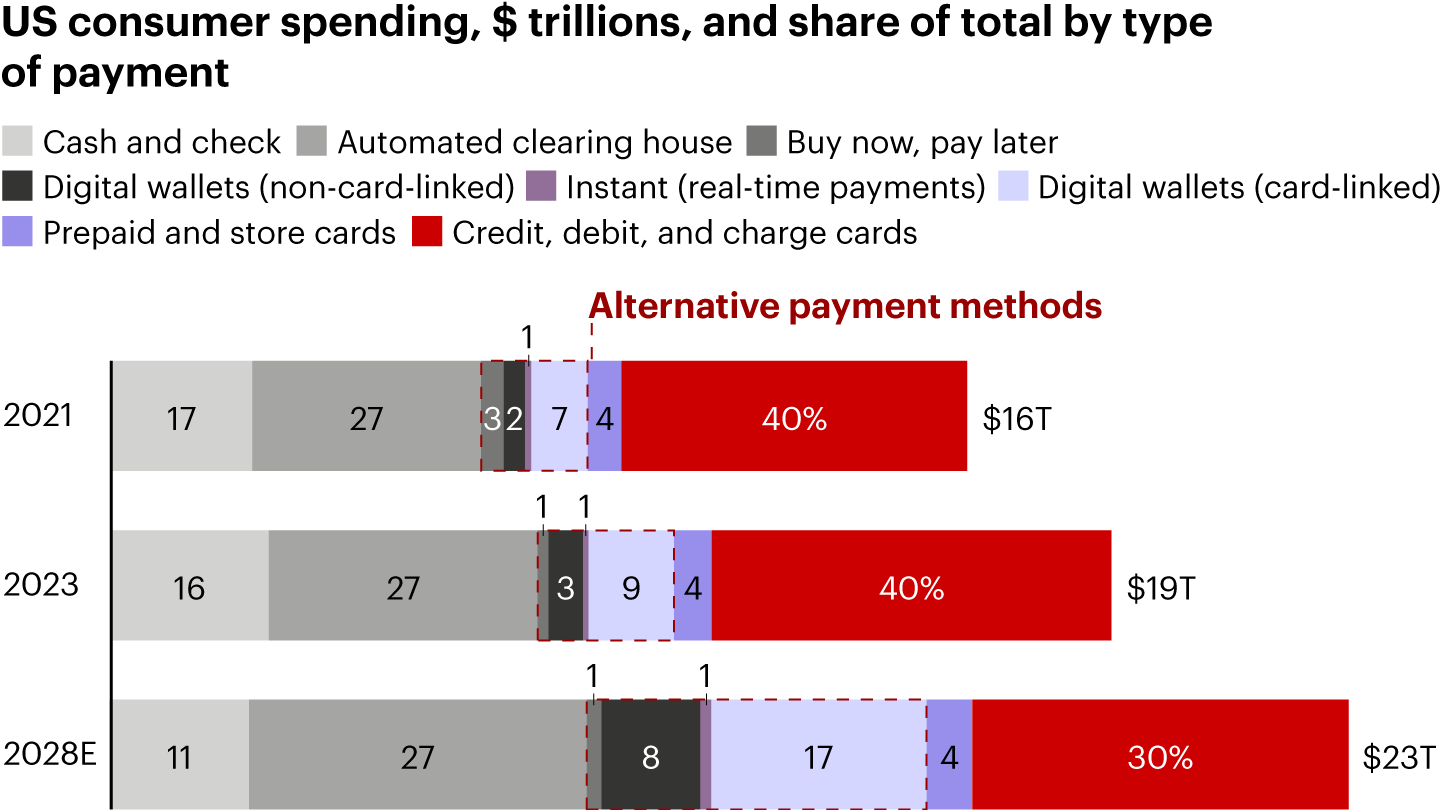
      US payment growth will shift toward alternative methods, including digital wallets
      Sources: Worldpay; GlobalData; Euromonitor; analyst reports; Bain analysis

      Make it easy, convenient, and digital

      Consumers increasingly value easy, convenient digital experiences, which partly explains why they’re more satisfied with the offerings from insurgent companies, as measured by Net Promoter Score℠, a key metric of loyalty, through an NPS Prism® survey (see Figure 2). Banks and other traditional providers risk losing ground to technology firms that increasingly dominate the customer interface via their app or their digital wallets. For instance, Apple Pay’s user base of roughly 61 million subscribers in 2024 is projected to grow to over 82 million by 2030.  

      Figure 2
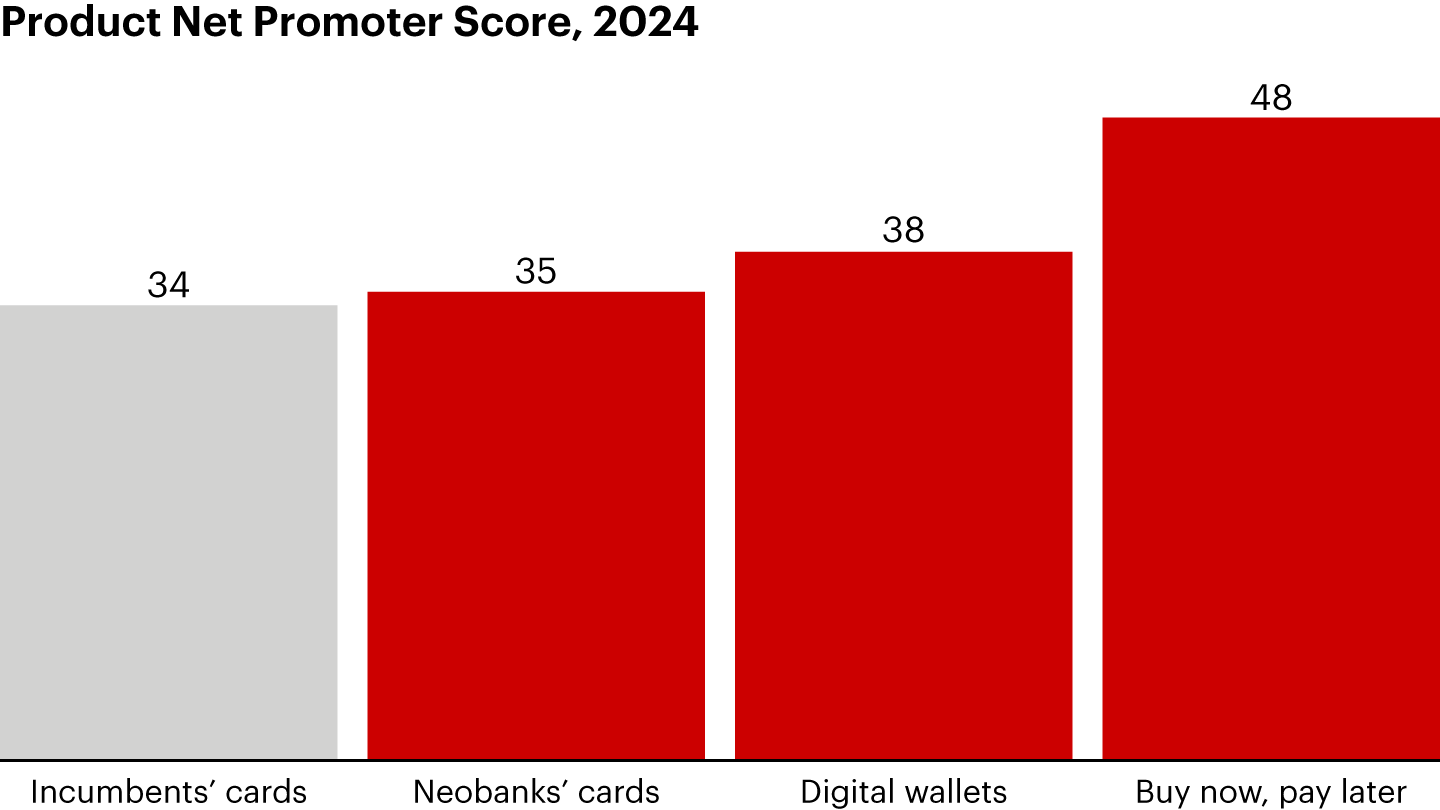
      Consumers increasingly value the offerings from insurgent companies
      출처: NPS Prism US Consumer Banking and Payments Survey, 2024 (n=90,691)

      There’s a demographic risk for incumbent banks in these trends, since around 40% of their card customers belong to the millennial or Generation Z cohorts, as shown by a recent NPS Prism survey. Younger consumers have been the most avid users of buy-now-pay-later offerings and digital wallets, raising the stakes for banks around future card revenues, cross-selling opportunities, and customer loyalty (see Figure 3).

      Figure 3
      Younger generations have led the way in using digital wallets
      출처: NPS Prism US Consumer Banking and Payments Survey, 2024 (n=254,304)

      To be sure, new payment methods also appeal to many in the Generation X and baby boomer cohorts, as seen by the slightly higher or roughly equivalent Net Promoter Scores they give to neobanks, digital wallets, and buy-now-pay-later services compared to younger generations. The risk for card issuers is even broader, as having primacy on cards helps a bank strengthen customer loyalty across other products as well. Companies with credit card primacy have a nine-percentage-point-higher Net Promoter Score than companies without primacy, according to the NPS Prism survey.

      Building resilience in payments

      The good news for banks is that they lead insurgent competitors in preventing fraud and resolving disputes—capabilities built on trusted infrastructure that will be crucial for maintaining good customer relationships. Still, banks must strengthen traditional card-based offerings while embracing alternatives. They can stay relevant by taking the following steps.

      • Elevate the customer experience. This involves focusing first on such moments of truth as adjusting limits, handling a missed payment, or processing an application for a card (see Figure 4). It also requires tailoring propositions for individual customer segments; some segments, for instance, prefer cash-back offers, while others prefer miles-based cards. A better experience hinges on banks having a deep understanding of priorities for each target segment in order to personalize different features, including elements of their loyalty program.
        Figure 4
        Card issuers should focus on moments of truth that can create promoters or detractors
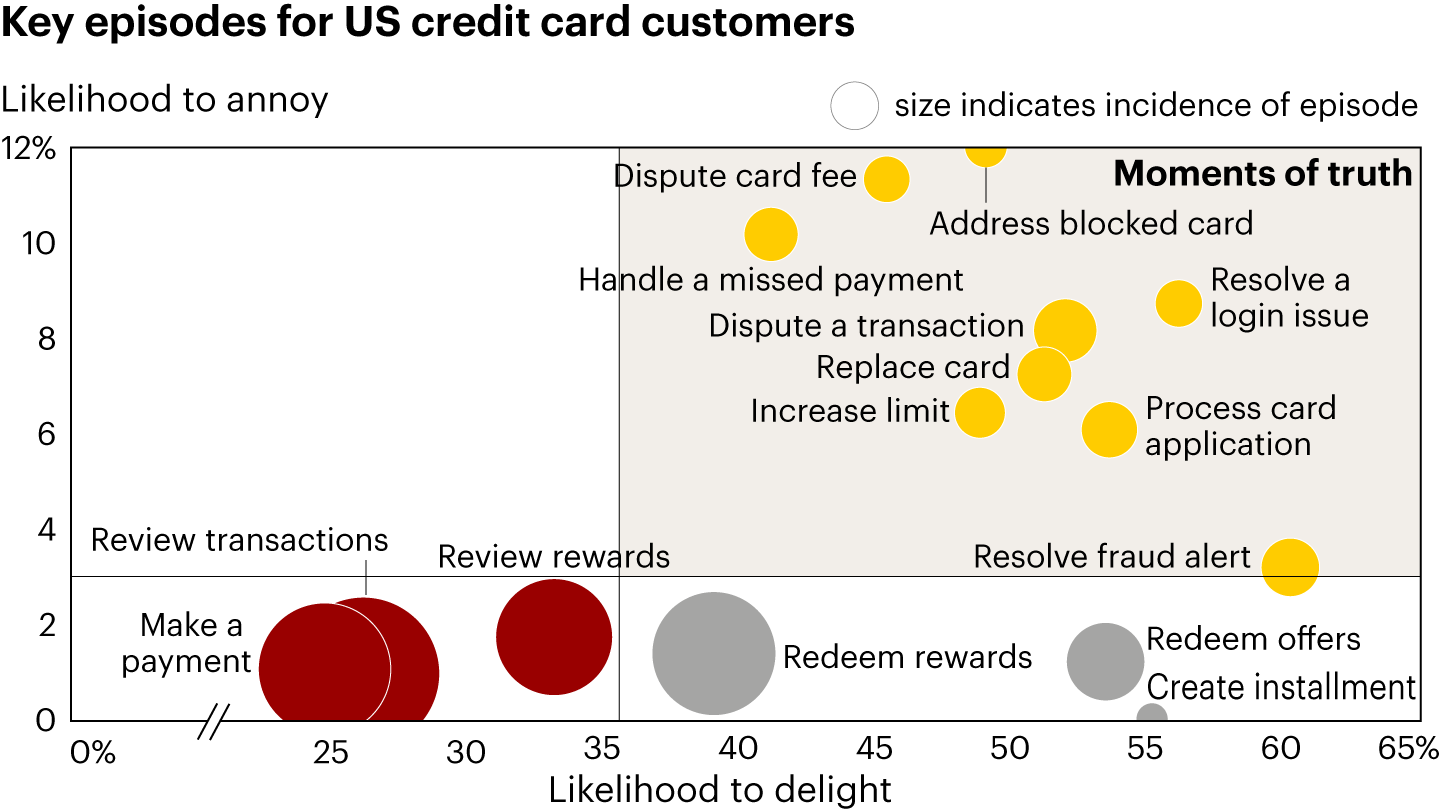
        출처: NPS Prism US Consumer Banking and Payments Survey, 2024 (n=4,382)
      • Integrate alternative payment methods. Giving customers more flexibility will boost their engagement. Nubank in Brazil allows customers to initiate an account-to-account transaction using Pix, Brazil’s real-time payment rail, but fund it with a card-based installment plan; more than 35% of their active credit card customers used the Pix financing feature in 2023.

        For US banks, Apple’s opening the iPhone’s NFC chip to third-party developers allows for contactless transactions outside of Apple Pay and Apple Wallet. Banks can now develop their own NFC-based payment solutions for the iPhone, giving them a route to win back the customer interface.

      • Use data to personalize offerings and improve risk assessments. Open banking allows card issuers to use new internal and external data pools. Banks can go beyond traditional credit scoring methods to use open finance and alternative data such as rental payment records and smartphone app usage, thereby building highly predictive risk assessments. And card issuers can create their own commerce media networks within their apps to promote products directly to consumers and tap into other revenue sources.

      • Incorporate generative artificial intelligence (AI). Generative AI technologies are already transforming payments, from setting up accounts, to analyzing customer spending, to providing shopping recommendations. Mastercard integrated generative AI into fraud detection in 2024. So far, the company has doubled its detection rate for compromised cards before they can be used fraudulently and has tripled the speed of identifying merchants at risk.

      • Rationalize the organization. Banks typically have a dedicated group for card products. To make the most of alternative payment systems, they should consider a customer-centered approach that organizes around all types of payment-related needs, regardless of the product or payment rail.

      • Modernize the processing infrastructure. A more flexible technology stack will reduce process complexity and manual work, and more easily integrate services, such as combining a checking account with a credit card account. This type of contemporary system is able to quickly accommodate new features that improve the customer experience, and interface easily with external partners when necessary.

      Demand for payments in the US will continue to shift toward digital wallets, peer-to-peer services, and account-to-account transactions. For banks, staying competitive will require more than incremental adjustments. They will have to update loyalty programs, modernize technology, and leverage data to provide personalized propositions to their target customer segments. Those banks that adapt their payments strategies will benefit from robust growth in this market, along with enhanced customer loyalty and the cross-selling opportunities that come with it.

      NPS Prism®

      Our cloud-based customer experience benchmarking service provides actionable insights and analysis that guide your creation of game-changing customer experiences.

      저자
      • Headshot of Antonio Cerqueiro
        Antonio Cerqueiro
        파트너, São Paulo
      • Headshot of Erin McCune
        Erin McCune
        Alumni, San Francisco
      • Headshot of Tevia Segovia
        Tevia Segovia
        파트너, New York
      • Headshot of Joe Fielding
        Joe Fielding
        파트너, New York
      • Headshot of Philipp Grimmig
        Philipp Grimmig
        Practice Director, Frankfurt
      문의하기
      관련 산업
      • 금융 서비스
      • 뱅킹
      • 뱅킹(2)
      • Payments
      관련 컨설팅 서비스
      • Customer Experience
      • Net Promoter System®
      최적의 솔루션 찾기
      • NPS Prism®
      금융 서비스
      How Banks Can Tease Out the Loyalty Metrics That Matter

      Measuring performance on the key episodes for a bank’s customers allows the bank to focus on investments that will improve loyalty—and its economics.

      자세히 보기
      금융 서비스
      The Fragmentation of Wholesale Payments Calls for Banks to Remake Their Approach

      Banks have a dominant position, but competitors look set to take market share.

      자세히 보기
      NPS Prism®
      Utilities Can Power Growth Through a Better Customer Experience

      Top performers turn everyday interactions into loyalty, lower costs, greater revenue streams, and stronger reputations.

      자세히 보기
      금융 서비스
      Why Banks Should Treat Payments as a Business

      As payment volumes grow at a healthy clip, banks must manage payments cohesively to retain customer loyalty and expand into other offerings.

      자세히 보기
      금융 서비스
      When Bots Say No, Customers Don’t Let Go

      For complex service episodes, a machine’s answer often feels hollow. To earn trust and loyalty, companies need human agents in the loop—backed by AI.

      자세히 보기
      First published in 3월 2025
      태그
      • 금융 서비스
      • 뱅킹
      • 뱅킹(2)
      • Customer Experience
      • Net Promoter System®
      • NPS Prism®
      • Payments

      프로젝트 사례

      어드밴스드 애널리틱스 Blockchain-enabled Payment Flows: A Payments Company Reviews its Strategy

      See more related case studies

      어드밴스드 애널리틱스 A Digital-First Bank Finds a Customer-Driven Path to Profitability

      See more related case studies

      정보기술(IT) An Omnichannel Redesign Helps Transform a Bank’s Customer Experience

      See more related case studies

      베인에 궁금하신 점이 있으신가요?

      베인은 주저 없이 변화를 마주할 줄 아는 용감한 리더들과 함께합니다. 그리고, 이들의 담대한 용기는 고객사의 성공으로 이어집니다.

      Net Promoter®, NPS®, NPS Prism®, and the NPS-related emoticons are registered trademarks and Net Promoter Score℠ and Net Promoter System℠ are service marks of Bain & Company, Inc., Satmetrix Systems, Inc., and Fred Reichheld.

      급변하는 비즈니스 환경에서 살아남기 위한 선도자의 시각. 월간 Bain Insights에서 글로벌 비즈니스의 핵심 이슈를 확인하십시오.

      *개인정보 정책을 읽었으며 그 내용에 동의합니다.

      Privacy Policy를 읽고 동의해주십시오.
      Bain & Company
      문의하기 환경정책 Accessibility 이용약관 개인정보 보호 쿠키 사용 정책 Sitemap Log In

      © 1996-2026 Bain & Company, Inc.

      문의하기

      무엇을 도와드릴까요?

      • 프로젝트 문의
      • 채용 정보
      • 언론
      • 제휴 문의
      • 연사 초청
      오피스 전체보기