

Brief

With marketing technologies growing ever more powerful, many companies are deploying the latest tools to personalize marketing or make ad spending more efficient. There’s no question that new digital technologies allow marketers to approach customers with surgical precision, unlike the blunter instruments of just five years ago. But the rush to invest in new technologies designed to boost the return on investment (ROI) of a single purchase or channel often misses the foundational goal of knowing who your target customers are, what they’re worth to the firm and how they behave. If a customer has a high potential lifetime value, it’s worth pulling out the spending stops to persuade him or her to make a first purchase with the brand, which, of course, would likely hurt short-term ROI. Without that perspective, companies might waste money acquiring low-value customers or targeting prospects who are unlikely to make a purchase.
Leading marketers are using advanced analytics to predict and understand customer behavior, to connect effectively and retain high value customers. Brian Dennehy, expert vice president in Bain's Customer Strategy & Marketing practice, outlines how a marketer can turn a hypothesis into action.
What marketing leaders do differently
Marketers who train their machines, metrics and minds to improve customer lifetime value emphasize enduring customer relationships over immediate channel results or a single transaction’s value. As marketers adopt increasingly powerful artificial intelligence tools—whether for one-to-one or segment marketing—they will want to direct those tools and related ROI metrics to deepening customer relationships.
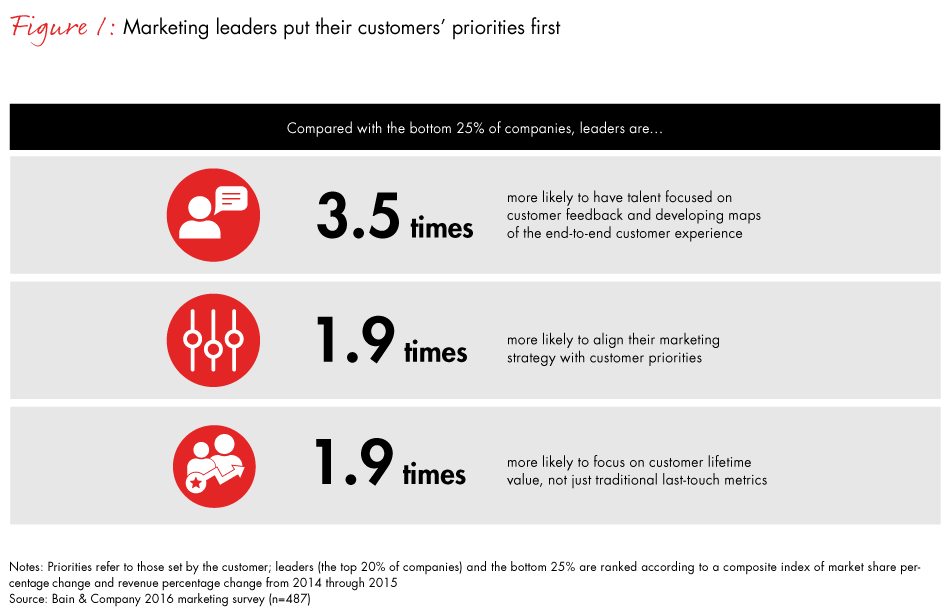
Marketing leaders today do more than acknowledge that customer lifetime value matters; they actually focus their spending and staff resources accordingly. A Bain & Company survey of roughly 500 companies found that marketing leaders exhibit a few characteristics that set them apart from the bottom 25% of companies. The leaders are:
-
3.5 times more likely to embed employees in marketing who specifically focus on understanding the customer's end-to-end experience;
-
1.9 times more likely to align their strategy with customer needs rather than channel needs; and
-
1.9 times more likely to scrutinize customer lifetime value in addition to more traditional last-touch metrics such as ROI, customer acquisition cost and click-through rate (see Figure 1).
Shifting to a customer focus leads to better economics. That financial benefit flows largely from creating more promoters among the customer base—people who spend more with the company, stay longer and generate more referrals.
Marketing leaders break down the challenge of this shift into manageable pieces, and hone skills in three key steps:
- Build smart, targeted segmentation based on a customer’s overall value.
- Use technology to develop a deeper understanding of customers’ priorities and experience at each step of their relationship with the company.
- Make data-informed hypotheses about which technologies to use in order to acquire and retain the customer.
1. Learn who your customers are and what they are worth to you
Not all customers are created equal, and gaining a thorough understanding of the variations among customers allows marketers to gauge how much to invest in each one. Fortunately, marketers don’t need a complete view of a customer to reach her effectively, just some minimum viable data such as demographic and location data, frequency of purchase and average purchase size.
Even that basic level of knowledge allows marketers to explore how target segments behave, and where to increase or decrease spending in order to influence behavior. The Carlson School of Management at the University of Minnesota wanted to improve the number and quality of applications. It began projecting application numbers and choosing marketing investments based on segment sizes and conversion rates at each stage of the marketing funnel, from awareness to consideration to action. Previously, Carlson used a set cost-per-lead metric, with no calculation for projecting which of the potential students actually applied. Now, Carlson uses the lifetime value metric to know the effectiveness of each early-stage campaign in creating applications, and has realized a 28% lift in applications with the same level of spending.
Applying a lifetime value lens also helps to identify the individual customers who merit the highest and lowest levels of investment. For years, a major clothing retailer had considered all customers as essentially having equal potential, and it spread its marketing dollars too thin. By turning a value lens on its department, channel and demographic data, the company learned that women whose first purchase was a handbag frequently returned to buy goods in other departments. Women who started through lower-priced, more impulse-based departments rarely returned. Likewise, first-time shoppers who then shopped in a new channel such as online had a higher lifetime value than those who shopped only in a single channel. Armed with this new knowledge, the retailer steered its marketing communications to women with the highest potential value, and realized a threefold annual increase in its return on spending for three years running.

What Separates Marketing Leaders
Marketing leaders are changing the game in a variety of ways.
2. Once you know your high-value customers, learn how to connect with them
After a company has built a smart segmentation scheme, the next task is determining how best to connect with target customers at a personal level. Before consumers buy, they typically have hundreds of touchpoints, online and in the physical world, across many channels, devices and situations (see Figure 2). Marketers must understand an individual’s needs and wants throughout the episodes that make up his experience—where he shops, what products he buys, what moments and interactions annoy or delight him.
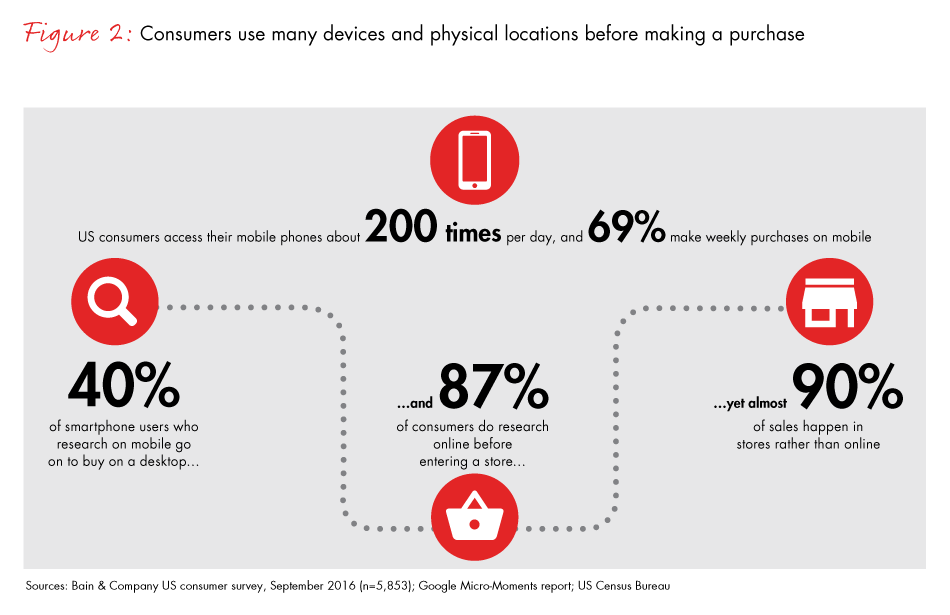
Technologies can help marketers fill out the picture of how people behave before they make a purchase. For example, Google Analytics shows whether people redeem discounts that increase their loyalty, or whether mobile or desktop searches result in more conversions for a particular product. Marketers can choose billboard or radio advertising by mining smartphone location data to see where and when people drive before they enter a grocery store.
When consumer engagements are complex enough that it’s difficult to manually optimize marketing, some companies have deployed machine learning in a more automated approach (see sidebar, "Questions to consider when evaluating automation"). Sam’s Club, a retail warehouse club, has learned that people who download its mobile application and start browsing consumables will probably become regular members. Using a machine learning tool from Liftoff, Sam’s Club has been targeting “lookalikes”—prospects who have characteristics matching current customers—to identify users most likely to sign up for membership. Now it’s raising the average revenue per member by reminding them to complete half-completed tasks within the app.
3. Use informed hypotheses to identify which marketing levers to pull
Having identified which high-value customers to address, defined their lifetime value and drawn a profile of their priorities, leading marketers then make informed hypotheses on which media levers to test first. Knowing someone’s shopping history, location, media preferences and at least some of her expressed views would be enough information to, for instance, push marketing messages to certain websites on her cellphone during her morning train commute. If the customer follows influential reviewers, those reviewers could merit a pitch by the company.
When one consumer products company teamed with a drugstore chain to increase sales of an everyday personal-care product, it first set about creating detailed digital profiles of likely customers in test cities. The company gathered demographic and economic data on residents near the drugstores, then overlaid the responses to advertising on two groups that it hypothesized would be likely customers with a high lifetime value: heavy coffee drinkers and online daters. It made several offers through such channels as mobile ads on Match.com, Marthastewart.com and other websites, as well as mobile ads to nearby Starbucks locations. The company also discovered that ads shown during the 7 to 10 days per month when residents typically receive their paychecks sharply increased sales. By reaching the right people in the right stores at the right time and through the right channels—and at relatively low cost—the campaign spurred a 34% increase in sales through control stores.
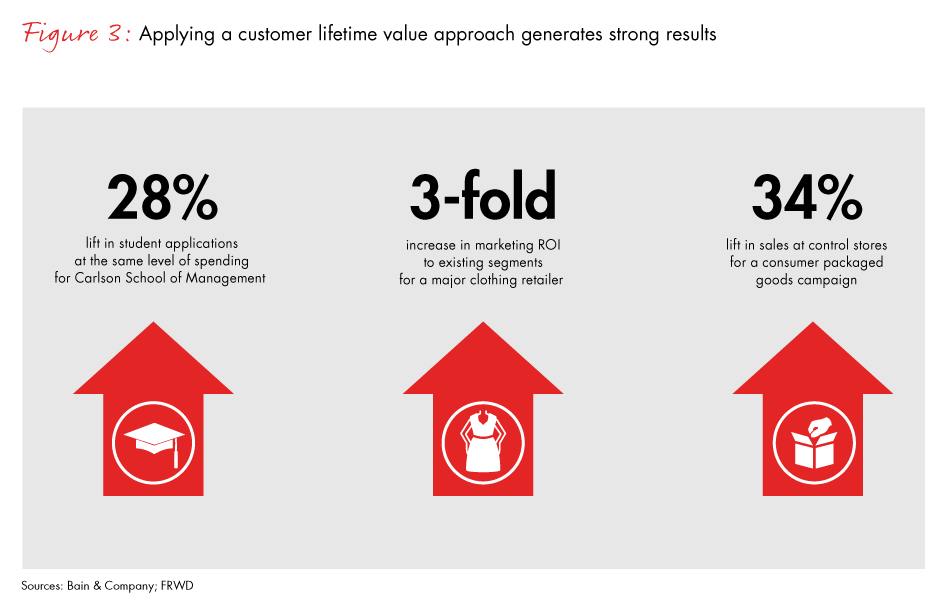
Marketers benefit from the proliferation of digital data exhaust and better tools to analyze the data. But machines alone cannot build strong relationships with target customers; the care and feeding of relationships require human intervention, as the experiences of these companies attest (see Figure 3). Marketing staff will still add value by hypothesizing what variables to test and what stories to tell, and the most powerful marketing will bring together the machines, metrics and minds.
Questions to consider when evaluating automation
Succeeding with a customer-centered approach entails integrating the strands of technology that may be scattered inside an organization, such as first-party data, the customer relationship management (CRM) system and the programmatic ad-buying system. To assess whether their technology is customer-worthy, marketers can address a few key questions:
- Do we own our customer data sets, and do customer insights inform our advertising?
- Do our CRM system and first-party data connect to our data management platform and digital marketing?
- Will we bid higher in our digital advertising for customers with a greater potential lifetime value?
- Can we link online actions with offline results, and vice versa, to truly measure ROI?
- Are our marketing model and data centralized so that all the business units can learn collectively?
- Are we making decisions on outdated historical data or investing in predictive analytics to inform our next moves?
Laura Beaudin is a partner in Bain & Company’s Customer Strategy & Marketing practice and leads Bain’s global marketing excellence work. Brian Dennehy is an expert vice president in the Customer Strategy & Marketing practice. John Grudnowski is the founder and CEO of digital agency FRWD. Beaudin and Dennehy are based in San Francisco, and Grudnowski is based in Minneapolis.
The authors thank colleagues John Campbell, Francine Gierak, Wendy Grad, Anjali Joy and Jared Sisk for their help in developing this brief.
First published in 8월 2017