

M&A Report

한눈에 보기
- Oil and gas companies enjoyed a wave of consolidation in 2024, and chemicals companies reshaped portfolios.
- The energy sector engaged in more than $400 billion in deals, a three-year record.
- Now, companies across both sectors are striving to achieve deal value faster than ever.
- Acquirers are increasingly using generative AI to enable more robust and more reliable deal synergy estimates.
This article is part of Bain's 2025 M&A Report.
While many companies pumped the brakes on energy transition deals in 2024, it was a record-setting year for consolidations by oil and gas companies anticipating a longer path for hydrocarbon demand. The energy sector saw more than $400 billion in acquisitions—a three-year high—with more than 10 megadeals, the biggest of which was the Diamondback Energy and Endeavor Energy Resources merger. There were also a host of midsize deals, such as Chord Energy and Enerplus. All in all, the sector saw a shift toward scale deals, which comprised 86% of strategic M&A in excess of $1 billion.
Meanwhile, in chemicals, forward-looking companies embarked on portfolio reshaping. Some companies divested assets as they strategically rethought the market segments and geographies that would offer the best opportunities for profitable growth and leadership. Another key theme was Middle East–based oil and gas companies moving into chemicals through organic and inorganic investments—such as Adnoc’s announced acquisition of Covestro—and lowering their long-term risk from the energy transition.
Overall, deal value in the energy and natural resources industries rose by 2%, and volume grew by 4% during the first 10 months of 2024 over the same period last year.
As companies pursue different approaches to M&A, they find themselves racing to meet the same goal—namely, to generate higher deal value at a faster pace to make the deal economics work. Consider ConocoPhillips banking on its Marathon Oil acquisition to achieve $500 million of run-rate cost and capital savings in the first year following closing.
Several upstream oil and gas companies have set timetables for achieving deal synergy targets by the end of year one while also increasing the focus on working capital, including inventory optimization. At the same time, midstream oil and gas companies are increasing the focus on commercial synergies and capturing value across the integrated value chain from “wellhead to the water’s edge.” With intensified competition for the industry’s best assets, acquirers must look at all of these levers to achieve their target deal economics.
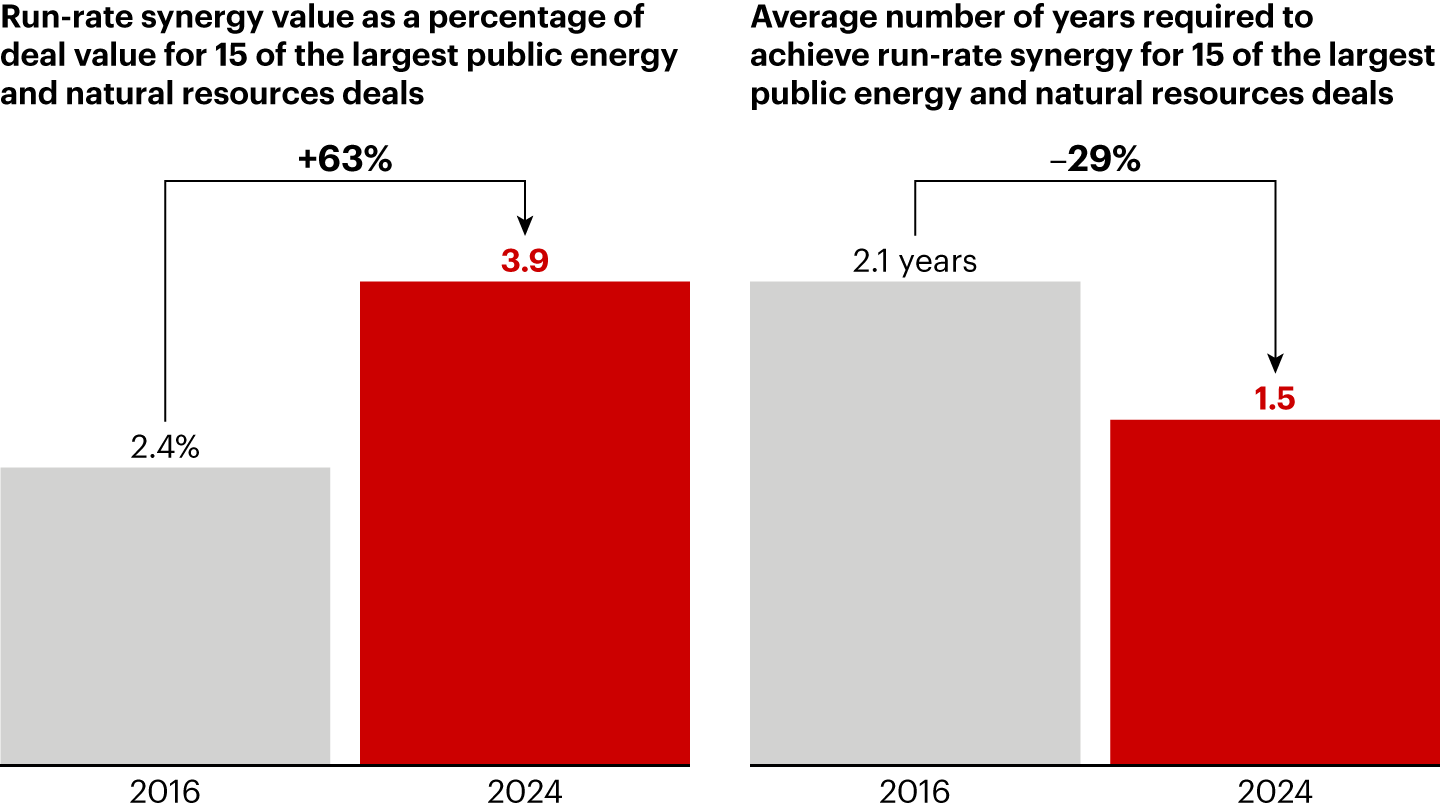
These and other companies across the industry are taking advantage of the shifting dynamics that will make it possible to unlock more value faster. For example, forward-thinking companies are increasingly using generative AI capabilities to enable more robust and more reliable deal synergy estimates. Similarly, some companies are investing more rigor and planning to develop synergy realization plans during pre-close periods, allowing them to execute immediately at close and thus increase synergies that are created (see Figure 1).
Figure 1

Let’s look at five ways companies are accelerating deal synergies.
Robust, evergreen M&A pipeline management
To win in the energy industry’s active deal environment, successful companies are obsessive about the industry game board. They actively engage in scenario planning for different potential M&A combinations, always preemptively evaluating strategic fit rather than waiting to react to shifting market dynamics.
Many companies are even taking it a step further and proactively engaging in outbound activity to get deals done. We increasingly see that assets are not coming to market formally through investment banks. Instead, successful deals are the result of informal connections or regular outreach among CEOs and M&A executives. Companies that choose to wait for formal processes risk missing out on the best potential deal opportunities.
Higher standards for diligence
Interest rate increases caused 95% of strategic buyers to change their M&A approach, according to the energy and natural resources industry respondents to our 2024 M&A practitioner survey. The bar for sourcing and diligence is rising as the high cost of capital shrinks the margin of error for delivering deal returns.
This means companies need to work on generating better insights and developing higher confidence in synergies. It is no longer enough to apply broad brushstrokes of industry benchmarks. The best acquirers are relying on swiftly evolving tools and data to forge a tangible path to rapid synergies, and they’re engaging in stronger integration planning earlier.
We see more companies deploying generative and traditional AI to quickly assess data from both parties and identify synergy potential. For example, companies can review large numbers of supplier contracts to identify procurement savings and even use generative AI to draft correspondence for the long tail of suppliers. The new technology also is being utilized to analyze customer data, market segmentation, and product portfolios to identify customer cross-selling opportunities.
We see more companies deploying generative and traditional AI to quickly assess data from both parties and identify synergy potential.
This is particularly critical in the early stages of deal formation to rapidly (and creatively) assess the potential levers for value at stake. These models combine structured and unstructured data to screen hundreds of targets against a diverse set of criteria, including financial health, growth, market position, and even elements of the business model such as whether the target has a direct-to-end-user channel.
Pre-close integration planning
Beyond higher diligence standards, the best companies now devote more energy to translating the deal thesis into an integration thesis. Knowing the what is no longer enough; companies in energy and natural resources now need a clear view of the how for delivering value.
This imperative leads companies to engage integration teams sooner, spanning the full suite of planning from IT and systems to supply chains and operating model design. We see teams digging in earlier on what will be harmonized, how the integration will deliver quick wins for value, and what contingencies are needed. One common example in shale oil and gas involves establishing the asset and basin-level operating model and a common decision-making framework for operational teams. These teams make complex technical decisions as well as trade-offs between optimizing costs and maximizing production and recovery. So, it’s critical to define a company’s decision process and decision accountabilities.
Capabilities transfer in the integration
As companies search for value, we find that the best acquirers consider opportunities to transform both the buyer and target companies to deliver new value. There are fundamental questions to ask:
- What is the target best-in-class at?
- What are the learnings that can be expanded to a combined organization?
- What enables the target to perform exceptionally well—for example, are there systems, structures, or specific behaviors at the target company that the acquirer can learn from?
- What is core to the target’s culture and ways of working?
- Where should it be maintained, and where will cultural fault lines need to be mitigated through thoughtful change management?
As companies search for value, we find that the best acquirers consider opportunities to transform both the buyer and target companies to deliver new value.
Indeed, it’s a time to determine which improvement areas could be unlocked through the target’s capabilities and best practices (a.k.a., reverse synergies). One shale oil and gas company believed that the target had a superior approach to completions in a particular basin and sought to apply the methods across its footprint. A chemicals company identified in due diligence that the acquirer performed plant turnarounds faster and sought to apply those practices to its own assets. In the best of situations, the acquirer identifies how the integration can be a catalyst for deeper, more transformative change.
Collaborating and learning from each other can begin in a pre-close environment; it’s an especially valuable opportunity in deals with extended timelines. In addition to the exchange of information (of the not competitively sensitive variety), direct interactions with employees of the target company—be they through one-on-one interviews, surveys, or joint workshops—can accelerate the process of learning how each other works.
Culture integration focus to avoid eroding deal value
Energy and natural resources M&A practitioners tell us that cultural integration is now a top three issue for any transaction. The goal of any deal is to secure its intended value. There’s now industry-wide recognition that the tricky issue of merging cultures can make or break the integration and value delivery.
Leading acquirers strive to mitigate cultural obstacles before even putting time into developing broader, full-potential culture plans. These players proactively identify issues that could disrupt the integrations—we call these cultural fault lines—such as differences in purpose, decision making, or ways of working. A couple of issues we typically see involve differences in the level of detail of business performance reviews and in approaches to budget variances.
Also, it’s not uncommon to see differences in capital decision making, such as the level of rigor and number of scenarios required before making a final investment decision. If left unaddressed, these differences could harbor misunderstanding and misinterpretation, sometimes taking years to unwind. The best companies use the pre-close period to identify and address these cultural fault lines and the issues they could create.
Companies in energy and natural resources are also putting greater emphasis on defining a cultural thesis. They think through when to assimilate, when to preserve and protect aspects of the target culture and the processes that have enabled its success, when to bring the best of both organizations to bear, and when to use the integration as a catalyst for cultural reinvention. The right answer will vary by deal and by the organizations’ teams. As many companies have discovered, culture is a bespoke problem that requires a bespoke solution.