

Brief

Grocery chains in many countries face intense price pressures due to the rise of competition from new entrants with discount-heavy business models, mass merchants and online channels. In the US, for example, food deflation over the past year stems partly from low oil and grain prices but also from cutthroat competition.
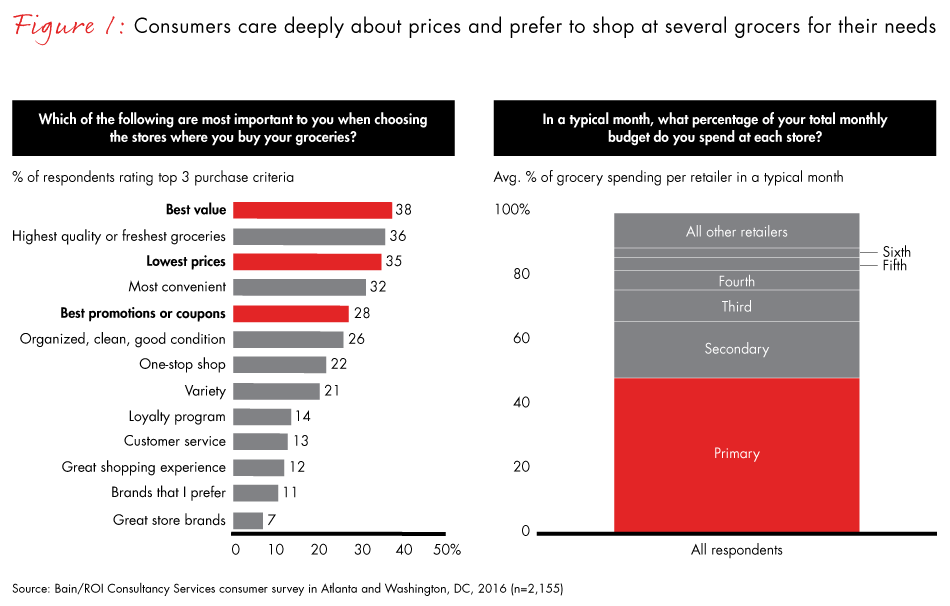
Consumer preferences reinforce the trend. “Best value” and “lowest prices” are the first and third most important factors in choosing a grocer, according to a recent survey of nearly 2,200 consumers in Atlanta and Washington, DC, by Bain & Company and ROI Consultancy Services. And it’s easier than ever for consumers to spread their spending among different grocers. Almost half of monthly grocery spending, on average, goes to stores that are not the consumer’s primary store, with many shoppers buying from three or more retailers, Bain’s survey found (see Figure 1).
Sandeep Heda, a partner with Bain's Retail practice, outlines four key areas where retailers can focus to improve price perception.
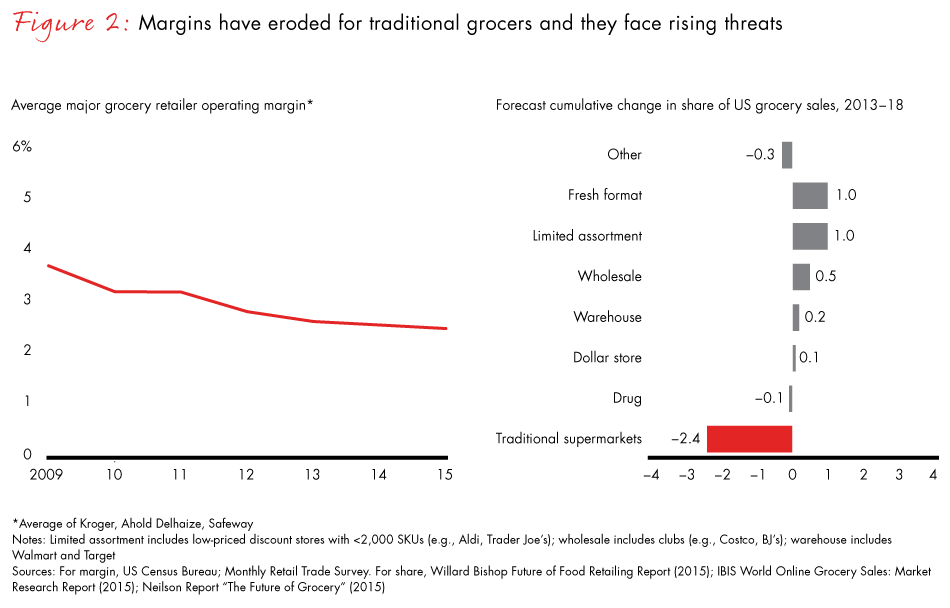
Traditional grocers in the US now face aggressive, discount-oriented competitor ALDI from Germany, with Lidl hard on its heels, along with Save-A-Lot, Dollar General, mass merchant Walmart and other homegrown firms touting low prices. ALDI has been winning in the center-store, nonperishable section with an emphasis on private-label products, and now is making headway in produce and other fresh items. Traditional chains such as Safeway, Kroger and Ahold Delhaize have turned to price reductions as one major defensive move, which has contributed to profit margin erosion over the past five years (see Figure 2). Yet the traditional chains are expected to lose market share over the next couple of years to fresh format and limited-assortment discount chains. And now Amazon is testing small-format grocery stores under its name.
In the UK, traditional retailers like Sainsbury’s, Tesco and Asda also face intense competition from the rise of discount retailers including ALDI and Lidl. Despite their more limited ranges and foreign brands, the discounters’ formats increasingly appeal to a growing share of price-minded consumers. Traditional UK chains have made deep price investments, especially for known value items (KVIs) that they hope will draw people into stores. As a result of the price war, profitability for the UK industry as a whole has suffered.
Many of these chains have made huge investments to slash prices broadly. As pressure intensifies to reduce prices, either by cutting the list price or offering a discount, grocers may act hastily, without the same rigor they apply to investments elsewhere. Yet, changing prices can have an even greater effect on company financials. Operating margins have been declining for years, and as margins erode further, pressure on ROI will increase.
For struggling grocers, knowing how to invest to gain share of wallet among current customers, and attract new customers, has become critical to their survival. A key part of that process is to embed a favorable price-value image in consumers’ minds.
Will customers notice?
When grocery managers make decisions on pricing, two fundamental questions sometimes go unasked: Will customers notice? And will the retailer get an attractive return on the investment?
Even though what ultimately matters most is how customers perceive the price point, all too often, they do not notice. At the very least, though, a grocer wants to get credit for the chosen price structure—in other words, for consumers to have a good sense of how its prices compare with competitors. And most grocers want to be perceived by consumers as having lower prices, relative to competitors, than they in fact do. A retailer with average prices that are 5% higher than a key competitor’s prices would love to be perceived as being at parity.
In fact, grocers often can find better ways to improve price perception than investing in lower shelf prices. Even a 1- or 2-point difference in perceived prices can be worth hundreds of millions of dollars in sales or margin—by attracting new customers and expanding share of wallet with existing customers.
There are clear winners and losers in the battle to get this pricing credit from consumers. Our survey asked consumers about the prices at eight retail chains carrying groceries. We found that retailers get more or less recognition for their pricing than actual shelf prices would suggest (see Figure 3). Retailers above the diagonal line are perceived by consumers to have higher prices than the actual prices warrant, and are losing the battle for favorable perception.
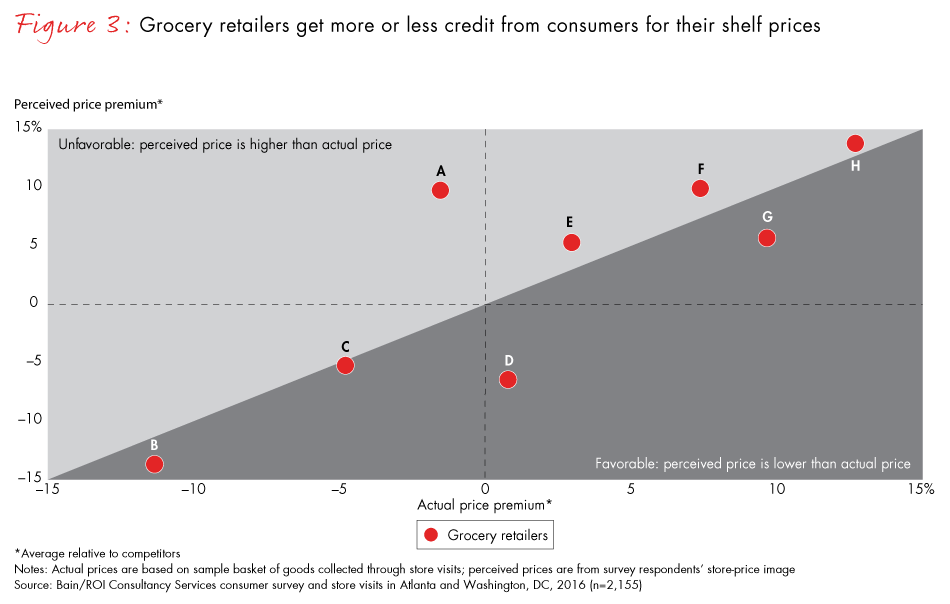
For example, Retailer A’s store and product design has given consumers in the survey the impression that it charges a price premium when, in fact, its prices run slightly lower than the average in the two cities. Its pricing strategy does not mesh with its overall proposition to customers. As a result, the retailer does not get the pricing credit it deserves. Retailer A might decide to capture more margin through selective price increases, since customers have already (incorrectly) baked the perceived premium into their shopping decisions.
Beyond shelf price, how can grocers get more credit from consumers in order to build traffic, expand share of wallet and earn loyalty with their target customers?
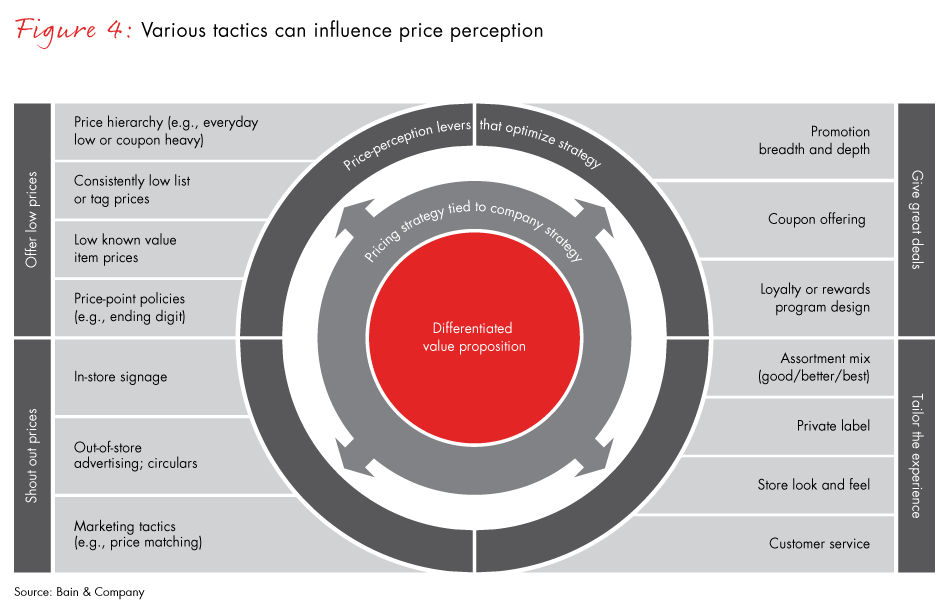
Grocers can choose among more than 15 tactics in these four categories: offering lower prices, shouting out those prices, giving great deals and tailoring the experience (see Figure 4). Not all price tactics make sense for all grocers, and there is no single best mix of tactics. The right combination depends on a grocer’s strategy and proposition to customers.
However, the survey findings do contain insights with practical value for any retailer. Because perceptions coalesce based on many variables apart from the relative shelf price, most traditional grocers probably invest too much in price matching and in “low, low price” blasts in circulars. Our survey found that respondents generally care less about those expensive tactics than about other things.
A traditional grocer that caters mainly to middle- and higher-income customers, for instance, needs to have a broad assortment of grocery items and strong perceived quality. It should focus on very targeted moves, including KVIs, promotions and signage, rather than on tactics that could significantly change the high-end proposition to consumers. Out-of-store advertising, excessive price matching or coupons may undermine the chain’s quality perception (see Figure 5).
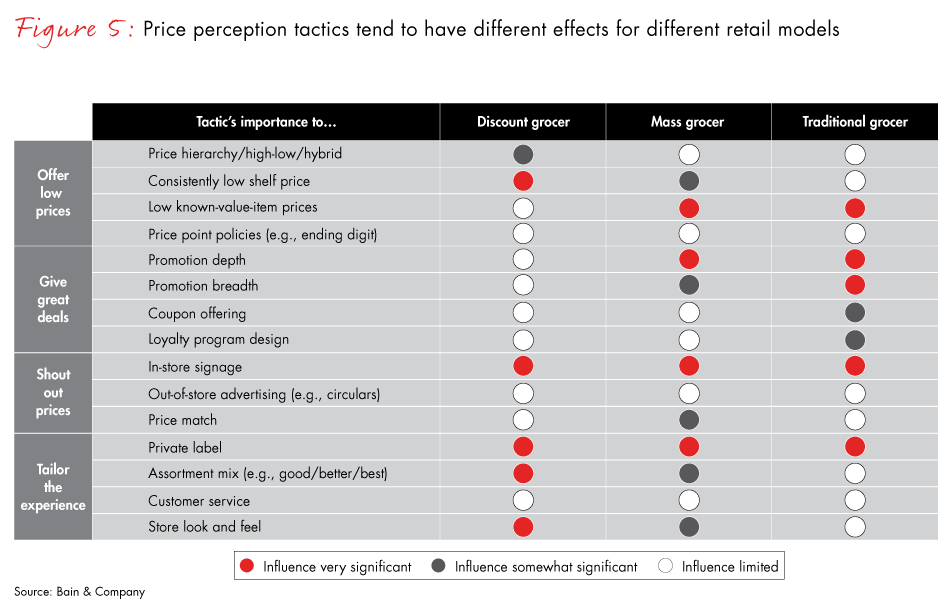
A discount grocer, by contrast, typically uses product offering and architecture—a limited offering with a few high-end products—to influence perceptions. Since its customers are less sensitive to product quality and breadth, the discounter can offer a narrower assortment, letting it present a lower-price, affordable image in stores.
Our survey asked consumers about a couple of competing grocers where they have shopped, and how they view each grocer’s pricing. By aggregating the responses, a distinct pattern of price perception for each company emerged. We also asked consumers about specific tactics such as signage, promotions coupons and so on. Again, aggregating responses shows how strong or weak, relative to key competitors, consumers perceive each grocer’s performance in each tactic. These answers can be compared with the aggregate responses giving more or less credit than deserved on price positions. In that way, a grocer’s perceived price position can be correlated with the most relevant tactics.
The survey findings, combined with our experience working with grocery chains on their pricing, highlight other tactical implications:
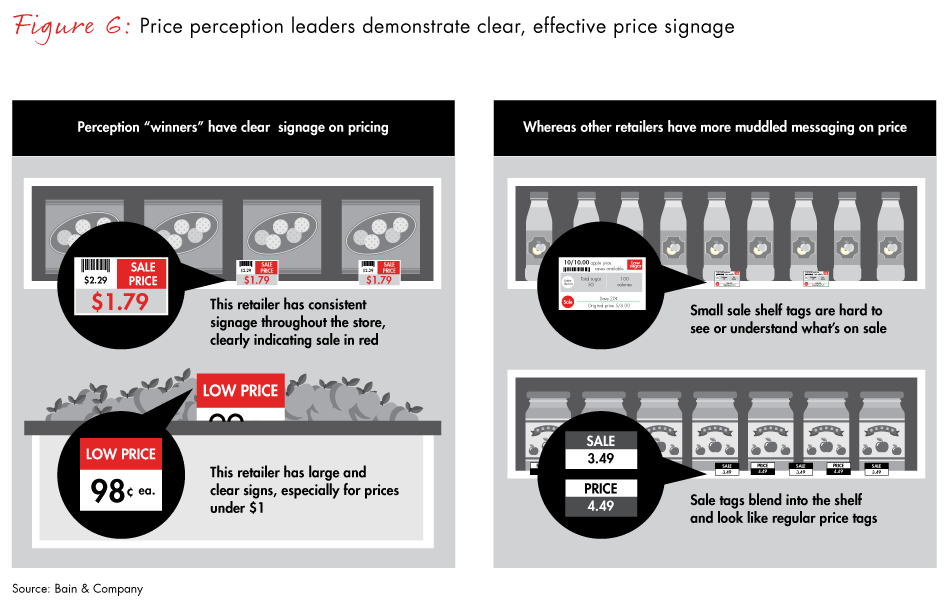
- Signage. Clear and consistent in-store signage stands out as a powerful tactic for all grocers, though not all excel in this area (see Figure 6).
- KVI. Effective KVI pricing serves as table stakes, but does not guarantee favorable perception in a crowded market.
- Promotions. Deep promotions on select items help form positive perceptions. For traditional chains that use a high-low pricing model, the breadth of promotions, coupon offerings and loyalty programs can further enhance perception. Because their cost structure is higher than the discounters and mass retailers, traditional grocers can improve price perception through strategic use of promotions.
- Private label. Beyond delivering value, private-label products can also be used to strengthen quality perception. Wegmans, a private chain in the Northeast US, uses private label to advance its more premium experience. Wegmans has been ahead of the curve with unique private-label products, introducing gluten-free, wheat-free, and organic options early on. The company views private label not as an entry price point, but rather as a way of offering differentiated products that consumers want but can’t find affordably elsewhere.
- Store design. The look and feel of stores can influence perception for discount and mass grocers. However, for traditional grocers, design may have little effect or is hard to pull off without eroding the quality that customers expect.
- Out-of-store advertising. Circulars and other external advertising are proving less valuable in forming perception than in-store signage and messages. Circulars could shift to other content, such as meal solutions and unique items, without hurting perception.
Mapping a path to improved perception
The pricing game plan should combine price data, intelligence on consumers’ perceptions, the pricing strategy and the overall value proposition. To determine which tactics to deploy, a grocer should first gain a deeper understanding of its current price position vs. consumers’ perceptions. Checking its prices against competitors’ prices on comparable items will reveal actual price gaps. Then, determining consumers’ perceptions through primary research, similar to the survey we described earlier, will show whether and how they actually perceive those price gaps.
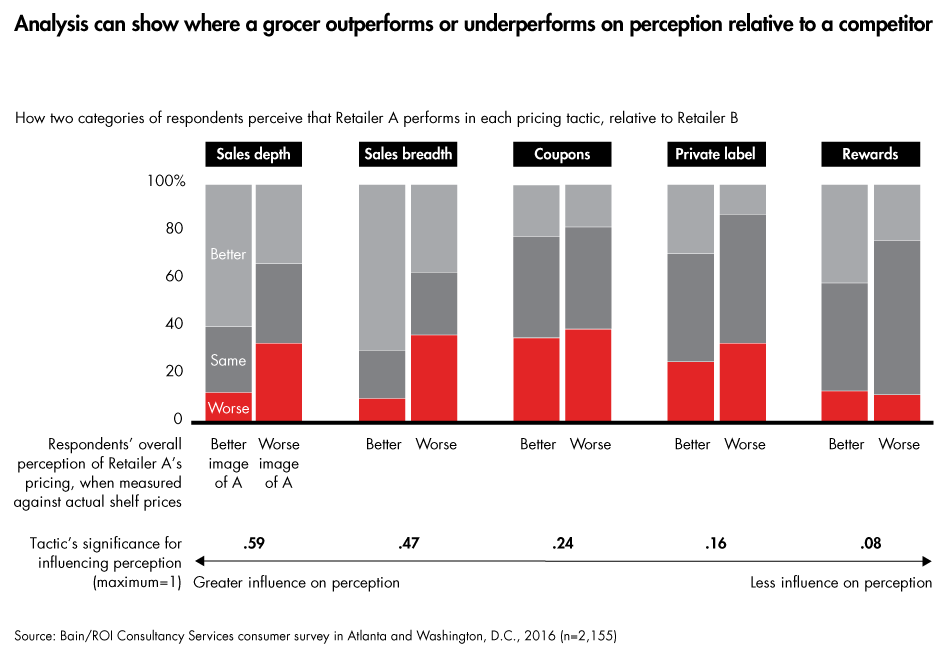
The next task is to identify the factors with the strongest influence on consumers’ perceptions. They can be gleaned through surveys and in-store visits, asking consumers about the grocer’s signage, promotions and so on. Again, aggregating responses allows managers to see how strong or weak, relative to key competitors, consumers perceive the company’s performance on each tactic. These answers can be compared with the aggregate responses giving more or less credit than deserved for actual price positions. If consumers perceive that a chain’s prices are lower than they really are, the analysis can home in on the areas where consumers think the grocer outperforms (see below for a sample type of analysis, and the sidebar, "How one grocer corrected perceptions and turned the tide," for one grocer’s moves to improve perception).
A grocery retailer can tease out the specific ways in which consumers perceive that it outperforms or underperforms a key competitor in pricing. The first step is to classify respondents as having a better image or worse image of the company—call it retailer A—based on their response about how much $50 worth of goods at retailer A would cost at retailer B, and comparing their response to actual shelf prices. A respondent who says retailer A would be 10% more expensive, yet shelf prices indicate they are actually 20% more expensive, would go into the “better A image” category. The survey then asks consumers which retailer performs better at specific price-related tactics including sales depth, coupons and rewards. Their responses are calibrated from much better to much worse for each tactic. The greater the difference between each pair of bars (better A image and worse A image), the greater the effect on price perception. In the chart, sales depth has more influence on pricing perception for retailer A than rewards.
Data on the factors that influence perception should serve as the foundation for a plan to build a more effective price image. The plan will likely include a mix of direct price changes and indirect tactics such as rewards programs. Insights gleaned from surveys and store visits should link directly to the company’s strategy so that every subsequent price move will create the greatest possible value and stay true to the brand. While pricing perception will advance the overall strategy, it’s not the whole solution; it should combine with a solid shelf-price structure.
Executing a pricing strategy effectively requires that all the relevant parts of the organization—strategy, finance, merchandising, marketing, store operations, real estate, suppliers and the senior executive team—agree on the pricing strategy itself and on the tactics to shape accurate perceptions. Teams responsible for pricing can then continually experiment with pricing tactics to test, track and learn what works with particular segments of customers.
With grocery competition so intense and margins razor-thin, pricing power must involve more than just price adjustments. Given that shaping perception involves the management of several tactics, reducing prices in isolation isn’t sufficient to boost a retailer’s traffic and economics. Directing investments to lower prices has largely failed to improve profitability and may risk undermining the store brand image. Worse, they may backfire if consumers don’t give the company sufficient credit for its relative price position. On the other hand, using and properly implementing more indirect tactics, such as signage, may have an outsized impact on pricing perception—a proven and effective route to sustainable gains in profitable revenue growth.
How one grocer corrected perceptions and turned the tide
A major developed-market grocer faced a dilemma: Despite price levels that were at or below its major competitor for most items, its store traffic and market share was declining. Part of the problem was that customers did not give the chain credit for the significant investments it was making in price reductions and promotions.
To formulate its response, the grocer conducted research to understand which factors influenced price perception based on customer segment and product category. It learned that while the gap between reality and perception existed across most customer segments, the biggest gap occurred in “family” segments consisting of parents with children (see figure).
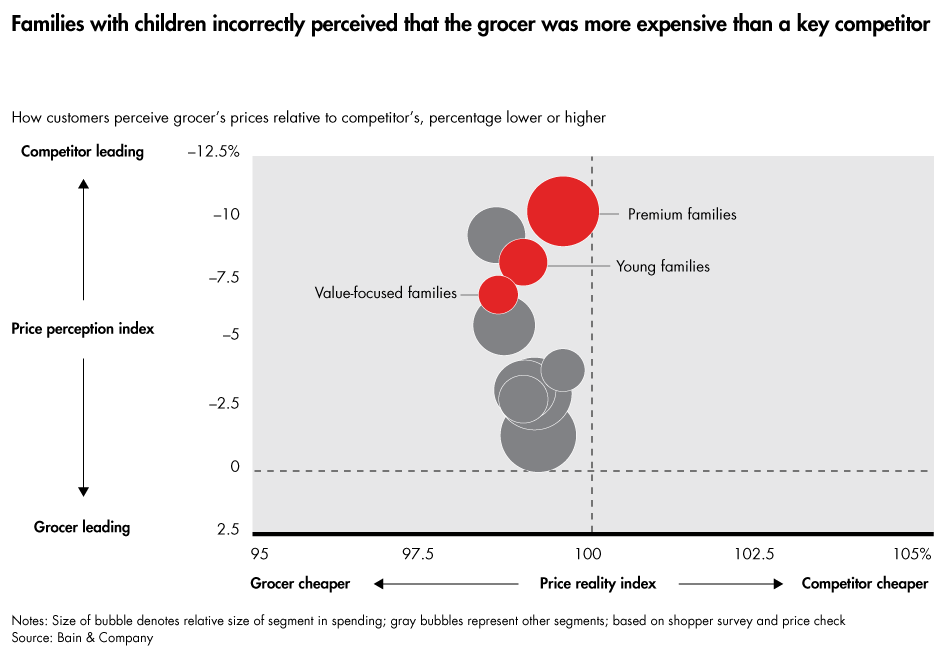
The research highlighted which products and tactics would be most useful in shifting perception among families. For example, prices on staples, fresh produce, meat and baby products were critical. Certain promotional mechanics, such as deep discounts and everyday low-pricing programs, also would be quite effective, as would strong price communication, especially through in-store signage.
With the benefit of these insights, the grocer reallocated price investments to focus on the categories and customers that mattered most, reshaped its promotional calendars to maximize returns and dramatically increased its focus on price communication and execution. These moves have put the chain on the path to more favorable perception among customers, increases in store traffic and better margins.
Sandeep Heda, Stephen Mewborn and Stephen Caine are partners with Bain & Company’s Customer Strategy & Marketing and Retail practices. Mewborn leads Bain’s global pricing work and is based in Chicago. Heda and Caine are based, respectively, in Atlanta and Chicago.
ROI Consultancy Services (formerly PollBuzzer) provides full-service research, marketing and sales automation, and digital agency support to consultants, investors and corporate clients. For details, visit roiconsultancyservices.com or contact Noah Seton (noah.seton@roirocket.com).
First published in 2월 2017