

Brief

Consider an industry with more than 15,000 firms in which scale can be a clear advantage. Sounds like a fertile field for consolidation, right?
Not if the industry happens to be private capital.
For much of the industry’s history, consolidation has largely been a nonstarter. Firms have tried over time to expand geographically or add an asset class through M&A. But very often, mergers have foundered on the many levels of integration complexity that arise when private partnerships try to combine.
There are certainly exceptions: Blackstone’s well-timed acquisition of credit firm GSO Capital Partners in 2008 is an example of a large deal that worked out well. But too often, cultures clash, compensation and carry issues prove insurmountable, or talent jumps ship. The difficulties are stubborn enough that most general partners (GPs) simply assume that consolidation makes perfect sense in every industry but their own.
For multiple reasons, however, that’s starting to change, especially for the growing number of public alternative asset managers. The race to expand assets under management (AUM) among ever-larger firms is putting pressure on GPs to find new ways to grow, encouraging more firms to give M&A a fresh look. It’s also true that smaller firms are facing higher hurdles to growth as fund-raising becomes more difficult. That is prompting many to consider hitching on to a larger platform.
The public-firm advantage
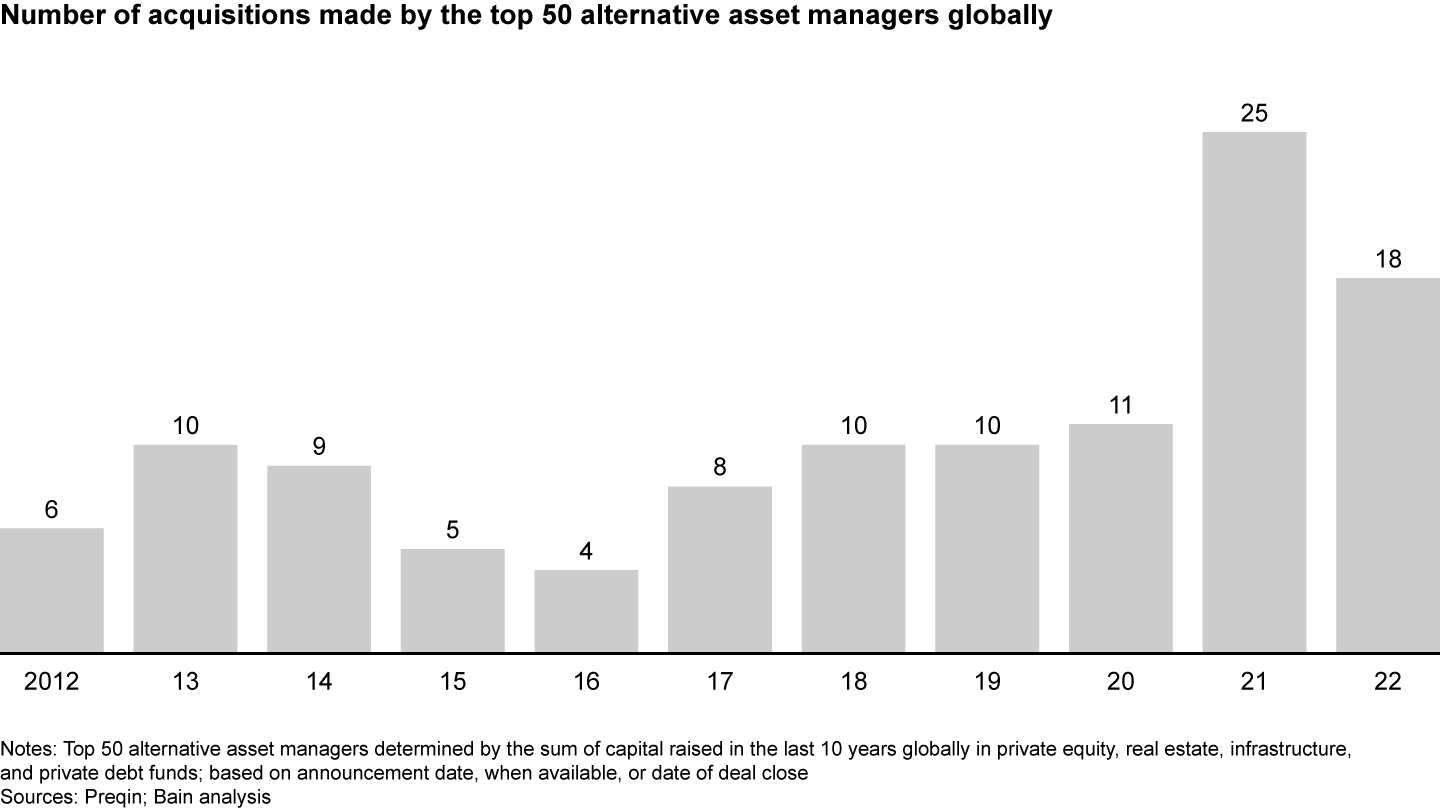
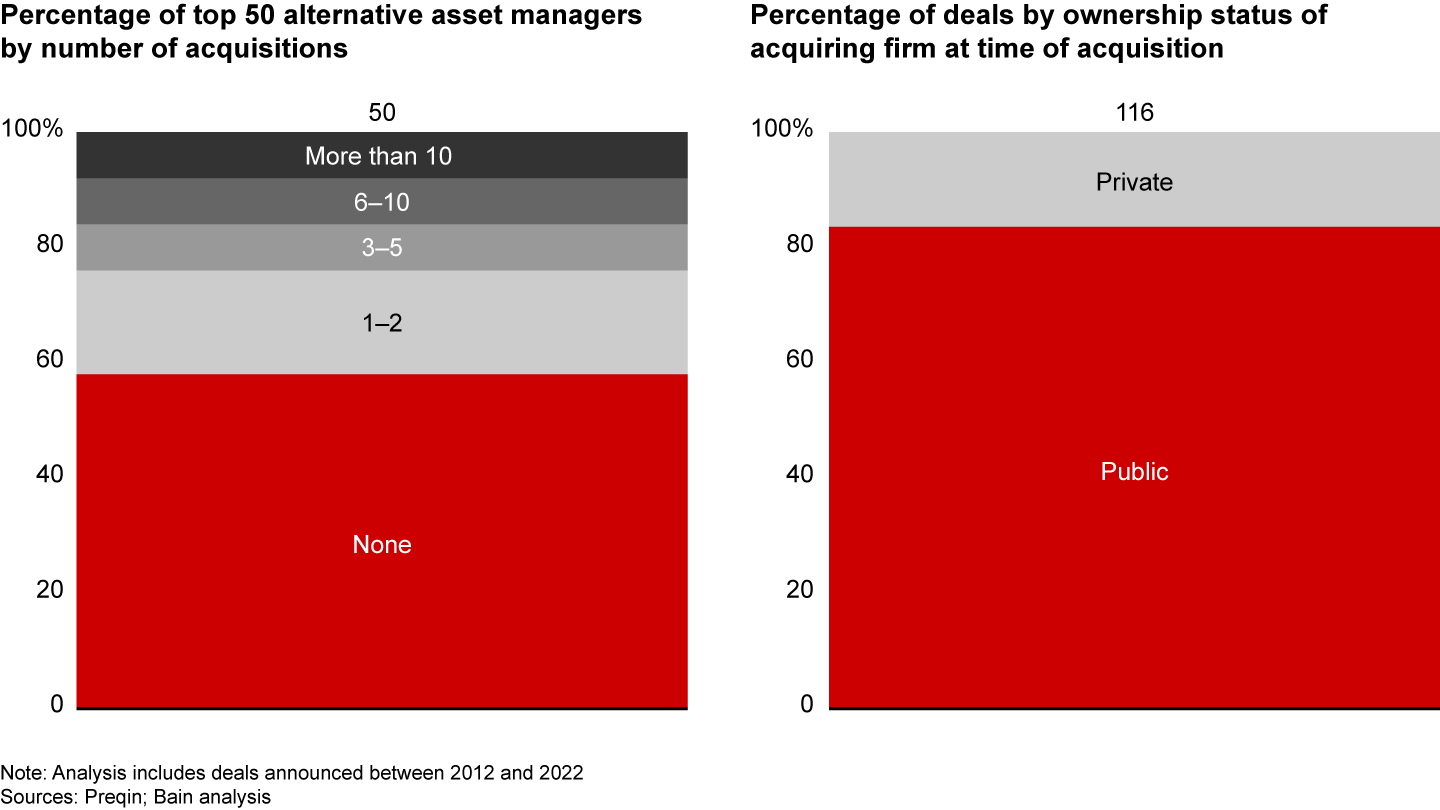
Among the top 50 alternative asset managers by AUM, the number of strategic acquisitions and strategic minority investments globally has accelerated in recent years, with a sharp spike in 2021 (see Figure 1). The numbers are still small: The top 50 firms have done a total of just 116 strategic deals since 2012, and more than half of that group (29 firms) haven’t done a deal at all. But the trend suggests that firms are increasingly looking for ways to make M&A work.
Figure 1

What’s clear is that strategic acquisitions and investments are significantly easier for firms that are publicly traded. Public alts managers have accounted for a full 84% of the deals done since 2012, largely because they have firepower in the form of balance sheets and liquid currency that private partnerships lack (see Figure 2). Private firms face the challenge of financing a merger out of the partners’ own pockets and sorting out the economics for the acquired firm. It’s also harder to access debt financing for private deals because private businesses are hard to value. All of this leads to fewer and smaller targets.
Figure 2

Public firms not only find it easier to structure deals, but they are also under more pressure to do them. Public shareholders typically look for 15%-plus annual organic growth in fee-bearing AUM. That’s nudging public firms to think expansively about how to sustain that pace over time. Adding asset classes to a larger platform, geographic expansion, new customer channels, and strategic distribution are all means to that end. M&A can be an important way to accelerate those growth strategies.
These issues help explain why a firm like Sweden’s EQT had not done a strategic acquisition before it went public in 2019 but has done five since then. The firm has used M&A to expand its presence in Asia and build out adjacencies in real estate and healthcare venture investing. Referring to the firm’s biggest deal, the $7.5 billion acquisition of Baring Private Equity Asia, Christian Sinding, EQT’s CEO, told Forbes, “We realized for us to be able to build that scale organically in Asia would probably take another 10 years.”
He added that building scale is critical to winning in many of EQT’s new asset classes and will create the kind of global brand necessary to succeed in the private wealth channel, which accounts for half of all global assets under management but only 16% of alts portfolios. “Being public gives us a currency. It gives us a stronger balance sheet, so we can actually support these new initiatives,” Sinding said.
Asset class expansion has been the dominant driver of strategic acquisitions over the past decade (see Figure 3). Moving into a new asset class organically may be the more common route to diversification. But many rapidly growing asset classes like credit and real estate often require scale to compete, which is why 60% of the M&A related to asset class expansion since 2012 was to acquire positions in those two classes. A deal like Brookfield’s acquisition of a majority stake in Oaktree Capital, which has long had a strong position in credit, is a good example.
Figure 3


Geographic expansion and access to permanent capital virtually tied for the second-biggest impetus for deals over the past decade. An example of the latter was Apollo’s relationship and subsequent merger with Athene, which bolstered the firm by providing access to a significant source of permanent capital. KKR’s acquisition of Global Atlantic had the same objective.
While our top 50 study was limited to M&A between private capital firms, traditional investment managers are also showing increased strategic interest in alternatives. Firms like T. Rowe Price, Franklin Templeton, Nuveen, and BlackRock have been actively chasing the outsize growth of private capital in recent years. Those four and others have been snapping up private firms like Oak Hill Advisors and Lexington Partners, seeing real opportunity in providing access to private capital through their extensive distribution networks.
The due diligence imperative
Our experience working with firms doing strategic acquisitions in the alts space suggests that none of this is easy. The financing and deal-structure hurdles can be tricky, but the real challenge is translating M&A into sustained organic growth. Acquirers need a full understanding of what they’re buying and whether it’s the right fit strategically, culturally, and organizationally. Indeed, firms regularly underestimate how difficult it is to move into a new asset class or geography. Channel and customer segment expansion are also significantly more challenging than many assume.
Due diligence, therefore, needs to provide a fine-grained understanding of what it really takes to win in a firm’s chosen adjacency, geography, or new channel. Firms also need insight into whether a strategic acquisition target is well positioned to execute against those requirements. Where synergies come into play, it is essential to develop a clear-eyed assessment of the true size of these opportunities and a realistic time line for capturing them. This sort of analysis is especially important in today’s market. A rising tide has lifted all boats over the industry’s past decade of exceptional performance. As the cycle turns, the new diligence challenge is determining which strategies and firms can continue to outperform.
Talent assessment is another key issue. Because private capital is essentially a people business, the success of a strategic acquisition in the alts space often boils down to retaining the target firm’s key talent. This involves three critical areas of inquiry: Who on the acquired management team is indispensable? Will those people mix well with our culture? And how do we structure the economics to hold the whole thing together?
These three factors are deeply interrelated. Understanding who drives value at the target firm and creating economics attractive enough to keep them in the fold is often the most significant hurdle. Yet if those people are a bad fit culturally, it may never work anyway.
Whether a target firm is selling a stake or control, the buyer is typically taking over a large portion of future income streams. So retaining top talent requires articulating a compelling growth story that demonstrates why the whole will be greater than the sum of its parts. Firms must be willing to reset the table economically for the people they need to retain. This is where public firms have a true advantage: While it is difficult (though certainly not impossible) for private firms to sort out these ownership and compensation issues, paying for deals with stock provides a super-liquid mechanism to both create and realize value over the short and long term.
The integration conundrum
Related to the talent-retention and culture questions is how to structure the new firm. This involves how much—and how quickly—to integrate the two organizations. Again, experience suggests this needs to be done thoughtfully, with a full appreciation for what it feels like to walk in the target team’s shoes. In an entrepreneurial business like private capital, the kind of people you want to fold into your organization don’t need or want a boss. They thrive on a sense of proprietorship, which can be easy to undermine.
Deals that work start from a simple principle: Do no harm. In other words, don’t rush to integrate anything before you know what you’ve got. A deal thesis may anticipate synergies in areas like back-office IT, recruiting, or training. But even things that seem simple—like consolidating investor relations—often aren’t. While there may be overlap between firms in terms of covering various geographies or working with limited partners, the answer isn’t always to rationalize. Historical client relationships matter a lot, and though it may make sense eventually to eliminate overlap, doing so shortsightedly could compromise fund-raising velocity or volume.
The most successful deals take time to gestate. They have a long and gradual period of integration—over a decade or more—to arrive at the model that works. Often this is tied to generational change. As senior members of the original team move on, opportunities for greater integration present themselves. A well-constructed investment thesis anticipates these factors, and the integration plan follows the thesis faithfully.
The reality is that linear growth in assets creates exponential growth in complexity. Going from a single-strategy firm to a multistrategy alternative asset manager raises all kinds of operating model questions and hurdles. And even if you are a public firm eyeing what seems like a relatively straightforward acquisition, evaluating a target and bringing it into the fold remains a significant challenge. For lots of good reasons, strategic M&A is on the rise in the private capital industry. But that doesn’t mean achieving success has gotten any easier.
First published in 5월 2023