
Skip to Content
  • 오피스

    오피스

    미주
    • Atlanta
    • Austin
    • Bogota
    • Boston
    • Buenos Aires
    • Chicago
    • Dallas
    • Denver
    • Houston
    • Los Angeles
    • Mexico City
    • Minneapolis
    • Monterrey
    • Montreal
    • New York
    • Rio de Janeiro
    • San Francisco
    • Santiago
    • São Paulo
    • Seattle
    • Silicon Valley
    • Toronto
    • Washington, DC
    유럽, 중동, 아프리카
    • Amsterdam
    • Athens
    • Berlin
    • Brussels
    • Copenhagen
    • Doha
    • Dubai
    • Dusseldorf
    • Frankfurt
    • Helsinki
    • Istanbul
    • Johannesburg
    • Kyiv
    • Lisbon
    • London
    • Madrid
    • Milan
    • Munich
    • Oslo
    • Paris
    • Riyadh
    • Rome
    • Stockholm
    • Vienna
    • Warsaw
    • Zurich
    아시아, 호주
    • Bangkok
    • Beijing
    • Bengaluru
    • Brisbane
    • Ho Chi Minh City
    • Hong Kong
    • Jakarta
    • Kuala Lumpur
    • Manila
    • Melbourne
    • Mumbai
    • New Delhi
    • Perth
    • Seoul
    • Shanghai
    • Singapore
    • Sydney
    • Tokyo
    오피스 전체보기
  • 얼럼나이
  • 미디어 센터
  • 구독
  • 연락처
  • Korea | 한국어

    지역 및 언어 선택

    글로벌
    • Global (English)
    미주
    • Brazil (Português)
    • Argentina (Español)
    • Canada (Français)
    • Chile (Español)
    • Colombia (Español)
    유럽, 중동, 아프리카
    • France (Français)
    • DACH Region (Deutsch)
    • Italy (Italiano)
    • Spain (Español)
    • Greece (Elliniká)
    아시아, 호주
    • China (中文版)
    • Korea (한국어)
    • Japan (日本語)
  • Saved items (0)
    Saved items (0)

    You have no saved items.

    관심 있는 내용을 북마크하여 Red 폴더에 저장할 수 있습니다. Red 폴더 에서 저장된 내용을 읽거나 공유해보세요.

    Explore Bain Insights
  • 산업
    메인 메뉴

    산업

    • 우주항공, 방산 및 정부 서비스
    • 농업 관련 산업
    • 화학
    • 인프라, 건설 및 건축 자재
    • 소비재
    • 금융 서비스
    • 헬스케어
    • 산업용 기계 및 장비
    • 미디어 및 엔터테인먼트
    • 금속
    • 광업
    • 석유 및 가스
    • 제지 및 패키징 산업
    • 사모펀드
    • 사회 및 공공 부문
    • 유통
    • 기술
    • 텔레콤
    • 운송
    • 여행·여가
    • 유틸리티 및 재생가능 에너지
  • 컨설팅 서비스
    메인 메뉴

    컨설팅 서비스

    • Customer Experience
    • ESG
    • Innovation
    • M&A
    • 운영
    • 조직
    • 사모펀드
    • 고객 전략 및 마케팅
    • 전략
    • AI, 인사이트 및 솔루션
    • Technology
    • 변화 혁신
  • Digital
  • 인사이트
  • 베인 소개
    메인 메뉴

    베인 소개

    • 업무 소개
    • 베인의 신념
    • 구성원 및 리더십 소개
    • 고객 성과
    • 주요 수상 경력
    • 글로벌 파트너사
    Further: Our global responsibility
    • 다양성과 포용
    • 사회 공헌 활동
    • Sustainability
    • World Economic Forum
    Learn more about Further
  • Careers
    메인 메뉴

    Careers

    • Work with Us
      Careers
      Work with Us
      • Find Your Place
      • Our Work Areas
      • Integrated Teams
      • Students
      • Internships & Programs
      • Recruiting Events
    • Life at Bain
      Careers
      Life at Bain
      • Blog: Inside Bain
      • Career Stories
      • Our People
      • Where We Work
      • Supporting Your Growth
      • Affinity Groups
      • Benefits
    • Impact Stories
    • Hiring Process
      Careers
      Hiring Process
      • What to Expect
      • Interviewing
    FIND JOBS
  • 오피스
    메인 메뉴

    오피스

    • 미주
      오피스
      미주
      • Atlanta
      • Austin
      • Bogota
      • Boston
      • Buenos Aires
      • Chicago
      • Dallas
      • Denver
      • Houston
      • Los Angeles
      • Mexico City
      • Minneapolis
      • Monterrey
      • Montreal
      • New York
      • Rio de Janeiro
      • San Francisco
      • Santiago
      • São Paulo
      • Seattle
      • Silicon Valley
      • Toronto
      • Washington, DC
    • 유럽, 중동, 아프리카
      오피스
      유럽, 중동, 아프리카
      • Amsterdam
      • Athens
      • Berlin
      • Brussels
      • Copenhagen
      • Doha
      • Dubai
      • Dusseldorf
      • Frankfurt
      • Helsinki
      • Istanbul
      • Johannesburg
      • Kyiv
      • Lisbon
      • London
      • Madrid
      • Milan
      • Munich
      • Oslo
      • Paris
      • Riyadh
      • Rome
      • Stockholm
      • Vienna
      • Warsaw
      • Zurich
    • 아시아, 호주
      오피스
      아시아, 호주
      • Bangkok
      • Beijing
      • Bengaluru
      • Brisbane
      • Ho Chi Minh City
      • Hong Kong
      • Jakarta
      • Kuala Lumpur
      • Manila
      • Melbourne
      • Mumbai
      • New Delhi
      • Perth
      • Seoul
      • Shanghai
      • Singapore
      • Sydney
      • Tokyo
    오피스 전체보기
  • 얼럼나이
  • 미디어 센터
  • 구독
  • 연락처
  • Korea | 한국어
    메인 메뉴

    지역 및 언어 선택

    • 글로벌
      지역 및 언어 선택
      글로벌
      • Global (English)
    • 미주
      지역 및 언어 선택
      미주
      • Brazil (Português)
      • Argentina (Español)
      • Canada (Français)
      • Chile (Español)
      • Colombia (Español)
    • 유럽, 중동, 아프리카
      지역 및 언어 선택
      유럽, 중동, 아프리카
      • France (Français)
      • DACH Region (Deutsch)
      • Italy (Italiano)
      • Spain (Español)
      • Greece (Elliniká)
    • 아시아, 호주
      지역 및 언어 선택
      아시아, 호주
      • China (中文版)
      • Korea (한국어)
      • Japan (日本語)
  • Saved items  (0)
    메인 메뉴
    Saved items (0)

    You have no saved items.

    관심 있는 내용을 북마크하여 Red 폴더에 저장할 수 있습니다. Red 폴더 에서 저장된 내용을 읽거나 공유해보세요.

    Explore Bain Insights
  • 산업
    • 산업

      • 우주항공, 방산 및 정부 서비스
      • 농업 관련 산업
      • 화학
      • 인프라, 건설 및 건축 자재
      • 소비재
      • 금융 서비스
      • 헬스케어
      • 산업용 기계 및 장비
      • 미디어 및 엔터테인먼트
      • 금속
      • 광업
      • 석유 및 가스
      • 제지 및 패키징 산업
      • 사모펀드
      • 사회 및 공공 부문
      • 유통
      • 기술
      • 텔레콤
      • 운송
      • 여행·여가
      • 유틸리티 및 재생가능 에너지
  • 컨설팅 서비스
    • 컨설팅 서비스

      • Customer Experience
      • ESG
      • Innovation
      • M&A
      • 운영
      • 조직
      • 사모펀드
      • 고객 전략 및 마케팅
      • 전략
      • AI, 인사이트 및 솔루션
      • Technology
      • 변화 혁신
  • Digital
  • 인사이트
  • 베인 소개
    • 베인 소개

      • 업무 소개
      • 베인의 신념
      • 구성원 및 리더십 소개
      • 고객 성과
      • 주요 수상 경력
      • 글로벌 파트너사
      Further: Our global responsibility
      • 다양성과 포용
      • 사회 공헌 활동
      • Sustainability
      • World Economic Forum
      Learn more about Further
  • Careers
    최근 검색어
      최근 방문 페이지

      Content added to saved items

      Saved items (0)

      Removed from saved items

      Saved items (0)

      Report

      Spotlight on Private Equity in China: The Case for Caution

      Spotlight on Private Equity in China: The Case for Caution

      China's bubble may be ready to burst.

      글 Hugh MacArthur, Rebecca Burack, Christophe De Vusser, Kiki Yang, and Brenda Rainey

      • 읽기 소요시간
      }

      Report

      Spotlight on Private Equity in China: The Case for Caution
      en

      This article is part of Bain’s 2019 Global Private Equity Report. Explore the contents of the report here or download the PDF to read the full report.

      Despite the overall slowing of China’s GDP growth, its new-economy sector has expanded dramatically over the past five years. Chinese Internet and technology firms are capturing a growing share of global private equity and venture investment, a signal of just how much has changed. In 2018, global investors poured an estimated $81 billion into Chinese start-ups—32% of invested global venture capital, up from 4% five years ago and creeping up on the 47% received by US start-ups (see Figure 1.12).

      Figure 1.12
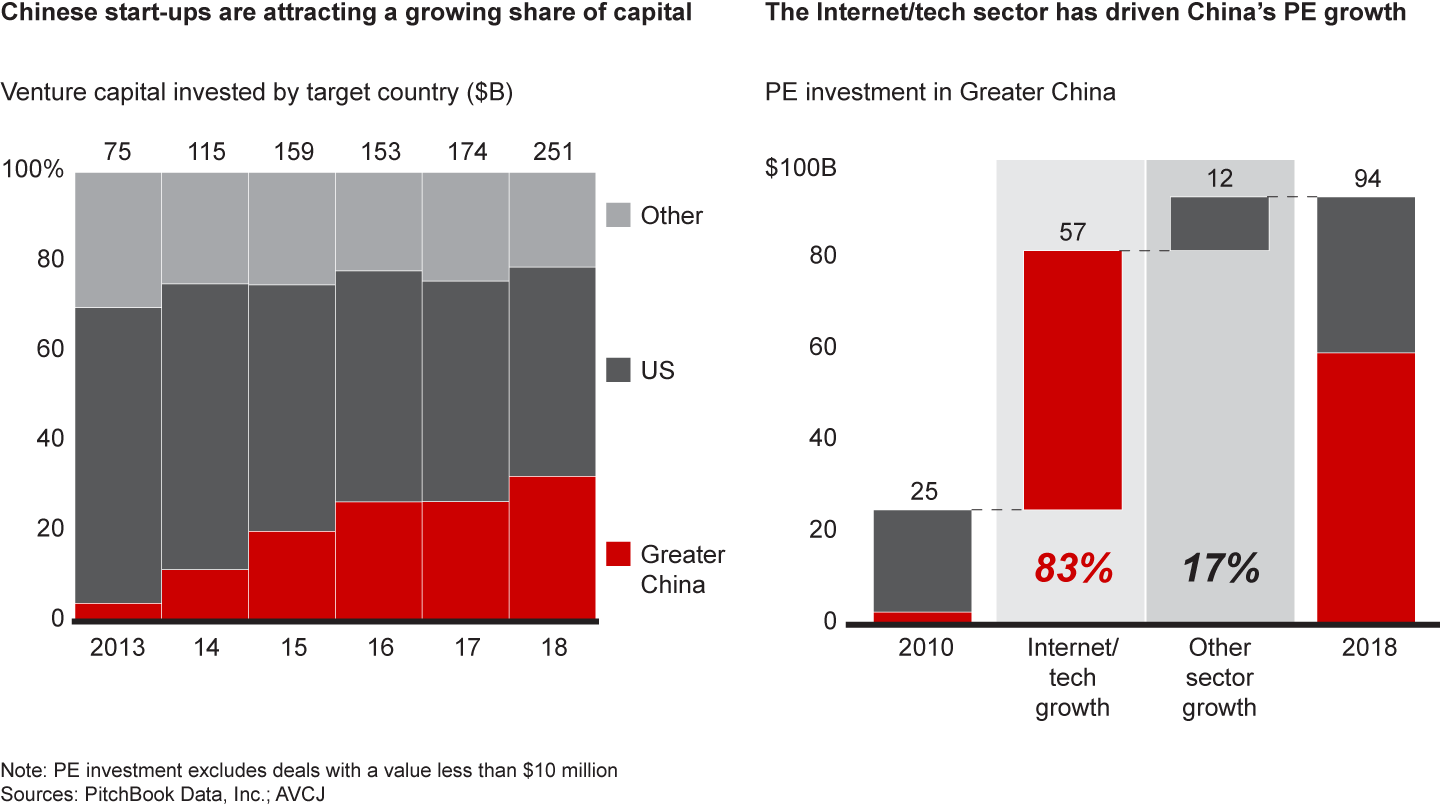
      Greater China’s new economy is moving at astonishing speed
      Greater China’s new economy is moving at astonishing speed
      Greater China’s new economy is moving at astonishing speed

      The US still produces more unicorns—start-ups valued at $1 billion or more—but Greater China is now producing them at a faster pace than the US. Internet and technology deals have accounted for roughly 85% of Greater China’s PE investment growth over the past eight years, and they represented fully half of all Asia-Pacific deal value in 2018.

      As investors flock into the market, however, there are clear signs that China’s new economy may be overheating. With asset values soaring, we see potential for the speculative bubble to burst sooner rather than later. Fund managers who continue investing in Chinese Internet and tech companies do so now at considerable risk. Some may have the expertise to navigate the risks successfully, but for most investors, particularly those that haven’t yet entered the market, staying on the sidelines is likely the smartest short-term approach. Now’s the time to develop a clear strategy for the future by identifying where to strike opportunistically when valuations become more attractive. Given its long-term potential, China’s new economy will almost certainly bounce back from any crash.

      A different world

      By many measures, China’s new economy is in a class of its own. China’s consumers behave differently than Western consumers. Obsessed with technology and convenience, they snap up new products and online services quickly. Chinese Internet users surpass US users, for example, in adopting new apps for online entertainment, payments, and education and travel services. In the mobile payments industry, China racked up $9 trillion in transactions in 2016, 80 times the US level of $112 billion.

      Cutthroat competition among the country’s burgeoning Internet and tech companies has shaped a Darwinian corporate culture. Managers expect their teams to deliver the rapid growth needed to survive. Employees in China’s tech sector work a grueling 72 hours per week on average—12 hours a day, six days a week. The pool of skilled labor is also deeper—China has almost six times more computer science graduates than the US. Overall, US computer scientists may be more skilled, but the profusion of engineering talent in China accelerates development.

      Fueled by intense, open-source competition, Chinese tech companies also grow faster. While Silicon Valley companies have tended to steer clear of copycat products and services, Chinese managers consider it good corporate practice to copy the competition. Unlike their US counterparts, Chinese Internet and tech companies expand outside their core product or service in every direction. China’s Internet giants, for example, have acquired companies in financial services, gaming, education, healthcare and artificial intelligence.

      Unsurprisingly, this dynamism has attracted a stampede of investors keen to tap into this large and growing market. According to Bain’s 2019 Asia-Pacific private equity survey, 80% of Greater China–focused funds are considering or actively pursuing new-economy deals. In 2017–18, more than 800 PE investors had a stake in an Internet or technology deal in China with a value greater than $10 million, up from about 170 in 2009–10. China’s new economy, once dominated by venture capitalists, now includes traditional private equity houses, LPs, sovereign wealth funds, and Internet giants such as Alibaba, Tencent and Baidu. The influx of investors has saturated the market for smaller deals and prompted many to focus on larger investments: Average deal size rose to $213 million in 2018, up from $30 million in 2013.

      Insights in Your Inbox

      Get Our Latest Private Equity Insights

      Receive Bain’s landmark Global Private Equity Report each February, plus the latest insights and developments in private equity throughout the year.

      Early warning signs

      For traditional PE investors, China’s new economy can be particularly challenging. Our research shows that 85% of PE investors focused on Greater China consider it difficult to evaluate new-economy companies, mainly because traditional PE valuation techniques don’t work in that market and because it’s difficult to justify investing in loss-making businesses.

      At the moment, those risks are magnified by inflated expectations. Internet and technology deals already are wildly overpriced compared with other sectors. At 31 times EBITDA, median M&A deal multiples for Chinese Internet and tech companies are twice as high as those for other industries in Greater China, and 2.4 times greater than the median multiple for Asia-Pacific deals in 2016–18. That’s a warning signal for investors, and funds’ recent performance underscores the danger. China’s new-economy returns are in free fall: Median return multiples dropped to less than 2.0 times in 2016–18, from 4.7 times in 2014–15.

      Another ominous sign: the sizable and expanding exit overhang of Internet and tech assets. Over the past five years, PE funds acquired more than 1,000 Internet and technology companies in Greater China with a value of $10 million or more, but they divested only about 130 in the same time frame. That trend means viable exit opportunities are scarce. Recent initial public offerings (IPOs) are a case in point. Companies that went public between 2017 and 2018 had lost, on average, 21% of their initial market capitalization 12 months post-IPO. And the losers lost big: 62% of companies that went public shed more than 30% of their value. By contrast, companies that went public between 2015 and 2016 gained an average of 105% in value in the first 12 months after the IPO. Only 7% lost more than 30% of their value. As the IPO market softens and return multiples drop, funds that overpaid for companies in their portfolios see no alternative but to hold onto assets (see Figure 1.13).

      Figure 1.13
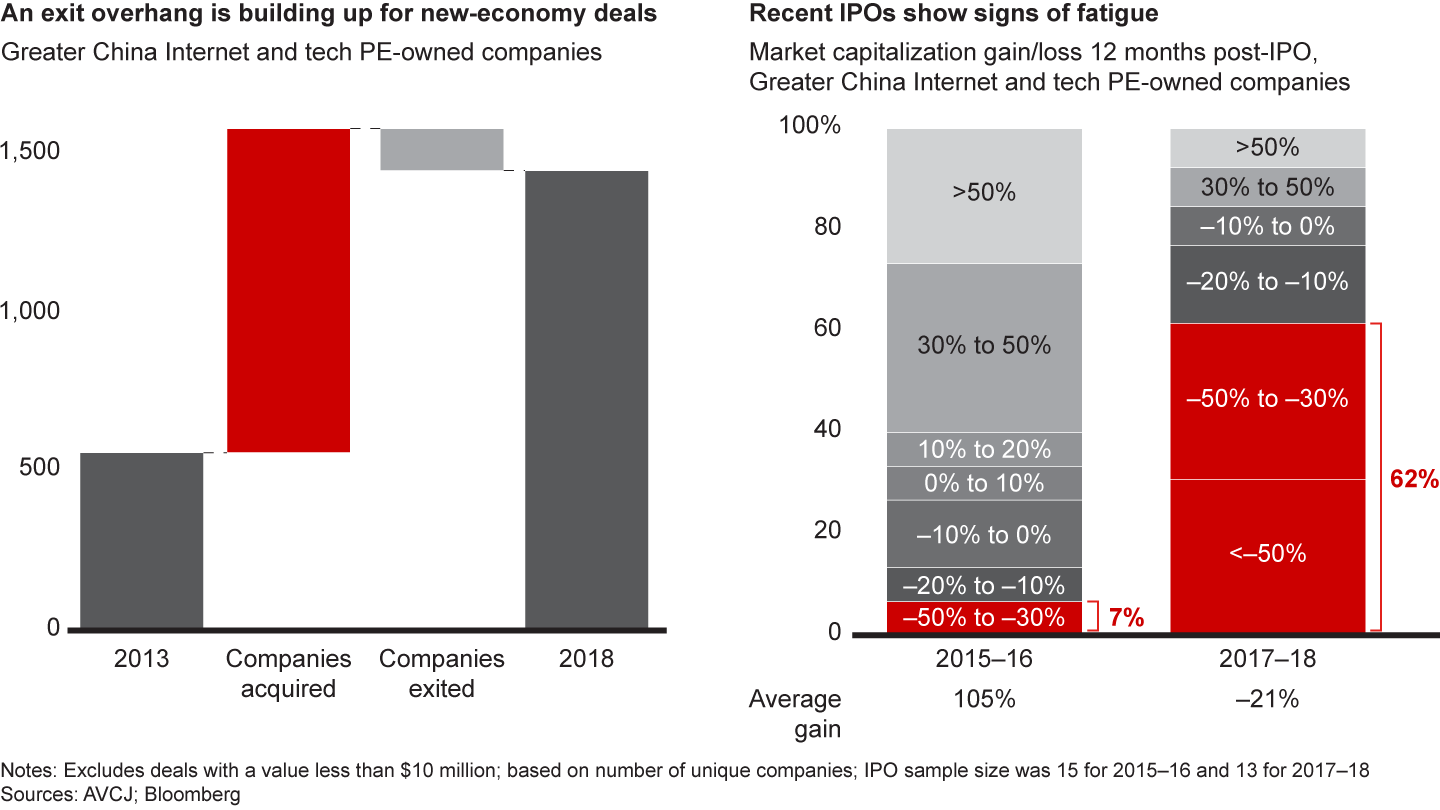
      There are warning signs that China’s new-economy bubble may burst
      There are warning signs that China’s new-economy bubble may burst
      There are warning signs that China’s new-economy bubble may burst

      Given those challenges, it’s no surprise that GPs focused on Greater China are wary. A full 65% of those we surveyed see a high to very high risk of a bubble bursting in the coming years. Meanwhile, only 6% of them believe they are operating at full potential when it comes to establishing partnerships to help source new-economy deals. The same small proportion say they have a proven model to evaluate risks or add value in this sector.

      Strategies for the future

      Given the degree of uncertainty, the best strategy is likely to hold fire. There are plenty of solid investment opportunities outside China’s new economy, in markets that are not so overpriced. What is risky today, however, could well become attractive in the future, when soaring valuations retreat to a normal range. China’s new economy is moving at astonishing speed. Its entrepreneurs are creating a new paradigm for growth and value creation. That’s a wake-up call that fund managers should not ignore. Those who focus on defining a strategy now will be well positioned to seize opportunities, especially in a post-bubble market.

      A few questions can help fund managers map out a clear approach for the future:

      • What are the distinct capabilities that helped us win in the past, and which ones are transferable to new-economy markets in China?
      • Under what conditions might it make sense to invest in Chinese tech or Internet companies in the future?
      • If we decide to enter this market, where should we play first, and why?
      • What are the capabilities or partnerships we would need? Which ones can be built or bought now?

      This article is part of Bain’s 2019 Global Private Equity Report. Explore the contents of the report here or download the PDF to read the full report.

      저자
      • Headshot of Hugh MacArthur
        Hugh MacArthur
        파트너, Boston
      • Headshot of Rebecca Burack
        Rebecca Burack
        파트너, Boston
      • Headshot of Christophe De Vusser
        Christophe De Vusser
        Worldwide Managing Partner, New York
      • Headshot of Kiki Yang
        Kiki Yang
        파트너, Hong Kong
      • Headshot of Brenda Rainey
        Brenda Rainey
        Executive Vice President, Boston
      문의하기
      관련 산업
      • 사모펀드
      관련 컨설팅 서비스
      • 전략
      최적의 솔루션 찾기
      • Firm Strategy & Operations
      사모펀드
      Private Equity: Still Booming, but Is the Cycle Near Its End?

      Deal count declines, but value jumps to a five-year record.

      자세히 보기
      사모펀드
      Buy-and-Build: A Powerful PE Strategy, but Hard to Pull Off

      Getting it right hinges on three critical factors.

      자세히 보기
      사모펀드
      Public Vs. Private Assets: The Big Switch

      The pendulum has swung in favor of private—will it swing back?

      자세히 보기
      사모펀드
      Private Equity’s New Take on Diversification: Don’t Stray Too Far

      Funds that stay close to the core have a leg up.

      자세히 보기
      사모펀드
      Spotting the Downturn Early and Coming Out Ahead with Gryphon’s David Andrews

      We ask the co-CEO of Gryphon Investors how he spotted one of the harshest cycles in the industry’s history and when he thinks it may finally break.

      자세히 보기
      First published in 2월 2019
      태그
      • 사모펀드
      • 전략
      • Firm Strategy & Operations

      베인에 궁금하신 점이 있으신가요?

      베인은 주저 없이 변화를 마주할 줄 아는 용감한 리더들과 함께합니다. 그리고, 이들의 담대한 용기는 고객사의 성공으로 이어집니다.

      급변하는 비즈니스 환경에서 살아남기 위한 선도자의 시각. 월간 Bain Insights에서 글로벌 비즈니스의 핵심 이슈를 확인하십시오.

      *개인정보 정책을 읽었으며 그 내용에 동의합니다.

      Privacy Policy를 읽고 동의해주십시오.
      Bain & Company
      문의하기 환경정책 Accessibility 이용약관 개인정보 보호 쿠키 사용 정책 Sitemap Log In

      © 1996-2026 Bain & Company, Inc.

      문의하기

      무엇을 도와드릴까요?

      • 프로젝트 문의
      • 채용 정보
      • 언론
      • 제휴 문의
      • 연사 초청
      오피스 전체보기