

Brief

Holiday sales are exceeding expectations, thanks to strong growth of in-store sales and continued double-digit growth in e-commerce. In this issue, we examine the role promotions might be playing in this growth, reviewing the holiday promotional landscape and sharing how retailers can tap into the science behind customers’ behaviors to get more out of their promotional strategies.
Holiday sales are surpassing expectations
This November, Bain-defined retail sales grew by 6% over last year, the highest growth in November since 2010. Much of the growth came from physical stores, where sales grew 5% over last year. The highest growth categories were building materials (up 11.2%) and furniture and home furnishing stores (up 8.6%), perhaps linked to post-hurricane rebuilding and rising home sales. Electronics and appliances stores also posted big gains, growing at 7.3%. E-commerce continues to outpace the overall market, up 16% year over year according to Adobe Analytics. Sales through mobile devices (smartphones and tablets) are growing as a percentage of overall e-commerce, accounting for 32% between November 1 and December 10. Meanwhile, Amazon.com continues to outshine its competitors. The company reported its highest one-day sales in history on Cyber Monday, and estimates suggest it accounted for more than 60% of all US online sales that day (versus just under 40% on average for the year to date).
Underpinning this impressive sales growth are some strong macroeconomic drivers: The Conference Board Consumer Confidence Index remained at a 17-year high (129.5), and the S&P retail stock index is up 15% since the start of November.1 That said, retailers capitalized on more than macroeconomic good fortune. They significantly increased advertising to pull in customers and delivered better experiences when shoppers arrived in stores:
- Retailers are reminding customers to shop. Retailers have ramped up their paid advertising, especially on mobile devices. Our research with Market Track shows that advertisement spending from mid-October through Cyber Monday for Amazon, Best Buy, Walmart and Target was up 9% year over year. This increase was propelled by a 141% increase in mobile web advertising.
- Shoppers are more satisfied with their in-store experiences. In-store shoppers are reporting greater satisfaction with their shopping experiences. The group’s Net Promoter Score® rose from 36% in October to 43% in November, according to Bain’s 2017 Holiday Shopper Pulse survey (conducted in partnership with Research Now).2 Over the same period, shoppers’ satisfaction with Amazon and other online retailers stayed around 52% and 42%, respectively.
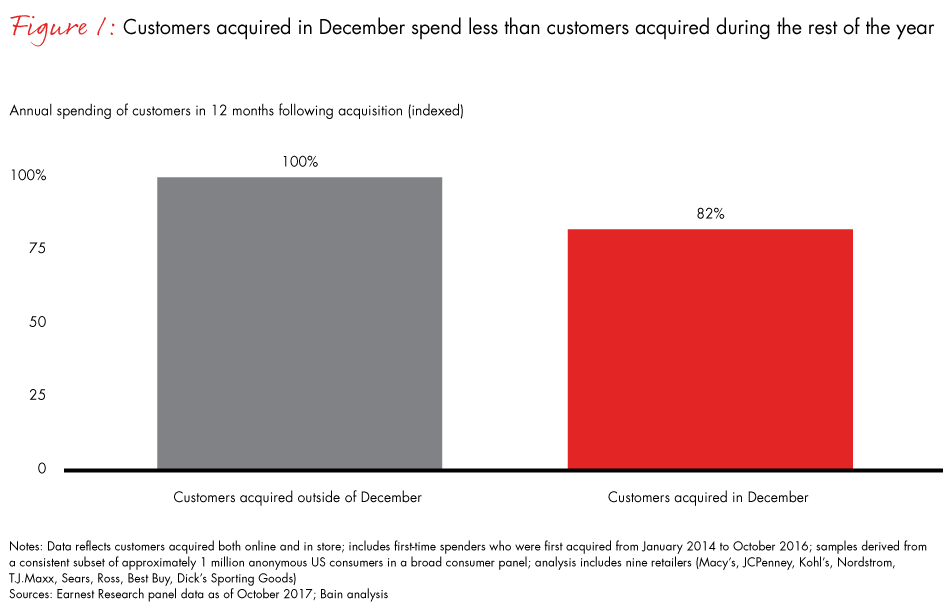
While our partnership with Earnest Research suggests customers acquired during the holidays are not as valuable as customers acquired during the rest of the year (see Figure 1), this season’s spike in holiday sales bodes well for retailers that can keep delighting shoppers in 2018.
What’s the “deal” with pricing and promotions this holiday season?
In 1861, legendary retailer John Wanamaker opened his Oak Hall store in Philadelphia. The store, which sold men’s and boys’ clothing, grew rapidly based on its “one price and goods returnable” policy plus a revolutionary new concept—the price tag. No more confusion or haggling. The price you saw was the price you paid.
About 25 years later, Coca-Cola introduced its namesake beverage along with an innovation called the “coupon.” The regular price of a glass of Coke was 5 cents, but the coupon entitled bearers to try one glass for free. People flocked to their favorite pharmacies for samples. Experts estimate that by 1894, one in nine Americans had tried a free Coke, making Coca-Cola a household brand. The use of coupons exploded during the Great Depression, and retailers have never looked back.
Today, deals are a staple—especially during the holidays. And despite this year’s healthy economy, the duration, depth and breadth of deals continue to be as strong as ever. Many retailers, including Amazon, Kohl’s and Target, launched their holiday promotions well before Thanksgiving. The deals leading up to and after Thanksgiving remained deep. In partnership with Market Track, we found that discounts in circulars averaged 42% between October 22 and December 11, much like last year. And working with Wiser, we found that discounts in email promotions averaged 36%—slightly higher than last year’s 34%. Beneath these averages lie some interesting details.
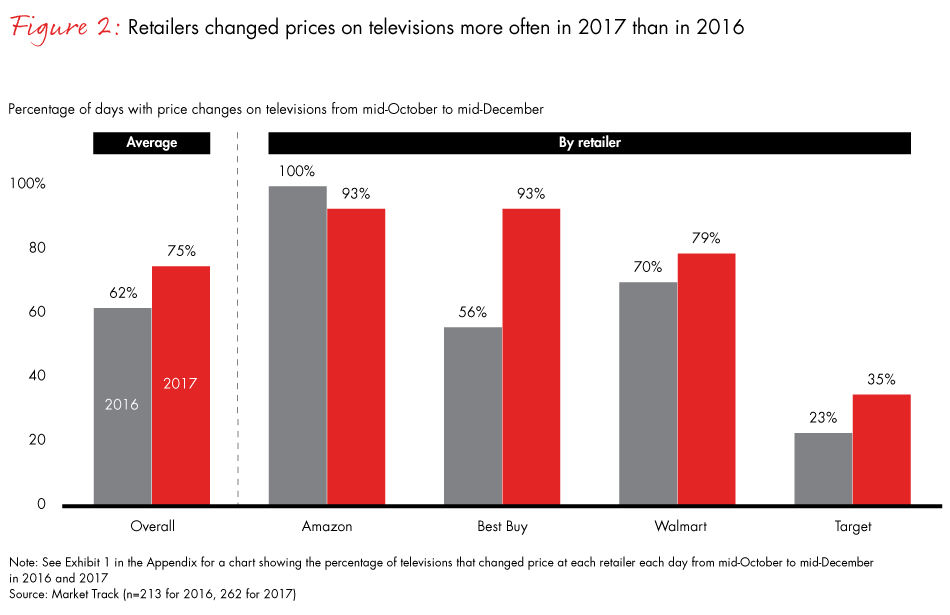
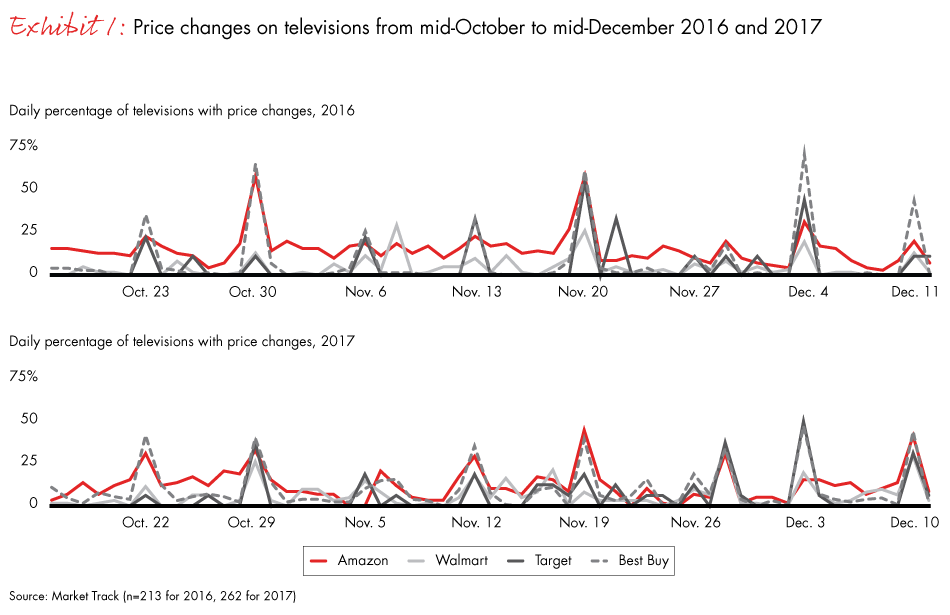
- Following in Amazon’s footsteps, retailers are changing prices more frequently. Amazon’s proprietary algorithms change prices many times a day, matching competitors’ lowest prices on select items and pricing on a per-SKU basis with different prices for variations (like color or size) of the same item. This season Amazon brought dynamic pricing to its Calvin Klein pop-up shops, where customers use a mobile app to scan barcodes and see an item’s current price. Meanwhile, Walmart has increased its use of machine-learning algorithms that allow it to make quick price adjustments. According to Gartner, 70% of the retailers it surveyed in April 2017 planned for significant investments in promotion optimization and pricing intelligence tools in the next 1 to 2 years. Our work with Market Track shows that on average, Amazon, Best Buy, Walmart and Target changed their prices for televisions on 75% of the days between October 15 and December 11, versus 62% in 2016 (see Figure 2). For more details, see Exhibit 1 in the Appendix.
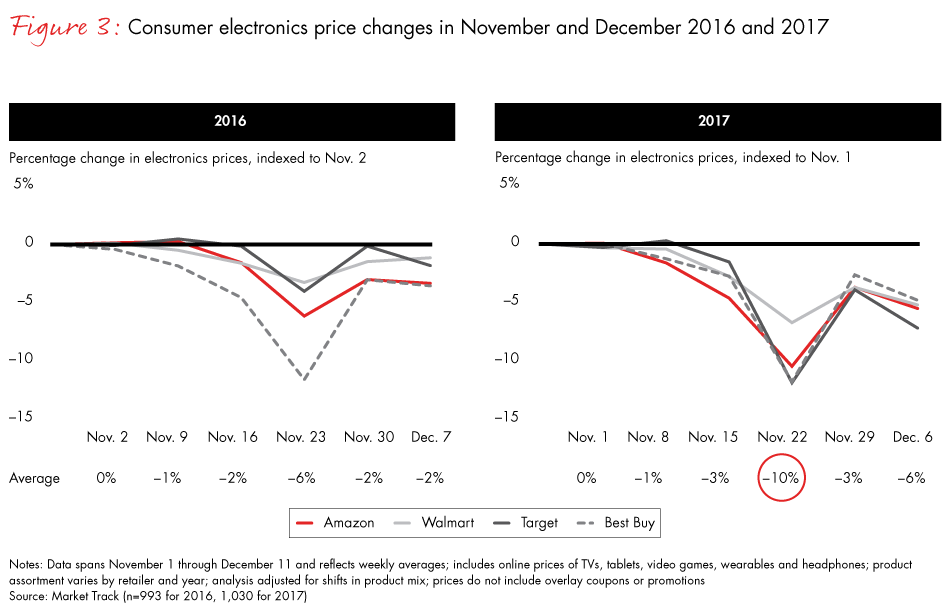
- Retailers heavily discounted electronics. With Market Track, we traced daily online electronics prices at four major retailers between November 1 and December 11 (see Figure 3). On average these retailers ran deeper promotions in 2017, with prices dropping up to 10%, compared to only 6% in 2016.
- Retailers offered more free-shipping promotions earlier in the season. Retailers offer many types of promotions beyond price discounts, and free shipping continues to grab holiday headlines. This season, retailers offered more free-shipping promotions earlier in the season. In partnership with Wiser, we found that 56% of promotional emails sent this October included free-shipping offers, compared to just 40% in October 2016. Retailers’ incentives: fewer peak-volume surcharges from shipping companies and less stress on their own fulfillment centers. Retailers also reduced or removed minimum thresholds to qualify for free shipping.
Unwrapping the long-term impact of price promotions
Americans redeemed more than 2 billion coupons in 2016. Why has the use of promotions increased so dramatically since Wanamaker opened his first store and Coca-Cola offered its first coupon? Partially because they produce such rapid results, partially because technology is making coupons easier to issue and redeem and partially because everyone assumes that someone else is bearing most of the cost. Customers believe they’re getting great deals from desperate retailers. Retailers aren’t terribly worried because they plan to go back to vendors to recover substantial markdown money. And vendors expect to raise future prices to fund the markdowns. When that happens, retailers raise prices to recover increased costs, ultimately pegging deeper discounts to rising list prices in a seemingly never-ending cycle of promotions.
But there are a few important by-products of this cycle. First, although retailers’ gross margins have stayed relatively stable, the gap between list prices and sale prices is growing, reducing consumers’ trust in original list prices. Second, shoppers have learned to wait for deals. Third, technology is making it easier for customers to cherry-pick the best offers from multiple retailers.
Perhaps the greatest consequence of this cycle has been the rise of low and off-price retailers. Off-price retailers like Ross Stores and T.J.Maxx “price-compare” their goods to high-list-price goods at traditional stores, creating the perception of great bargains. Dollar stores and deep discounters steal customers from traditional retailers through consistent, ultra-low prices. And Walmart’s improving performance shows how advertising and delivering everyday low prices (EDLP), a strategy harkening back to Wanamaker, can improve growth while reducing complexity and operating costs. These disruptive strategies have paid off: T.J.Maxx’s stock price has jumped about 80% over the last 5 years, Aldi is set to grow its US store footprint by 25% in 2018 and Walmart’s same-store sales have increased for 13 quarters in a row.
Tapping into the science and psychology of holiday promotions
Some statistics surrounding promotions are relatively easy to track, but they tell us nothing about the effectiveness of those promotions. Are promotions capitalizing on what we know about the science and psychology behind shoppers’ behaviors?
Used effectively, special offers should do four things:
- Spur strategic innovation
- Strengthen a brand’s image
- Create happier and more loyal customers
- Grow long-term sales and profits
The funny thing is that we seldom hear retailers talking about these objectives as they prepare their holiday promotions. Their primary objective seems to be hitting their holiday plan (even though that plan might involve a drop in sales) and the safest way to do so is to repeat previous promotions (even if they are producing diminishing returns).
Spur strategic innovation
It’s so easy to slip into incremental thinking: “We’ll do the same things we did last year, but a little bit more.” There’s not enough understanding of what drives customers’ behaviors and how to influence them in more creative or economical ways. Often, even small strategic changes can convert more shoppers into customers and boost bottom lines. Consider the science and psychology within our Holiday Shopping Quiz.

Holiday Shopping Behavior Quiz
Do your special holiday offers capitalize on the science and psychology behind consumer behaviors? Take the quiz to find out.
Strengthen a brand’s image
All too often promotions hurt a brand’s image. But they don’t have to. Take Coca-Cola: The company gave away free sodas to earn consumer loyalty and build its brand image without devaluing Coke’s price. Sometimes retailers are better off offering “free” once instead of “20% off” forever.
Winning retailers align holiday promotions with their long-term brand strategies. That’s why a number of luxury retailers choose to highlight the quality of their products rather than the depth of their discounts. Louis Vuitton, for example, doesn’t hold sales over the holidays. It draws in traffic with special campaigns, like its partnership with renowned artist Jeff Koons. Koons created Louis Vuitton holiday window displays that situate luxury bags against the backdrop of his famous white sculptures. These displays emphasize the brand’s beauty and creativity—and reinforce its high-end image. On the other hand, it makes sense for Dollar General to offer a special holiday promotion where customers can take advantage of up to $200 in additional savings. This strategy reinforces (and exaggerates) the company’s image as a retailer that saves its customers a lot of money.
Create happier and more loyal customers
Happy customers make for happy retailers. Bain’s research shows that advocacy leaders in retail—those that delight their customers and receive the highest Net Promoter Scores—outperform competitors within their price tier and segment by two to three times in terms of organic annual growth.
Price discounts are often a short-term fix for delighting customers, but they usually need to be offered over and over again to keep or regain shoppers’ interest. Better promotional strategies create loyalty over the long term. They draw on motivating factors that extend beyond just a price cut, such as rewards, entertainment or the avoidance of hassles. Take rewards programs as an example: Few shoppers would find a 1% to 5% off sale very enticing and yet, many would happily change their behavior to get rewards benefits that are of equivalent (or lesser) value. Macy’s, for example, introduced its new Star Rewards program this fall, which offers its top shoppers 5% back in store credit for all purchases.
Grow long-term sales and profits
Promotional strategies too often are viewed through a short-term lens. Retailers calculate short-term price elasticities and 14-day ROIs. They focus on how price changes impact quarterly results and neglect longer-term behaviors, new customer acquisitions or the lifetime value of their customers. That’s a mistake. Meaningful innovations can take 5 to 7 years of testing and learning to deliver significant results. For example, many retailers would have scoffed at the idea of a membership program such as Prime given its high costs. Yet Amazon considered the benefits of higher traffic and increased share of spending that would come with shopper enrollment. The company figured out ways to make it sticky and lower churn, while continuously adding features and increasing member value. All the while, many competitors watched and tried to figure out Prime economics, as well as ways to copy small parts of the Prime value proposition, without creating something unique and compelling of their own. As a result, Amazon now has a meaningful and durable competitive advantage.
One reason we see companies—at least public companies—take a short-term view is that they are under the scrutiny of shareholders, analysts and the markets. But imagine this: Your company goes private and you are no longer under a microscope each quarter (let alone each day). What would you do differently with your promotional strategy? Would you examine the impact on customer behavior and sentiment rather than on next quarter’s bottom line? Why not start now? Five years from now, your investors will likely be happy that you did.
…
Changing pricing and promotional strategies is risky business. Several retailers have learned this lesson the hard way. If you hope to reduce discounts, the three biggest tips we can offer: First, find other ways of meeting the four objectives mentioned above. Retailers that do this well invest in other sources of value beyond discounts—unique merchandise, customer rewards, added services, engaging in-store experiences—that help build loyalty and sales. Second, listen to customers and measure their behaviors throughout testing and scaling. Keep an eye on longer-term trends versus just short-term reactions. Lastly, tackle the change—from design to messaging, technology requirements, and training—with cross-functional teams rather than hand-offs across silos. This boosts both results and very importantly, speed.
Looking forward: Post-holiday recap and outlook
We hope you have a wonderful break over the holidays. We’ll be back in the new year with our final issue of the 2017–2018 holiday season, "Post-Holiday Recap and Resolutions for 2018."
Please let us know if you have any questions or would like to arrange a follow-up discussion on the issues addressed in this newsletter or any other retail topics by emailing us at RetailHolidayNewsletter@bain.com.
Appendix
View the full PDF for a list of references
About Our Research Partners
Earnest Research, a data innovation company, offers market and consumer research products derived from the transaction data of millions of anonymous US-based consumers to support consultants, investors and corporate clients. Leveraging a proprietary full-digital-wallet methodology and longitudinal cohorting, Earnest Research provides insight into consumer behavior trends and an unbiased look into competitive market dynamics with a high degree of accuracy against company-reported metrics. For details, visit https://earnestresearch.com or contact Elina Baygildina (ebaygildina@earnestresearch.com).
Market Track creates stronger marketing outcomes for companies and a more relevant shopper journey for consumers through the curation and aggregation of proprietary data streams, offering a one-stop shop for mission-critical market intelligence accessible at any time and from anywhere. With more than 2,100 clients and solutions across all business lines, Market Track is committed to delivering market intelligence to increase marketing effectiveness for manufacturers, retailers and agencies. For details, visit https://markettrack.com.
Research Now is a global leader in digital research data for better insights and business decisions. Founded in 1999, the company was a pioneer in originating online data sampling. The company provides research data solutions for its 3,000 market research, consulting, media and corporate clients through access to more than 11 million deeply profiled business professionals and consumers. Research Now currently operates in more than 40 countries around the globe with locations in the Americas, Europe, the Middle East and Asia-Pacific. For more information, please go to www.researchnow.com.
Wiser is a leading provider of actionable data for better decisions. Wiser collects and analyzes online and in-store data with speed, scale and accuracy. The Wiser platform then blends these insights with advanced workflow software to drive business value for brands and retailers. Using a unique combination of data science and human validation, Wiser offers integrated solutions for every aspect of retail, all in one place. For more information on Wiser, please visit http://www.wiser.com.
Recommended Reading
Ariely, Dan. Predictably Irrational: The Hidden Forces That Shape Our Decisions. Revised and expanded edition. New York: HarperCollins, 2009.
Chen, Haipeng (Allan), Howard Marmorstein, Michael Tsiros and Akshay R. Rao. “When More Is Less: The Impact of Base Value Neglect on Consumer Preferences for Bonus Packs over Price Discounts.” Journal of Marketing 76, no. 4 (July 2012): 64–77.
Coulter, Keith S., and Dhruv Grewal. “Name-Letters and Birthday-Numbers: Implicit Egotism Effects in Pricing.” Journal of Marketing 78, no. 3 (May 2014): 102–120.
Coulter, Keith S., Pilsik Choi and Kent B. Monroe. “Comma n’ Cents in Pricing: The Effects of Auditory Representation Encoding on Price Magnitude Perceptions.” Journal of Consumer Psychology 22, no. 3 (July 2012): 395–407.
Mazumdar, Tridib, S. P. Raj, and Indrajit Sinha. “Reference Price Research: Review and Propositions.” Journal of Marketing 69, no. 4 (October 2005): 84–102.
1 The SPDR Standard & Poor Retail ETF tracks a broad range of stocks in the US retail industry.
2 The Net Promoter Score® is derived by asking consumers, “On a scale of zero to 10, how likely would you be to recommend this company (or this product) to friends and colleagues?” Ratings of 9 or 10 indicate promoters; 7 and 8, passives; and zero through 6, detractors. The score is simply the percentage of promoters minus the percentage of detractors. Net Promoter®, Net Promoter System®, Net Promoter Score® and NPS® are registered trademarks of Bain & Company, Inc., Fred Reichheld and Satmetrix Systems, Inc.
First published in 12월 2017