


Etude


|
En Bref
Artificial intelligence promised to increase procurement efficiency. Leading companies are discovering something more consequential: When procurement is redesigned around AI, it becomes one of the most powerful sources of enterprise profitability. In our experience, companies that make that shift are achieving up to five times returns on their AI investments, 10% to 15% incremental expense savings, and productivity gains exceeding 60% (see Figure 1). The bigger opportunity is in decision speed, supplier innovation, and risk-adjusted performance—contributions that show up in EBIT, not just in the procurement budget. Those gains require more than new technology; they require a fundamentally different operating model.
Figure 1
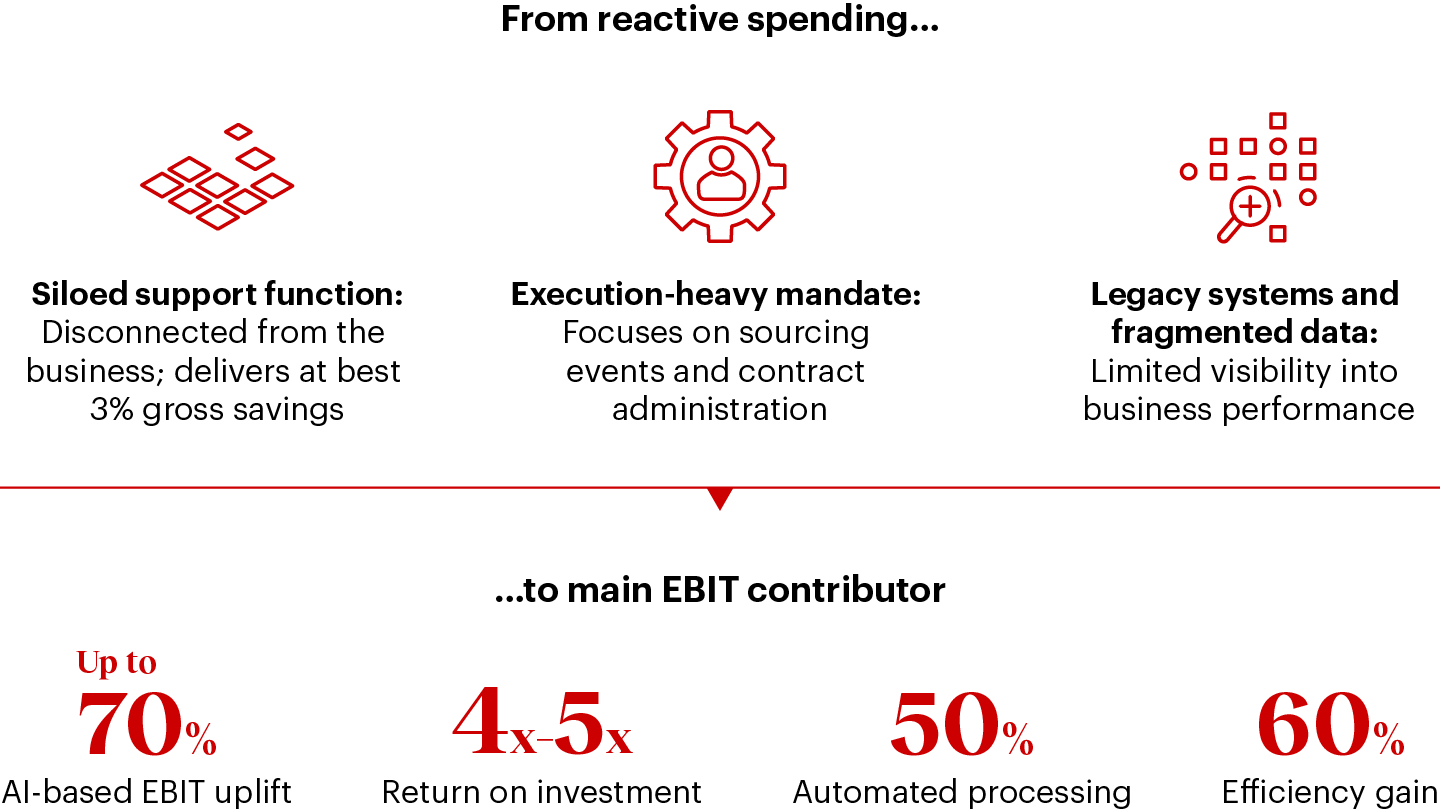

A small group of leading chief procurement officers (CPOs) is already making that shift. Rather than layering AI onto existing workflows, they are rethinking how decisions are made, how work gets done, and where people create the most value. The result is a widening gap between leaders and followers. And the risk of inaction is growing. Suppliers are already deploying negotiation agents, pricing intelligence tools, and risk monitors. Every commercial interaction with an agent-enabled supplier conducted by a procurement team still working manually tilts in the supplier's favor. CPOs who have not yet begun reshaping their operating model risk a negotiating disadvantage. Beyond cost controlCPOs have always navigated supply disruption, inflation, tariffs, sustainability, and supplier innovation. But disruptions are now more frequent, more volatile and more consequential for business performance. As a result, the C-suite is asking procurement to do far more than control costs, including accelerate decisions, improve forecasting, strengthen resilience, and help the business grow. The pressure is no longer cyclical. Geopolitics, tariffs, and inflation coexist with constant supplier volatility, multiplying compliance obligations and accelerating technological change. Category teams are being asked to operate at twice the pace with the same headcount, a load that existing operating models cannot absorb. That is a fundamentally different mandate than negotiating savings and enforcing compliance. The challenge is that most procurement organizations still operate as if cost control is their primary purpose. Rebuild, don’t retrofitWhen companies apply AI to existing procurement workflows, automating tasks within processes that were designed for a different era, the gains are real but limited. Organizations that automate tasks using isolated pilots typically achieve anywhere from 5% to 10% efficiency improvements. Organizations that redesign processes with AI capture up to 80%. The largest gains come from changing how decisions are made, not simply how tasks are performed. Leading organizations are reassessing every major procurement process (category management, source to contract, procure to pay, supplier management) and asking how each would be designed if built today. One global industrial OEM deployed a multiagent system that now handles more than 10,000 internal and external procurement inquiries per year, automating 80% of routine touchpoints. The humans who used to field those requests focus on exceptions, judgment calls, and supplier relationships. That is a fundamentally different procurement model. A leading technology company achieved similar results at enterprise scale. By redesigning its source-to-contract process, it increased the amount of company spending managed by procurement by 50% without adding staff. It also reimagined the procure-to-pay process, reducing manual steps from 30 to 3 and cutting invoice cycle time from 20 days to just 2. From analyst to value creatorUntil recently, category managers created value through analysis, gathering market intelligence, building expense models, drafting RFPs, scoring supplier responses, and engaging multiple internal stakeholders. That work was time consuming, and doing it well required experience. It also consumed most of the working day. AI is already doing most of those tasks. A category strategy optimizer can combine expense, contract, supplier, and market data to recommend value opportunities in minutes. It can also benchmark prices against external data to identify negotiation opportunities. A sourcing agent can draft RFPs, evaluate supplier responses, and recommend negotiation strategies before the category manager opens the file. Consider what this means for the role. In 2026, a category manager’s typical day involves several hours comparing RFP responses, drafting stakeholder updates, creating management reports, and aligning on evaluation criteria. By 2027, on the current trajectory, those tasks will be largely handled by agents. AI will do much of the analysis, while the category manager reviews its recommendations, applies judgment, and retains decision authority. The manager will spend the freed-up time on strategy, discussing vertical integration risk with the CFO, negotiating a strategic partnership with a supplier, and rebalancing expense allocation after a risk flag. AI will compress nine hours of analytical work to one, with the remaining hours redeployed to the tasks that actually require a human. The implication is a fundamental shift in what makes a procurement professional valuable. If an agent can build the category strategy, run the should cost analysis, and surface the supplier risk in minutes, the scarce skill is no longer producing the analysis; it is knowing which recommendation to trust, where to overrule it, and when to escalate. Competitive advantage shifts from access to information to quality of judgment. That shift has implications for hiring, training, and the CPO’s own role. The CPO is evolving from overseeing sourcing and operations to governing how AI is deployed, where human judgment is required, and how procurement creates value across the enterprise. Four defining movesFour practices distinguish the CPOs moving fastest from those still experimenting on the sidelines. Redesign before scaling. Don’t automate broken processes. AI accelerates whatever it is applied to, including inefficiency. The organizations capturing the most value are rethinking workflows end to end before scaling automation. That means being willing to question processes that have existed for years and to design from the desired outcome backward rather than from the inherited workflow forward. Commit to outcomes, not pilots. Proof-of-concept pilots rarely generate the organizational learning or the executive conviction required to scale. Leading organizations run proofs of value—real outcomes in real categories with real money on the line—on a 12-week timeline. The goal is not to prove that the technology works; it is to demonstrate what an AI-designed function delivers. Set decision rights before granting autonomy. The shift to agentic AI requires clarity on where agents act autonomously and where humans decide. That means establishing delegation of authority, guardrails, and audit trails before deployment, not after. Which decisions can an agent make on its own? Which should be routed to a human for approval? Organizations that set these guidelines up front move faster and take fewer risks than those that discover the gaps under live conditions. Earn the C-suite’s commitment. Rebuilding procurement around AI requires executive sponsorship, which means making a value case that goes well beyond savings. Resilience, decision quality, speed, and supplier innovation are all now part of what procurement can deliver. The CPOs moving fastest have reframed that story and brought the CEO and CFO along with them. AI-enabled procurement redesign is already underway. The emerging leaders are building functions that help the business move faster, manage risk more effectively, and capture greater value from their supplier ecosystems. The result is an increasingly durable source of competitive advantage. |