
Skip to Content
  • Bureaux

    Bureaux

    Amérique du Nord et Amérique du Sud
    • Atlanta
    • Austin
    • Bogota
    • Boston
    • Buenos Aires
    • Chicago
    • Dallas
    • Denver
    • Houston
    • Los Angeles
    • Mexico City
    • Minneapolis
    • Monterrey
    • Montreal
    • New York
    • Rio de Janeiro
    • San Francisco
    • Santiago
    • São Paulo
    • Seattle
    • Silicon Valley
    • Toronto
    • Washington, DC
    Europe, Moyen-Orient et Afrique
    • Amsterdam
    • Athens
    • Berlin
    • Brussels
    • Copenhagen
    • Doha
    • Dubai
    • Dusseldorf
    • Frankfurt
    • Helsinki
    • Istanbul
    • Johannesburg
    • Kyiv
    • Lisbon
    • London
    • Madrid
    • Milan
    • Munich
    • Oslo
    • Paris
    • Riyadh
    • Rome
    • Stockholm
    • Vienna
    • Warsaw
    • Zurich
    Asie et Australie
    • Bangkok
    • Beijing
    • Bengaluru
    • Brisbane
    • Ho Chi Minh City
    • Hong Kong
    • Jakarta
    • Kuala Lumpur
    • Manila
    • Melbourne
    • Mumbai
    • New Delhi
    • Perth
    • Seoul
    • Shanghai
    • Singapore
    • Sydney
    • Tokyo
    Voir tous les bureaux
  • Alumni
  • Presse
  • S’abonner
  • Contacter
  • France | Français

    Sélectionnez votre région et votre langue

    Global
    • Global (English)
    Amérique du Nord et Amérique du Sud
    • Brazil (Português)
    • Argentina (Español)
    • Canada (Français)
    • Chile (Español)
    • Colombia (Español)
    Europe, Moyen-Orient et Afrique
    • France (Français)
    • DACH Region (Deutsch)
    • Italy (Italiano)
    • Spain (Español)
    • Greece (Elliniká)
    Asie et Australie
    • China (中文版)
    • Korea (한국어)
    • Japan (日本語)
  • Saved items (0)
    Saved items (0)

    You have no saved items.

    Bookmark content that interests you and it will be saved here for you to read or share later.

    Explore Bain Insights
  • Expertises Sectorielles
    Menu principal

    Expertises Sectorielles

    • Aerospace et Défense
    • Agroalimentaire
    • Chimie
    • Infrastructures, BTP et Matériaux de Construction
    • Grande Consommation
    • Services Financiers
    • Santé
    • Engins & Equipements Industriels
    • Media et Divertissement
    • Metals
    • Mining
    • Pétrole & Gaz
    • Papier et Emballage
    • Private Equity
    • Secteur Public
    • Distribution
    • Technologie
    • Télécommunications
    • Transportation
    • Travel & Leisure
    • Utilities & Energies Renouvelables
  • Expertises Fonctionnelles
    Menu principal

    Expertises Fonctionnelles

    • Expérience Client
    • ESG
    • Innovation
    • Fusions et Acquisitions
    • Opérations
    • People & Organization
    • Private Equity
    • Sales & Marketing
    • Stratégie
    • IA, Perspectives et Solutions
    • Technology
    • Transformation
  • Digital
  • Points de Vue
  • À propos
    Menu principal

    À propos

    • Notre Activité
    • Nos Valeurs
    • Nos Collaborateurs et Notre Équipe Dirigeante
    • Notre Impact
    • Prix & Récompenses
    • Partenariats Internationaux
    • Evénements
    Further: Our global responsibility
    • Diversité et Inclusion
    • Impact Social
    • Sustainability
    • World Economic Forum
    Learn more about Further
  • Carrières
    Menu principal

    Carrières

    • Rejoignez-nous
      Carrières
      Rejoignez-nous
      • Find Your Place
      • Nos domaines d’expertise
      • Equipes multidisciplinaires
      • Étudiants
      • Stages et programmes
      • Événements de recrutement
    • La vie chez Bain
      Carrières
      La vie chez Bain
      • Blog: Inside Bain
      • Récits de carrière
      • Nos collaborateurs
      • Nos bureaux
      • Soutenir votre évolution professionnelle
      • Groupes d’affinités
      • Avantages chez Bain
    • Histoires d’impact
    • Notre processus de recrutement
      Carrières
      Notre processus de recrutement
      • Ce que vous pouvez attendre
      • Entretiens
    Trouver un poste
  • Bureaux
    Menu principal

    Bureaux

    • Amérique du Nord et Amérique du Sud
      Bureaux
      Amérique du Nord et Amérique du Sud
      • Atlanta
      • Austin
      • Bogota
      • Boston
      • Buenos Aires
      • Chicago
      • Dallas
      • Denver
      • Houston
      • Los Angeles
      • Mexico City
      • Minneapolis
      • Monterrey
      • Montreal
      • New York
      • Rio de Janeiro
      • San Francisco
      • Santiago
      • São Paulo
      • Seattle
      • Silicon Valley
      • Toronto
      • Washington, DC
    • Europe, Moyen-Orient et Afrique
      Bureaux
      Europe, Moyen-Orient et Afrique
      • Amsterdam
      • Athens
      • Berlin
      • Brussels
      • Copenhagen
      • Doha
      • Dubai
      • Dusseldorf
      • Frankfurt
      • Helsinki
      • Istanbul
      • Johannesburg
      • Kyiv
      • Lisbon
      • London
      • Madrid
      • Milan
      • Munich
      • Oslo
      • Paris
      • Riyadh
      • Rome
      • Stockholm
      • Vienna
      • Warsaw
      • Zurich
    • Asie et Australie
      Bureaux
      Asie et Australie
      • Bangkok
      • Beijing
      • Bengaluru
      • Brisbane
      • Ho Chi Minh City
      • Hong Kong
      • Jakarta
      • Kuala Lumpur
      • Manila
      • Melbourne
      • Mumbai
      • New Delhi
      • Perth
      • Seoul
      • Shanghai
      • Singapore
      • Sydney
      • Tokyo
    Voir tous les bureaux
  • Alumni
  • Presse
  • S’abonner
  • Contacter
  • France | Français
    Menu principal

    Sélectionnez votre région et votre langue

    • Global
      Sélectionnez votre région et votre langue
      Global
      • Global (English)
    • Amérique du Nord et Amérique du Sud
      Sélectionnez votre région et votre langue
      Amérique du Nord et Amérique du Sud
      • Brazil (Português)
      • Argentina (Español)
      • Canada (Français)
      • Chile (Español)
      • Colombia (Español)
    • Europe, Moyen-Orient et Afrique
      Sélectionnez votre région et votre langue
      Europe, Moyen-Orient et Afrique
      • France (Français)
      • DACH Region (Deutsch)
      • Italy (Italiano)
      • Spain (Español)
      • Greece (Elliniká)
    • Asie et Australie
      Sélectionnez votre région et votre langue
      Asie et Australie
      • China (中文版)
      • Korea (한국어)
      • Japan (日本語)
  • Saved items  (0)
    Menu principal
    Saved items (0)

    You have no saved items.

    Bookmark content that interests you and it will be saved here for you to read or share later.

    Explore Bain Insights
  • Expertises Sectorielles
    • Expertises Sectorielles

      • Aerospace et Défense
      • Agroalimentaire
      • Chimie
      • Infrastructures, BTP et Matériaux de Construction
      • Grande Consommation
      • Services Financiers
      • Santé
      • Engins & Equipements Industriels
      • Media et Divertissement
      • Metals
      • Mining
      • Pétrole & Gaz
      • Papier et Emballage
      • Private Equity
      • Secteur Public
      • Distribution
      • Technologie
      • Télécommunications
      • Transportation
      • Travel & Leisure
      • Utilities & Energies Renouvelables
  • Expertises Fonctionnelles
    • Expertises Fonctionnelles

      • Expérience Client
      • ESG
      • Innovation
      • Fusions et Acquisitions
      • Opérations
      • People & Organization
      • Private Equity
      • Sales & Marketing
      • Stratégie
      • IA, Perspectives et Solutions
      • Technology
      • Transformation
  • Digital
  • Points de Vue
  • À propos
    • À propos

      • Notre Activité
      • Nos Valeurs
      • Nos Collaborateurs et Notre Équipe Dirigeante
      • Notre Impact
      • Prix & Récompenses
      • Partenariats Internationaux
      • Evénements
      Further: Our global responsibility
      • Diversité et Inclusion
      • Impact Social
      • Sustainability
      • World Economic Forum
      Learn more about Further
  • Carrières
    Recherches les plus fréquentes
    • Agile
    • Digital
    • Stratégie
    Vos recherches précédentes
      Pages récemment visitées

      Content added to saved items

      Saved items (0)

      Removed from saved items

      Saved items (0)

      Etude

      Finding the "X" Factor in Product Design

      Finding the "X" Factor in Product Design

      Using a technique called design-to-X, companies can identify and prioritize the key elements of product design. Finding the X factor helps companies discover what customers truly value.

      Par Markus Bürgin, Jordi Moncada, Joe Terino and Raymond Tsang

      • min
      }

      Etude

      Finding the "X" Factor in Product Design
      en

      Most companies like to think they have a good handle on what their customers want. Firms build products and put them on the market. If consumers like the product, and they think the price is fair, they purchase it. That’s the theory, in any case. But what if something is missing from this equation?

      While most companies listen to their customers, are they asking them the right questions? Most customers have a wish list of functions and features they’d like to see in a product. But there’s often a gap between what customers say they want and what they’re willing to pay for. So, although companies may know what their customers desire, that doesn’t mean they have a good grasp of what their customers truly value.

      When companies don’t know what really matters to their customers, the whole enterprise can suffer. Companies can spend precious resources researching, developing, manufacturing and marketing products with innovative features designed to meet the perceived needs of their customers—only to find that those new and improved products fall flat in the marketplace. The results of such miscalculations can be significant: Revenues and profits can fall, new entrants can steal market share and no-frills manufacturers can undercut the company on price.

      Companies are constantly looking at ways to design and manufacture their products more efficiently, a process known as design-to-cost (D2C). While D2C is an important and useful approach, many companies miss the customer component of the analysis. They focus on the expense of developing, making and selling a product, not on what it actually does—or on what matters to the customer. In short, many companies spend too much time looking in the mirror (at themselves), when they should be looking out the window (at their customers). Even when companies do attempt to discern what the customer values, a method known as design-to-value (D2V), the customers may get what they want, but the firm may not make any money providing it.

      Some companies have begun looking out the window, using a new approach called design-to-X (D2X). In D2X, the “X” factor is anything the customer values that has an impact on design. D2X is a more comprehensive approach than D2C or D2V. Discovering the X factor can involve challenging generally accepted ideas. The D2X process requires dedicated cross-functional teams that can bring a wide range of input and design options to the table. Once the teams identify the best option, they should rigorously track and test the implementation.

      Take the example of a commercial truck manufacturer. Conventional D2C analysis would suggest that truck buyers want the best features at the most reasonable prices. But what if the most important factor for these customers, the X factor, isn’t more features or lower prices?

      It turns out that what these truck customers care about most is fuel efficiency, and thus their X factor is the weight of their vehicles. Having a truck that’s several pounds lighter is more important to these customers than having one that’s a few dollars cheaper. By focusing inwardly (looking in the mirror), the truck maker may find new ways to produce its vehicles at a lower cost, but if those efficiencies involve using cheaper—but heavier—components, the company could end up with a less expensive truck that customers won’t buy. By not looking through the window, it could be missing out on big opportunities to win customers and increase revenues and profits.

      How do companies discover this elusive X? It takes a multidisciplinary, cross-functional approach, one involving R&D, manufacturing, supply chain management, marketing and sales. These cross-functional teams—which constitute the “other X” in D2X—should seek the answers to some basic questions:

      • Which product features are customers willing to pay for? For retail customers, carefully considered market research can help provide the answers. For business customers, a rigorous examination of the profit-and-loss statement can reveal a great deal.
      • How do competitors build features? Break down and meticulously analyze rival products. A systematic tear down can provide important insights into new ways to design features and functions.
      • What is the best alternative design approach? Use cross-functional teams to generate different feature choices for products, along with cost-optimization ideas.
      • What’s the business case for pursuing this new design approach? What’s the likely net benefit to the company, after all change costs have been included? What’s the likely return on investment in new, high-value product features? Which features give the company a genuine opportunity to differentiate itself from competitors, and which ones would be better if standardized across the industry?

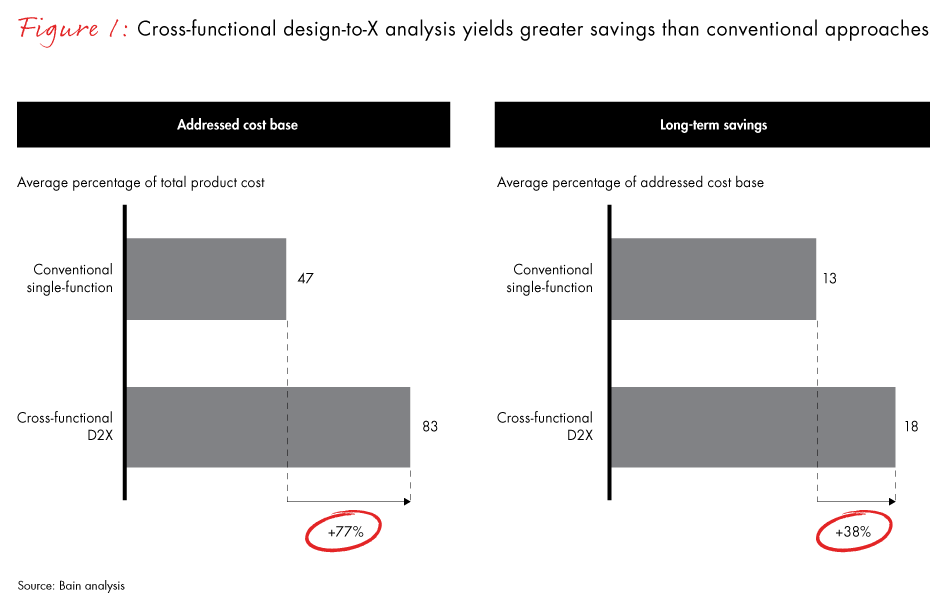
      Bain & Company’s research shows that cross-functional D2X analysis can reap superior results. Using the D2X methodology, cross-functional teams can address a larger share of the costs and generate higher long-term savings rates. When a company employs a conventional, single-function analysis, it typically identifies 47% of the total cost base as addressable. With a cross-functional approach, by contrast, it earmarks 83% of costs as addressable. Over the long term, cross-functional teams reduce costs by 38% more than single-function teams (see Figure 1).

      finding-the-x-factor-fig01_embed

      Discover what customers truly value


      Customers often have a wish list of features and functions they want to see on the next iteration of a product. In many organizations, there’s a direct pipeline from sales to R&D that works like this: Here’s what the customer wants, now figure out how to make it. Other companies rely on off-the-shelf market research to gain insights into what their customers desire.

      But just because customers tell salespeople or generic market researchers they want something, that doesn’t mean they’re willing to pay for it. Companies can discover what their customers value through in-depth interviews, focus groups, observational research and closed, invitation-only online communities. Using the data they’ve gathered, firms can run a conjoint analysis, a methodology for discerning which product attributes a consumer considers most influential in deciding what to buy.

      It can take serious digging to find the X factor. In one recent example, the salesforce of a manufacturer of large cargo-handling equipment reported that customers wanted cranes with longer and faster booms. Making such changes would have involved a costly and extensive redesign of the crane. However, using advanced D2X analytics, the company determined that, although all customers would like more length and speed, only a vocal minority considered those attributes essential. For most customers, about 70%, the two most important purchasing criteria were price and precision. They weren’t willing to pay extra for a longer or faster boom. Once the company found the true X factor for most of its customers, it refocused its value proposition and avoided a severe misallocation of product-development resources.

      Sometimes less is more


      A leading US manufacturer of set-top cable TV boxes was struggling to sustain margins in a category that was being overrun by low-cost producers. The company reduced its costs by 5% per year, but that wasn’t enough to keep pace with falling prices, which were declining by 10% annually. The company produced a premium product with features tailored to the specific needs of its customers, cable TV providers. Among other things, the company used high-grade components that helped its boxes withstand rigorous reliability tests.

      When the company did a D2X analysis, it concluded that it was, in effect, overengineering its boxes. As a first step, the company tore down its competitors’ boxes and discovered that those products had fewer features and used cheaper components. But that tear down alone didn’t lead the company to the X factor. To get to X, the company needed to thoroughly research what really mattered to its customers.

      In an evolving marketplace, the company learned, cable TV providers no longer valued the extra durability; many no longer subjected the boxes to reliability tests before installing them. The company redesigned its boxes, cutting out most of the features the customers didn’t want and preserving the few things they really cared about. Once the company understood the X factor, it significantly reduced costs along its supply chain and stopped the margin decline in a highly competitive environment.

      After companies analyze their competitors and customers, they can look at the other critical factors that influence product design, including regulatory trends, supplier capabilities and new digital manufacturing techniques. One producer of machine tools, for example, was seeking a better way to cool its equipment. The company used additive manufacturing to create an almost horizontal system of fluid channels that would not have been feasible with traditional manufacturing. In this case, the X factor for the customer was a dramatic reduction in the time required to cool down the tool-formed material, enabling a massive efficiency gain of nearly 100%.

      Design for maximum return


      When companies look at design through a D2X lens, they can gain new insights into when to customize and when to standardize components. The key questions to ask are: What does the customer see and care about, and what is “below the skin” and not visible or important enough to the customer for us to spend resources on developing a custom solution? Components that don’t matter to the customer’s X can be standardized not just within a company, but across an entire industry.

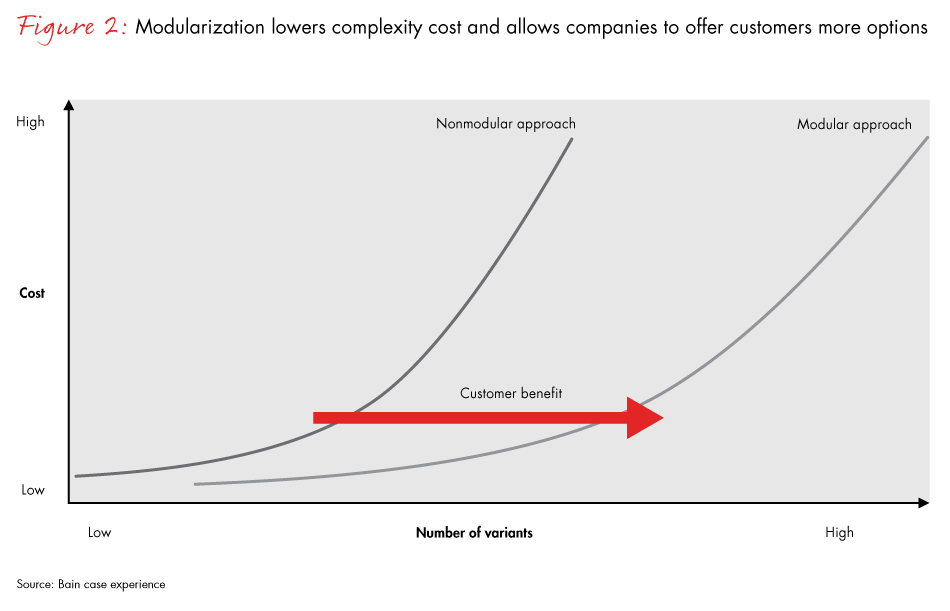
      When companies do need to customize products, they can do it in a smart, cost-effective way, using a technique known as modular architecture. This approach might be best understood by evoking two brands of children’s building sets: Playmobil and LEGO. Playmobil offers a huge variety of customized pieces. LEGO, by contrast, provides a limited number of standardized components that children can combine in multiple ways. The disassembled pieces of a Playmobil truck look like truck components that can easily be reassembled into a vehicle. The disassembled pieces of a LEGO truck, by contrast, look like a pile of uniform bits that can be reassembled into almost anything.

      With modular architecture, manufacturers can use a limited number of LEGO-like components to build customized products, thus bringing down complexity costs and making scale effects attainable—even in highly engineered products (see Figure 2).

      finding-the-x-factor-fig02_embed

      Through D2X, companies can focus on giving customers products with features and functions that matter to them, whether those products are trucks, cranes, cable boxes or machine tools. D2X isn’t a one-off exercise. It’s a capability that companies should build into their DNA. Look out the window, not in the mirror. With D2X you can discover what your customers truly value—and then come up with a smart, cost-effective way to deliver it.

      Markus Buergin, Jordi Moncada, Joe Terino and Raymond Tsang are partners in Bain & Company’s Performance Improvement practice. They are located, respectively, in Munich, Silicon Valley, Boston and Shanghai.

      Special thanks to Michael Weber and Daniel Arand, managers in Bain’s Munich office, and Thomas Schneider, a principal in the firm’s Düsseldorf office.


      finding-the-x-factor-fig01_full

      finding-the-x-factor-fig02_full
      Auteurs
      • Headshot of Markus Bürgin
        Markus Bürgin
        Associé, Munich
      • Jordi Moncada
        Former Partner, Silicon Valley
      • Joe Terino
        Alumni, Boston
      • Headshot of Raymond Tsang
        Raymond Tsang
        Associé, Hong Kong
      Contactez-nous
      Expertises fonctionnelles transverses
      • Amélioration de la Performance
      • Opérations
      Stratégie Client et Marketing
      The Elements of Value

      Understanding the 30 elements of value for consumers can help companies gain an edge.

      Voir plus
      Amélioration de la Performance
      Focus on the Customer

      Companies that seek to be the best at something may have to be only average at everything else.

      Voir plus
      Amélioration de la Performance
      Don’t Underestimate the Cost of Overcapacity

      Overcapacity is endemic to the paper and packaging industry, but these actions can help you maintain margins.

      Voir plus
      Amélioration de la Performance
      Solving for AI’s Data Center Construction Crunch

      AI’s computing needs could reach 200 gigawatts of new global demand by 2030, requiring companies to build faster and smarter.

      Voir plus
      Amélioration de la Performance
      Technology Is Radically Reshaping Auto Economics

      Digital technologies and AI are poised to increase the efficiency of automotive processes by 30%.

      Voir plus
      First published in avril 2017
      Mots clés
      • Amélioration de la Performance
      • Opérations

      Comment nous avons aidé nos clients

      Amélioration de la Performance An Energy Company Sees the Big Financial Picture

      Lire l’étude de cas

      Amélioration de la Performance Turning bottlenecks into growth opportunities

      Lire l’étude de cas

      Digital Bain and Bosch Connected Industry Team Up to Help Automaker Build a New Plant Based on Industry 4.0 Technology

      Lire l’étude de cas

      Vous souhaitez continuer cette conversation ?

      Nous aidons des dirigeants du monde entier à matérialiser des impacts et des résultats pérennes et créateurs de valeur dans leurs organisations.

      Les points de vue de Bain : notre perspective sur des problématiques auxquelles sont confrontées les entreprises à travers le monde, envoyés chaque mois dans votre boîte de réception. 

      *J’ai lu la politique de confidentialité et j’accepte les conditions.

      Merci de lire notre politique de confidentialité.
      Bain & Company
      Contactez-nous Sustainability Accessibility Conditions d’utilisation Politique de Confidentialité Cookie Policy Mentions Légales Sitemap Log In

      © 1996-2026 Bain & Company, Inc.

      Contacter Bain

      Comment pouvons-nous vous aider ?

      • Business inquiry
      • Career information
      • Press relations
      • Partnership request
      • Speaker request
      Voir tous les bureaux