
Skip to Content
  • Bureaux

    Bureaux

    Amérique du Nord et Amérique du Sud
    • Atlanta
    • Austin
    • Bogota
    • Boston
    • Buenos Aires
    • Chicago
    • Dallas
    • Denver
    • Houston
    • Los Angeles
    • Mexico City
    • Minneapolis
    • Monterrey
    • Montreal
    • New York
    • Rio de Janeiro
    • San Francisco
    • Santiago
    • São Paulo
    • Seattle
    • Silicon Valley
    • Toronto
    • Washington, DC
    Europe, Moyen-Orient et Afrique
    • Amsterdam
    • Athens
    • Berlin
    • Brussels
    • Copenhagen
    • Doha
    • Dubai
    • Dusseldorf
    • Frankfurt
    • Helsinki
    • Istanbul
    • Johannesburg
    • Kyiv
    • Lisbon
    • London
    • Madrid
    • Milan
    • Munich
    • Oslo
    • Paris
    • Riyadh
    • Rome
    • Stockholm
    • Vienna
    • Warsaw
    • Zurich
    Asie et Australie
    • Bangkok
    • Beijing
    • Bengaluru
    • Brisbane
    • Ho Chi Minh City
    • Hong Kong
    • Jakarta
    • Kuala Lumpur
    • Manila
    • Melbourne
    • Mumbai
    • New Delhi
    • Perth
    • Seoul
    • Shanghai
    • Singapore
    • Sydney
    • Tokyo
    Voir tous les bureaux
  • Alumni
  • Presse
  • S’abonner
  • Contacter
  • France | Français

    Sélectionnez votre région et votre langue

    Global
    • Global (English)
    Amérique du Nord et Amérique du Sud
    • Brazil (Português)
    • Argentina (Español)
    • Canada (Français)
    • Chile (Español)
    • Colombia (Español)
    Europe, Moyen-Orient et Afrique
    • France (Français)
    • DACH Region (Deutsch)
    • Italy (Italiano)
    • Spain (Español)
    • Greece (Elliniká)
    Asie et Australie
    • China (中文版)
    • Korea (한국어)
    • Japan (日本語)
  • Saved items (0)
    Saved items (0)

    You have no saved items.

    Bookmark content that interests you and it will be saved here for you to read or share later.

    Explore Bain Insights
  • Expertises Sectorielles
    Menu principal

    Expertises Sectorielles

    • Aerospace et Défense
    • Agroalimentaire
    • Chimie
    • Infrastructures, BTP et Matériaux de Construction
    • Grande Consommation
    • Services Financiers
    • Santé
    • Engins & Equipements Industriels
    • Media et Divertissement
    • Metals
    • Mining
    • Pétrole & Gaz
    • Papier et Emballage
    • Private Equity
    • Secteur Public
    • Distribution
    • Technologie
    • Télécommunications
    • Transportation
    • Travel & Leisure
    • Utilities & Energies Renouvelables
  • Expertises Fonctionnelles
    Menu principal

    Expertises Fonctionnelles

    • Expérience Client
    • ESG
    • Innovation
    • Fusions et Acquisitions
    • Opérations
    • People & Organization
    • Private Equity
    • Sales & Marketing
    • Stratégie
    • IA, Perspectives et Solutions
    • Technology
    • Transformation
  • Digital
  • Points de Vue
  • À propos
    Menu principal

    À propos

    • Notre Activité
    • Nos Valeurs
    • Nos Collaborateurs et Notre Équipe Dirigeante
    • Notre Impact
    • Prix & Récompenses
    • Partenariats Internationaux
    • Evénements
    Further: Our global responsibility
    • Diversité et Inclusion
    • Impact Social
    • Sustainability
    • World Economic Forum
    Learn more about Further
  • Carrières
    Menu principal

    Carrières

    • Rejoignez-nous
      Carrières
      Rejoignez-nous
      • Find Your Place
      • Nos domaines d’expertise
      • Equipes multidisciplinaires
      • Étudiants
      • Stages et programmes
      • Événements de recrutement
    • La vie chez Bain
      Carrières
      La vie chez Bain
      • Blog: Inside Bain
      • Récits de carrière
      • Nos collaborateurs
      • Nos bureaux
      • Soutenir votre évolution professionnelle
      • Groupes d’affinités
      • Avantages chez Bain
    • Histoires d’impact
    • Notre processus de recrutement
      Carrières
      Notre processus de recrutement
      • Ce que vous pouvez attendre
      • Entretiens
    Trouver un poste
  • Bureaux
    Menu principal

    Bureaux

    • Amérique du Nord et Amérique du Sud
      Bureaux
      Amérique du Nord et Amérique du Sud
      • Atlanta
      • Austin
      • Bogota
      • Boston
      • Buenos Aires
      • Chicago
      • Dallas
      • Denver
      • Houston
      • Los Angeles
      • Mexico City
      • Minneapolis
      • Monterrey
      • Montreal
      • New York
      • Rio de Janeiro
      • San Francisco
      • Santiago
      • São Paulo
      • Seattle
      • Silicon Valley
      • Toronto
      • Washington, DC
    • Europe, Moyen-Orient et Afrique
      Bureaux
      Europe, Moyen-Orient et Afrique
      • Amsterdam
      • Athens
      • Berlin
      • Brussels
      • Copenhagen
      • Doha
      • Dubai
      • Dusseldorf
      • Frankfurt
      • Helsinki
      • Istanbul
      • Johannesburg
      • Kyiv
      • Lisbon
      • London
      • Madrid
      • Milan
      • Munich
      • Oslo
      • Paris
      • Riyadh
      • Rome
      • Stockholm
      • Vienna
      • Warsaw
      • Zurich
    • Asie et Australie
      Bureaux
      Asie et Australie
      • Bangkok
      • Beijing
      • Bengaluru
      • Brisbane
      • Ho Chi Minh City
      • Hong Kong
      • Jakarta
      • Kuala Lumpur
      • Manila
      • Melbourne
      • Mumbai
      • New Delhi
      • Perth
      • Seoul
      • Shanghai
      • Singapore
      • Sydney
      • Tokyo
    Voir tous les bureaux
  • Alumni
  • Presse
  • S’abonner
  • Contacter
  • France | Français
    Menu principal

    Sélectionnez votre région et votre langue

    • Global
      Sélectionnez votre région et votre langue
      Global
      • Global (English)
    • Amérique du Nord et Amérique du Sud
      Sélectionnez votre région et votre langue
      Amérique du Nord et Amérique du Sud
      • Brazil (Português)
      • Argentina (Español)
      • Canada (Français)
      • Chile (Español)
      • Colombia (Español)
    • Europe, Moyen-Orient et Afrique
      Sélectionnez votre région et votre langue
      Europe, Moyen-Orient et Afrique
      • France (Français)
      • DACH Region (Deutsch)
      • Italy (Italiano)
      • Spain (Español)
      • Greece (Elliniká)
    • Asie et Australie
      Sélectionnez votre région et votre langue
      Asie et Australie
      • China (中文版)
      • Korea (한국어)
      • Japan (日本語)
  • Saved items  (0)
    Menu principal
    Saved items (0)

    You have no saved items.

    Bookmark content that interests you and it will be saved here for you to read or share later.

    Explore Bain Insights
  • Expertises Sectorielles
    • Expertises Sectorielles

      • Aerospace et Défense
      • Agroalimentaire
      • Chimie
      • Infrastructures, BTP et Matériaux de Construction
      • Grande Consommation
      • Services Financiers
      • Santé
      • Engins & Equipements Industriels
      • Media et Divertissement
      • Metals
      • Mining
      • Pétrole & Gaz
      • Papier et Emballage
      • Private Equity
      • Secteur Public
      • Distribution
      • Technologie
      • Télécommunications
      • Transportation
      • Travel & Leisure
      • Utilities & Energies Renouvelables
  • Expertises Fonctionnelles
    • Expertises Fonctionnelles

      • Expérience Client
      • ESG
      • Innovation
      • Fusions et Acquisitions
      • Opérations
      • People & Organization
      • Private Equity
      • Sales & Marketing
      • Stratégie
      • IA, Perspectives et Solutions
      • Technology
      • Transformation
  • Digital
  • Points de Vue
  • À propos
    • À propos

      • Notre Activité
      • Nos Valeurs
      • Nos Collaborateurs et Notre Équipe Dirigeante
      • Notre Impact
      • Prix & Récompenses
      • Partenariats Internationaux
      • Evénements
      Further: Our global responsibility
      • Diversité et Inclusion
      • Impact Social
      • Sustainability
      • World Economic Forum
      Learn more about Further
  • Carrières
    Recherches les plus fréquentes
    • Agile
    • Digital
    • Stratégie
    Vos recherches précédentes
      Pages récemment visitées

      Content added to saved items

      Saved items (0)

      Removed from saved items

      Saved items (0)

      Etude

      How Shared Services Organizations Can Scale Up by Earning Internal Customers’ Love

      How Shared Services Organizations Can Scale Up by Earning Internal Customers’ Love

      How are we doing? When shared services organizations ask that question of their internal customers and act on the feedback, great business outcomes can happen.

      Par Michael Heric, Mark Krafft, et Praveen Bhardwaj

      • min
      }

      Etude

      How Shared Services Organizations Can Scale Up by Earning Internal Customers’ Love
      en
      At a Glance
      • Most midsize and large companies have centralized two or three functions under shared services to reduce costs and improve service quality—an attractive proposition now that a recession looks imminent.
      • But relatively few companies expand that effort into global business services, typically because business units and functions have not trusted a central group to reliably deliver value beyond basic transactions. 
      • Earning trust and scaling up shared services require the same mindset and approach to internal customers that companies take with their external customers.
      • Our global survey finds that the leading shared service organizations use the Net Promoter System™ to improve the internal customer experience, enhance performance, and consequently integrate more, higher-value services.

      With a recession looming and inflation persisting, companies are facing significant pressure to reset their cost base to stay competitive. As they search for savings, many managers turn to their back-office functions to close the gap, with cost programs often generating 20% to 40% savings through automation, process improvements, labor arbitrage, and other means.

      Most major companies have centralized back-office functions to some extent, from simple, single-function shared services focused on finance, HR, or IT, to more sophisticated, multifunction, integrated global business services (GBS). GBS organizations reduce costs, enhance performance, increase agility and scalability, and accelerate digital processes.

      However, full-fledged, broad-scale GBS remain rare. Business leaders often resist shared services beyond the most basic activities in finance, HR, and IT. Many business units or functions hesitate to expand shared services into higher-value activities, such as sales and marketing, or analytics in finance, because they do not trust a central group to perform effectively and generate valuable insights. As Bain & Company found in a recent survey of 935 GBS decision-makers worldwide, two-thirds of GBS or shared service organizations contain three or fewer service lines, and 40% contain only one. That narrow band of service lines prevents firms from reaping the full value of centralization within shared services, such as standardizing back-office processes, sharing investments in new technology to automate processes, or improving performance across the enterprise.

      One global consumer packaged goods company wanted to extend global shared services into new areas such as financial planning and analysis (FP&A). Before doing so, it had struggled to generate the scale, standardization, and alignment needed to simplify its monthly volume and revenue forecast process worldwide. Once these activities became shared services, the company could develop and deploy a machine-learning solution that collapsed the creation of a forecast from two weeks to several hours, eliminated manual error-prone work, and improved data accuracy and availability.

      To shift more work into GBS, companies must take a customer-centric view on how they deliver functions, much like how they approach external-customer-facing activities. Internal customers often want more than rote transaction execution; they seek responsive, tailored service experiences and a value-added partnership, just as external customers do.

      In the case of the consumer packaged goods company, to support monthly planning and decision-making, business unit finance leaders needed not only insightful analysis of historical business performance, with a tailored assessment of P&L variances, but also a view of future market opportunities within each country, considering factors such as macroeconomic trends, supply chain dynamics, customer wins and losses, and weather patterns. Transactional execution of standard reporting dashboards was not sufficient to support effective decision-making and build a partnership.

      Internal customers want to be heard, but shared services groups aren’t listening

      While two-thirds of shared services organizations in our survey cite putting internal customers front and center as a top strategic priority, an alarming 68% of them do not even measure internal customer satisfaction. Further, while half of these companies use the Net Promoter Score (NPS)—the gold standard in measuring and improving customer advocacy—for external customers, only 8% of respondents use NPS for internal customers (see Figure 1). To calculate NPS, a company asks customers the ultimate question: On a scale of 0 to 10, how likely are you to recommend [company, brand, product, service] to a friend or relative?, Those answering 0 to 6 are detractors; 7 to 8 are passives; and 9 to 10 are promoters. The aggregate score derives from the percentage of promoters minus the percentage of detractors.

      Figure 1
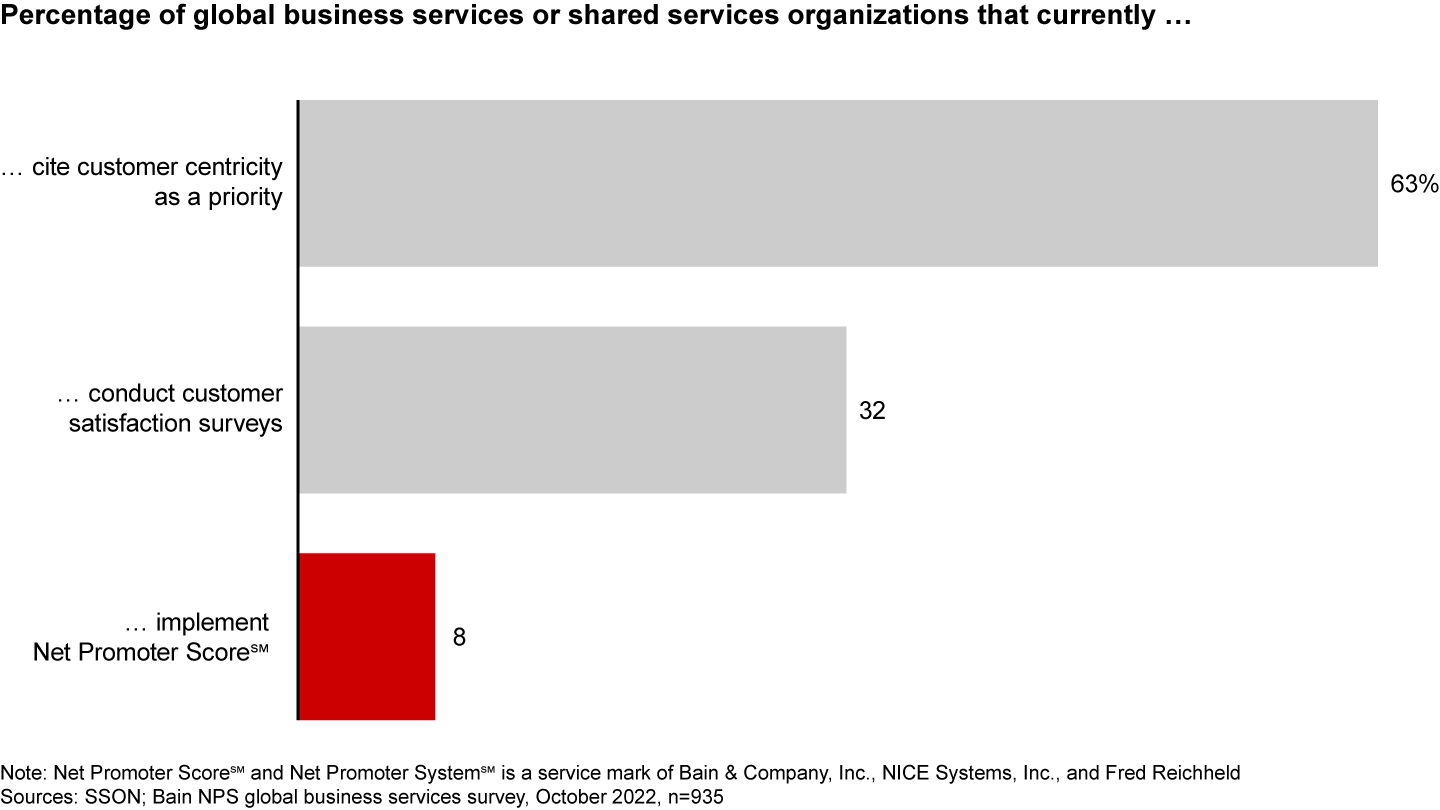
      Shared services organizations recognize the value of customer centricity, but few adopt systems that measure and respond to internal customers’ priorities

      Although most companies realize the importance of customer experience, they are not applying the same level of rigor with internal customers. They rarely ask for feedback or benchmark performance. Shared services thus remain confined to low-value, transactional activities. And when companies force higher levels of adoption without fully accounting for customer needs, they often cause shadow processes and organizations to spring up, leading to duplicate work at higher costs.  

      Leaders are beginning to pay attention

      Our survey suggests this situation could soon change. Roughly 8% of firms we surveyed are starting to implement the metric, with another 12% planning to implement in the next 12 months.

      As companies have discovered with their external customers, the Net Promoter Score is more effective than measuring customer satisfaction because it measures advocacy and ultimately loyalty. Externally, companies with higher scores benefit from customers who stay longer, buy more, and tell their friends more often than competitors with lower scores. This results in lower costs to retain customers and acquire new ones, along with higher sales. 

      While only a small number of shared services organizations currently use NPS, those that have adopted the Net Promoter Score find it effective, continue using it for long periods, and incorporate more services, our survey shows:

      • NPS adopters have integrated 36% more business functions in shared services than other companies.
      • They tend to stick to the system, with almost 90% still using it three years after initial adoption and measuring the score at least quarterly.
      • Nearly all adopters set and track specific targets of NPS performance.

      Consider how a large B2B services company used NPS to incorporate additional services into its global business services organization. After establishing a three-service-line GBS organization, the company engaged the team that focused on improving the external customer experience to deploy a similar tool kit within GBS. The team gathered internal customer feedback using NPS, built improvement plans in collaboration with internal customers, and delivered on those plans in a way that improved performance and built confidence among internal customers in GBS’ ability to add value to the business. Within two years, the organization expanded to operate nine service lines and was recognized by the Shared Services & Outsourcing Network (SSON) as among the most admired such organizations globally.

      Smith+Nephew, a medical technology company, has also relied on NPS for its GBS organization’s strategy. An automated NPS solution rapidly flags process improvement opportunities through alerts and AI-enabled sentiment analysis. Through effective listening to and acting on customer feedback, Smith+Nephew has improved processes customer satisfaction, and it was recognized by SSON as one of the 20 most admired organizations in 2022.

      The most mature GBS organizations do not simply track Net Promoter Score. They create a Net Promoter System surrounding the score, with a comprehensive, repeatable approach that puts customer priorities at the heart of operations. They have a closed-loop feedback system that engages the relevant service lines to develop and implement improvements based on listening to and acting on feedback. They assemble action plans with front-line customers as well as with business unit and function leaders, tailoring the approach for each group of stakeholders. And they consider absolute NPS alongside the more important trajectory and qualitative feedback. Our research shows that organizations that embed these actions are significantly more likely to achieve higher customer satisfaction as measured by NPS (see Figure 2).

      Figure 2
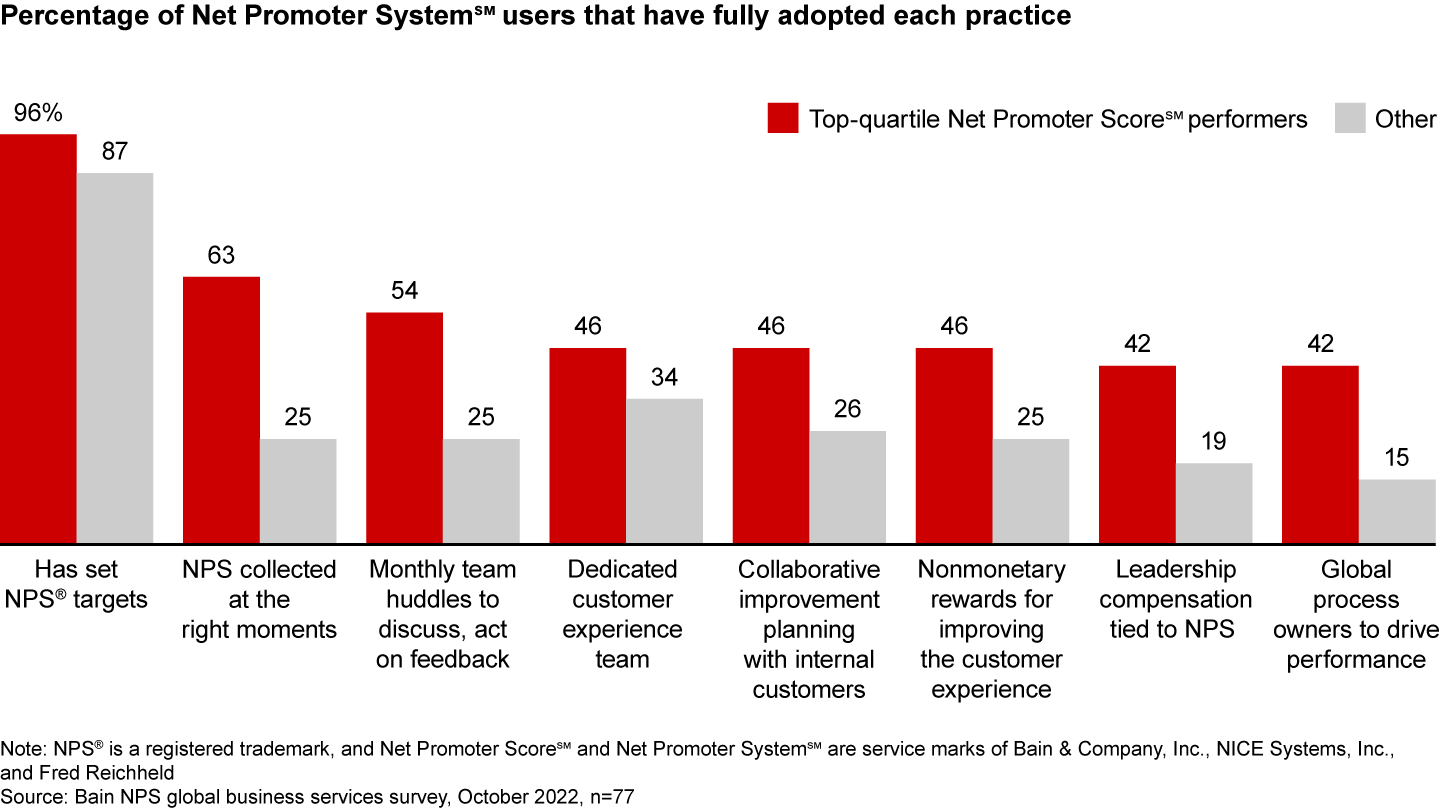
      High-performing shared services organizations embed customer-centered practices

      For example, AB InBev, the world’s leading beer company, has been able to improve performance in its Global Capability Center (GCC) through extensive deployment of NPS practices, including closed-loop feedback mechanisms, an automated NPS technology solution to identify issues and track follow-ups, and the establishment of a customer experience lead position. These practices helped improve performance in areas such as treasury, where internal customers were not fully satisfied with the speed of cash disbursement in certain situations, and sales support, where existing metrics did not fully capture evolving customer expectations. The company’s efforts helped the GCC dramatically improve its Net Promoter Score by 110 points from 2019 to 2022, while increasing response rates from 16% to 66%.

      Shared services organizations can also use NPS feedback to identify other systemic issues that degrade the internal experience and route them to the right parts of the organization to review and take action. For instance, they can flag that a sales team should gather critical data from customers in initial discussions to avoid delays later in the process.

      Making the most of a Net Promoter System

      Implementing the Net Promoter System with internal customers requires thoughtful application, and should include all of these features:

      • Clear link between customer-centered behaviors and business outcomes;
      • Tailored approach for each customer group;
      • Closed-loop system so that customers see their feedback acted on;
      • Empowered teams with the right training and incentives; and
      • Centralized, automated technology platform to support NPS.

      Companies that want to establish a Net Promoter System for their shared services or GBS can follow these steps:

      1. Establish ambitious business outcomes and key performance indicators beyond transactional delivery and cost.
      2. Develop a deep understanding of the customer journey, prioritizing the moments that matter most to customers.
      3. Commit to customer-centered behaviors and making performance transparent to other units in the organization.
      4. Select several services for a pilot, run by a small team, to build understanding, capabilities, and proof points associated with NPS.
      5. Map out how to expand and embed NPS, through regular performance reviews, tailored training for employees to learn from feedback, and dedicated technologies.

      As companies tighten their belts to deal with the current economic uncertainty, expanding the use of shared services is a natural way to contain costs. But along with that expansion comes a responsibility to perform at high standards, or else risk resistance among employees and managers. Embedding the Net Promoter System is the surest way to catch problems early, improve performance in support of business outcomes, and earn the right to integrate even more services into a global group.

      Auteurs
      • Headshot of Michael Heric
        Michael Heric
        Associé, New York
      • Headshot of Mark Krafft
        Mark Krafft
        Associé, Washington, DC
      • Headshot of Praveen Bhardwaj
        Praveen Bhardwaj
        Associé, Washington, DC
      Contactez-nous
      Expertises fonctionnelles transverses
      • Accelerated Performance Transformation
      • Customer Experience
      • Net Promoter System®
      • Support Functions
      Comment pouvons-nous vous aider ?
      • Business Process Redesign
      • Capability Sourcing
      • Finance Function Advantage
      • HR Function Advantage
      • Shared Services
      CIO Insights
      Automation Scorecard 2024: Lessons Learned Can Inform Deployment of Generative AI

      The most experienced firms are widening their lead in cost savings and productivity.

      Voir plus
      CIO Insights
      Four Ways Leaders Can Make AI Redesigns Stick

      As companies redesign to scale AI, these four lessons help leaders ensure their organizations actually live the new operating model.

      Voir plus
      CFO Insights
      Patrick O'Hagan: Shared Services

      How successful companies can accelerate profitable growth with the Share Smarter, Serve Better model.

      Voir plus
      Net Promoter System®
      What Loyalty-Leading Banks Do Differently

      Bain’s global survey reveals consumer preferences and how those flow through to lower costs and higher revenues.

      Voir plus
      CIO Insights
      The 2026 Retail Executive Agenda

      Here are letters to the C-suite to help strengthen strategy, catalyze collaboration, and expand value creation in the AI age.

      Voir plus
      First published in janvier 2023
      Mots clés
      • Accelerated Performance Transformation
      • Business Process Redesign
      • Capability Sourcing
      • CFO Insights
      • CIO Insights
      • Customer Experience
      • Finance Function Advantage
      • HR Function Advantage
      • Net Promoter System®
      • Shared Services
      • Support Functions

      Comment nous avons aidé nos clients

      Digital A Chemical Company’s Transformation Reduces Support Function Costs by 25%

      Lire l’étude de cas

      Amélioration de la Performance Lean Six Sigma solves a commercial bank's growth problem

      Lire l’étude de cas

      Amélioration de la Performance When market leadership is not enough

      Lire l’étude de cas

      Vous souhaitez continuer cette conversation ?

      Nous aidons des dirigeants du monde entier à matérialiser des impacts et des résultats pérennes et créateurs de valeur dans leurs organisations.

      Net Promoter®, NPS®, NPS Prism®, and the NPS-related emoticons are registered trademarks and Net Promoter Score℠ and Net Promoter System℠ are service marks of Bain & Company, Inc., Satmetrix Systems, Inc., and Fred Reichheld.

      Les points de vue de Bain : notre perspective sur des problématiques auxquelles sont confrontées les entreprises à travers le monde, envoyés chaque mois dans votre boîte de réception. 

      *J’ai lu la politique de confidentialité et j’accepte les conditions.

      Merci de lire notre politique de confidentialité.
      Bain & Company
      Contactez-nous Sustainability Accessibility Conditions d’utilisation Politique de Confidentialité Cookie Policy Mentions Légales Sitemap Log In

      © 1996-2026 Bain & Company, Inc.

      Contacter Bain

      Comment pouvons-nous vous aider ?

      • Business inquiry
      • Career information
      • Press relations
      • Partnership request
      • Speaker request
      Voir tous les bureaux