
Skip to Content
  • Bureaux

    Bureaux

    Amérique du Nord et Amérique du Sud
    • Atlanta
    • Austin
    • Bogota
    • Boston
    • Buenos Aires
    • Chicago
    • Dallas
    • Denver
    • Houston
    • Los Angeles
    • Mexico City
    • Minneapolis
    • Monterrey
    • Montreal
    • New York
    • Rio de Janeiro
    • San Francisco
    • Santiago
    • São Paulo
    • Seattle
    • Silicon Valley
    • Toronto
    • Washington, DC
    Europe, Moyen-Orient et Afrique
    • Amsterdam
    • Athens
    • Berlin
    • Brussels
    • Copenhagen
    • Doha
    • Dubai
    • Dusseldorf
    • Frankfurt
    • Helsinki
    • Istanbul
    • Johannesburg
    • Kyiv
    • Lisbon
    • London
    • Madrid
    • Milan
    • Munich
    • Oslo
    • Paris
    • Riyadh
    • Rome
    • Stockholm
    • Vienna
    • Warsaw
    • Zurich
    Asie et Australie
    • Bangkok
    • Beijing
    • Bengaluru
    • Brisbane
    • Ho Chi Minh City
    • Hong Kong
    • Jakarta
    • Kuala Lumpur
    • Manila
    • Melbourne
    • Mumbai
    • New Delhi
    • Perth
    • Seoul
    • Shanghai
    • Singapore
    • Sydney
    • Tokyo
    Voir tous les bureaux
  • Alumni
  • Presse
  • S’abonner
  • Contacter
  • France | Français

    Sélectionnez votre région et votre langue

    Global
    • Global (English)
    Amérique du Nord et Amérique du Sud
    • Brazil (Português)
    • Argentina (Español)
    • Canada (Français)
    • Chile (Español)
    • Colombia (Español)
    Europe, Moyen-Orient et Afrique
    • France (Français)
    • DACH Region (Deutsch)
    • Italy (Italiano)
    • Spain (Español)
    • Greece (Elliniká)
    Asie et Australie
    • China (中文版)
    • Korea (한국어)
    • Japan (日本語)
  • Saved items (0)
    Saved items (0)

    You have no saved items.

    Bookmark content that interests you and it will be saved here for you to read or share later.

    Explore Bain Insights
  • Expertises Sectorielles
    Menu principal

    Expertises Sectorielles

    • Aerospace et Défense
    • Agroalimentaire
    • Chimie
    • Infrastructures, BTP et Matériaux de Construction
    • Grande Consommation
    • Services Financiers
    • Santé
    • Engins & Equipements Industriels
    • Media et Divertissement
    • Metals
    • Mining
    • Pétrole & Gaz
    • Papier et Emballage
    • Private Equity
    • Secteur Public
    • Distribution
    • Technologie
    • Télécommunications
    • Transportation
    • Travel & Leisure
    • Utilities & Energies Renouvelables
  • Expertises Fonctionnelles
    Menu principal

    Expertises Fonctionnelles

    • Expérience Client
    • ESG
    • Innovation
    • Fusions et Acquisitions
    • Opérations
    • People & Organization
    • Private Equity
    • Sales & Marketing
    • Stratégie
    • IA, Perspectives et Solutions
    • Technology
    • Transformation
  • Digital
  • Points de Vue
  • À propos
    Menu principal

    À propos

    • Notre Activité
    • Nos Valeurs
    • Nos Collaborateurs et Notre Équipe Dirigeante
    • Notre Impact
    • Prix & Récompenses
    • Partenariats Internationaux
    • Evénements
    Further: Our global responsibility
    • Diversité et Inclusion
    • Impact Social
    • Sustainability
    • World Economic Forum
    Learn more about Further
  • Carrières
    Menu principal

    Carrières

    • Rejoignez-nous
      Carrières
      Rejoignez-nous
      • Find Your Place
      • Nos domaines d’expertise
      • Equipes multidisciplinaires
      • Étudiants
      • Stages et programmes
      • Événements de recrutement
    • La vie chez Bain
      Carrières
      La vie chez Bain
      • Blog: Inside Bain
      • Récits de carrière
      • Nos collaborateurs
      • Nos bureaux
      • Soutenir votre évolution professionnelle
      • Groupes d’affinités
      • Avantages chez Bain
    • Histoires d’impact
    • Notre processus de recrutement
      Carrières
      Notre processus de recrutement
      • Ce que vous pouvez attendre
      • Entretiens
    Trouver un poste
  • Bureaux
    Menu principal

    Bureaux

    • Amérique du Nord et Amérique du Sud
      Bureaux
      Amérique du Nord et Amérique du Sud
      • Atlanta
      • Austin
      • Bogota
      • Boston
      • Buenos Aires
      • Chicago
      • Dallas
      • Denver
      • Houston
      • Los Angeles
      • Mexico City
      • Minneapolis
      • Monterrey
      • Montreal
      • New York
      • Rio de Janeiro
      • San Francisco
      • Santiago
      • São Paulo
      • Seattle
      • Silicon Valley
      • Toronto
      • Washington, DC
    • Europe, Moyen-Orient et Afrique
      Bureaux
      Europe, Moyen-Orient et Afrique
      • Amsterdam
      • Athens
      • Berlin
      • Brussels
      • Copenhagen
      • Doha
      • Dubai
      • Dusseldorf
      • Frankfurt
      • Helsinki
      • Istanbul
      • Johannesburg
      • Kyiv
      • Lisbon
      • London
      • Madrid
      • Milan
      • Munich
      • Oslo
      • Paris
      • Riyadh
      • Rome
      • Stockholm
      • Vienna
      • Warsaw
      • Zurich
    • Asie et Australie
      Bureaux
      Asie et Australie
      • Bangkok
      • Beijing
      • Bengaluru
      • Brisbane
      • Ho Chi Minh City
      • Hong Kong
      • Jakarta
      • Kuala Lumpur
      • Manila
      • Melbourne
      • Mumbai
      • New Delhi
      • Perth
      • Seoul
      • Shanghai
      • Singapore
      • Sydney
      • Tokyo
    Voir tous les bureaux
  • Alumni
  • Presse
  • S’abonner
  • Contacter
  • France | Français
    Menu principal

    Sélectionnez votre région et votre langue

    • Global
      Sélectionnez votre région et votre langue
      Global
      • Global (English)
    • Amérique du Nord et Amérique du Sud
      Sélectionnez votre région et votre langue
      Amérique du Nord et Amérique du Sud
      • Brazil (Português)
      • Argentina (Español)
      • Canada (Français)
      • Chile (Español)
      • Colombia (Español)
    • Europe, Moyen-Orient et Afrique
      Sélectionnez votre région et votre langue
      Europe, Moyen-Orient et Afrique
      • France (Français)
      • DACH Region (Deutsch)
      • Italy (Italiano)
      • Spain (Español)
      • Greece (Elliniká)
    • Asie et Australie
      Sélectionnez votre région et votre langue
      Asie et Australie
      • China (中文版)
      • Korea (한국어)
      • Japan (日本語)
  • Saved items  (0)
    Menu principal
    Saved items (0)

    You have no saved items.

    Bookmark content that interests you and it will be saved here for you to read or share later.

    Explore Bain Insights
  • Expertises Sectorielles
    • Expertises Sectorielles

      • Aerospace et Défense
      • Agroalimentaire
      • Chimie
      • Infrastructures, BTP et Matériaux de Construction
      • Grande Consommation
      • Services Financiers
      • Santé
      • Engins & Equipements Industriels
      • Media et Divertissement
      • Metals
      • Mining
      • Pétrole & Gaz
      • Papier et Emballage
      • Private Equity
      • Secteur Public
      • Distribution
      • Technologie
      • Télécommunications
      • Transportation
      • Travel & Leisure
      • Utilities & Energies Renouvelables
  • Expertises Fonctionnelles
    • Expertises Fonctionnelles

      • Expérience Client
      • ESG
      • Innovation
      • Fusions et Acquisitions
      • Opérations
      • People & Organization
      • Private Equity
      • Sales & Marketing
      • Stratégie
      • IA, Perspectives et Solutions
      • Technology
      • Transformation
  • Digital
  • Points de Vue
  • À propos
    • À propos

      • Notre Activité
      • Nos Valeurs
      • Nos Collaborateurs et Notre Équipe Dirigeante
      • Notre Impact
      • Prix & Récompenses
      • Partenariats Internationaux
      • Evénements
      Further: Our global responsibility
      • Diversité et Inclusion
      • Impact Social
      • Sustainability
      • World Economic Forum
      Learn more about Further
  • Carrières
    Recherches les plus fréquentes
    • Agile
    • Digital
    • Stratégie
    Vos recherches précédentes
      Pages récemment visitées

      Content added to saved items

      Saved items (0)

      Removed from saved items

      Saved items (0)

      Etude

      Is your electric vehicle strategy shock-proof?

      Is your electric vehicle strategy shock-proof?

      Power providers must look beyond electricity sales to profit from electric vehicles.

      Par Bain Global Utilities practice

      • min

      Etude

      Is your electric vehicle strategy shock-proof?
      en

      As the era of electric vehicles dawns, utility CEOs find themselves in the spotlight answering questions on how electric vehicles will impact their businesses. Most utility companies already know that their core business—generating, trading and selling power—will hardly change, other than perhaps to shift to lower carbon emission sources of energy. However, the advent of e-mobility opens up a suite of opportunities for utility companies outside their immediate core. The question is: How to identify dependable, low-risk adjacencies to invest in? 

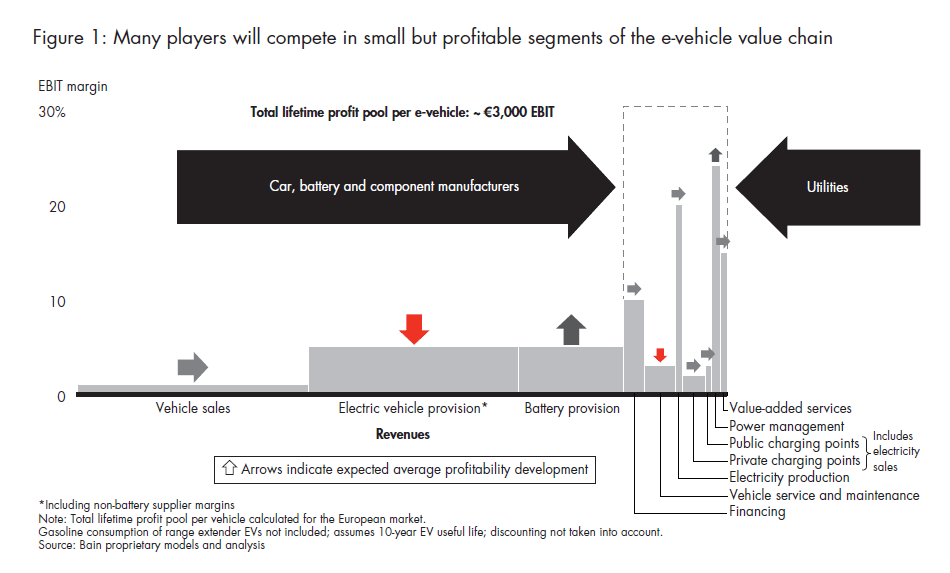
      A good starting point is to consider the electric vehicle value chain, which combines links from the value chains of the automotive and utility industries. According to Bain & Company estimates, the total profit pool of each e-vehicle in Europe adds up to around €3,000 ($4,000) over its lifetime (see Figure 1). That covers a number of business opportunities from one end of the value chain to the other: starting with vehicle sales and battery provision; going on to power management and value-added services; and ultimately, the resale of the vehicle or reuse of its components.

      Of these, the smallest slice of the profit pool goes to a utility’s core business: electricity production. Predictions vary but most estimates agree that by 2020, as much as 50 percent of the new vehicles sold in the US and Europe could consist of some form of electric vehicles (battery electric, range extender or hybrid). Our research shows that at that level, electric vehicles have the power to shift profit pools substantially for the automobile industry—but only marginally for utilities. In a base scenario—a projected market penetration of battery electric vehicles of about 25 percent—electricity demand will increase by just 2 to 5 percent. Even if electric vehicles storm the market, with say a penetration of 50 percent, the additional increase in electricity demand would add up to just 5 to 10 percent. Most markets already have enough power capacity in reserve to meet this spike in future demand.

      is-your-electric-vehicle-strategy-shock-proof-fig-01_embed

      To profit from electric vehicles, “power providers” like utilities and oil and gas companies must, therefore, look beyond electricity sales. But that gets tricky, as each link on the electric vehicle value chain also attracts competitors from other industries: “hardware providers” like auto original equipment manufacturers (OEMs) and battery manufacturers; “infrastructure providers” like service stations and parking garages; and “service providers” like banks, leasing companies, independent resellers and even info-tech and infotainment companies.

      The six most promising bets

      Responding to market pressure, some utility companies moved fast to place bets on new business ideas centered on electric vehicles. Many announced initiatives that projected a clean, green image of the corporate brand. In Germany E.ON is partnering with Audi for a fleet trial in the Munich region. The New York Power Authority is working with Ford. In Italy, Enel and Daimler are working together, introducing electrically powered vehicles in major cities. However, now companies find they can do more: they can find a new source of revenue for the business by investing in the right adjacency. Our research shows that six key nodes on the e-vehicle value chain appear particularly promising for utilities—even though each comes bundled with start-up issues. These include:

      • Power management: Increasingly, managing the grid will present significant challenges. On the one hand, as the number of solar and wind power generation plants rises and more distributed generation installations come into play, supply volatility will increase. On the other hand, with the advent of more energy efficient options, such as electric vehicles and heat pumps, demand volatility will also rise. Utilities can provide an answer to volatility by offering intelligent load control services for e-vehicles.

        Options include starting or stopping the load in line with the level of power supply in the grid. They can also use the battery in the car, with the consent of the owner, to provide regulation energy for the grid as needed. Major utilities have started pilot programs to test this service offering, such as RWE’s project “e-mobility Berlin” and E.ON Avacon’s project, Harz.EE-mobility. Vattenfall is investigating how e-vehicle batteries can help store power in times of oversupply. In all these pilots, pricing models will need to take the additional wear and tear on the battery into account.

      • Installation and operation of public charging infrastructure: The high cost of public charging points—in Germany, for example, they cost €8,000 to €10,000 ($10,800 to $13,400) each—means that the business model for installing public charging stations remains fragile. Most service providers see no way to earn the capital and operation costs with revenues of only €2–4 ($3–6) per charge. Consequently, most public charging infrastructure will depend on cross-subsidies. Either the regulator allows the utility to add the cost to the grid costs and charge grid users, or local communities pick up the tab, or the incumbent utility invests in a public charging infrastructure to run a pilot and promote its brand.

        Another option: partnering with local businesses such as supermarkets, fast-food chains and cinemas that can use charging stations to attract customers. In Stockholm, Elforsk is conducting a pilot by running charging stations at McDonald’s restaurants. Germany’s EnBW has installed a network of charging stations in the Stuttgart region. E.ON’s pilot project in Munich provides test drivers a fleet of Mini E battery electric vehicles that can be charged at E.ON branded charging stations in the city center.

      • Installation and operation of private charging points: Private charging points offer a quicker path to revenues. They require fewer security and safety features than public charging points and are often cheaper to install and maintain. Besides, anyone who buys an electric vehicle is likely to pay the extra money to install a charging point.

        Recognizing that, RWE is piloting a program to offer consumers across Germany a wall-box charging station at their homes. Electric vehicle owners can charge their car for a 100–140-km range in only one hour. In the US, NRG now offers customers private charging stations. This option will require investments from the grid operators over time. Most local grids lack sufficient capacity to supply the growing number of private charging stations in a given residential area.

      • Value-added services: Utilities providing charging infrastructure (public or private) can also pipe “content” into the car in the form of navigation maps, traffic updates, or even music or films for car entertainment systems. Other services offered: monitoring car electronics and providing remote car-diagnosis services. Some utilities might also consider the option of offering advisory services to communities. Sweden’s Vattenfall recently initiated a project to develop user-friendly, value-added services and applications for cost-efficient charging of EVs at home and for fleet operators.
      • Financing vehicle batteries: Utilities have the option to develop innovative financing schemes for the sale or lease of electric vehicles and batteries. Depending on the specific scheme, utilities can enter into agreements with the car user on the extent to which the battery can be used for providing (positive or negative) regulation energy or regulation energy reserve. Such contracts can also specify the terms and conditions for battery usage once the battery’s useful life in the electric vehicle is over. E.ON recently announced a partnership with Athlon Car Lease in Germany for the provision and financing of fleet cars.
      • Reuse of battery for power storage: Even after lifetime employment as a vehicle battery, electric vehicle batteries still retain 50–60 percent of their capacity. A utility could also build a business model around bundling used batteries for power storage at wind farms or large-scale solar power generators. According to Bain calculations, under current regulations and given the energy prices in Germany, a used car battery still has a net present value (NPV) of around €1,000 ($1,300) if used in a bundled storage facility. Drawn to the idea, General Motors is teaming up with the Swiss-based utility supplier ABB to conduct research on reusing spent Chevy Volt batteries for power storage.

      Prioritizing e-mobility business models

      Utilities face a plethora of choices but most of them currently represent high-risk and untested business models. CEOs must not only pick their battles carefully, they must look beyond their own industry to gauge their ability to win. Which e-mobility activities will suit their businesses best? Do they have the right assets and capabilities to venture into new areas? What impact will the new adjacencies have on the corporate brand and reputation?

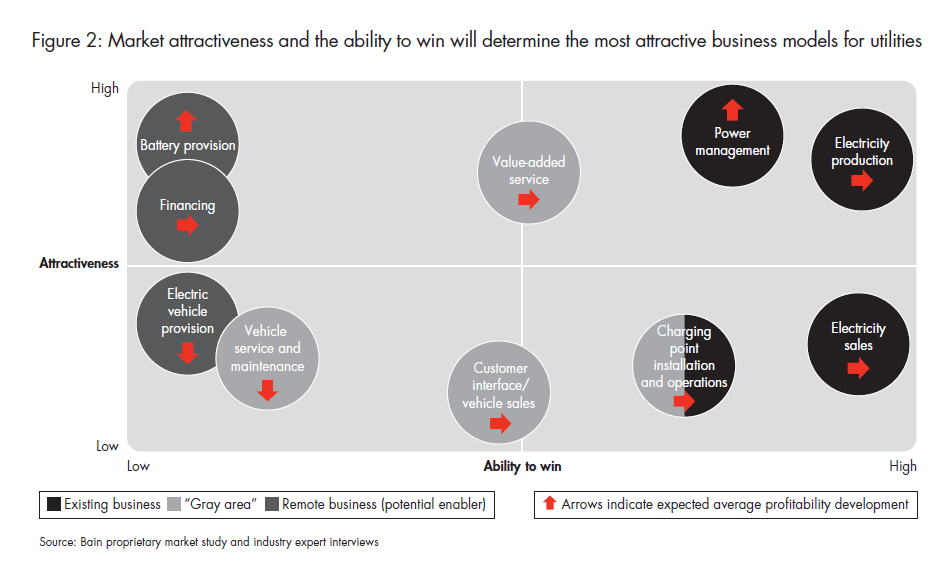
      Leaders can make decisions more confidently if they develop a framework to weigh options—and shortlist those that make sense. In our experience, to get the best out of the e-vehicle opportunity, a utility can prioritize potential business ideas on two dimensions (see Figure 2).

      is-your-electric-vehicle-strategy-shock-proof-fig-02_embed

      The first criterion ranks business models on their attractiveness in terms of the projected market size, the expected rate of growth and their potential profitability. The second prioritizes business models on the utility’s ability to win: the assets and capabilities that the utility can bring to the table by itself or through partnerships.

      The attractiveness and ability to win approach also helps companies zero in to the capabilities they lack. Then, the company can identify potential partners that can help it build successful new business models. For example, one utility company found that it lacked skills in consumer lending know-how and inexpensive refinancing. As the company identified financing as an attractive adjacent business, it began seeking a bank or leasing partner. Another utility company saw itself as an “e-mobility enabler.” It identified partners such as parking garages to install branded charging stations and began to build its own public charging station network.

      Such frameworks also highlight business areas where utilities can play the role of an investor. In this case, instead of new revenue streams, the utility seeks to maximize the return on investments. For example, when Delphi, a leading global supplier to the automotive industry, recognized that electric vehicles will require new components it began investing in equipment technology suppliers for components like EV inverters. Similarly, Comverge invested in developing vehicle-to-grid (V2G) technology for future applications in demand management.

      A critical issue in making the right decision is to consider timing. Utilities might not perceive a need for urgency if they consider only what competitors are doing within the industry. However, for most utility companies, the disruptive force will appear from other industries such as oil and gas, telecom, and component and infrastructure equipment providers: These companies will want to access a greater share of the profit pool by directly offering services to electric vehicle consumers. Utilities can preempt the threats by planning the right strategy and making the right investments early. For most utilities, electric vehicles hold plenty of promise—not just in green slogans, but also green-field ventures.


      is-your-electric-vehicle-strategy-shock-proof-fig-01_full

      is-your-electric-vehicle-strategy-shock-proof-fig-02_full
      Synergies sectorielles
      • Pétrole et Gaz
      • Utilities & Energies Renouvelables
      Expertises fonctionnelles transverses
      • Développement Durable et Responsabilité Sociétale des Entreprises (RSE)
      Automobile
      Affluent likely to lead charge for electric vehicles

      Affluent buyers will be the first to get behind the wheel of electric cars.

      Voir plus
      Pétrole et Gaz
      Tilting at Windmills: How to Make the Most of Clean Tech Opportunities, Developing Portfolio Investments into Standalone Businesses

      Clean technology suffers from the usual perils of early-stage industries. Companies should invest with discipline and target opportunities that fit into their core activities.

      Voir plus
      Utilities & Energies Renouvelables
      Business Breakthrough Barometer 2025

      The annual pulse check from leading businesses on the pace of the net-zero transition.

      Voir plus
      Utilities & Energies Renouvelables
      Sustaining Capital: From Chaos to Discipline

      Fragmented budgets, poor visibility, and missed forecasts are fixable with the right approach.

      Voir plus
      Développement Durable et Responsabilité Sociétale des Entreprises (RSE)
      How AI Is Starting to Transform Circular Packaging

      There are 15 AI use cases companies across the value chain can use today to accelerate circularity.

      Voir plus
      First published in janvier 2011
      Mots clés
      • Développement Durable et Responsabilité Sociétale des Entreprises (RSE)
      • Pétrole et Gaz
      • Utilities & Energies Renouvelables

      Comment nous avons aidé nos clients

      Organisation Moving Beyond an Operating Model Redesign to Live the Model

      Lire l’étude de cas

      IA, Perspectives et Solutions Advanced Analytics powers up UtilityCo’s reliability, and customers notice

      Lire l’étude de cas

      Fusions et Acquisitions An OFS captures post-merger growth synergies

      Lire l’étude de cas

      Vous souhaitez continuer cette conversation ?

      Nous aidons des dirigeants du monde entier à matérialiser des impacts et des résultats pérennes et créateurs de valeur dans leurs organisations.

      Les points de vue de Bain : notre perspective sur des problématiques auxquelles sont confrontées les entreprises à travers le monde, envoyés chaque mois dans votre boîte de réception. 

      *J’ai lu la politique de confidentialité et j’accepte les conditions.

      Merci de lire notre politique de confidentialité.
      Bain & Company
      Contactez-nous Sustainability Accessibility Conditions d’utilisation Politique de Confidentialité Cookie Policy Mentions Légales Sitemap Log In

      © 1996-2026 Bain & Company, Inc.

      Contacter Bain

      Comment pouvons-nous vous aider ?

      • Business inquiry
      • Career information
      • Press relations
      • Partnership request
      • Speaker request
      Voir tous les bureaux