

Rapport

En Bref
- Groundbreaking research by Comité Colbert and Bain & Company shows European luxury groups spend an average of 3.1% of their revenue on technology, with a range of 1.9%–5.5%.
- This spending can be sharpened by prioritizing investments in alignment with business imperatives, streamlining architecture, and finding the right talent model to unlock engineering productivity.
- As the industry’s technological maturity continues to grow, deeper partnership between chief executives and chief information officers will also be crucial.
Artisanal, exclusive, and tech-enabled.
Luxury has shown in recent years that it can embrace the latest technology without losing its traditional values and allure. Across the industry, digital tools and data analytics now power an increasingly omnichannel customer experience that is more immersive and personalized than before. Technology is also creating new possibilities in other areas, such as manufacturing, logistical flows, forecasting, and inventory management.
Written in collaboration with
Written in collaboration with

But even though digital and data initiatives now account for a significant portion of costs at most luxury groups, technology spending within the industry has been hard to benchmark, with a lack of cross-cutting data making it hard for executive teams to compare their investment approach to rival luxury houses or other relevant industries.
To bridge this information gap and help luxury players unlock even more value from technology, Bain & Company and Comité Colbert, the French luxury trade association, moved beyond our previous focus on innovation to jointly assess the entirety of the industry’s technological foundations and investment strategies, mapping our findings against cross-sector and in-sector benchmarks.
Our assessment included data analysis, executive surveys, and interviews, carried out in collaboration with top European luxury players; among the participants were individual maisons and group-level executives from Chanel, Hermès, Kering, LVMH, Richemont, Bonpoint, Longchamp, Christian Louboutin, Messika, and Rochas. We found a palpable belief among luxury groups that technological prowess is essential to their long-term success: 85% of CEOs say that technology is important to deliver their strategy, and another 8% consider it critical. In addition, more than three-quarters of the CEOs and CIOs in our survey say that technology is a strategic function and is integrated into key decisions at their companies.
There are other clear signs of luxury’s increased technological maturity. For instance, 78% of the chief executives and CIOs in our survey say they are satisfied with the expertise of their tech teams, while 80% say business and technology teams are collaborating well on day-to-day projects—a figure that rises to 88% for large transformation projects. Even better, 93% say employees are open to incorporating tech into their daily work.
For a sector built on centuries of manual craftsmanship, without a screen in sight, this is no small achievement. Yet there’s still a long way to go: Only 37% of the companies we surveyed feel they largely have the technological and data capabilities to realize their strategy (see Figure 1).
Figure 1


What’s more, now may be the right time for the luxury industry to accelerate its technology and data transformation. The slowdown currently affecting the luxury industry has pressured executive teams to optimize resource allocation across their businesses, including within the tech function. At the same time, the scaling-up of generative AI tools now promises significant productivity gains across all functions to support this broader push for streamlined growth.
Our analysis of luxury’s deployment of technology so far reveals a twofold opportunity to maximize its long-term transformative and commercial power. First, our benchmarking of technology spending patterns—both within the luxury sector and relative to other industries—highlights ways in which executive teams at some companies could now benefit from adjusting their investment approach. Second, our study shows how deeper collaboration between the CEO and CIO can give luxury groups a valuable edge as the industry enters the next phase of its technological maturity.
With demand for luxury goods and experiences likely to rebound eventually from today’s constrained levels, aided by prospective growth in the ranks of wealthy consumers and the resilient allure of high-status purchases, executive teams can’t afford to ease up on their technological ambition, even as they seek savings across their businesses. As technology becomes more embedded in every business function, luxury houses will need stronger technology foundations to seize tomorrow’s growth and profit opportunities—and keep up with their increasingly tech-savvy customers.
How luxury invests in technology today
There isn’t a dominant model for tech investment in luxury. Spending is heavily influenced by factors such as operating model (such as the extent to which functions are centralized or locally driven), product lines (the different demands faced by makers of jewelry, fashion, beauty, and accessories, etc.), and acquisition history. On average, our exclusive research shows that luxury players spend 3.1% of annual revenue on technology overall, including operating costs, capital expenditure, and people costs. Deviations from the average are significant, though. At one end of the range, spending drops to a low of 1.9% of revenue, while the highest proportion we surveyed is 5.5% (see Figure 2).
Figure 2


Notes: Small companies are defined as having fewer than 3,500 full-time-equivalent employees; large companies are defined as having more than 3,500
Source: Comité Colbert and Bain & Company 2025 SurveyScale economies have not been fully captured yet; larger companies tend to spend the same proportion of their revenue on technology as smaller ones. This partly reflects the growth through acquisition of major industry players and the difficulty they have faced in realizing post-acquisition economies of scale, given the importance of history and autonomy for individual brands. Legacy systems are another drag, as is the widespread use of high-cost external vendors.
In the future, most groups anticipate continued growth in tech investment, particularly driven by areas like AI, cybersecurity, and core systems upgrades: 60% expect the absolute value of tech spending to grow by more than 5% over the next 2–3 years, with 28% expecting an increase above 10%.
We also split spending into costs associated with running existing businesses and solutions (“run” spending) and investment in initiatives that significantly modernize tech infrastructure and/or promise a genuine transformation (“change” spending). We found that luxury groups still tend to allocate a slightly bigger portion of their technology spending to the “run” category than other industries. Across the luxury groups we surveyed, the average share of the tech budget allocated to “run” activities is 63%, with only 37% dedicated to “change” initiatives. Other industries tend to devote more of their spending to “change” projects—up to almost 50% in some cases (see Figure 3).
Figure 3


Notes: “Run” costs include spending to maintain existing systems or make minor changes; “change” costs include major upgrades and IT investment to support business expansion and enable new business models or strategies
Sources: Bain ITeS Survey, January 2025 (n=262); Comité Colbert and Bain & Company 2025 SurveyLuxury’s lower average spending on “change” initiatives today is best seen as a by-product of having fully embarked on its digital journey later than some sectors, with a lot of modernization still to come. It’s also worth noting that the proportion allocated to “change” investments varies across our sample of luxury firms, from 15% to 55%. Companies at the upper end of that range are already displaying characteristics of businesses in more technological industries, having created extra room for innovation spending by making greater progress on foundational issues such as the overhaul of legacy systems.
It won’t be easy to keep a lid on “run” costs, which are closely tied to a business’ growth and inflated by myriad challenges, such as rising customer expectations and systems proliferation. Yet executive teams must make every euro of “run” spending work harder, decreasing unit costs to increase the proportion of the budget set aside for transformation. Some luxury houses we surveyed harbor a bold ambition in this regard, notably those with CEOs who are viewed by their CIOs as technologically proactive.
Our research highlights another key area in which luxury differs from other industries in its tech spending: Luxury groups tend to devote more of their “change” investment to customer-facing initiatives—a chunky 40%, vs. 32%–36% in retail and consumer products (see Figure 4).
Figure 4


Notes: For luxury, customer-facing activities include retail and wholesale, e-commerce, contact centers, marketing, and cross-channel sales and services; core operations include logistics and supply, manufacturing, and merchandizing; support functions include finance, HR, legal, and administration
Sources: Bain ITeS Survey, January 2025 (n=262); Comité Colbert and Bain & Company 2025 SurveyConversely, luxury groups allocate less of their “change” spending than other industries to enterprise technology, data, and AI—only 21%, vs. 26%–36% in consumer products and retail. This imbalance partly reflects the luxury industry’s rapid build-out of digital channels and logistics networks when the Covid-19 pandemic shuttered brick-and-mortar stores. Our survey suggests that luxury CEOs and CIOs are now shifting their investment focus to non-customer-facing areas such as data, analytics, and AI, which nevertheless are integral to creating a rich customer experience.
"While recent investments have centered on front-end innovation, we’re now entering a critical phase that demands renewed focus on data, AI, operations, supply chain, and back-office transformation."
Optimizing technology spending tomorrow
There’s still considerable room to optimize technology spending. The first big opportunity concerns prioritization of investments and their alignment with business imperatives. Our research suggests that some luxury CIOs aren’t getting a clear enough picture of these overarching business priorities and how they intersect with the tech function, particularly at groups where the CEO is less of a catalyst for technology transformation.
When we asked CIOs to name what they needed most from the CEO or executive committee, there was a clear No. 1 identified by CIOs at companies where the CEO is less involved in tech: More than half of these CIOs said they craved "a clear roadmap, with specific objectives.” At companies where the CEO is a technological driving force (50% of those surveyed), CIOs don’t seem to experience the same lack of clarity about business priorities and what the tech function needs to do to support them (see Figure 5).
Figure 5
In many cases, CEOs could benefit from checking whether there’s enough clear communication of business priorities from the top, while also ensuring that those priorities are granular enough to be turned into targeted action and can be translated into tech function workflows. Addressing any miscommunications and information gaps now could create powerful commercial momentum at a time when headwinds abound.
At the same time, the full impact of technology spending could also be measured more effectively. Most CEOs are relatively upbeat about the return on investment (ROI) for technology spending: 77% say their ROI expectations are being met on most or all of their initiatives. However, while there is clear momentum in the industry toward implementing more advanced ROI approaches, these are often based on a partial view of tech project costs and benefits rather than a true end-to-end perspective that tracks all business impacts.
"Cybersecurity is a top priority in luxury, threatening business continuity and brand reputation, not just causing data loss."
The second big opportunity to spend smarter is through streamlining duplicative technology architecture. On one level, that’ll involve eliminating redundancies and fixing legacy systems. In many cases, there’s likely to be an opportunity to rely more on shared solutions and platforms across brands, categories, business units, or regions, obtaining scale efficiencies without jeopardizing the autonomy and growth-creating innovation of individual maisons, business lines, or local units.
Tech procurement and IT cost-tracking might also benefit from greater centralization. At the same time, executive teams should encourage best practice in innovation to radiate outward from individual maisons, regions, and divisions by scaling the most promising local tech pilots across the organization.
There’s a third way to spend smarter: by finding the right talent model to unlock engineering productivity. In our research, we found that the technology function in luxury houses currently channels 68% of “change” spending to external service providers. This is more than in other industries, where the comparable figure for such transformative initiatives is 44%–61% (see Figure 6).
Figure 6


Note: “Change” spending includes major upgrades and IT investment to support business expansion and enable new business models or strategies
Sources: Bain ITeS Survey, January 2025 (n=262); Comité Colbert and Bain & Company 2025 SurveyTo increase agility and self-sufficiency, some luxury groups should consider pruning the number of external partners they use and bringing strategic tech capabilities in-house instead, particularly in cases where vendor costs are high and difficult to control. The strategic argument for insourcing can be particularly strong in areas where genuine differentiation is achievable, such as cybersecurity, front-end development, and AI/machine learning. As companies insource work, they should also take advantage of new tools, such as AI coding assistants, to boost productivity.
One senior luxury executive we spoke to crisply summarized the key to balancing internal and external provision: “What matters isn’t the percentage of externalized resources, but which capabilities are kept in-house (e.g., architecture, vendor management). Internal leaders must be able to challenge external partners effectively.”
However, we don’t underestimate the recruitment challenge that many luxury companies will face in any insourcing push, whether they are searching for talent in their home market or in other markets that offer bigger—and sometimes more competitive—tech talent pools. Competition for the best engineers in areas such as data and ERP program leadership is brutal, and rival industries can exert a greater pull. Luxury groups can at least ease that challenge by elevating the perception of technology functions internally, creating long-term development paths for tech talent, and looking beyond the luxury and fashion industry in their recruitment (a tactic that has the added benefit of bringing in fresh perspectives).
All three of the tactics outlined in this section—aligning spending more closely with business imperatives, streamlining architecture, and changing the talent model—can generate meaningful efficiencies for luxury groups without compromising the continued development of their technological capabilities. Executive teams should avoid cost-cutting measures that jeopardize this vital progression.
How CEOs and CIOs can enable progress together
From a CEO’s perspective, the technology function isn’t like other parts of the organization. Although it absorbs a chunky 2%–5% of group revenue each year, a typical luxury CEO might not understand its workings as much as, say, the marketing function’s. That relative incomprehension can sometimes lead to inconsistent engagement from the CEO—periods in which the tech function is left to its own devices, followed by spells of intense, anxious scrutiny.
"I usually dive into most topics, from merchandising to finance, and make sense of them. But tech is more complex, as I don’t have the background to easily dive into the content. As a result, I focus more on the outcomes than how it’s done."
CIOs face their own issues. While luxury groups are adept at recognizing and managing creative talent, tech talent doesn’t necessarily command the same internal credibility, at least not yet. Luxury CIOs are still more frequently seen as operational enablers rather than strategic leaders. “Tech is still too often viewed as a support desk,” admits one senior luxury executive. Our research also shows that CIOs in luxury are much less likely to sit on the executive committee than they are in other industries, including mass retail (see Figure 7).
Figure 7
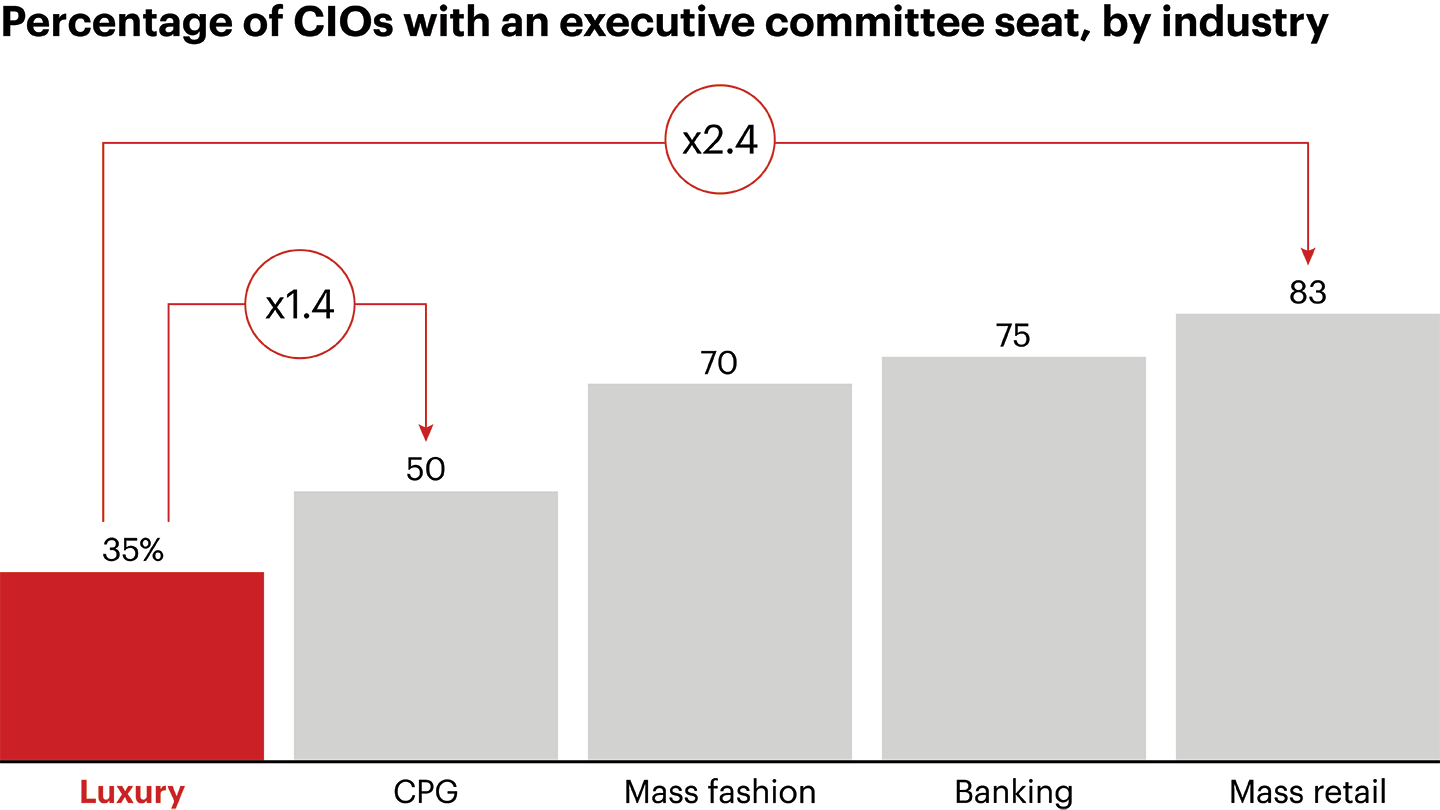

Notes: Mass retail includes grocery retail and sector-specialized retail players, but excludes fashion; based on July 2025 snapshot
Sources: Comité Colbert and Bain & Company 2025 Survey; Bain benchmarkingTo some extent, these are natural growing pains for the tech function in luxury. As luxury’s maturity in this field increases, the technological literacy and engagement of the CEO and other senior executives are likely to increase, as are the strategic capabilities and involvement of the CIO.
But CEOs and CIOs can’t just sit back and wait for that to happen. To harness technology’s full transformative power, they need to find ways to seamlessly collaborate and catalyze change. That collaboration needs to include a regular dialogue between the CEO and the CIO to agree on key topics such as the tech roadmap, investment prioritization, and spending optimization.
"In our company, the CIO is part of the business and sits on the ExCo, because we need to couple business transformation and tech transformation."
Enhanced technology training could enable CEOs and other senior executives to form a more effective partnership with the CIO (perhaps surprisingly, only 52% of the CEOs and CIOs we surveyed say that most of their group’s executives have received training on key technology topics). Training should increase tech literacy and exposure to the latest trends (such as vibe coding) through boot camps, university “treks,” start-up demos, and specialized conferences. Luxury groups might also need to tweak their governance and reporting structures to strengthen dialogue between technology and business leaders.
As well as deepening the CEO and CIO relationship, luxury groups should consider organizing more teams according to the product model, popularized by digital-native businesses, in which technology and business experts work side by side. Our survey shows that adoption of this model is most advanced in customer-facing parts of luxury groups (55% adoption) and least advanced in core operations (25%). Creating truly cross-functional teams will likely require—and, in turn, foster—greater tech literacy at all levels of the organization.
"Tech and data teams are all the more effective and value-adding when they have a clear understanding of the 'why' behind their work. It is therefore crucial to involve them early on in business challenges and reasoning."
Reflections to get started
With profit pressures rising in luxury, it’s essential that executive teams optimize their technology investment, creating room for more growth-enabling innovation without compromising day-to-day excellence. CEOs and CIOs can make a start today by reflecting on the following questions:
CEO:
- Do I have a regular and structured dialogue with the CIO?
- Am I equipped to ask the right questions and push the discussion when it comes to tech topics?
- Am I clear on the key tech priorities for my business and in my roadmap?
- Are we investing shrewdly in what truly matters to the business and differentiates it from rivals?
- How can I support the CIO in maximizing ROI?
- Are business leaders working closely with the CIO to heighten our company’s impact?
CIO:
- Am I part of critical information-sharing and decision-making forums, and do I feel empowered to challenge and contribute?
- Do I have robust tools and criteria to quantify and prioritize tech initiatives?
- Should I tighten spending discipline? Do I provide consistent visibility into tech spending and explain the rationale behind it?
- Can we escalate the simplification of our estate?
- Am I regularly engaging the C-suite on the latest trends in tech?
- Do we clearly understand the target mix of internal and external tech talent and how to attract, retain, and upskill these workers?
Given the progress in recent years, executive teams should feel confident about their ability to take this next step. A new era of sharper technology spending is within the industry’s grasp.

About Comité Colbert
Founded in 1954 by Jean-Jacques Guerlain, Comité Colbert is a unique collective gathering 98 French luxury Maisons, 17 cultural institutions, and six European luxury Maisons. Through its members, Comité Colbert unites 14 different métiers: crystal, leather goods, design, publishing, faïence and porcelain, gastronomy, haute couture and fashion, jewelry and horology, music, silver smithery, luxury hotels, fragrance and cosmetics, heritage and museums, and wines and spirits. Comité Colbert’s mission is conveyed in its raison d’être: to passionately promote, to sustainably develop, and to patiently transmit French savoir faire and creation to infuse a new sense of wonder. Our actions aim to collectively promote French art de vivre on the world stage, to preserve French savoir faire and creation, and to participate in their transmission to new generations.
First published in septembre 2025