
Skip to Content
  • Bureaux

    Bureaux

    Amérique du Nord et Amérique du Sud
    • Atlanta
    • Austin
    • Bogota
    • Boston
    • Buenos Aires
    • Chicago
    • Dallas
    • Denver
    • Houston
    • Los Angeles
    • Mexico City
    • Minneapolis
    • Monterrey
    • Montreal
    • New York
    • Rio de Janeiro
    • San Francisco
    • Santiago
    • São Paulo
    • Seattle
    • Silicon Valley
    • Toronto
    • Washington, DC
    Europe, Moyen-Orient et Afrique
    • Amsterdam
    • Athens
    • Berlin
    • Brussels
    • Copenhagen
    • Doha
    • Dubai
    • Dusseldorf
    • Frankfurt
    • Helsinki
    • Istanbul
    • Johannesburg
    • Kyiv
    • Lisbon
    • London
    • Madrid
    • Milan
    • Munich
    • Oslo
    • Paris
    • Riyadh
    • Rome
    • Stockholm
    • Vienna
    • Warsaw
    • Zurich
    Asie et Australie
    • Bangkok
    • Beijing
    • Bengaluru
    • Brisbane
    • Ho Chi Minh City
    • Hong Kong
    • Jakarta
    • Kuala Lumpur
    • Manila
    • Melbourne
    • Mumbai
    • New Delhi
    • Perth
    • Seoul
    • Shanghai
    • Singapore
    • Sydney
    • Tokyo
    Voir tous les bureaux
  • Alumni
  • Presse
  • S’abonner
  • Contacter
  • France | Français

    Sélectionnez votre région et votre langue

    Global
    • Global (English)
    Amérique du Nord et Amérique du Sud
    • Brazil (Português)
    • Argentina (Español)
    • Canada (Français)
    • Chile (Español)
    • Colombia (Español)
    Europe, Moyen-Orient et Afrique
    • France (Français)
    • DACH Region (Deutsch)
    • Italy (Italiano)
    • Spain (Español)
    • Greece (Elliniká)
    Asie et Australie
    • China (中文版)
    • Korea (한국어)
    • Japan (日本語)
  • Saved items (0)
    Saved items (0)

    You have no saved items.

    Bookmark content that interests you and it will be saved here for you to read or share later.

    Explore Bain Insights
  • Expertises Sectorielles
    Menu principal

    Expertises Sectorielles

    • Aerospace et Défense
    • Agroalimentaire
    • Chimie
    • Infrastructures, BTP et Matériaux de Construction
    • Grande Consommation
    • Services Financiers
    • Santé
    • Engins & Equipements Industriels
    • Media et Divertissement
    • Metals
    • Mining
    • Pétrole & Gaz
    • Papier et Emballage
    • Private Equity
    • Secteur Public
    • Distribution
    • Technologie
    • Télécommunications
    • Transportation
    • Travel & Leisure
    • Utilities & Energies Renouvelables
  • Expertises Fonctionnelles
    Menu principal

    Expertises Fonctionnelles

    • Expérience Client
    • ESG
    • Innovation
    • Fusions et Acquisitions
    • Opérations
    • People & Organization
    • Private Equity
    • Sales & Marketing
    • Stratégie
    • IA, Perspectives et Solutions
    • Technology
    • Transformation
  • Digital
  • Points de Vue
  • À propos
    Menu principal

    À propos

    • Notre Activité
    • Nos Valeurs
    • Nos Collaborateurs et Notre Équipe Dirigeante
    • Notre Impact
    • Prix & Récompenses
    • Partenariats Internationaux
    • Evénements
    Further: Our global responsibility
    • Diversité et Inclusion
    • Impact Social
    • Sustainability
    • World Economic Forum
    Learn more about Further
  • Carrières
    Menu principal

    Carrières

    • Rejoignez-nous
      Carrières
      Rejoignez-nous
      • Find Your Place
      • Nos domaines d’expertise
      • Equipes multidisciplinaires
      • Étudiants
      • Stages et programmes
      • Événements de recrutement
    • La vie chez Bain
      Carrières
      La vie chez Bain
      • Blog: Inside Bain
      • Récits de carrière
      • Nos collaborateurs
      • Nos bureaux
      • Soutenir votre évolution professionnelle
      • Groupes d’affinités
      • Avantages chez Bain
    • Histoires d’impact
    • Notre processus de recrutement
      Carrières
      Notre processus de recrutement
      • Ce que vous pouvez attendre
      • Entretiens
    Trouver un poste
  • Bureaux
    Menu principal

    Bureaux

    • Amérique du Nord et Amérique du Sud
      Bureaux
      Amérique du Nord et Amérique du Sud
      • Atlanta
      • Austin
      • Bogota
      • Boston
      • Buenos Aires
      • Chicago
      • Dallas
      • Denver
      • Houston
      • Los Angeles
      • Mexico City
      • Minneapolis
      • Monterrey
      • Montreal
      • New York
      • Rio de Janeiro
      • San Francisco
      • Santiago
      • São Paulo
      • Seattle
      • Silicon Valley
      • Toronto
      • Washington, DC
    • Europe, Moyen-Orient et Afrique
      Bureaux
      Europe, Moyen-Orient et Afrique
      • Amsterdam
      • Athens
      • Berlin
      • Brussels
      • Copenhagen
      • Doha
      • Dubai
      • Dusseldorf
      • Frankfurt
      • Helsinki
      • Istanbul
      • Johannesburg
      • Kyiv
      • Lisbon
      • London
      • Madrid
      • Milan
      • Munich
      • Oslo
      • Paris
      • Riyadh
      • Rome
      • Stockholm
      • Vienna
      • Warsaw
      • Zurich
    • Asie et Australie
      Bureaux
      Asie et Australie
      • Bangkok
      • Beijing
      • Bengaluru
      • Brisbane
      • Ho Chi Minh City
      • Hong Kong
      • Jakarta
      • Kuala Lumpur
      • Manila
      • Melbourne
      • Mumbai
      • New Delhi
      • Perth
      • Seoul
      • Shanghai
      • Singapore
      • Sydney
      • Tokyo
    Voir tous les bureaux
  • Alumni
  • Presse
  • S’abonner
  • Contacter
  • France | Français
    Menu principal

    Sélectionnez votre région et votre langue

    • Global
      Sélectionnez votre région et votre langue
      Global
      • Global (English)
    • Amérique du Nord et Amérique du Sud
      Sélectionnez votre région et votre langue
      Amérique du Nord et Amérique du Sud
      • Brazil (Português)
      • Argentina (Español)
      • Canada (Français)
      • Chile (Español)
      • Colombia (Español)
    • Europe, Moyen-Orient et Afrique
      Sélectionnez votre région et votre langue
      Europe, Moyen-Orient et Afrique
      • France (Français)
      • DACH Region (Deutsch)
      • Italy (Italiano)
      • Spain (Español)
      • Greece (Elliniká)
    • Asie et Australie
      Sélectionnez votre région et votre langue
      Asie et Australie
      • China (中文版)
      • Korea (한국어)
      • Japan (日本語)
  • Saved items  (0)
    Menu principal
    Saved items (0)

    You have no saved items.

    Bookmark content that interests you and it will be saved here for you to read or share later.

    Explore Bain Insights
  • Expertises Sectorielles
    • Expertises Sectorielles

      • Aerospace et Défense
      • Agroalimentaire
      • Chimie
      • Infrastructures, BTP et Matériaux de Construction
      • Grande Consommation
      • Services Financiers
      • Santé
      • Engins & Equipements Industriels
      • Media et Divertissement
      • Metals
      • Mining
      • Pétrole & Gaz
      • Papier et Emballage
      • Private Equity
      • Secteur Public
      • Distribution
      • Technologie
      • Télécommunications
      • Transportation
      • Travel & Leisure
      • Utilities & Energies Renouvelables
  • Expertises Fonctionnelles
    • Expertises Fonctionnelles

      • Expérience Client
      • ESG
      • Innovation
      • Fusions et Acquisitions
      • Opérations
      • People & Organization
      • Private Equity
      • Sales & Marketing
      • Stratégie
      • IA, Perspectives et Solutions
      • Technology
      • Transformation
  • Digital
  • Points de Vue
  • À propos
    • À propos

      • Notre Activité
      • Nos Valeurs
      • Nos Collaborateurs et Notre Équipe Dirigeante
      • Notre Impact
      • Prix & Récompenses
      • Partenariats Internationaux
      • Evénements
      Further: Our global responsibility
      • Diversité et Inclusion
      • Impact Social
      • Sustainability
      • World Economic Forum
      Learn more about Further
  • Carrières
    Recherches les plus fréquentes
    • Agile
    • Digital
    • Stratégie
    Vos recherches précédentes
      Pages récemment visitées

      Content added to saved items

      Saved items (0)

      Removed from saved items

      Saved items (0)

      Technology Report

      Taking the Hyperbole Out of the Metaverse

      Taking the Hyperbole Out of the Metaverse

      The metaverse isn’t dead, but it’s time to take a more sober view of its future.

      Par Chris Johnson, David Crawford, Nihar Naik, et Neha Verma

      • min
      }

      Rapport

      Taking the Hyperbole Out of the Metaverse
      en
      En Bref
      • The metaverse is here, with immersive gaming platforms boasting hundreds of millions of monthly active users, and emerging metaverse technologies deployed across industries.
      • Bain projects that the metaverse could reach a market size of $700 billion to $900 billion by 2030 and that the major winners will likely be determined in that time frame.
      • While it’s unclear how the competitive landscape will shift, five tech battlegrounds will shape the metaverse: virtual experiences, content-creation tools, app stores and operating systems, devices, and computing and infrastructure.

      This article is part of Bain's 2023 Technology Report.

      Explore the report

      The debate over what the metaverse will ultimately become misses the more salient point: The metaverse is already here.

      People imagine a future straight from the sci-fi novel-turned-movie Ready Player One, in which we would spend most of our time living in completely immersive virtual worlds. But when we break it down, the metaverse is a collection of immersive, collaborative, and interactive environments that span digital and physical worlds and enable us to create, exchange, socialize, and learn. And that part of the vision already exists.

      Popular gaming platforms today—Fortnite, Roblox, and Minecraft—are becoming more interactive, enable users to create avatars and worlds within them, and deepen the level of immersion players experience by delivering increasingly photorealistic content. They’re also doing this on a massive scale. Each of the platforms mentioned has around 200 million monthly active users, on par with the respective number of subscribers of Amazon Prime and Disney+.

      In the business world, a suite of emerging metaverse technologies that leverage virtual reality (VR) and augmented reality (AR) are already providing value. These include applications in areas of high risk (e.g., AR-assisted spinal surgery) and high expense (e.g., jet engine manufacturing) in which interacting with digital models can help improve care or save money.

      While it’s challenging to predict exactly how the metaverse will look decades from now, it’s clear that the journey is well underway and there’s a real and growing economic opportunity. We project the metaverse could reach a market size of $700 billion to $900 billion by 2030. Furthermore, the next 5 to 10 years will likely determine the metaverse’s major winners (more on this below).

      A multiyear tech boom and free-flowing venture capital fueled a lot of excitement about the metaverse over the past few years. Now, as executives map their strategies in a very different economic environment, we think framing the discussion through the following lenses will help determine where to focus their metaverse investments.

      The metaverse will take years to reach full scale

      The metaverse will likely remain in the first phase of development—what we call the “seed” stage of the platform development journey—for at least another 5 to 10 years (see Figure 1). Reaching scale requires bringing compelling, breakthrough use cases to market in a format that enhances user experiences. It took more than 10 years for smartphones and gaming consoles to each exit the seed stage and begin scaling up, while it took almost 20 years for the Internet and personal computers, respectively.

      Figure 1
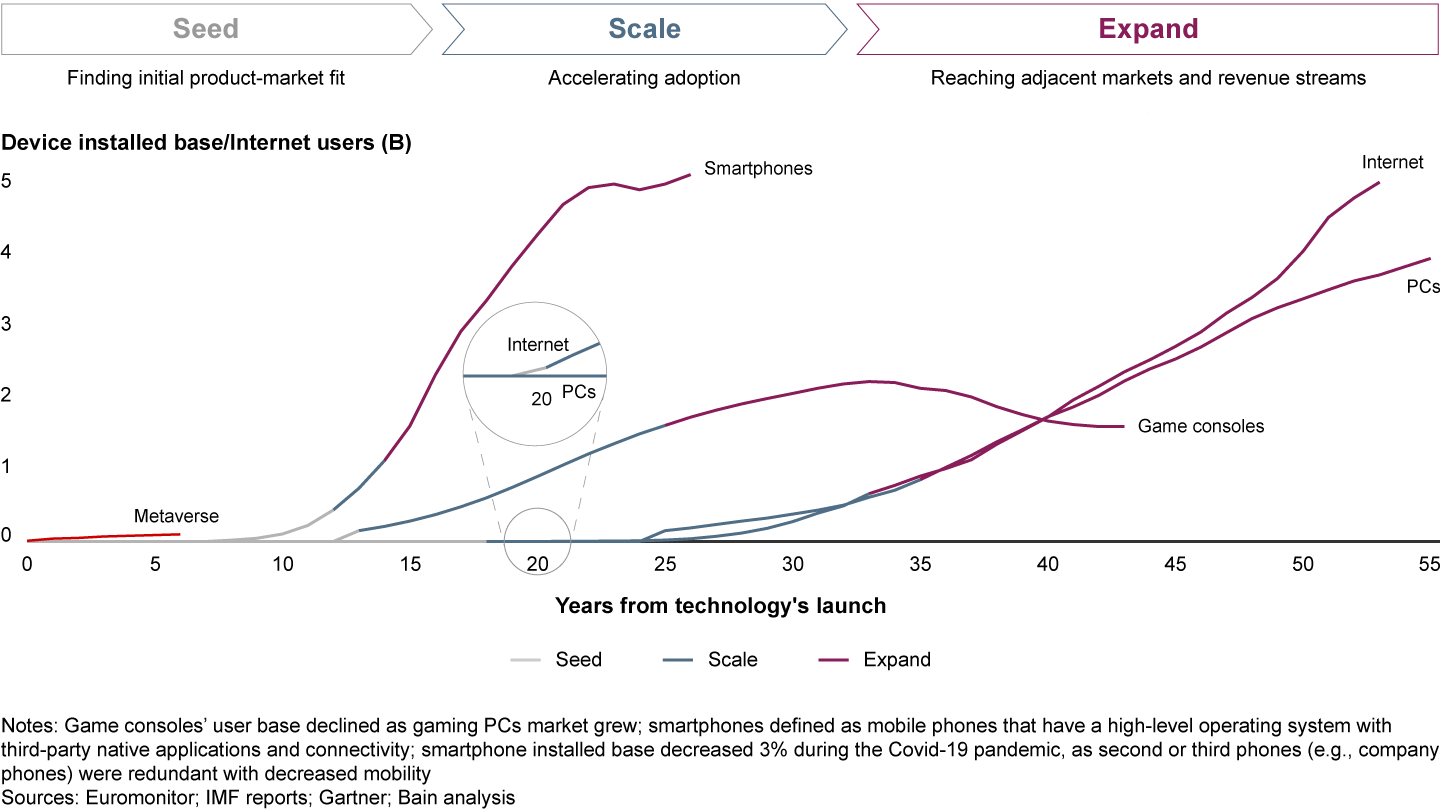
      The metaverse may take 5 to 10 years to begin scaling, based on the evolution of analogous technologies
      The metaverse may take 5 to 10 years to begin scaling, based on the evolution of analogous technologies
      The metaverse may take 5 to 10 years to begin scaling, based on the evolution of analogous technologies

      Nevertheless, it wouldn’t be surprising if the metaverse grew faster than other influential technologies, given how the pace of change has accelerated. And if a company waits for the metaverse to reach the scale phase before it enters the market, it’s likely already too late. Big market winners often emerge during the seed stage: think Microsoft and Apple in PCs, Nintendo in video games, or Apple’s iPhone in smartphones and iPad in tablets.

      Today, a mix of metaverse strategies exist, from companies with a vertically integrated approach that spans multiple segments of the metaverse technology stack to those with a horizontal strategy that focuses on a single layer of the stack. It remains to be seen which will prove to be most effective as the market develops, and the shape of the ecosystem (vertical vs. horizontal) is likely to evolve over time. Meta has established an early lead among those focused on vertical integration, combining leading hardware, app stores, and virtual content in pursuit of widespread user adoption and engagement. The company’s vertical approach allows for tight coupling of hardware and content and, therefore, strong curation of the user experience.

      Another notable company with a vertical strategy is Apple. It entered the market in June with the announcement of a mixed-reality headset that combines AR and VR, uses Apple-designed chips and an Apple-designed operating system, and connects with Apple’s existing app ecosystem.

      Companies that have adopted a more horizontal approach include Nvidia and Epic Games. Rather than build end-to-end technology stacks, they supply silicon and content-creation tools, respectively, that are used by many companies in the metaverse ecosystem.

      The metaverse will be plural

      Today’s consumer and enterprise applications will become increasingly immersive and collaborative, moving closer to the most aspirational vision of the metaverse by unlocking richer experiences and better functionality (see Figure 2). And while it’s unclear how the competitive landscape will shift and potentially converge, it’s unlikely to become one big platform dubbed “the metaverse.”

      Figure 2
      Today’s consumer and enterprise apps already exhibit metaverse attributes and are evolving quickly

      Although open standards initiatives have attracted the attention of major tech companies, including Microsoft and Meta, an industrywide shift to a truly interoperable metaverse likely won’t happen anytime soon. Similar to today’s Internet, private companies have strong incentives to maintain “walled gardens” and the companies’ proprietary datasets within them so that they can effectively monetize and recoup the investments required to develop metaverse technologies.

      Rather, platforms with large user bases today may take steps to become increasingly immersive and engaging, while smaller, metaverse-like worlds will try to attract bigger user bases. The size of these walled gardens will depend on their ability to tap into network effects and spur user-generated content, kicking off a flywheel effect that accelerates the platform’s growth. These efforts won’t preclude open standards initiatives from making progress, but walled gardens will likely remain more prevalent for the foreseeable future.

      Five battlegrounds are shaping the metaverse

      Metaverse profit pools are likely to accrue across the technology stack at key control points (see Figure 3). In short strokes, here’s where the most consequential competitive dynamics are taking place.

      Figure 3
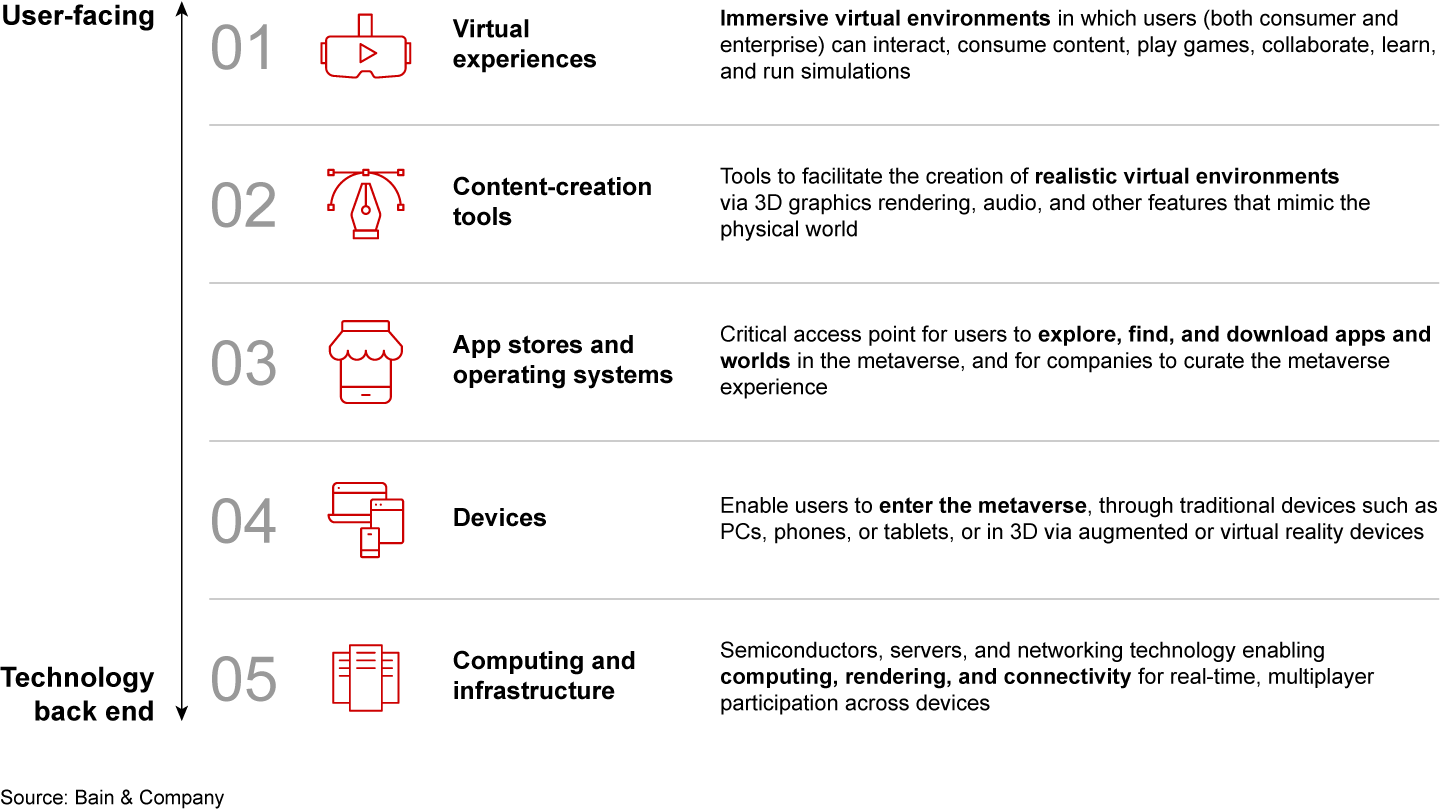
      In the tech industry, there are five key metaverse battlegrounds
      In the tech industry, there are five key metaverse battlegrounds
      In the tech industry, there are five key metaverse battlegrounds
      • Virtual experiences (about 65% of metaverse projected market size in 2030): Although gaming is currently the leading consumer metaverse application, immersive fitness and entertainment could also be compelling in the medium term. On the enterprise side, innovative use cases are emerging, primarily in collaboration and productivity but also in digital marketing, employee training, education, and healthcare.
      • Content-creation tools (about 5% of metaverse market size in 2030): There’s a growing field of software tools that provide the building blocks, editing platforms, and interfaces for creating metaverse worlds and experiences. Many leading platforms offer simple drag-and-drop world-building features that are typically free and intended to cultivate user engagement, retention, and monetization. Generative AI will also transform the way content is created by making it easier to create avatars, in-world assets, and interactions with virtual characters. Meanwhile, developer tools continue to advance, both for consumers and enterprises.
      • App stores and operating systems (about 10% of metaverse market size in 2030): We expect the metaverse to follow the smartphone model, with app stores serving as the primary access points for users to explore apps and worlds in the metaverse. The app store role will be even more crucial during the metaverse’s seed stage, helping provide users with curated, high-quality experiences to keep them engaged with the platform and headset they use to access the metaverse; this need is amplified by the immersive nature of VR content.
      • Devices (about 10% of metaverse market size in 2030): Significant technological barriers must be overcome before the arrival of comfortable, lightweight, standalone devices that allow for truly immersive experiences. To achieve mass adoption, metaverse content will need to work across all types of devices—including, for the foreseeable future, personal computers, gaming consoles, and smartphones. These device manufacturers may see their businesses benefit as some consumers opt for their higher-end product lines to unlock more immersive, collaborative experiences.
      • Computing and infrastructure (about 10% of metaverse market size in 2030): Demands on computing power will continue to grow significantly. That will pressure hardware companies to develop higher-performing chips, servers, and networking technologies to render high-quality graphics and reduce latency. Improvements are already underway, including 5G network rollouts and advances in system-on-chip performance.

      While executives can’t ignore the metaverse, neither are we suggesting that every company pivot its entire strategy to focus on this sector. It’s more about making targeted adjustments to existing roadmaps to ensure that the company moves in the same direction as its ecosystem of customers, partners, and competitors. No one knows exactly what the metaverse’s final destination will be, but all signs indicate it’s going to be a journey well worth taking.

      Read the Next Chapter

      The Untapped Value at the Intelligent Edge

      Read our 2023 Technology Report

      Download the PDF Explore the report
      Auteurs
      • Headshot of Chris Johnson
        Chris Johnson
        Alumni, San Francisco
      • Headshot of David Crawford
        David Crawford
        Associé, Silicon Valley
      • Headshot of Nihar Naik
        Nihar Naik
        Alumni, San Francisco
      • Neha Verma
        Associate Partner, San Francisco
      Contactez-nous
      Synergies sectorielles
      • Média
      • Technologie
      Expertises fonctionnelles transverses
      • Digital
      • Innovation & Design
      Artificial Intelligence Insights
      From Pilots to Payoff: Generative AI in Software Development

      AI tools improve productivity, but process changes are necessary to generate real value.

      Voir plus
      Artificial Intelligence Insights
      Quantum Computing Moves from Theoretical to Inevitable

      Quantum will likely become part of a mosaic, working with classical computing to solve big problems.

      Voir plus
      Artificial Intelligence Insights
      Generative AI’s Potential to Improve Customer Experience

      Bain's research identifies five design principles for deploying generative AI in the customer journey.

      Voir plus
      Artificial Intelligence Insights
      How Can We Meet AI’s Insatiable Demand for Compute Power?

      Technological innovation, new revenue, and public support may be needed to fund and supply enough electricity.

      Voir plus
      Technologie
      No Place to Hide: AI Demands Excellence in All Aspects of Marketing

      Top performers don’t just use generative AI, they create deep consumer insights and embrace robust data and technology to grow six times faster than peers.

      Voir plus

      Value Evolution

      • Creating Value in Tech Throughout the Life Cycle

      • Preparing for Exit: A Buyer’s Market Is Coming for Tech Assets

      • AI Investors: Act Fast, Act Wisely

      • Technology Enters Its Post-Globalization Era

      Strategic Battlegrounds

      • You’re Out of Time to Wait and See on AI

      • How AI Is Recoding the Software Business Model

      • Generative AI and Cybersecurity: Strengthening Both Defenses and Threats

      • Taking the Hyperbole Out of the Metaverse

      • The Untapped Value at the Intelligent Edge

      • After the Chip Shortage, Fears of a Capacity Glut Are Overblown

      Operational Transformations

      • Digital Innovation: Getting the Architecture Foundations Right

      • The Talent Implications of Generative AI

      • How Enterprise Sales Can Supercharge Product-Led Growth

      • How Your Revenue Can Grow Faster Than Your Salesforce

      • Decarbonizing Technology Supply Chains

      First published in août 2023
      Mots clés
      • Artificial Intelligence Insights
      • Digital
      • Innovation & Design
      • Média
      • Technologie
      • Technology Report

      Comment nous avons aidé nos clients

      Organisation A Video Game Company Levels Up With a New Operating Model

      Lire l’étude de cas

      Helping a Midsize ERP Player Compete against the Giants

      Lire l’étude de cas

      Amélioration de la Performance Aggressively growing an IT service provider with a high-performance culture

      Lire l’étude de cas

      Vous souhaitez continuer cette conversation ?

      Nous aidons des dirigeants du monde entier à matérialiser des impacts et des résultats pérennes et créateurs de valeur dans leurs organisations.

      Les points de vue de Bain : notre perspective sur des problématiques auxquelles sont confrontées les entreprises à travers le monde, envoyés chaque mois dans votre boîte de réception. 

      *J’ai lu la politique de confidentialité et j’accepte les conditions.

      Merci de lire notre politique de confidentialité.
      Bain & Company
      Contactez-nous Sustainability Accessibility Conditions d’utilisation Politique de Confidentialité Cookie Policy Mentions Légales Sitemap Log In

      © 1996-2026 Bain & Company, Inc.

      Contacter Bain

      Comment pouvons-nous vous aider ?

      • Business inquiry
      • Career information
      • Press relations
      • Partnership request
      • Speaker request
      Voir tous les bureaux