

Brief

At a Glance
- Australia’s major banks have tried various customer programs over the years, which largely failed because of the banks’ need to focus on short-term profitability rather than on decisions that deliver better long-term customer outcomes.
- Restoring trust will require a shift to a purpose-led culture and a level of commitment analogous to the safety-first approach that mining companies take.
- Select banks in other countries provide models on how to implement a customer-centric culture, even in an environment with heavy regulatory demands.
- Boards and executive teams must address the customer deficit and demand greater accountability from the entire organisation. Banks that fail to shift their stance almost guarantee that competitors will siphon off customers.
Explore Bain’s latest Customer Loyalty in Banking insights.
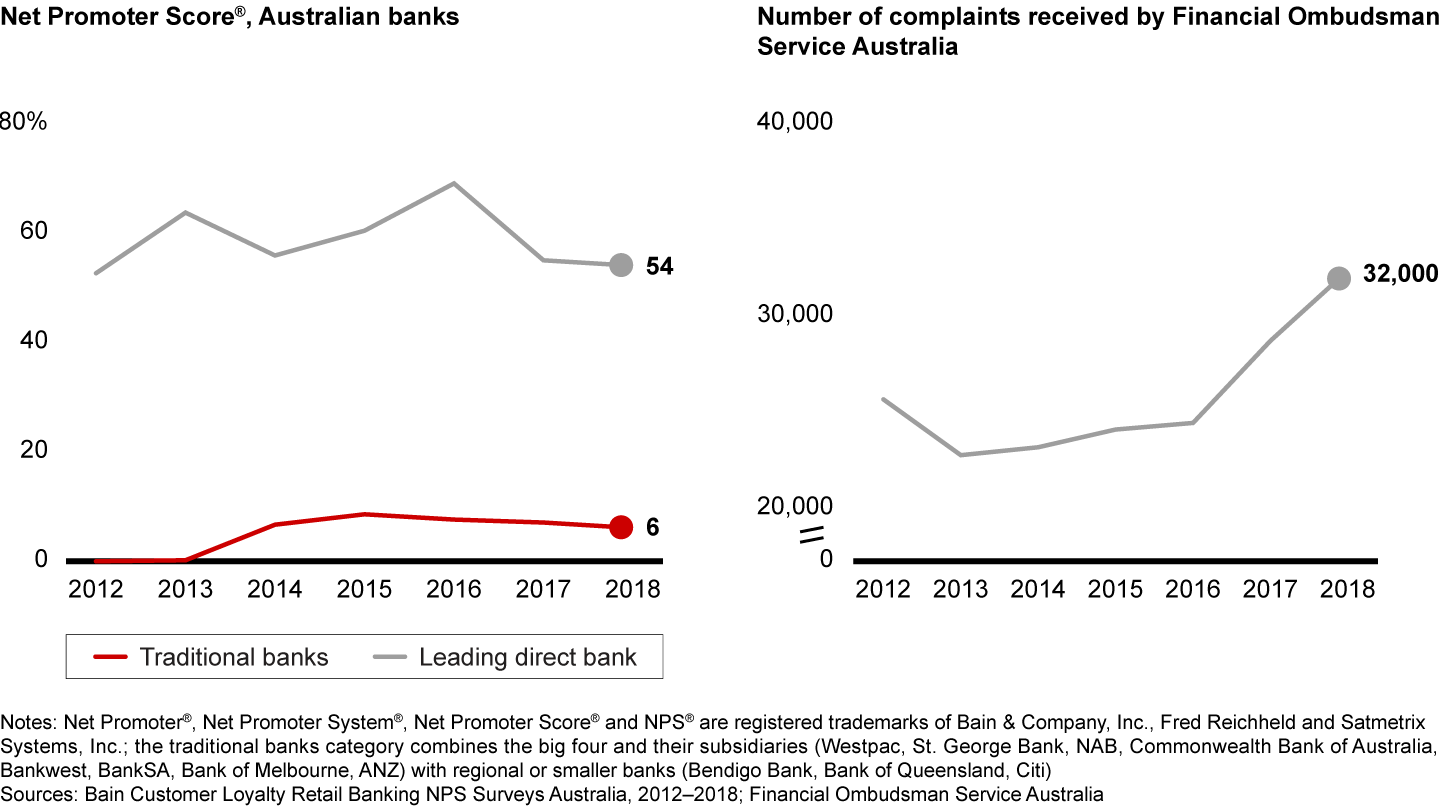
Over the past two decades, banks in Australia have launched many programs to become more customer centric. Yet none of these programs have led to sustained improvement in customer loyalty or related outcomes. Instead, a lacklustre experience for many customers has taken its toll. The Net Promoter Score® (a key metric of loyalty) for Australian banks has flatlined over the past six years, and complaints received by the Financial Ombudsman Service Australia increased by 23% (see Figure 1). More recently, the Royal Commission has shone a harsh light on practices that cut against the stated goal of delivering a great experience to customers, putting more pressure on banks to follow through on their promises.
Figure 1

Why have customer programs stalled to date? Typically, three barriers prevent their taking hold.
- Leaders’ narrow focus on delivering short-term results to shareholders. Shareholder pressure to boost quarterly results, exacerbated by the short duration of CEO tenures, led to underinvestment in actions to improve customers’ experience. Senior teams may have wanted to do the right thing, but banks focus on short-term revenue and assets in their reports to shareholders, not customer-centric metrics. For instance, if a bank increases a fee, it would boost revenue on the profit-and-loss statement, but the multiyear effect of annoyed customers who switch to a competitor gets overlooked. Banks have not yet convinced investors that better customer outcomes deliver higher customer lifetime value, which, in turn, yields greater shareholder value.
- Siloed organisations. The dominant organising principle remains functional for reporting lines and investment allocation. The “I’m on the compliance team” type of tribal affinity that naturally occurs among employees, however, makes improving end-to-end processes difficult, or even impossible, because the silos hinder employees from collaborating effectively.
- Inadequate customer metrics. Most Australian banks rely heavily on rolling averages and aggregate measures rather than de-averaged metrics tracking specific experiences or cohorts of customers or the long tail of bad outcomes. Their metrics do not show what factors create customer lifetime value or how problematic episodes create detractors among customers. And they lack practical operational metrics, such as straight-through processing rates or attrition for specific customer segments. Moreover, metrics alone do not suffice; banks must have routines in place to draw insights from the metrics and then take action on those insights.
Now, Australia’s banks have reached an inflection point that demands a new approach to investing and organising for a step change in customer outcomes. Many senior bankers have publicly acknowledged that the pendulum has swung too far toward shareholder value and that it should return to balance with customers’ needs and priorities. Regulatory changes in the wake of the Royal Commission will likely reinforce that shift.
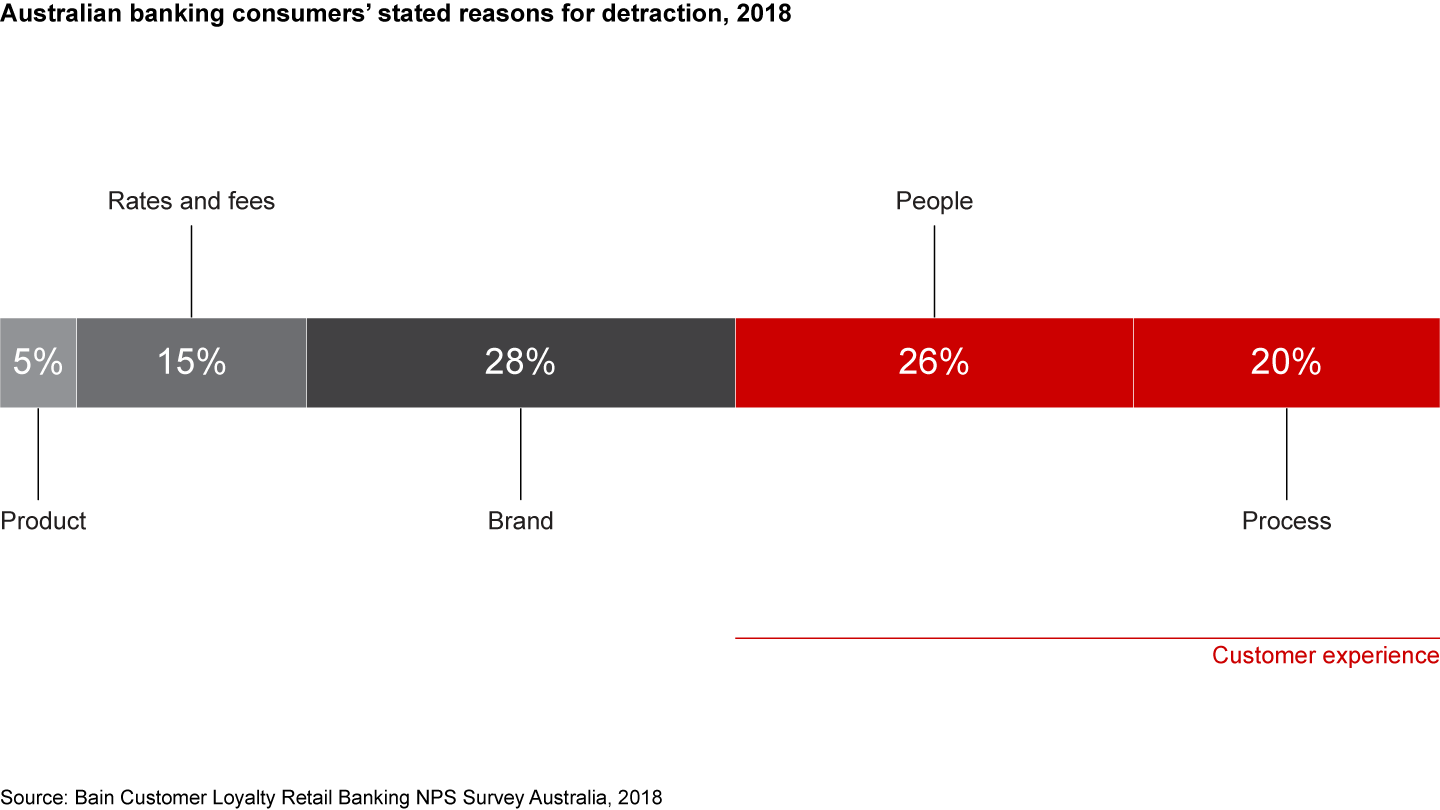
Regulations aside, the marketplace itself has put a much higher value on the customer experience. A poor experience has become the major reason cited by detractors among surveyed customers—more than brand, rates and fees, or products (see Figure 2). Customers' experiences with other products and services, including those offered by digital natives, have reset their expectations.
Figure 2

Banks face a substantial challenge. Working through reputational and compliance issues and making the required investments will take years. But if banks don’t invest to address the root causes of the problems created over the past decade or so, they will not restore their social contract with customers.
So, what is a practical path for Australia’s banks? The experiences of customer-centric organisations around the world highlight common traits that can guide both strategy and daily execution.
Senior leaders hardwire the customer’s perspective into all of their important decisions. Changing a corporate culture to champion other values alongside shareholder returns requires a deep commitment among the C-suite to build a purpose-led business. This is analogous to how some airlines and mining companies exemplify a zero-tolerance safety-first culture. BHP, for instance, puts safety above productivity. Meetings start with a safety moment, dedicated safety committees have the power to raise and resolve safety issues, and decisions and standards of behaviour prominently feature safety issues.
Likewise, some financial institutions exemplify a customer-first culture. Take Charles Schwab, which was struggling in 2004. As the company strayed from its close relationships with individual investors, costs spun out of control, and the stock price plummeted. Founder Charles Schwab returned as CEO that year to put the customer at the heart of the business again—a shift that continued after Walter Bettinger became CEO in 2008. Bettinger spent substantial time with customers and employees to understand the root causes of customer issues. As just one example, Schwab was among the first financial services companies to install unfiltered feedback regarding the performance of its website. The company then set up processes to incorporate feedback into business operations and decisions, such as how to improve the website or how to change pricing on select products. More broadly, Schwab views all major decisions through the customer’s eyes. By constantly asking what customers value, Schwab has ranked among the top five US financial services companies in Net Promoter Score from 2013 through 2018.
Compelling propositions, not customer inertia or ignorance, drive profits. The whole organisation understands a customer-friendly bank’s position in the market and tunes its target customer segments, offerings and experiences accordingly. Santander launched its “123” transaction account in 2012 throughout the UK, with low fees and simple rules for cash back on many everyday purchases. Santander then launched a “Simple, Personal and Fair” proposition to customers. The bank streamlined the number of transaction accounts and made sure that each action aligned with the Simple, Personal and Fair narrative.
Of course, any pricing adjustments made to wean a bank from “bad” profits have a significant effect on the bottom line. Many Australian banks now are considering whether they should review their fees from a customer perspective. Fortunately, banks can smooth out the effect to avoid a single hit. In the US, Huntington took a programmatic approach to removing its bad profits through “fair play” initiatives in two waves.
The customer experience is simple, digital first and personalised. Consider DBS in Singapore, which has invested over multiple years to encourage its customers to shift to digital interactions. It reports financials separately for digital customers, defined by the share of transactions, product purchases or upgrades via digital channels. DBS’s digital customers generate nearly twice the income of other customers—they have higher deposits, loans and investments, and they cost much less to acquire.
DBS aspires to be highly tech proficient. It introduced Facebook Messenger artificial intelligence in 2017 for human-like interactions. And from 2012 through 2016, DBS invested $3.5 billion to replace its legacy IT stack with cloud-ready infrastructure and to build more than 150 application programming interfaces.
DBS pairs its digital-first approach with other ways to make customers’ lives easier. Its organisational mantra of RED (respectful, easy to deal with, dependable) includes a barometer of customer hours. By assembling cross-functional teams to improve processes, DBS has removed 250 million hours in waiting time for customers over a two-year period. Being simple and digital first has helped the bank earn steadily higher loyalty over the past five years.
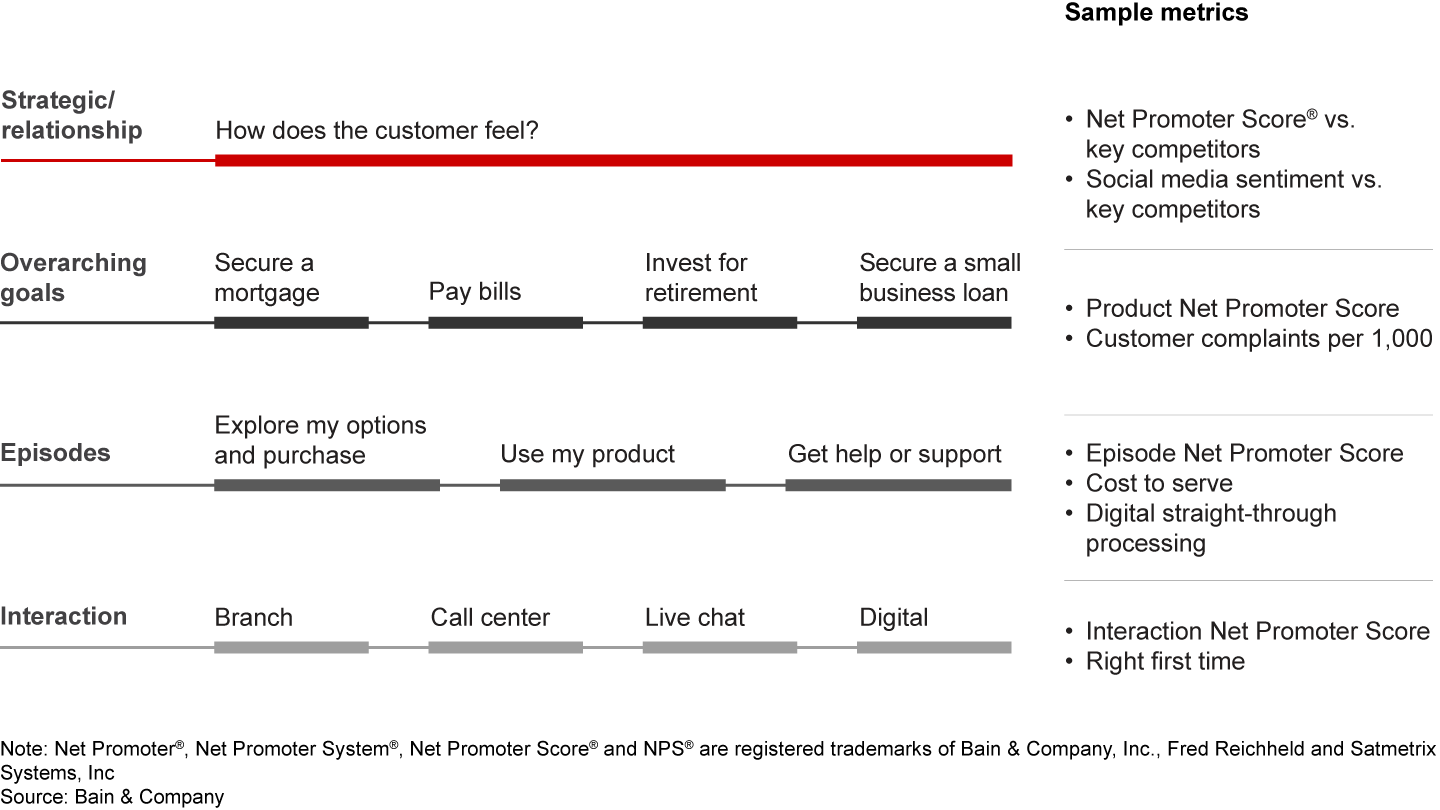
Robust metrics and feedback mechanisms promote learning and action at pace. Virtually all banks track metrics. But all too often, they rely heavily on high-level competitive benchmarks (whether loyalty, satisfaction or another measure) rather than the full suite of customer feedback and financial and operational metrics required to produce better customer outcomes (see Figure 3). Leading banks and card companies track a suite of such metrics that range from social media sentiment to cycle time to digital straight-through processing to the percentage of “right first time” interactions at a contact centre. They have also implemented a strong system or routines to manage those outcomes.
Figure 3

American Express, the global credit card provider, runs a customer balance sheet that takes into account the characteristics of each customer segment, such as loyalty scores and income, along with their spending behaviours. Those metrics inform the return on investment calculation, including the predicted lifetime value of a card member relative to the total cost to acquire the member. American Express removed metrics that might undermine a customer perspective, such as average handling time for contact centres. The company has consistently ranked highly in JD Power’s customer satisfaction surveys.
Employees get the support and resources they need to deliver great customer outcomes. For a bank to deliver a great customer experience, it must set up cross-functional teams and governance forums that allow people to work across departmental boundaries. All employees should understand how they influence the customer experience, and they will need tools, training and day-to-day coaching to help them understand the effect they have on customers and when they need to change behaviours. USAA, for instance, puts all new employees through a training course that explains life in the military so that employees become more empathetic with their members. USAA has typically ranked first in Net Promoter Score among US banks and in the top 10% of all large US companies for employee Net Promoter Score.
Finding the funds for investment
With all the spending that goes toward regulatory compliance and remediation, one challenge for Australia’s banks is how to fund investments that will improve customer outcomes. New pots of money will not appear, but there are ways to make current spending work harder. Each of the leading banks described here were able to navigate the practical constraints that Australia’s banks face. Some had to make significant investments in remediation and regulatory compliance because of immediate and severe consequences if not delivered. They were able to optimise their investments by solving for crossover opportunities between compliance and the customer.
Regulators probed JPMorgan Chase, for example, after the financial crisis. The bank made the most of this situation by investing $500 million in process automation. That investment helped reduce complexity for employees and customers, and it dealt with both compliance and customer experience issues.
No excuses
Major banks in any region cannot afford to continue business as usual. Customers now have too many alternatives and too much familiarity with excellent experiences in other industries to tolerate mediocre performance. Australia’s senior banking executives need to reestablish trust through visible and sustained behaviours.
Make no mistake, this shift in mindset and culture will require multiple years of investment. Executives and boards of directors will have to educate investors about the links among customer outcomes, customer lifetime value and shareholder value. Similar to how they monitor profit and risk outcomes, boards should hold executives accountable for customer outcomes and have zero tolerance for failure. And executives will have to coach managers and employees on maintaining a customer-centric business. That’s how Australia’s banks can get back on the path to creating long-term value for customers and shareholders.
Richard Hatherall and Katrina Cuthell are partners with Bain & Company’s Financial Services practice. They are based in Sydney.
Net Promoter®, Net Promoter System®, Net Promoter Score® and NPS® are registered trademarks of Bain & Company, Inc., Fred Reichheld and Satmetrix Systems, Inc.
Published in July 2019