


Brief


|
||||||||||||||
At a Glance
Upstream capital projects carry unique complexities other megaprojects don't: The value potential depends on a reservoir that cannot be fully understood, even after millions to billions of dollars of investment and decades of production. This uncertainty, along with a range of technical and commercial complexities, dictates whether a project succeeds. Estimating the value potential is expensive and happens well before sanction in an appraisal that characterizes the reservoir and a concept selection phase that weighs genuine alternatives and challenges underlying assumptions. Subsurface uncertainty is the biggest risk to value, and it runs in both directions. When teams underestimate uncertainty or frame known risks as manageable to secure approval, the result is underdelivery and loss, made worse by large-scale complexity, new technology, and premature concept lock-in. But the same uncertainty can surprise on the upside: Some projects find better rock than sanctioned, only to leave that value on the table because the concept was locked in too narrowly to capture it. Either way, the chosen concept sets the ceiling on value. The stakes attached to that concept choice are rising. The oil and gas sector faces a continued need for reserves amid increasing project complexity and growing shareholder expectations. More than a decade of underinvestment in exploration has thinned the opportunity hopper, and too few investable projects are coming through to replace what's being produced. That scarcity is dangerous. When the pipeline is thin, operators are tempted to "make it work" by advancing marginal concepts, downplaying uncertainty, and forcing projects toward sanction that a robust hopper would have filtered out. Learning from experience and taking an objective, risk-balanced approach to development decisions is more important than ever.
Figure 1
Notes: Hindcast view of deepwater, non-OPEC FID NPVs; the implied dispersion, including loss, shows many projects do not follow expectations set at sanctioning; FID is final investment decision; NPV is net present value Sources: Wood Mackenzie; Bain analysisProject net present values (NPVs) often diverge from sanctioned estimates (see Figure 1). No company sanctions a project expecting to lose money or erode value, yet some do. Other projects, often because of subsurface factors, exceed expectations but may leave money on the table. A recent portfolio review reinforced these findings: Across 110 oil and gas investments, gross costs exceeded early-stage estimates by $138 billion, with 21 projects accounting for 93% of overspending. The question is, Why do upstream projects continue to fall into these traps? Enduring mistakes exacerbated by human cognitive biasesThese are among the most common and enduring mistakes, along with illustrative examples of why they still occur:
These errors are familiar, but sunflower, anchoring, and confirmation biases exacerbate them. Teams need to employ deliberate operating processes to mitigate the effect of these biases when early warnings emerge. Unfortunately, teams often ignore warning signs and rarely self-correct. Bad projects usually get worse, and after the costs, scope, or schedule deteriorates, the project likely needs a reset. Racing to produce technology “firsts” accelerates this dynamic, particularly when compensating for subsurface complexity. Recognition of these mistakes before sanction is what separates calibrated decision making from procedural assurance.
Figure 2
Notes: Trajectories are for discussion only; FID is final investment decision; NPV is net present value Sources: Westwood Global Energy Group; Bain analysisMistakes happen at different points in the project life cycle (see Figure 2). Value erosion related to execution often appears early, while subsurface and operating surprises emerge later, during ramp-up and early production. By then, the sanctioned concept is increasingly locked in, limiting self-correction and driving actual value away from the final investment decision. Four decision strategies, one capital systemMore governance is not the answer. International oil companies already have stage gates, technical assurance, peer reviews, and capital committees. Teams need to honestly challenge decisions, increase rigor, strengthen owner-team capability and bias awareness, and tailor contracting to the project’s uncertainty and financial exposure. The following framework can help teams make more disciplined decisions. Uncertainty is multidimensional, affected by technical, commercial, fiscal, market, regulatory, and execution factors. Exposure is the magnitude of irreversible loss if the decision is suboptimal or wrong. Together, uncertainty and exposure cover four quadrants (see Figure 3), each calling for a different approach. An effective capital system must be able to apply all four.
Figure 3
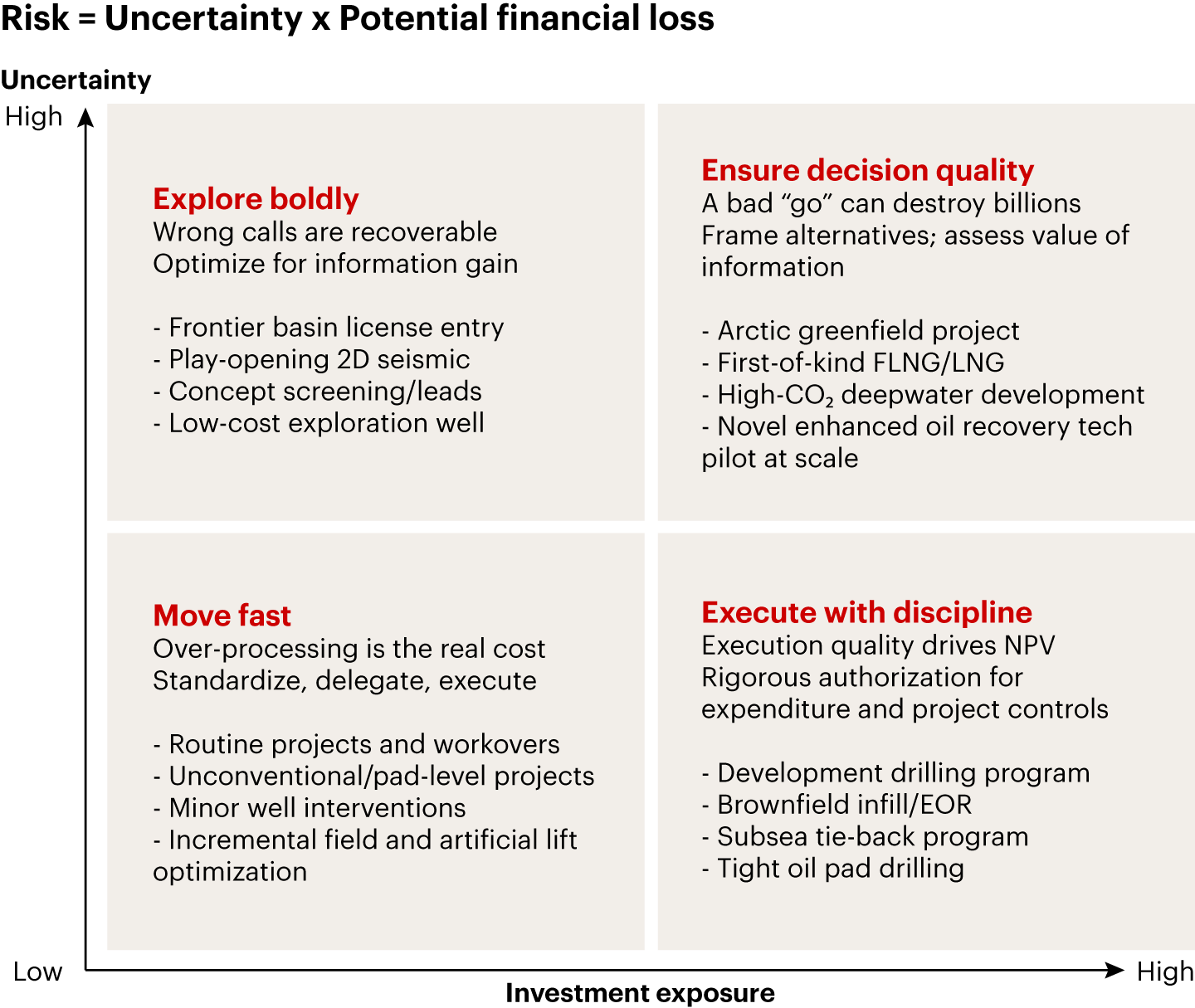

Notes: CO2 is carbon dioxide; EOR is enhanced oil recovery; FLNG is floating liquefied natural gas; LNG is liquefied natural gas Source: Bain analysisIn practice, each approach requires a different balance of testing, decision rigor, speed, and execution control:
The approach can’t be static. Through their life cycles, opportunities migrate across quadrants as uncertainty resolves and exposure evolves, so timing matters. A risk-balanced approach applies more rigor and senior-level involvement when necessary, without costly assurance of routine projects. Without these approaches, teams face leakage later: cost overruns, scope changes, and contracting and execution problems. Recognizing risksAttrition, outsourcing, cost reduction, and portfolio churn have weakened many owner teams. These teams are often less able to distinguish project risk from contractor risk, technical uncertainty from governance noise, or concept problems from execution problems. Leaders who have full-cycle major project experience and can challenge contractors and counter biases are scarcer than the headcount suggests. The engineering, procurement, and construction (EPC) market has seen the same project-performance data and may have learned these lessons better than owner teams. EPCs no longer absorb risks that owners can’t define. Risk-sharing works only when both sides can price risks honestly, requiring that owner teams be capable of managing these structures. So why do projects continue to fall short?Many causes of value erosion in upstream capital projects (premature concept lock-in, under-appraisal, weak assumption challenges, overconfidence in base cases, and insufficient attention to uncertainty and life cycle flexibility) have been well understood for years. Yet organizations continue to err because decisions are still shaped by human involvement, incentives, hierarchies, and cognitive biases (such as sunflower, confirmation, anchoring, overconfidence, and near-term reward bias). AI and agentic decision support can help. They can surface disconfirming evidence, test assumptions, and benchmark against past outcomes. But AI is an enabler, not a fix. Bolt it onto a system that still rewards clearing the gate over getting the concept right, and it will only make biased decisions faster. Without deeper change to how capital decisions are governed, resourced, and rewarded, the value destruction stays exactly as it is today: avoidable but not avoided. Six questions for leadership teamsThe next step for many oil and gas companies is to install an upgraded capital management system that is calibrated to risk and past performance and built on bias mitigation and rebuilt owner capability. Answer these six questions to determine whether your organization has such a system:
Owner teams that achieve sustained performance in upstream capital deployment know when to be more deliberate, when to simplify, when to build flexibility into the infrastructure, and when to own the risks contractors can’t absorb. Leading organizations also learn from past performance and can self-identify and mitigate their biases. In a sector that must keep investing just to stand still, this capital discipline and self-awareness are what separate organizations that consistently deliver from those that keep relearning the same lessons. |