
Skip to Content
  • Offices

    Offices

    North & Latin America
    • Atlanta
    • Austin
    • Bogota
    • Boston
    • Buenos Aires
    • Chicago
    • Dallas
    • Denver
    • Houston
    • Los Angeles
    • Mexico City
    • Minneapolis
    • Monterrey
    • Montreal
    • New York
    • Rio de Janeiro
    • San Francisco
    • Santiago
    • São Paulo
    • Seattle
    • Silicon Valley
    • Toronto
    • Washington, DC
    Europe & Africa
    • Amsterdam
    • Athens
    • Berlin
    • Brussels
    • Copenhagen
    • Dusseldorf
    • Frankfurt
    • Helsinki
    • Istanbul
    • Johannesburg
    • Kyiv
    • Lisbon
    • London
    • Madrid
    • Milan
    • Munich
    • Oslo
    • Paris
    • Rome
    • Stockholm
    • Vienna
    • Warsaw
    • Zurich
    Middle East
    • Doha
    • Dubai
    • Riyadh
    Asia & Australia
    • Bangkok
    • Beijing
    • Bengaluru
    • Brisbane
    • Ho Chi Minh City
    • Hong Kong
    • Jakarta
    • Kuala Lumpur
    • Manila
    • Melbourne
    • Mumbai
    • New Delhi
    • Perth
    • Seoul
    • Shanghai
    • Singapore
    • Sydney
    • Tokyo
    See all offices
  • Alumni
  • Media Center
  • Subscribe
  • Contact
  • Global | English

    Select your region and language

    Global
    • Global (English)
    North & Latin America
    • Brazil (Português)
    • Argentina (Español)
    • Canada (Français)
    • Chile (Español)
    • Colombia (Español)
    Europe, Middle East, & Africa
    • France (Français)
    • DACH Region (Deutsch)
    • Italy (Italiano)
    • Spain (Español)
    • Greece (Elliniká)
    Asia & Australia
    • China (中文版)
    • Korea (한국어)
    • Japan (日本語)
  • Saved items (0)
    Saved items (0)

    You have no saved items.

    Bookmark content that interests you and it will be saved here for you to read or share later.

    Explore Bain Insights
  • Industries
    Main menu

    Industries

    • Aerospace & Defense
    • Agribusiness
    • Chemicals
    • Construction & Infrastructure
    • Consumer Products
    • Financial Services
    • Healthcare & Life Sciences
    • Industrial Machinery & Equipment
    • Media & Entertainment
      Industries
      Media & Entertainment
      • Media Lab
    • Metals
    • Mining
    • Oil & Gas
    • Paper & Packaging
    • Private Equity
      Industries
      Private Equity
      • Due Diligence
      • Exit Planning
      • Firm Strategy & Operations
      • Portfolio Value Creation
    • Social Impact
    • Retail
    • Technology
    • Telecommunications
      Industries
      Telecommunications
      • Capital Expenditure
      • Telco Digital Transformation
    • Transportation
    • Travel & Leisure
    • Utilities & Renewables
  • Consulting Services
    Main menu

    Consulting Services

    • Customer Experience
    • Sustainability
    • Innovation
    • M&A
    • Operations
    • People & Organization
    • Private Equity
    • Sales & Marketing
    • Strategy
    • AI, Insights, and Solutions
    • Technology
    • Transformation
  • Digital
  • Insights
    Main menu

    Insights

    • Industry Insights
    • Services Insights
    • Bain Books
    • Webinars
    • Bain Futures
    View all Insights
    Featured topics
    • Tariff Response
    • Artificial Intelligence
    • Thriving in Uncertainty
    • Executive Conversations
    • Macro Trends
    • M&A Report
    • Healthcare Private Equity Report
    • Paper & Packaging Report
    • Technology Report
    • CEO's Guide to Sustainability
    • CEO Insights
    • CFO Insights
    • COO Insights
    • CIO Insights
    • CMO Insights
    View all featured topics
  • About
    Main menu

    About

    • What We Do
    • What We Believe
    • Our People & Leadership
    • Client Results
    • Awards & Recognition
    • Global Affiliations
    Further: Our global responsibility
    • Sustainability
    • Social Impact
    • World Economic Forum
    Learn more about Further
  • Careers
    Main menu

    Careers

    • Work with Us
      Careers
      Work with Us
      • Find Your Place
      • Our Work Areas
      • Integrated Teams
      • Students
      • Internships & Programs
      • Recruiting Events
    • Life at Bain
      Careers
      Life at Bain
      • Blog: Inside Bain
      • Career Stories
      • Our People
      • Where We Work
      • Supporting Your Growth
      • Affinity Groups
      • Benefits
    • Impact Stories
    • Hiring Process
      Careers
      Hiring Process
      • What to Expect
      • Interviewing
    FIND JOBS
  • Offices
    Main menu

    Offices

    • North & Latin America
      Offices
      North & Latin America
      • Atlanta
      • Austin
      • Bogota
      • Boston
      • Buenos Aires
      • Chicago
      • Dallas
      • Denver
      • Houston
      • Los Angeles
      • Mexico City
      • Minneapolis
      • Monterrey
      • Montreal
      • New York
      • Rio de Janeiro
      • San Francisco
      • Santiago
      • São Paulo
      • Seattle
      • Silicon Valley
      • Toronto
      • Washington, DC
    • Europe & Africa
      Offices
      Europe & Africa
      • Amsterdam
      • Athens
      • Berlin
      • Brussels
      • Copenhagen
      • Dusseldorf
      • Frankfurt
      • Helsinki
      • Istanbul
      • Johannesburg
      • Kyiv
      • Lisbon
      • London
      • Madrid
      • Milan
      • Munich
      • Oslo
      • Paris
      • Rome
      • Stockholm
      • Vienna
      • Warsaw
      • Zurich
    • Middle East
      Offices
      Middle East
      • Doha
      • Dubai
      • Riyadh
    • Asia & Australia
      Offices
      Asia & Australia
      • Bangkok
      • Beijing
      • Bengaluru
      • Brisbane
      • Ho Chi Minh City
      • Hong Kong
      • Jakarta
      • Kuala Lumpur
      • Manila
      • Melbourne
      • Mumbai
      • New Delhi
      • Perth
      • Seoul
      • Shanghai
      • Singapore
      • Sydney
      • Tokyo
    See all offices
  • Alumni
  • Media Center
  • Subscribe
  • Contact
  • Global | English
    Main menu

    Select your region and language

    • Global
      Select your region and language
      Global
      • Global (English)
    • North & Latin America
      Select your region and language
      North & Latin America
      • Brazil (Português)
      • Argentina (Español)
      • Canada (Français)
      • Chile (Español)
      • Colombia (Español)
    • Europe, Middle East, & Africa
      Select your region and language
      Europe, Middle East, & Africa
      • France (Français)
      • DACH Region (Deutsch)
      • Italy (Italiano)
      • Spain (Español)
      • Greece (Elliniká)
    • Asia & Australia
      Select your region and language
      Asia & Australia
      • China (中文版)
      • Korea (한국어)
      • Japan (日本語)
  • Saved items  (0)
    Main menu
    Saved items (0)

    You have no saved items.

    Bookmark content that interests you and it will be saved here for you to read or share later.

    Explore Bain Insights
  • Industries
    • Industries

      • Aerospace & Defense
      • Agribusiness
      • Chemicals
      • Construction & Infrastructure
      • Consumer Products
      • Financial Services
      • Healthcare & Life Sciences
      • Industrial Machinery & Equipment
      • Media & Entertainment
      • Metals
      • Mining
      • Oil & Gas
      • Paper & Packaging
      • Private Equity
      • Social Impact
      • Retail
      • Technology
      • Telecommunications
      • Transportation
      • Travel & Leisure
      • Utilities & Renewables
  • Consulting Services
    • Consulting Services

      • Customer Experience
      • Sustainability
      • Innovation
      • M&A
      • Operations
      • People & Organization
      • Private Equity
      • Sales & Marketing
      • Strategy
      • AI, Insights, and Solutions
      • Technology
      • Transformation
  • Digital
  • Insights
    • Insights

      • Industry Insights
      • Services Insights
      • Bain Books
      • Webinars
      • Bain Futures
      View all Insights
      Featured topics
      • Tariff Response
      • Artificial Intelligence
      • Thriving in Uncertainty
      • Executive Conversations
      • Macro Trends
      • M&A Report
      • Healthcare Private Equity Report
      • Paper & Packaging Report
      • Technology Report
      • CEO's Guide to Sustainability
      • CEO Insights
      • CFO Insights
      • COO Insights
      • CIO Insights
      • CMO Insights
      View all featured topics
  • About
    • About

      • What We Do
      • What We Believe
      • Our People & Leadership
      • Client Results
      • Awards & Recognition
      • Global Affiliations
      Further: Our global responsibility
      • Sustainability
      • Social Impact
      • World Economic Forum
      Learn more about Further
  • Careers
    Popular Searches
    • Agile
    • Digital
    • Strategy
    Your Previous Searches
      Recently Visited Pages

      Content added to saved items

      Saved items (0)

      Removed from saved items

      Saved items (0)

      Brief

      Beating the Odds: Improving Student Outcomes in Higher Education

      Beating the Odds: Improving Student Outcomes in Higher Education

      Advanced analytics can help colleges and universities learn from institutions that outperform.

      By Will Miller, Mark Krafft, Keri Larkin, and Jeff Denneen

      • min read
      }

      Brief

      Beating the Odds: Improving Student Outcomes in Higher Education
      en
      At a Glance
      • Students, parents, policymakers, and the media are shifting their focus from tuition, student debt, and institutional cost management to student outcomes.
      • However, differences in student body mix and geographic location can mask which institutions excel at helping students graduate and earn high wages.
      • Controlling for these factors reveals that some institutions are better than others at helping students graduate and earn high salaries early in their careers.
      • All colleges and universities can implement proven interventions from top performers to improve student outcomes.

      The US higher education system has historically inspired the world, generating groundbreaking innovation, expanding knowledge and creativity, and shaping leaders and critical thinkers who advance societal progress. For students, US colleges and universities have offered a path to a brighter future, enhanced social mobility, improved career opportunities, and broadened horizons.

      Yet in recent years, the value of higher education has come into question. In a recent Wall Street Journal–NORC poll, 56% of US respondents expressed doubt that a four-year college education is worth the cost.

      Underlying that skepticism is the fact that many students don’t achieve the anticipated outcomes. Recent studies show that 36% of students in four-year programs do not graduate even after six years, 40% earn less than a high school graduate after six years, and many graduate with unsustainable debt levels.

      Student outcomes vary widely across institutions. But because colleges and universities serve different student populations, it can be challenging to understand which institutions are most successful at helping students graduate and earn high wages. Fortunately, new data sources and advanced analytics can help identify outperformers and offer insights into how to improve student outcomes.

      Student outcomes vary by institution

      Student outcomes vary widely across the roughly 2,600 four-year colleges and universities in the US (see Figure 1). For example, undergraduate graduation rates range from 20% to over 95%, and median future earnings range from $30,000 to over $100,000 per year in our sample. A strong correlation (r=0.74) exists between graduation rates and earnings across institutions. Other outcomes that are positively correlated with educational attainment (e.g., life satisfaction, social mobility, personal growth, and civic engagement) are also important though not analyzed in this study.

      Figure 1
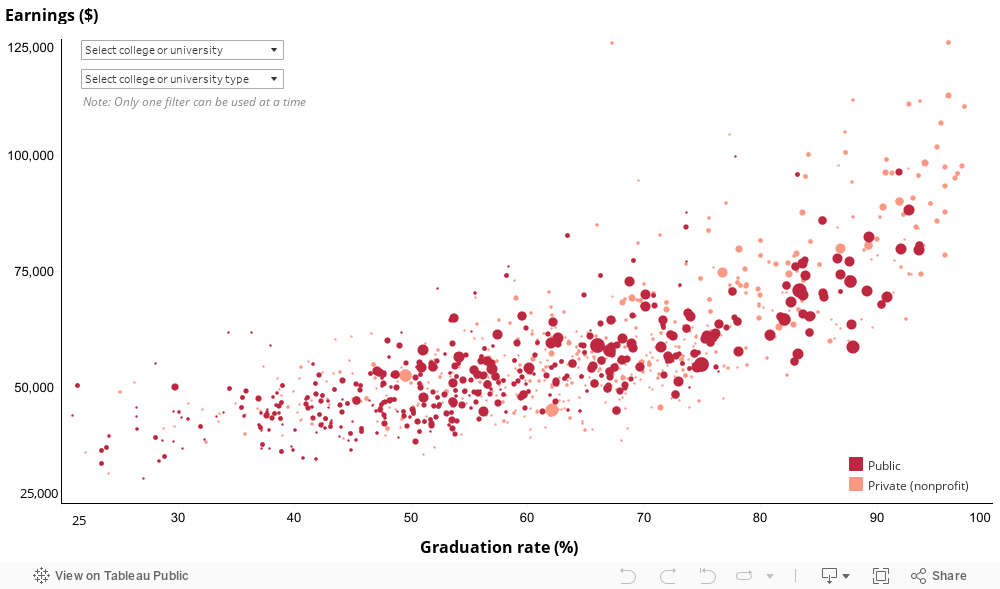
      Graduation rates and earnings vary significantly across US colleges and universities

      Notes: Graduation rate refers to first-time, full-time students graduating within six years; measured for the 2015–2016 academic year cohort. Earnings refer to the median annual earnings of students who received federal student aid and began college at the institution 10 years prior, regardless of their completion status; based on the pooled 2008–2009 and 2009–2010 academic cohorts; measured in 2019 and 2020, and inflation adjusted to 2021 dollars. Bubble size relates to undergraduate enrollment. The sample consists of 928 public and private nonprofit four-year colleges and universities with undergraduate enrollment of more than 1,000 students and availability of complete data.

      Source: College Scorecard; Integrated Postsecondary Education Data System; Bain analysis

      Despite the wide variation in outcomes, it can be misleading to assume that colleges and universities with higher earnings or graduation rates are doing more than other institutions to help their students succeed. Why? A large body of research shows that the underlying readiness and background of incoming students as well as the local cost of living impacts these outcomes.

      Some institutions, for instance, serve a higher proportion of students who have had fewer opportunities to prepare for college-level coursework. The graduation rates of these students may be lower than those of better-prepared peers. Other factors outside an institution’s direct influence that affect higher-education outcomes include a student’s family income, full- vs. part-time status, gender, race, age, and whether they are the first in their family to attend college.

      Public and less selective private institutions, for example, tend to have a higher proportion of students receiving need-based Pell Grants. Since family income can be a powerful predictor of future outcomes, these institutions tend to have lower average graduation rates and student earnings (see Figure 2).

      Figure 2
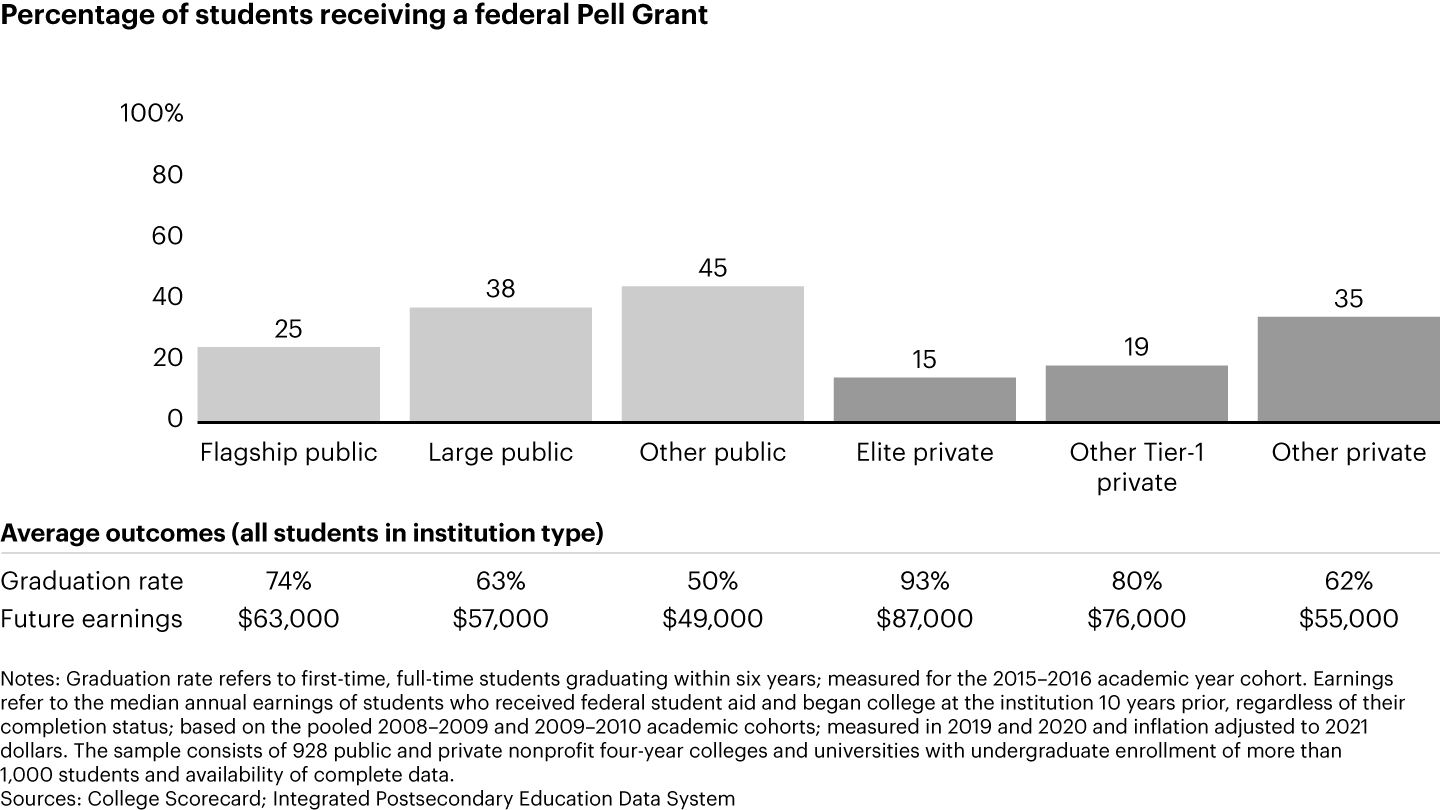
      Student body characteristics differ by institution type
      Student body characteristics differ by institution type
      Student body characteristics differ by institution type

      A predictive model

      A better way to understand how well institutions serve their students is to control for student population and location factors when comparing outcomes.

      To do this, Bain built a model to predict graduation rates and future earnings for more than 900 US public and private nonprofit four-year colleges (see Figure 3). Our model controls for student body characteristics, including family income and education history; academic preparation; full- or part-time status; racial, ethnic, and gender demographics; and the local cost-of-living index. Comparing each institution’s predicted outcomes to actual results gives us a starting point for understanding which institutions excel at helping students succeed compared to others serving a similar student population, even if factors like program mix affect these outcomes.

      Figure 3
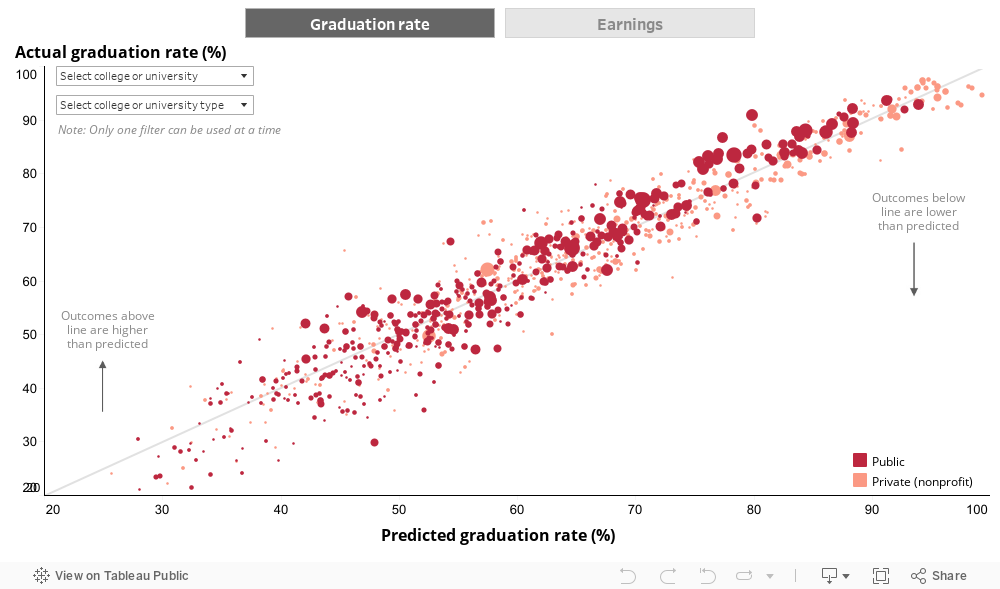
      Variation in student outcomes remains even after accounting for student population characteristics

      Notes: Graduation rate refers to first-time, full-time students graduating within six years; measured for the 2015–2016 academic year cohort. Earnings refer to the median annual earnings of students who received federal student aid and began college at the institution 10 years prior, regardless of their completion status; based on the pooled 2008–2009 and 2009–2010 academic cohorts; measured in 2019 and 2020 and inflation adjusted to 2021 dollars. Bubble size relates to undergraduate enrollment. The predicted graduation rate and predicted earnings are based on the authors’ calculations, controlling for student body characteristics, including family income and education history; academic preparation; full- or part-time status; racial, ethnic, and gender demographics; and local cost-of-living index. The sample consists of 928 public and private nonprofit four-year colleges and universities with undergraduate enrollment of more than 1,000 students and availability of complete data.

      Source: College Scorecard; Integrated Postsecondary Education Data System; Bain analysis

      Bain’s model reveals a strong relationship between actual and predicted outcomes, confirming that much of the variation across colleges and universities relates to the factors described above. Still, many institutions outperform expectations. Graduation rates for those in the 75th percentile are 5.4 percentage points higher than those in the 25th percentile with the same predicted graduation rate. Median annual earnings for institutions in the 75th percentile are at least $5,000 higher per year than those in the 25th percentile with the same predicted earnings.

      For example, Florida International University has invested heavily to improve graduation rates. The university uses data science to identify students at risk of not graduating on time and alerts academic advisers so they can provide support. Such efforts have helped improve graduation rates from 43% in 2006 to 67% in 2022, now five percentage points higher than our model would predict for institutions serving a similar student body.

      Another top performer in helping students graduate is Berea College, a small liberal arts college in Kentucky. Berea achieves a graduation rate of 66%, about 20 percentage points higher than predicted, while serving a student body where nearly 90% of individuals receive Pell Grants. Berea achieves these outcomes in part by eliminating some of the hurdles typically faced by its students. The college covers 100% of tuition expenses through its endowment and in-year donations and offers work opportunities for students throughout the entire period of study.

      Interestingly, overperforming on graduation rates is no guarantee that an institution will overperform on student earnings, or vice versa. Some institutions overperform on one outcome but underperform on the other. Many universities prioritize improving graduation rates given their importance and visibility, but they could have even greater impact if they also prioritized initiatives that enhance their graduates’ future earnings, such as expanding experiential learning, partnerships with employers, and embedding career-oriented skills. Other institutions deliver high graduate earnings but may focus less on graduation rates.

      Our analysis has important implications for leaders in higher education.

      First, it’s difficult to exceed predictions on student outcomes. For graduation rates, only the top 10% of more than 900 institutions outperform their predicted graduation rate by more than 5 percentage points. For earnings, the top 10% of institutions have median annual earnings at least $4,600 higher than predicted.

      Second, institutions that overperform represent a wide cross-section of US higher education, but a few noticeable trends emerge. For graduation rates, institutions in the top 10% of overperformers (in actual vs. predicted graduation rates) are evenly represented across institution types, but a disproportionate number of institutions in the bottom 10% are small or regional public institutions (categorized as “Other public” in the accompanying figures). For earnings, private institutions represent a disproportionate number of top performers.

      Third, top-performing institutions prove that students from any background can succeed at high levels given the right support. That result contains a powerful message for leaders at all educational institutions, including in K–12 systems, to learn from what works and take action to improve student outcomes.

      A roadmap for action

      Every institution, regardless of its starting point, can improve students’ graduation rates and future earnings. Based on our research and experience working with more than 200 colleges and universities, leaders focus on four priorities to improve outcomes:

      • Make student outcomes leadership’s top priority: Announce publicly that student outcomes are the top institutional priority, and shift time, attention, and resources accordingly. College and university leaders have many pressing concerns, and boosting student outcomes requires sustained, deliberate support from an institution’s board and senior leadership.
      • Address systemic barriers to student success: Map the student journey from admission to graduation to tackle barriers preventing students from succeeding. These can include internal barriers such as complex course registration or degree requirements, and external barriers such as financial need, mental health challenges, and family obligations. Universities can also improve outcomes by helping students make informed decisions about their courses, majors, and career paths, as well as better understand financial aid application processes and requirements.
      • Implement a strong career-connected learning strategy: Prepare students for successful careers and lives through a combination of classroom learning and real-world experiences. Partner with employers to determine the skills and experiences they value most, and then embed career-connected learning in the curriculum and academic journey of every major. Expand relevant, paid, work-based learning experiences like internships.
      • Employ data to set targets and inform the approach: Use data to understand institution- and department-level student outcomes and set realistic but ambitious improvement targets. Strong data infrastructure can also be used to monitor student progress throughout the college journey, identify students at risk of falling off track, and pinpoint trends and interventions capable of helping more students flourish.

      Many US institutions are already taking action to improve student outcomes. In 2011, the University of Texas at Austin set a goal of increasing four-year graduation rates from 51% to 70%. Shortly after that, the university implemented a student success program that provides peer mentoring, academic support, and enhanced scholarships to a significant number of incoming students. As of 2023, the university’s four-year graduation rate had increased to 74%, and six-year graduation rates had risen from 81% in 2013 to 88%. Student earnings 10 years after entering college also rose by more than $19,000 during this time, far outpacing the $11,500 median increase across all institutions in our sample.

      Georgia State University has also become a national role model for improving graduation rates. Since 2003, Georgia State has increased graduation rates from 32% to 56%, while also increasing its percentage of students receiving Pell Grants by more than 20 percentage points and closing gaps in graduation rates among underrepresented students. While these results required a dedicated effort, a key lesson learned was the power of removing hidden institutional barriers to student success, such as complex processes related to financial aid, registration, and academic major selection.

      Every institution’s journey to improving student outcomes will be different, depending on the students it serves. Colleges and universities that deliver relatively weaker results should use a data-driven approach to understand the root causes and then wield best practices to improve student performance. The institutions already helping students achieve at high levels can innovate further, proving that any student is capable of high levels of achievement with the right support.

      • Definitions and methodology (click to expand)

        Our analysis focused on four-year public and private (nonprofit) colleges and universities in the US with more than 1,000 undergraduate students. We excluded institutions that lacked data on graduation rates, earnings, or key student body characteristics (e.g., academic preparation, percentage of students receiving Pell Grants). In total, our analysis included 928 four-year institutions.

        We grouped these institutions into six classifications: Flagship public (defined as the flagship institution[s] in each state); Large public (non-flagship institutions with more than 10,000 undergraduate students); Other public (all remaining public institutions); Elite private (private institutions ranked in the top 50 national universities or top 30 liberal arts colleges by U.S. News, with an admission rate lower than 25%); Other Tier-1 private (private institutions ranked in the top 150 national universities [excluding elite private institutions] by U.S. News); and Other private (all remaining private institutions). These classifications are merely helpful categories for grouping and comparing similar schools and do not reflect any judgment by the authors as to the value, performance, and/or academic rigor of the institutions.

        We employ data from the Integrated Postsecondary Education Data System and College Scorecard for our analysis, which are two of the most rigorous and widely cited sources on this topic. Nevertheless, there are limitations to this data. Earnings data available from the College Scorecard is only available up to 10 years after students enter the institution. This may boost the relative earnings performance of institutions with a STEM focus because STEM majors often lead to high-paying jobs directly upon graduation. However, on a longer timeline, graduates with other majors may catch up or even surpass these earnings. This data only includes students who receive federal loans. Data on graduation rates does not account for students who transfer and complete their degree at another institution. For both graduation rates and earnings, there is a time lag between the outcomes reported in this paper. The most recent six-year graduation-rate data available via IPEDS reflects the student cohort entering in 2015, while earnings data covers the student cohort that entered in 2008 and 2009. In the interim, some institutions may have improved their practices or regressed.

        To develop a predicted graduation rate and earnings metric for each institution, we employed a nonlinear model, controlling for student body characteristics, including family income and education history; academic preparation (using SAT scores as a proxy); full- or part-time status; racial, ethnic, and gender demographics; and local cost-of-living index.

      The authors would like to recognize and thank Reed Abraham and Jackson Perry from Bain’s Advanced Analytics Group for their partnership and support in leading the analysis used in this brief.

      Authors
      • Headshot of Will Miller
        Will Miller
        Alumni, New York
      • Headshot of Mark Krafft
        Mark Krafft
        Partner, Washington, DC
      • Headshot of Keri Larkin
        Keri Larkin
        Partner, New York
      • Headshot of Jeff Denneen
        Jeff Denneen
        Partner, Atlanta
      Contact us
      Related Industries
      • Higher Education
      • Social Impact
      Related Consulting Services
      • Accelerated Performance Transformation
      Social Impact
      The Financially Sustainable University

      A focused strategy can help colleges and universities reinvent their industry and stop spending beyond their means.

      Read More
      Social Impact
      The Rise of the Canadian Venture Scientist

      This is Canada’s moment to turn AI pioneers into venture builders.

      Read More
      Accelerated Performance Transformation
      Don’t Underestimate the Cost of Overcapacity

      Overcapacity is endemic to the paper and packaging industry, but these actions can help you maintain margins.

      Read More
      Social Impact
      The Financially Sustainable University: The Lost Decade

      One-third of universities face an unsustainable financial future. Those that survive must take action now to prepare for the future.

      Read More
      Accelerated Performance Transformation
      Automotive Profitability: How OEM and Supplier Margins Are Faring

      The post-pandemic profit surge has reversed, as OEM margins have fallen more than 50% since 2023.

      Read More
      Published in May 2024
      Tags
      • Accelerated Performance Transformation
      • Higher Education
      • Social Impact

      How We've Helped Clients

      Operations Empowering a nonprofit to expand its mission: Reducing the high school dropout rate

      Read case study

      Transformation Turning around a pioneering service for working parents with sick children

      Read case study

      Strategy Execute global strategy for a nonprofit’s Mexico operations

      Read case study

      Ready to talk?

      We work with ambitious leaders who want to define the future, not hide from it. Together, we achieve extraordinary outcomes.

      Stay ahead in a rapidly changing world. Subscribe to Bain Insights, our monthly look at the critical issues facing global businesses.

      *I have read and understand Bain’s Privacy Notice.

      Please read and agree to the Privacy Policy.
      Bain & Company
      Contact us Sustainability Accessibility Terms of use Privacy Modern Slavery Act Statement Cookie Policy Sitemap Log In

      © 1996-2026 Bain & Company, Inc.

      Contact Bain

      How can we help you?

      • Business inquiry
      • Career information
      • Press relations
      • Partnership request
      • Speaker request
      See all offices