

Brief

On the face of it, Southeast Asia would seem like an e-commerce wonderland. No place on Earth matches this region in digital adoption. The people in the Philippines send more texts than any other country. Jakarta is the world’s No. 1 city for tweets. Indeed, Southeast Asia’s population of 620 million may be diverse, but its inhabitants have one important thing in common: an eagerness to use mobile technology. The region is home to more than 250 million smartphone users.
Then why is it that only one in four consumers over the age of 16 in the region has ever made an online purchase? And what will it take to help Southeast Asia reach its vast potential for digital commerce?
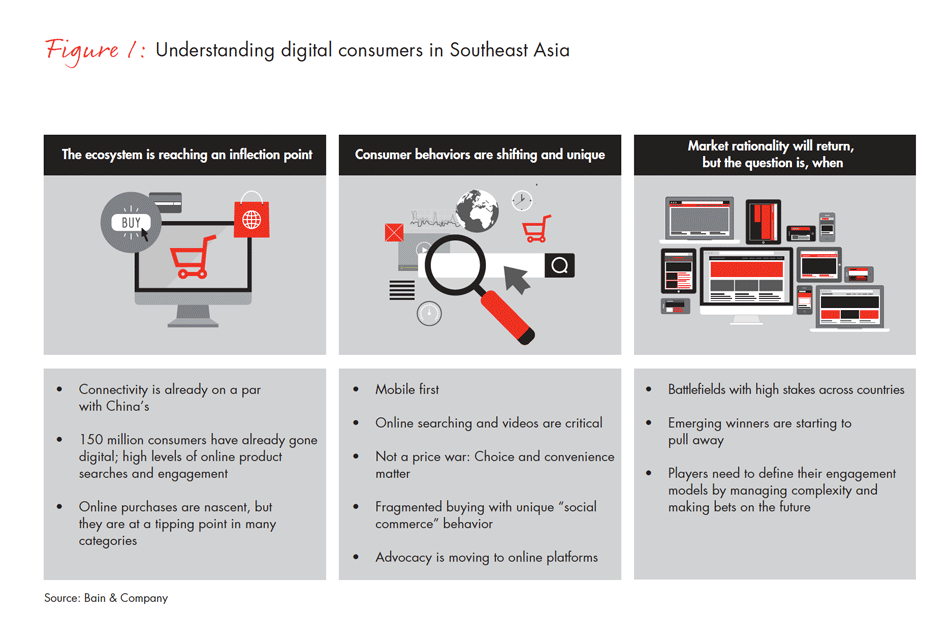
To get a clear picture of digital commerce in Southeast Asia, Bain & Company partnered with Google to survey more than 6,000 consumers in Singapore, Thailand, Malaysia, Indonesia, Philippines and Vietnam. In this extensive study, we gained important insights for e-commerce retailers, consumer goods companies, banks and other service providers into a market in transition (see Figure 1). Despite the region’s huge prospects, the online marketplace is still woefully small. Compare its 3% online retail penetration, representing only about $6 billion in sales, with the 14% penetration in both China and the US, where online sales total $293 billion and $270 billion, respectively.
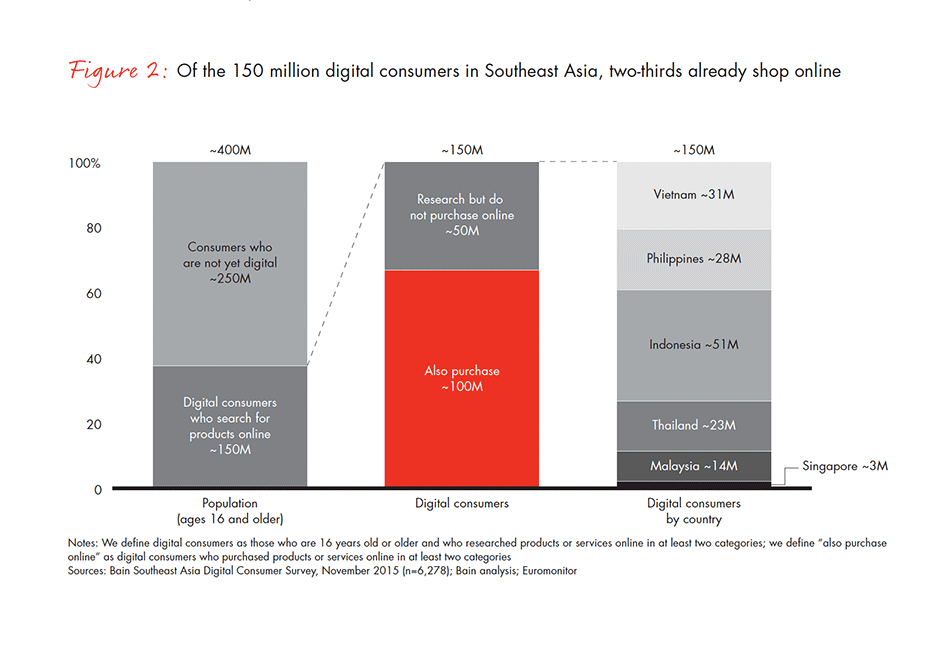
However, it’s a market rapidly approaching a tipping point. While 100 million consumers in Southeast Asia have made a digital purchase, a far larger group—150 million—has taken the first big step of researching products or engaging with sellers online (see Figure 2). Online retail penetration may be small, yet consumers are highly influenced by digital content. For example, penetration is a mere 1.2% in the Philippines, but 34% of those who have made a purchase online in that country reported they were influenced by online content prior to making their purchase.
Another big sign: Throughout the region, some categories already are starting to score big. Fully 24% of all clothing and footwear and 18% of all travel is now purchased online. Moreover, we have identified the emergence of distinct online consumer segments that reflect increasing sophistication. For example, there are the “all-around e-shoppers”—18 million consumers in Tier-1 cities and 13 million in outlying areas—who research and make purchases across all major product categories. We have identified the “beauty addict” segment of nine million young, female, urban consumers who research and purchase cosmetics products online; the 36 million “wellness shoppers,” who are female consumers in non-urban areas who buy and research health and beauty products online; and “online travelers,” consumers typically over the age of 36 who research and buy travel exclusively online.
Of course, Southeast Asia faces a host of challenges in its journey to becoming a flourishing e-commerce marketplace. For one thing, the region encompasses a broad range of ethnicities, languages, consumer preferences and regulations. For example, Indonesian law doesn’t allow foreign direct investment in local retail e-commerce companies. Also, Southeast Asia lacks a solid regional payment and logistics infrastructure, ingredients that have served as the foundation for China’s astounding growth in digital retail. In addition, surveyed consumers in the region say they don’t yet fully trust e-commerce platforms, are concerned about the lack of touch-and-feel inherent in digital commerce and report having trouble finding the products they want. These types of complaints about early-stage e-commerce markets are typical.

Southeast Asia: A Market in Digital Transition
A look inside the numbers, and three rules to success in the new digital landscape.
Yet given the sizable and digitally sophisticated population, the broad acceptance of e-commerce is inevitable in this region. For brands, retailers, technology companies or financial services players eager to establish a foothold and grow along with digital retailing here, succeeding will mean clearly understanding Southeast Asia’s online consumers and their rapidly shifting behavior and using that as the starting point for setting a digital vision. They must then translate that vision into a cohesive operating strategy and build a solid infrastructure and enablers to win.
A market unlike any other
What makes Southeast Asia’s digital consumers unique?
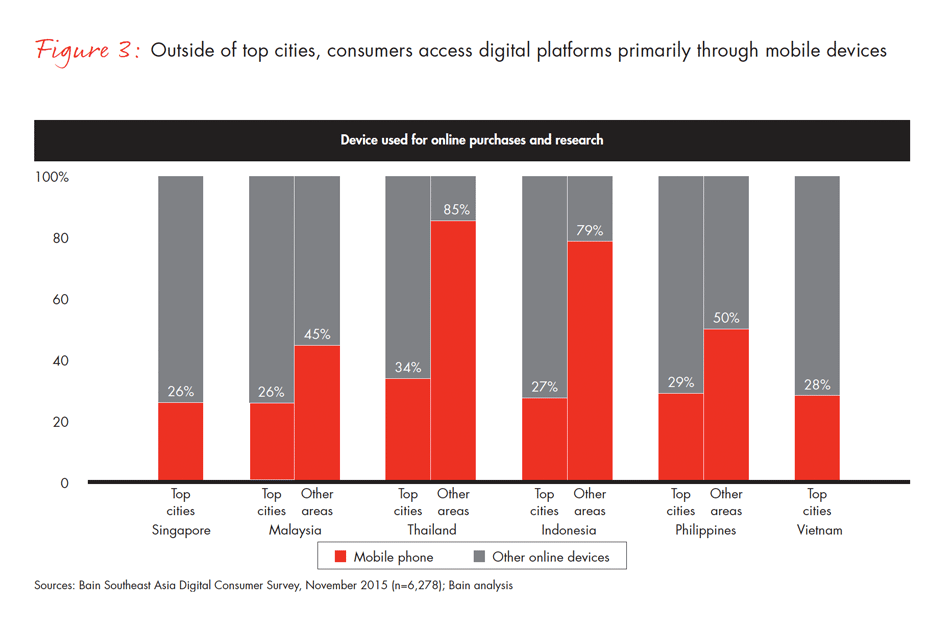
First, it’s important to recognize that consumers here are technology leapfrogs. Outside of Tier-1 cities, many have bypassed PCs, accessing digital platforms primarily through mobile phones (see Figure 3). In Thailand, 85% of consumers not living in major metropolitan hubs use mobile devices for their online purchases. Southeast Asia’s digital consumers also eagerly embrace video to learn about products, particularly those that attract online engagement (such as food recipes and cosmetics instructions). These preferences are already helping companies determine how best to use the format to win shoppers.
For example, one major fast-moving consumer goods company created two separate videos to promote a hair styling product in Indonesia. One was a typical advertisement, similar to a television commercial, and featured a celebrity promotion. The other was a nearly six-times-longer, how-to video by a video blogger. Overall, about 40% more people have viewed the how-to video on their smartphones than the celebrity promotion. These viewership results validated the company’s approach and affirmed its engagement strategy for beauty and cosmetics content.
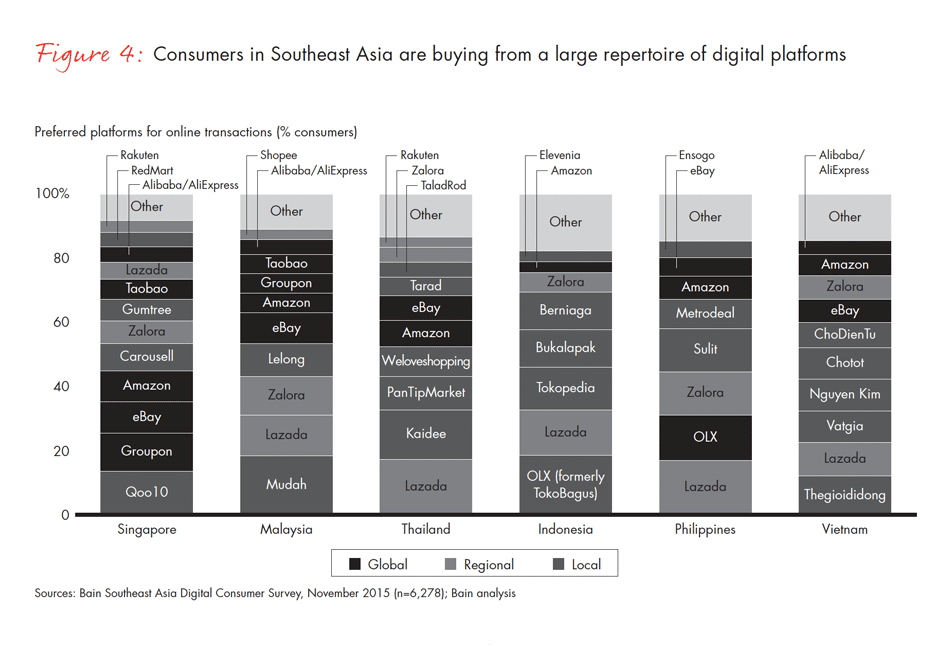
Another characteristic sets Southeast Asians apart from online shoppers in other markets: Digital consumers in this region choose from a large number of sites (see Figure 4). As evidence of the market fragmentation, consider that no retail platform is the preferred platform for more than 20% of consumers in any country. In Singapore, no fewer than 12 platforms serve 90% of the market. There are several consequences of this fragmentation. For one thing, shoppers are more likely to make search engines their first choice when looking for products—as opposed to checking company websites. In addition, because Southeast Asia’s digital consumers demonstrate little allegiance to retailing platforms, they are perfectly suited to shopping via social media.
Indeed, social commerce is highly influential in the region. Among digital consumers, more than 80% use social media options such as the ubiquitous photo-sharing site Instagram or messaging apps such as Japan-based Line to research products or otherwise connect with sellers. Those companies are rapidly expanding their array of services to attract consumers.
It’s to the point that such social sales comprise up to 30% of the volume of all transactions. A common scenario: A consumer interested in buying a product connects with a seller on Facebook, agrees to make the purchase and then arranges for payment and delivery on a peer-to-peer basis. There’s a lesson in the comment from one Thai consumer interviewed for our survey: “I bought my tea on social media because it’s a small-batch production and I enjoyed interacting with the seller. If I had seen the same product on an e-commerce website I wouldn’t have bought it.”
But the channel mix in Southeast Asia is in a state of evolution and quite fragmented. For example, in Indonesia, around 40% of sales are made on traditional e-commerce platforms—business-to-consumer or business-to-business-to-consumer. Another 30% of sales are made on consumer-to-consumer sites, and the remaining 30% come from social media, blog shops and messaging apps.
In many markets, consumers make the leap from the physical to online retail world in search of the cheapest deal. That is not the case in Southeast Asia, where digital shoppers, when citing the reasons for advocating a particular retailer, are more likely to mention the experience they had or the choice that was available to them than the price they paid. Among consumers participating in our survey, 60% mentioned experience and 61% mentioned choice as influencers in their decision to advocate. Price was cited by only 45%. Moreover, when it comes to advocating for retailers, 47% of digital consumers go online to share their experience, according to our survey, highlighting a trend with vast implications for e-commerce players.
A final distinction: Unlike many other markets, where the lion’s share of payments are made via non-cash methods such as credit cards and where door delivery is preferred, Southeast Asians desire other methods for payment and delivery. More than one-third of all consumers surveyed in top cities and outlying areas alike preferred the “cash on delivery” option. “Undoubtedly, winning in Southeast Asia e-commerce means investing in cash on delivery, no matter how difficult,” said one executive we spoke with. Door-to-door delivery is preferred in Tier-1 cities throughout the region, but in other areas, online consumers prefer to pick up their purchased items.
Bain Partner Florian Hoppe discusses digital shifts and how brands can win in Southeast Asia.
What it will take to win
It’s no secret that global and regional investors have targeted Southeast Asia and are betting huge sums on its e-commerce future. Some of the biggest funding is going to ride-hailing app GrabTaxi, which received $550 million, and regional marketplace Lazada, which received nearly $500 million. China’s JD.com has set up shop in Indonesia. Japan’s Softbank along with Sequoia Capital and SB Pan Asia Fund invested $100 million in Tokopedia, the country’s largest marketplace. The list expands every day.
The investments are spread across a growing set of players in each segment of the business. For example, dozens of companies—everyone from Lazada, Amazon and Alibaba to cungmua, blibli and Etsy—are competing for their share of the “traditional” e-commerce space, while startups including fastacash, xoom and GoSwiff are among a dozen players trying to establish a foothold in the payments infrastructure. The ranks of competitors in such areas as transport, groceries, logistics and food delivery just keeps growing, too.
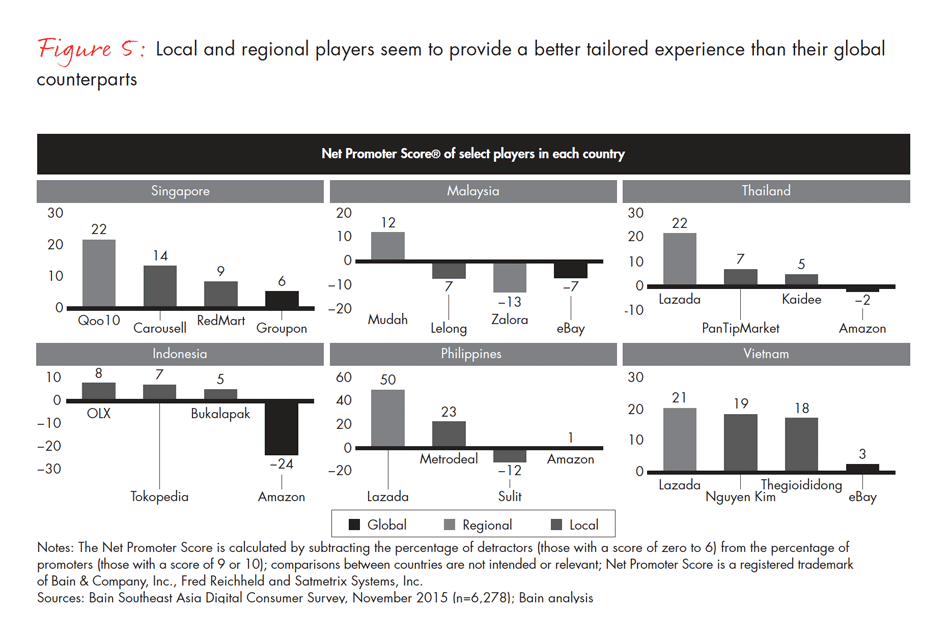
In this highly fragmented landscape, some winners are starting to emerge. We analyzed the Net Promoter Score® (NPS), which is a common measure of customer advocacy, for selected players in each country. We found that local and regional players earn higher marks than their global counterparts do. For example, in Malaysia, customers gave Mudah, the country’s largest marketplace, an NPS of 12 while eBay received a negative 7, indicating that the US-based company has many more detractors than promoters. In Indonesia, local player Tokopedia earned an NPS of 7 but Amazon scored a hugely disappointing negative 24.
Why are local and regional players the early winners? In large part, it’s because they typically provide a better-tailored experience for local consumers than global competitors offer (see Figure 5). For example, regional leaders such as Lazada have built local logistics footprints in each market to increase delivery reliability. The company has added motorbike fleets to provide speedier options to traditional truck deliveries. The local and regional companies that manage to stay on top do so by continually improving their offerings. In Thailand, its second-largest market outside of Japan, chat app Line has started free next-day delivery of groceries and expanded its payment options. It now claims two million more registered users than Facebook in that market. Local startups also are breaking new ground with innovative offerings. For example, Singapore-based Uskoop consolidates purchases from US retailers to offer consumers steep discounts on delivery fees.
However, this is a fast-moving game, and three major forces are changing the rules.
First, forward-thinking retailers are investing to maximize the potential of both physical and digital channels, honing such click-and-mortar capabilities as order online/pick up in store to advance powerful online-to-offline (O2O) strategies. Some are field-testing their innovations. Consider the “pop up” stores that e-commerce fashion retailer Zalora opens, only for a few months, in malls in Singapore, the Philippines, Hong Kong and Malaysia. These are physical stores designed to introduce consumers to apparel the company typically sells online.
Second, social media companies are continually experimenting with ways to expand the bounds of social commerce. For example, Instagram increased its value to users by aggregating sellers of products.
Finally, many global players that have stood on the sidelines in Southeast Asia are now poised to compete. The region’s fragmented e-commerce landscape, with such complications as the need to set up separate logistics operations, has kept multinationals (including Alibaba and Amazon) from investing heavily in the region. Now, as growth slows elsewhere, some feel they have little choice but to up their game in Southeast Asia. This is prompting companies such as Lazada—which operates in all six countries we’ve included in our research—to fight to protect their market position.
How can companies make the most of Southeast Asia’s raw potential?
In our work with clients, we counsel companies in all sectors to define their engagement model now—deciding where and how to play, and devising approaches to managing the complexity. They need to invest to understand the landscape, set a digital vision and, when appropriate, pick the right e-commerce partners.
For incumbents, there are three basic rules.
Go big or go home. Now is the time to set direction and place bets. The ecosystem is finally taking shape and the market is starting to take off. It’s no longer a game of wait-and-see, no longer a time for experimentation, no longer a market for small bets. It is critical to think through the dimensions of the digital ecosystem to seize opportunities and not be left behind.
Be careful about the partners you choose. In such a varied market, winning means finding the right local partners—and taking a nuanced approach. There is no silver bullet for success. Identify partners to serve each chosen category, segment and geography. Because the ecosystem is still evolving, with winners only beginning to emerge, it’s important to diversify your bets to increase your odds of winning.
Get ready for a long ride. Finally, most companies hoping to thrive in the digital world realize that it will be a multi-year journey. Digitizing a traditional business requires acquiring the right capabilities—which is not easy in a talent-scarce market such as Southeast Asia—and making fundamental changes to the company’s operating model to suit the new digital strategy. That isn’t going to happen overnight.
Florian Hoppe is a partner in Bain & Company’s Singapore office and a member of the firm’s Technology practice. Sebastien Lamy is a partner in Bain’s Singapore office and a member of the Consumer Products and Retail practices. Both co-lead Bain’s Digital practice in Southeast Asia. Alessandro Cannarsi is a Bain principal based in Singapore.
Published in March 2016