
Skip to Content
  • Offices

    Offices

    North & Latin America
    • Atlanta
    • Austin
    • Bogota
    • Boston
    • Buenos Aires
    • Chicago
    • Dallas
    • Denver
    • Houston
    • Los Angeles
    • Mexico City
    • Minneapolis
    • Monterrey
    • Montreal
    • New York
    • Rio de Janeiro
    • San Francisco
    • Santiago
    • São Paulo
    • Seattle
    • Silicon Valley
    • Toronto
    • Washington, DC
    Europe & Africa
    • Amsterdam
    • Athens
    • Berlin
    • Brussels
    • Copenhagen
    • Dusseldorf
    • Frankfurt
    • Helsinki
    • Istanbul
    • Johannesburg
    • Kyiv
    • Lisbon
    • London
    • Madrid
    • Milan
    • Munich
    • Oslo
    • Paris
    • Rome
    • Stockholm
    • Vienna
    • Warsaw
    • Zurich
    Middle East
    • Doha
    • Dubai
    • Riyadh
    Asia & Australia
    • Bangkok
    • Beijing
    • Bengaluru
    • Brisbane
    • Ho Chi Minh City
    • Hong Kong
    • Jakarta
    • Kuala Lumpur
    • Manila
    • Melbourne
    • Mumbai
    • New Delhi
    • Perth
    • Seoul
    • Shanghai
    • Singapore
    • Sydney
    • Tokyo
    See all offices
  • Alumni
  • Media Center
  • Subscribe
  • Contact
  • Global | English

    Select your region and language

    Global
    • Global (English)
    North & Latin America
    • Brazil (Português)
    • Argentina (Español)
    • Canada (Français)
    • Chile (Español)
    • Colombia (Español)
    Europe, Middle East, & Africa
    • France (Français)
    • DACH Region (Deutsch)
    • Italy (Italiano)
    • Spain (Español)
    • Greece (Elliniká)
    Asia & Australia
    • China (中文版)
    • Korea (한국어)
    • Japan (日本語)
  • Saved items (0)
    Saved items (0)

    You have no saved items.

    Bookmark content that interests you and it will be saved here for you to read or share later.

    Explore Bain Insights
  • Industries
    Main menu

    Industries

    • Aerospace & Defense
    • Agribusiness
    • Chemicals
    • Construction & Infrastructure
    • Consumer Products
    • Financial Services
    • Healthcare & Life Sciences
    • Industrial Machinery & Equipment
    • Media & Entertainment
      Industries
      Media & Entertainment
      • Media Lab
    • Metals
    • Mining
    • Oil & Gas
    • Paper & Packaging
    • Private Equity
      Industries
      Private Equity
      • Due Diligence
      • Exit Planning
      • Firm Strategy & Operations
      • Portfolio Value Creation
    • Social Impact
    • Retail
    • Technology
    • Telecommunications
      Industries
      Telecommunications
      • Capital Expenditure
      • Telco Digital Transformation
    • Transportation
    • Travel & Leisure
    • Utilities & Renewables
  • Consulting Services
    Main menu

    Consulting Services

    • Customer Experience
    • Sustainability
    • Innovation
    • M&A
    • Operations
    • People & Organization
    • Private Equity
    • Sales & Marketing
    • Strategy
    • AI, Insights, and Solutions
    • Technology
    • Transformation
  • Digital
  • Insights
    Main menu

    Insights

    • Industry Insights
    • Services Insights
    • Bain Books
    • Webinars
    • Bain Futures
    View all Insights
    Featured topics
    • Tariff Response
    • Artificial Intelligence
    • Thriving in Uncertainty
    • Executive Conversations
    • Macro Trends
    • M&A Report
    • Healthcare Private Equity Report
    • Paper & Packaging Report
    • Technology Report
    • CEO's Guide to Sustainability
    • CEO Insights
    • CFO Insights
    • COO Insights
    • CIO Insights
    • CMO Insights
    View all featured topics
  • About
    Main menu

    About

    • What We Do
    • What We Believe
    • Our People & Leadership
    • Client Results
    • Awards & Recognition
    • Global Affiliations
    Further: Our global responsibility
    • Sustainability
    • Social Impact
    • World Economic Forum
    Learn more about Further
  • Careers
    Main menu

    Careers

    • Work with Us
      Careers
      Work with Us
      • Find Your Place
      • Our Work Areas
      • Integrated Teams
      • Students
      • Internships & Programs
      • Recruiting Events
    • Life at Bain
      Careers
      Life at Bain
      • Blog: Inside Bain
      • Career Stories
      • Our People
      • Where We Work
      • Supporting Your Growth
      • Affinity Groups
      • Benefits
    • Impact Stories
    • Hiring Process
      Careers
      Hiring Process
      • What to Expect
      • Interviewing
    FIND JOBS
  • Offices
    Main menu

    Offices

    • North & Latin America
      Offices
      North & Latin America
      • Atlanta
      • Austin
      • Bogota
      • Boston
      • Buenos Aires
      • Chicago
      • Dallas
      • Denver
      • Houston
      • Los Angeles
      • Mexico City
      • Minneapolis
      • Monterrey
      • Montreal
      • New York
      • Rio de Janeiro
      • San Francisco
      • Santiago
      • São Paulo
      • Seattle
      • Silicon Valley
      • Toronto
      • Washington, DC
    • Europe & Africa
      Offices
      Europe & Africa
      • Amsterdam
      • Athens
      • Berlin
      • Brussels
      • Copenhagen
      • Dusseldorf
      • Frankfurt
      • Helsinki
      • Istanbul
      • Johannesburg
      • Kyiv
      • Lisbon
      • London
      • Madrid
      • Milan
      • Munich
      • Oslo
      • Paris
      • Rome
      • Stockholm
      • Vienna
      • Warsaw
      • Zurich
    • Middle East
      Offices
      Middle East
      • Doha
      • Dubai
      • Riyadh
    • Asia & Australia
      Offices
      Asia & Australia
      • Bangkok
      • Beijing
      • Bengaluru
      • Brisbane
      • Ho Chi Minh City
      • Hong Kong
      • Jakarta
      • Kuala Lumpur
      • Manila
      • Melbourne
      • Mumbai
      • New Delhi
      • Perth
      • Seoul
      • Shanghai
      • Singapore
      • Sydney
      • Tokyo
    See all offices
  • Alumni
  • Media Center
  • Subscribe
  • Contact
  • Global | English
    Main menu

    Select your region and language

    • Global
      Select your region and language
      Global
      • Global (English)
    • North & Latin America
      Select your region and language
      North & Latin America
      • Brazil (Português)
      • Argentina (Español)
      • Canada (Français)
      • Chile (Español)
      • Colombia (Español)
    • Europe, Middle East, & Africa
      Select your region and language
      Europe, Middle East, & Africa
      • France (Français)
      • DACH Region (Deutsch)
      • Italy (Italiano)
      • Spain (Español)
      • Greece (Elliniká)
    • Asia & Australia
      Select your region and language
      Asia & Australia
      • China (中文版)
      • Korea (한국어)
      • Japan (日本語)
  • Saved items  (0)
    Main menu
    Saved items (0)

    You have no saved items.

    Bookmark content that interests you and it will be saved here for you to read or share later.

    Explore Bain Insights
  • Industries
    • Industries

      • Aerospace & Defense
      • Agribusiness
      • Chemicals
      • Construction & Infrastructure
      • Consumer Products
      • Financial Services
      • Healthcare & Life Sciences
      • Industrial Machinery & Equipment
      • Media & Entertainment
      • Metals
      • Mining
      • Oil & Gas
      • Paper & Packaging
      • Private Equity
      • Social Impact
      • Retail
      • Technology
      • Telecommunications
      • Transportation
      • Travel & Leisure
      • Utilities & Renewables
  • Consulting Services
    • Consulting Services

      • Customer Experience
      • Sustainability
      • Innovation
      • M&A
      • Operations
      • People & Organization
      • Private Equity
      • Sales & Marketing
      • Strategy
      • AI, Insights, and Solutions
      • Technology
      • Transformation
  • Digital
  • Insights
    • Insights

      • Industry Insights
      • Services Insights
      • Bain Books
      • Webinars
      • Bain Futures
      View all Insights
      Featured topics
      • Tariff Response
      • Artificial Intelligence
      • Thriving in Uncertainty
      • Executive Conversations
      • Macro Trends
      • M&A Report
      • Healthcare Private Equity Report
      • Paper & Packaging Report
      • Technology Report
      • CEO's Guide to Sustainability
      • CEO Insights
      • CFO Insights
      • COO Insights
      • CIO Insights
      • CMO Insights
      View all featured topics
  • About
    • About

      • What We Do
      • What We Believe
      • Our People & Leadership
      • Client Results
      • Awards & Recognition
      • Global Affiliations
      Further: Our global responsibility
      • Sustainability
      • Social Impact
      • World Economic Forum
      Learn more about Further
  • Careers
    Popular Searches
    • Agile
    • Digital
    • Strategy
    Your Previous Searches
      Recently Visited Pages

      Content added to saved items

      Saved items (0)

      Removed from saved items

      Saved items (0)

      Brief

      Distributed energy: Disrupting the utility business model

      Distributed energy: Disrupting the utility business model

      More customers are generating their own power. Utilities can remain vital in this new energy world if they understand where they can profitably engage.

      By Berthold Hannes and Matt Abbott

      • min read

      Brief

      Distributed energy: Disrupting the utility business model
      en

      Utility executives around the world are watching the rise of distributed energy systems and trying to determine the best ways to react to this challenge to their traditional businesses. The rise of distributed energy (DE)—smaller power-generation systems for homes, businesses and communities—is a response to environmental concerns, rising power prices and regulatory pressures and incentives. In some European countries, the amount of power generated by intermittent sources like wind and photovoltaic (PV) cells also leads major energy consumers to explore on-site generation as a backup solution and to cap costs. In the US, the leasing model, coupled with net metering and tax subsidies, has fueled adoption of distributed solar for residential customers. In less developed countries, such as India, diesel generators provide electricity to small towns or villages that cannot count on the country's unreliable power grid.

      Growth of DE will force change on utilities' business models. Some of their most profitable customers will reduce their regular power consumption from the central grid in favor of locally produced power. These customers may still depend on the central grid for their emergency or peak use, so utilities will have to maintain their costly infrastructure and power-generating capabilities even as revenues from consumption decline. In many markets, utilities are working with regulators to adapt to this structural change by promoting a pricing model based more on connectivity and capacity and less on usage.

      To thrive in this new dynamic, utility executives will need to understand the value chain of distributed energy and related business opportunities. They may need to develop or acquire new capabilities, as well as secure regulatory support, as they move from a focus on centralized generation to models that rely on more customer interaction, commercial and energy services, and information management.

      What is distributed energy?

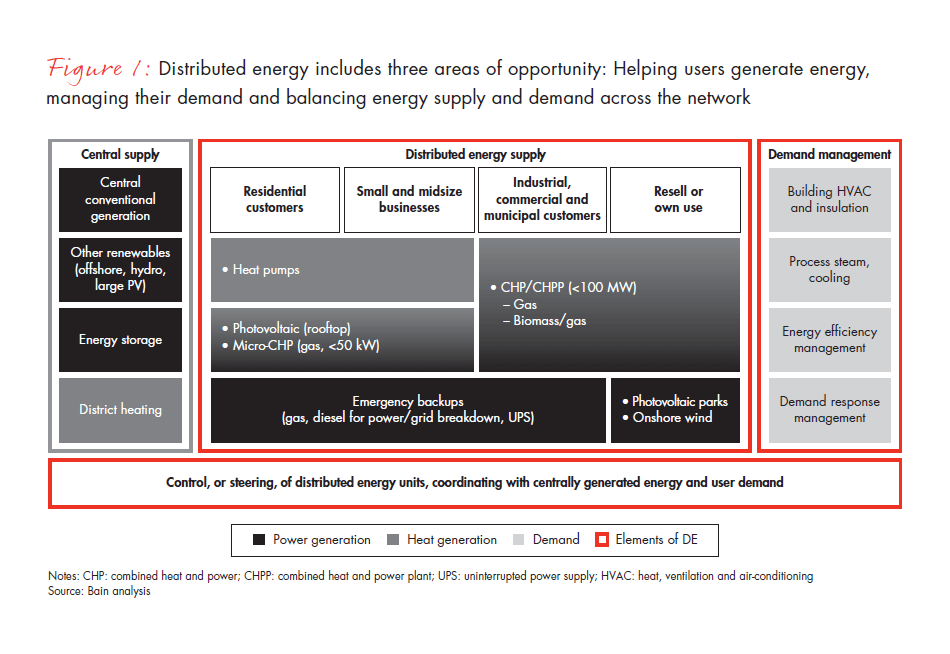
      Unlike centralized power generation—that is, large power plants (coal, gas, nuclear) transmitting power through a grid to the end customer—DE relies on smaller networks of power generation, consumed on-site or distributed locally through a low- or medium-voltage community network. We see three main opportunities for utilities in DE: helping customers generate their own energy supply, managing end-user demand for energy and controlling the distribution and consumption of energy within a DE network (see Figure 1).

      distributed-energy-disrupting-the-utility-v2-fig-01_embed


      Distributed energy supply. Typical power sources for these energy systems include:

      • Rooftop solar photovoltaic installations
      • Small combined heat and power plants (CHPP) for households and small and midsize businesses
      • Larger CHPPs for commercial and industrial environments
      • Larger PV installations
      • Onshore wind parks that industrial and commercial organizations rely on to generate their own electricity or feed it into the grid
      • Eventually, Bloom Boxes and other fuel cells

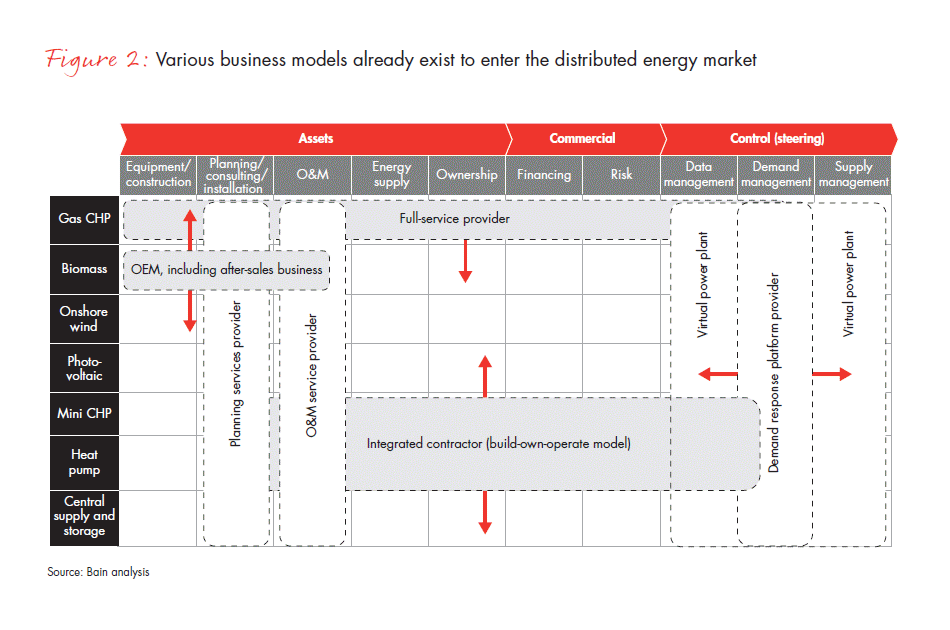
      The opportunities in this part of the value chain include planning, building, installing and operating the physical assets, as well as the commercial opportunities in financing and managing risk. For example, in the US, Public Service Electric and Gas (PSE&G) is able to include capital expenditures for certain solar programs in its rate base, generating regulated rates of return. While PSE&G's situation is unique, many companies are exploring contractor models in which they buy, install and maintain equipment, leasing the supply of electricity to customers. To date, managing these assets has delivered the lion's share of profits in distributed energy (see Figure 2).

      distributed-energy-disrupting-the-utility-fig-02_embed


      Demand management. We also see opportunities in working with industrial and commercial clients to reduce their power consumption (overall and peak) and related expenses through more efficient heating and cooling systems, better building insulation and smarter electric drives in automated equipment. Demand managers can also help customers smooth energy consumption curves by shifting demand into off-peak times with lower prices. Boston-based EnerNOC, for example, installs controllers in factories and manages electricity demand online and via a wireless network.

      Controlling (steering) a distributed energy network. Some integrated utilities already have this capability, given their experience managing their own networks. In this part of the business, utilities manage a distributed energy network in real time, via a control center that monitors generation capacity from various sources and distributes it according to demand. Analysis of data over time allows the controller to predict usage and balance loads in order to reduce overall investment in power generation. For example, in Berlin, the Swedish utility Vattenfall combines distributed small CHPPs and heat pumps with its own power sources (such as large CHPPs and onshore wind around the city) to create a "virtual power plant." Vattenfall's central controllers, connected by wire- less communication to sources and customers, balance generation with consumption, depending on demand.

      What's fueling the rise of distributed energy?

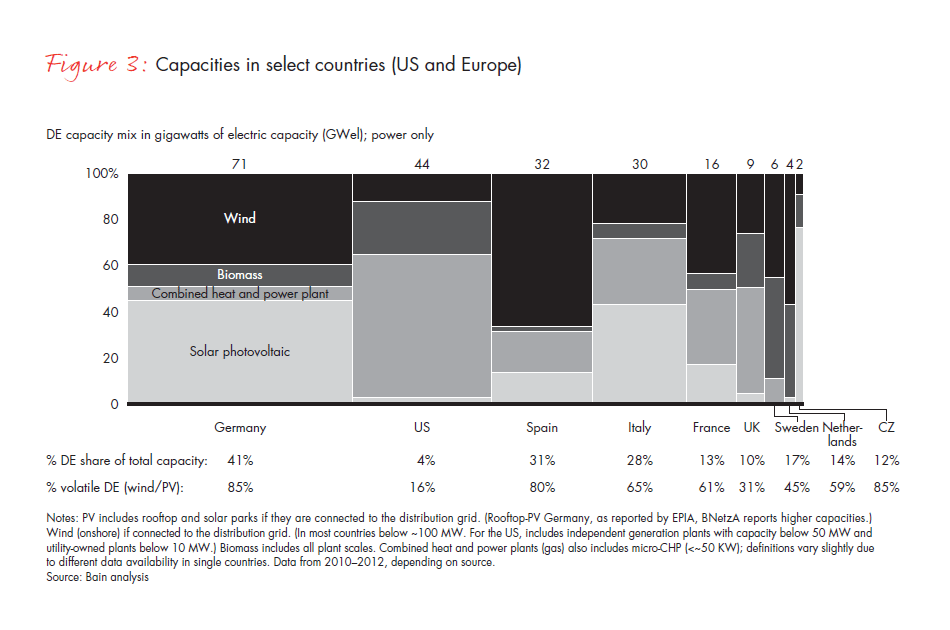
      Energy prices, environmental concerns and regulatory pressures contribute to the rising popularity of DE across markets (see Figure 3). Germany has the most extensive penetration so far. Energy prices there have risen 60% over the past decade by some accounts, due to taxes and levies on power consumption, making it advantageous to produce one's own power and heat. Germany has committed to deriving 80% of its power from renewable sources by 2050; many of those sources are likely to be distributed. Additionally, some communities in Germany (and in other countries like Sweden) have a long tradition of operating their own district heating. For example, Växjö, Sweden, has relied on biomass-fueled district heating for several decades.

      distributed-energy-disrupting-the-utility-fig-03_embed


      In the UK, the Renewable Heat Incentive (RHI) pays generators for heat they produce themselves, creating attractive economics for running small boilers (less than 200 kWh) with biomass fuel rather than oil. In the US, environmental concerns and financial incentives like tax credits and net metering, which gives credit to residential customers for electricity that they generate and send back into the grid, have encouraged distributed generation.

      In developing economies such as India, distributed energy is an option to expand the electrical system into locations that are not on the grid, or for whom the grid is not a reliable source of power. India's massive power outage in July 2012, which left 670 million people without grid electricity, reinforced the need for commercial and industrial clients that rely on their own on-site, gas-fueled power plants to secure power and steam. Another incentive in India is that local or on-site generation means the source lies close to the demand, so customers don't need to rely on national or state grids with their high rates of loss in transmission and distribution.

      What utilities must do to thrive

      The rise of distributed energy represents a significant disruption for large utilities, one that will put their current business models under severe pressure. Some already feel the impact on profitability as these systems reduce their revenue from usage-based rates. Consider the risk in Germany, where the new opportunities are large, but not large enough to cover losses in traditional businesses. In 2010, profits in traditional, centralized generation amounted to €7.5 billion. We estimate that centralized generation will decline by 20% through 2020 as distributed generation rises and takes market share, resulting in a profit loss of about one-third, or €2.5 billion. Distributed energy profits may account for €3 billion to €4 billion by 2020, but large utilities are likely to capture only a part of that, with the rest going to smaller energy service companies.

      Thus, the imperative to make the most of each opportunity is strong for each player. A well-balanced approach can ensure that existing capabilities support current operations while allowing players to expand into DE businesses.

      Preserve and extend existing core capabilities. While utilities continue to manage their large centralized power systems, they can rely on their current capabilities to begin to move toward new business models. The clearest possibility here will be in managing the supply and demand balance of DE systems through sophisticated control techniques. Other core capabilities that should help utilities succeed in the DE value chain include their experience and competence managing large engineering projects, as well as their expertise optimizing the use of operational assets, at the local, regional and even international levels.

      Expand existing capabilities. Utilities can begin to take "no regret" decisions that will put them in a better position to make the most of new opportunities. Foremost among these is improving customer loyalty and getting to know customers' needs and preferences better—skills increasingly critical in their traditional business of supplying power, but even more so in managing DE, where meeting customer needs must happen in real time. (See the Bain Brief, "Turning on utility customer loyalty.")

      Identify new businesses. One option is integrated contracting, where the utility offers services such as planning, installation, operations and maintenance, load management or demand management. For example, utilities could act as a contractor to manage the energy efficiency of residential buildings, hotels, hospitals or industrial facilities. Contractors often share in the savings from the energy conservation measures they put in place. Dalkia and GETEC Energie offer these kinds of services, and some larger utilities are entering these high-growth businesses, too. For example, E.ON is ramping up its distributed business, having announced investments of nearly €1.4 billion for 2013-2015 in that area.

      Explore partnerships and joint ventures. Build up other required DE capabilities through partnerships, joint ventures and acquisitions. Partnerships and JVs allow for staged investments along the DE value chain, and they let utilities tap into the entrepreneurial activity in this area.

      Distributed energy holds the promise of delivering efficient, reliable and, in many cases, renewable energy to customers around the world. As a result, customers will draw less power from the central grid and may unplug altogether. The sooner utilities identify the opportunities inherent in this growing movement, the more likely they are to capture the profits available to them.

      Berthold Hannes is a partner with Bain & Company in Düsseldorf. Matt Abbott is a Bain partner in Los Angeles.


      distributed-energy-disrupting-the-utility-v2-fig-01_full

      distributed-energy-disrupting-the-utility-fig-02_full

      distributed-energy-disrupting-the-utility-fig-03_full
      Related Industries
      • Energy & Natural Resources
      • Utilities & Renewables
      Oil & Gas
      Operational excellence: The imperative for oil and gas companies

      Rising complexity, costs and risks combine to make efficiency more important than ever. Change is challenging, but complacency isn’t an option.

      Read More
      Utilities & Renewables
      How utilities can succeed in the construction boom

      By enhancing their project management capabilities, utilities can use resources more efficiently and maintain a positive reputation with regulators and customers.

      Read More
      Utilities & Renewables
      How utilities should evaluate upstream and downstream integration

      Deregulation broke utilities apart, but many executives are now asking whether they should put the value chain back together.

      Read More
      Utilities & Renewables
      Utilities Can Power Growth Through a Better Customer Experience

      Top performers turn everyday interactions into loyalty, lower costs, greater revenue streams, and stronger reputations.

      Read More
      Utilities & Renewables
      Can the US Energy Grid Keep Up with AI Data Centers?

      Our latest forecast projects data centers will consume 9% of US electricity by 2030, straining the grid without new solutions.

      Read More
      Published in April 2013
      Tags
      • Energy & Natural Resources
      • Utilities & Renewables

      How We've Helped Clients

      An Environmental Services Company Captures Massive Savings from a Merger

      Read case study

      Performance Improvement Boosting a utility's workforce productivity

      Read case study

      Sales and Marketing Revitalizing a utility's market position with customer loyalty

      Read case study

      Ready to talk?

      We work with ambitious leaders who want to define the future, not hide from it. Together, we achieve extraordinary outcomes.

      Stay ahead in a rapidly changing world. Subscribe to Bain Insights, our monthly look at the critical issues facing global businesses.

      *I have read and understand Bain’s Privacy Notice.

      Please read and agree to the Privacy Policy.
      Bain & Company
      Contact us Sustainability Accessibility Terms of use Privacy Modern Slavery Act Statement Cookie Policy Sitemap Log In

      © 1996-2026 Bain & Company, Inc.

      Contact Bain

      How can we help you?

      • Business inquiry
      • Career information
      • Press relations
      • Partnership request
      • Speaker request
      See all offices