

Global Machinery & Equipment Report

At a Glance
- The digital transformations underway at many industrial machinery and equipment companies are paving the road for them to transition from a product-centric business model to a solutions-centric model. This shift to digital-enabled solutions provides an opportunity to tap into a faster-growing profit pool with higher margins.
- However, it’s a difficult transition, and few machinery companies have successfully executed a technology transformation.
- Five priority actions can give machinery leadership teams an edge as they invest in new digital solutions businesses.
This article is part of Bain's Global Machinery & Equipment Report 2022
Manufacturers of industrial machinery and equipment have many reasons to pursue digital transformations. The potential to redefine how products are created, made, sold, and serviced is profound. Within plants and factories, new digital capabilities are increasingly at the heart of virtually every process and activity, leading to enormous gains in efficiency and productivity. This industrial digitalization movement has been underway for a while, and there’s still huge growth potential that remains untapped.
For industrial machinery companies, however, the power of digital to change virtually every aspect of the business acquires an added dimension: the ability to support a shift from a product-centric business model to a solutions-centric model. By combining hardware, software, and services into a tightly integrated, tailored solution that meets a broader range of customer needs, companies can tap into a faster-growing profit pool, achieve higher margins, and turbocharge their sales. In many cases, they have an opportunity to enter markets with growth rates several times the size of their current portfolio, depending on the segment. For one food and beverage equipment maker in the early stages of this transition, adopting a digital-enabled solutions model has unlocked the opportunity to create a business with at least quadruple the annual revenue and more than double the profit margin of its traditional equipment business.
Indeed, across the industry, solutions are poised to deliver significant value on par with the business lift that industrials’ aftermarket services have provided over the past three-plus decades. In the industrial automation sector, where the shift to solutions has been underway for several years, solutions are the fastest-growing part of the business and will be an increasingly significant revenue generator in the coming years (see Figure 1).
Figure 1
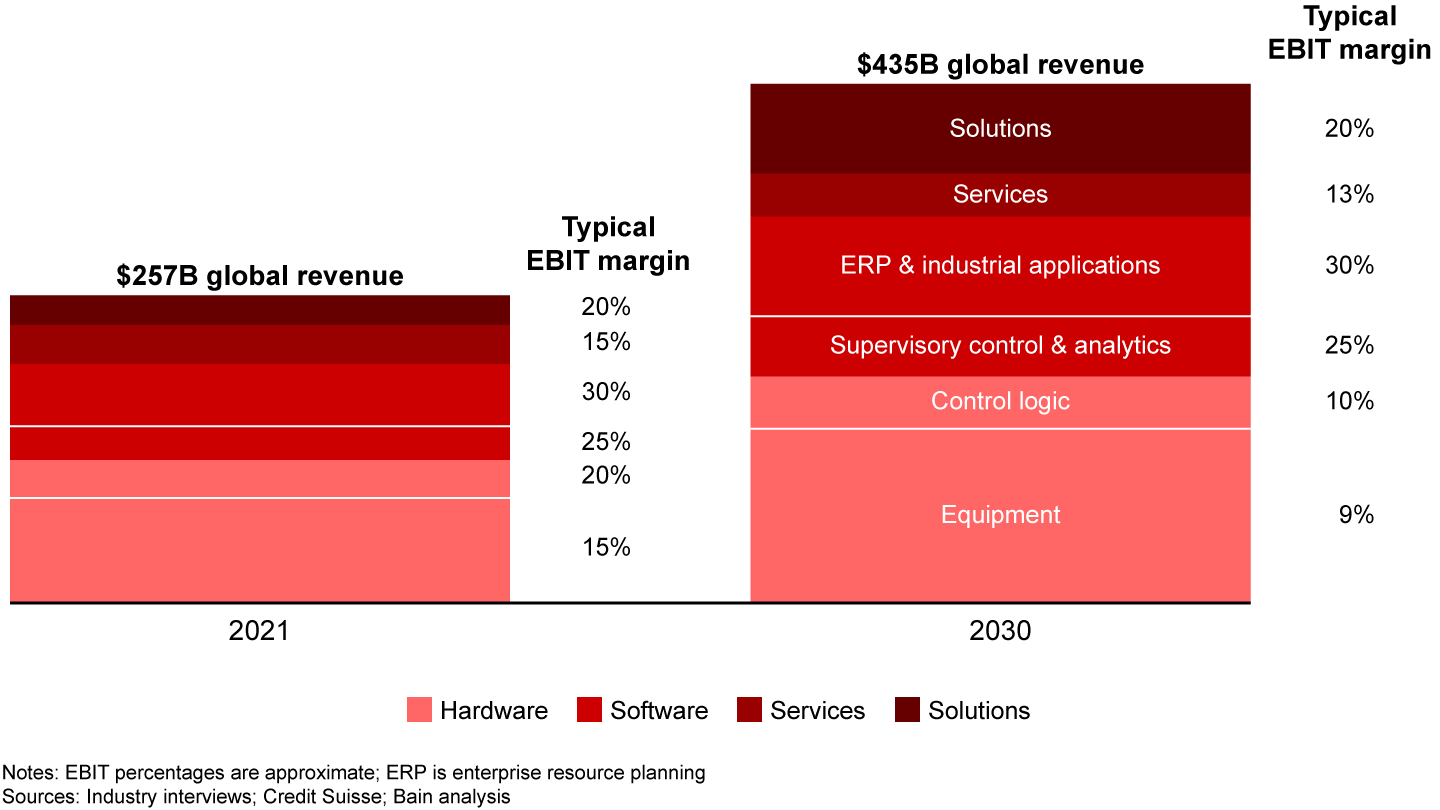

This shift is already happening, and for good reason. As competition intensifies and machinery-driven innovation slows, maintaining profitable growth in a product-centric model is becoming increasingly difficult. A solutions model, however—particularly one with a strong digital/technology underpinning—can propel machinery companies past their competitors, boosting growth and creating stronger bonds with customers as the companies understand and meet more of their needs.
Across the industry, solutions are poised to deliver significant value on par with the business lift that industrials’ aftermarket services have provided over the past three-plus decades.
But, as in other industries, these potential gains are attracting new competitors that often enter the industrial space horizontally, using their expertise in software, cloud and web services, or other advantages. That creates a sense of urgency that’s motivating the leaders of many machinery companies to move toward a solutions model, or risk missing a critical window. Our report explores this crucial trend toward solutions through multiple lenses. In this chapter, we’ll unpack the sector’s technology shift and how a focus on digital solutions can ensure that machinery companies make the right moves and achieve full value from this new, digitally powered revenue model.
The threat of complacency
Machinery company leaders acknowledge that a solutions focus presents an opportunity to catalyze growth (not to mention defend against competitive disruption), but most have been slow to act. There are two primary reasons. First, the pace of digital transformation—and the extent of the operational and organizational changes it has generated—can feel gradual, which creates a sense that there’s time to catch up. Second, most companies have made at least some digital or technology investments which, although often incremental, foster a misleading sense of momentum.
Yet, when you consider that fewer than 5% of companies across machinery and other industrial sectors have successfully executed a technologically or digitally based transformation, it’s clear that many management teams are underestimating the difficulty of moving to a digitally driven solutions model. They may also be underestimating the potential; digital can not only prove transformative in reducing costs and improving core processes but can—and often should—be a source of significant additional revenue. Industrials that put more effort into digital, in fact, are four times more likely to outperform the competition, while two out of three digital laggards perform worse than the competition, according to a 2019 Bain survey of 205 industrial companies.
Management teams underestimate the difficulty of moving to a digitally driven solutions model
As they pursue a digital transformation with the goal of moving toward a solutions-centric model, senior leaders should be prepared to address five strategic and operational challenges.
Key challenges:
- Changing life-cycle economics: Revenue streams will shift from one-off sales to recurring payments, so a company’s life-cycle economics will become more complex.
- Balance sheet transformation: Balance sheets are potentially transformed, as products that were once sold outright can now remain on the manufacturer’s balance sheet, e.g., through equipment-as-a-service (EaaS) models, which changes the manufacturer’s risk profile and financing requirements significantly.
- New operating model requirements: To successfully develop and sell solutions, rather than products, companies will need to rethink their operating models, removing organizational barriers that often hamper such transitions.
- Faster innovation cycles: Industrial products typically have multiyear innovation cycles, but solutions are often updated every 6 to 12 months, a much faster pace of development that many companies may struggle with.
- Ecosystem requirements: Solutions, by their very nature, integrate much more deeply into a customer’s processes, and may require an ecosystem of partners to facilitate deployment and interoperability.
Pilot projects can help machinery companies achieve a level of risk-free learning on some of those challenges. But creating a fully scaled solutions business is a multiyear journey that starts with strategic and competitive positioning and extends through the design of the tech stack, ownership of control points, curation of a partner ecosystem, enhancements to the operating model and talent pool, and the need to invest in and fund organic development and possible M&A moves.
The solution to solutions
That may sound daunting, but many leaders of machinery companies know they have much to gain by embracing the solutions model. And, they may have little choice but to move forward, given that both their direct competitors and companies in adjacent spaces are all eyeing this promising opportunity.
Here are five priority actions that leadership and management teams in the machinery and equipment sector can address now to help their companies gain a winning edge:
1. Assess the profit pool and potential competitors
Industry profit pools have experienced a paradigm shift, spurred by two factors:
- Downward margin pressure on traditional products and services due to decreasing technological differentiation and increasing competition from low-cost players, enabled by at-scale globalized supply chains.
- Emergence of tech-enabled products and services that better meet customers’ needs and so command higher margins.
As a result, a small but growing profit pool for high-margin digital solutions is attracting many new players. As traditional market boundaries blur and barriers to entry become lower, suppliers and even customers become potential competitors.
2. Formulate a clear vision and ambition
As opposed to traditional market-entry strategies—where companies size the market, assume a certain attainable market share, and identify a business opportunity to go after—digital solutions businesses require a more strategic approach to setting a vision and ambition. This is a greenfield opportunity to create and monetize new markets, which requires companies to define their unique play and derive the resulting opportunity from that. The required investment will scale with the breadth of use cases and the extent of integration across whatever stack a company pursues in its solutions business. Given that most companies have scarce resources, the most effective leaders will pursue those solutions businesses where they have a clear strategic fit.
One global food processing company saw an opportunity to help its customers reduce their factories’ annual operating costs by as much as one-third with digital solutions. By digitalizing operations, such as using remote sensors to more closely monitor machine performance, customers can improve maintenance and reduce machine downtime—the biggest contributor to their operating costs. The company gets paid based on its equipment meeting certain performance goals. If executed to its full potential, the company projects its new digital solutions business could generate hundreds of millions of dollars in annual revenue from its existing equipment customers alone.
3. Define winning solutions for the right customer segments
Machinery and equipment executives increasingly recognize that in order to succeed in digital solutions, they’ll need to define leadership differently. In hardware, winning is about product leadership because a majority of a company’s cost is in the product itself. That puts a focus on scale, to reduce product costs and reinvest savings in better products. In a solutions model that includes software and services, high-gross margins make product cost less of a concern. Instead, the priority becomes investing in customer acquisition and retention. The most successful companies excel at customer segmentation, develop digital solutions for the customer segments they can win, and maximize customer value over the long term.
Machinery and equipment executives increasingly recognize that in order to succeed in digital solutions, they’ll need to define leadership differently.
Hilti, a Liechtenstein-based maker of power tools, fastening systems, and other construction and manufacturing products, chose to market its digital offerings toward midsized construction contractors. Digital tools are increasing productivity in the construction industry, but midsized contractors have yet to adopt them at scale. Hilti acquired construction technology company Fieldwire, based in San Francisco, last year to expand its capabilities in this area. Fieldwire’s software helps contractors coordinate construction crews in the field; the company says its product improves trade productivity by more than 12% on average.
4. Create a development and delivery game plan
Once the company has defined its target segments and solutions, the next step is to assemble them along the technology stack. As the value propositions of machinery hardware increasingly blur with integrated software offerings, this stack will likely include elements that don’t exist in the company’s current portfolio. That necessitates make vs. acquire vs. partner decisions. Some solution elements will be control points with huge potential for monetization and will be handled firmly in-house, while other elements can be made better or cheaper by others. The most effective companies take an ecosystem mindset, rather than thinking in terms of a linear value chain with customers and suppliers. Similarly, companies are reevaluating operations from R&D to sales, because a solutions business entails much shorter development life cycles and a much more consultative selling model.
Rather than an organic, incremental approach, some machinery companies have chosen to acquire software solution companies and create separate business units focused on the new digital-enabled revenue model. For example, Hitachi, the Japan-based industrial conglomerate, last year acquired GlobalLogic, a US-based digital engineering services firm, for $9.6 billion, a deal aimed in part at bolstering Hitachi’s digital solutions business, Lumada.
5. Manage the solutions business along different metrics and risks
Entering the solutions space requires a clear strategic and financial roadmap and the right key performance indicators, which may change over time. Early on, for example, EBITDA margin isn’t as meaningful as customer unit contribution or customer churn. Risk is another critical consideration. Digital solutions businesses often have new business models (e.g., performance- or outcome-based payoffs) that create a risk profile for the business that needs to be professionally managed. And, while investors and shareholders are typically happy to hear about a company’s expansion into solutions, they may not fully understand the time and investment required to make it succeed. Leading companies are as clear as possible about the investments and time frame needed to see material returns.
The stakes are high. At a time when a traditional focus on products is under increasing pressure, machinery leadership teams recognize that harnessing the power of digital to launch and scale new solutions businesses provides a huge growth opportunity. They also recognize that, in this age of digitalization, the success or failure of their efforts on this front could determine the legacy they leave behind.
More from the report
Read our Global Machinery & Equipment Report 2022
Published in May 2022