

Brief

Imagine this scenario: It’s 7:30 AM, and time to leave for work. You normally drop your three-year-old daughter off at day care on your way to the train station. However, this morning she has developed two red, itchy blotches on her face. Is she sick, you wonder? Is it serious? Is she contagious? Looks like you’ll have to keep her out of day care and take her to the pediatrician, and who knows when you’ll be able to get an appointment. Or maybe you’ll just need to go to the doctor’s office and wait to be squeezed in. Either way, you or your spouse will have to miss a partial or full day of work.
But what if things could be done differently, more efficiently, with less time and less anxiety? What if you could use a smartphone app provided by your health insurance company to get background information on rashes, initiate a video consultation with your doctor and schedule an appointment with a highly rated specialist close by who can see your daughter that morning?
If this sounds far-fetched and futuristic, it’s not. In some countries, health insurers already have begun developing such services. Digitalization, the force that has revolutionized music, media, retail, travel and many other industries, is finally coming to healthcare—not just for back-office activities such as billing and claims processing, but to the front lines of patient care. Health insurers can play a leading role in this digital transformation, and those that move quickly and thoughtfully can seize a multibillion-dollar opportunity to contain costs and to help provide better, more efficient, more coordinated and more focused care for consumers (and their children).
With digitalization, insurers can help slow the seemingly inexorable rise in healthcare costs around the world. People are living longer, thanks in part to new, sophisticated treatments, but many of these therapies are expensive. Using advanced analytics and other digital techniques, insurers can help doctors and patients get access to the most up-to-date and relevant information when making decisions about treatments. Thanks to smart devices connected to the Internet of Things, insurers also can take the lead in helping people live healthier lives in their own homes, a benefit in terms of cost and convenience for consumers of all ages, particularly the elderly and the infirm.
Consumers have grown accustomed to living in a digital world for shopping, banking, communicating and many other activities. They now expect their healthcare providers to deliver a digitally enhanced experience, and they want health insurers to play a central role in that experience. More than 60% of insurance customers expressed interest in having their insurers offer healthcare services beyond their standard insurance offerings, according to a Bain & Company survey of 172,000 customers in 20 countries (Customer Behavior and Loyalty in Insurance: Global Edition 2017).
Health insurers face the enormous challenge of transforming themselves from narrowly focused payers of claims to purveyors of a broad array of services, ranging from apps that assess the severity of your daughter’s facial rash to apps that help you monitor your prescription drugs, alerting you to possible side effects or adverse interactions between medications—or simply helping you to stay healthy. Insurers can become the principal players at the center of an ecosystem of healthcare services, acting not just as processors and payers, but also as partners with their customers in the digital experience.
Seven disruptive healthcare technologies
Insurers will unlock the true potential of digitalization only when they begin using the full array of available technologies. Bain and Google have compiled a comprehensive portfolio of digital technologies relevant to health insurers and evaluated their usefulness in dozens of business cases. From this compendium, we’ve identified 30 cases with the potential to generate the most value in the next three to five years. We’ve grouped these applications under seven critical technologies (see Figure 1).
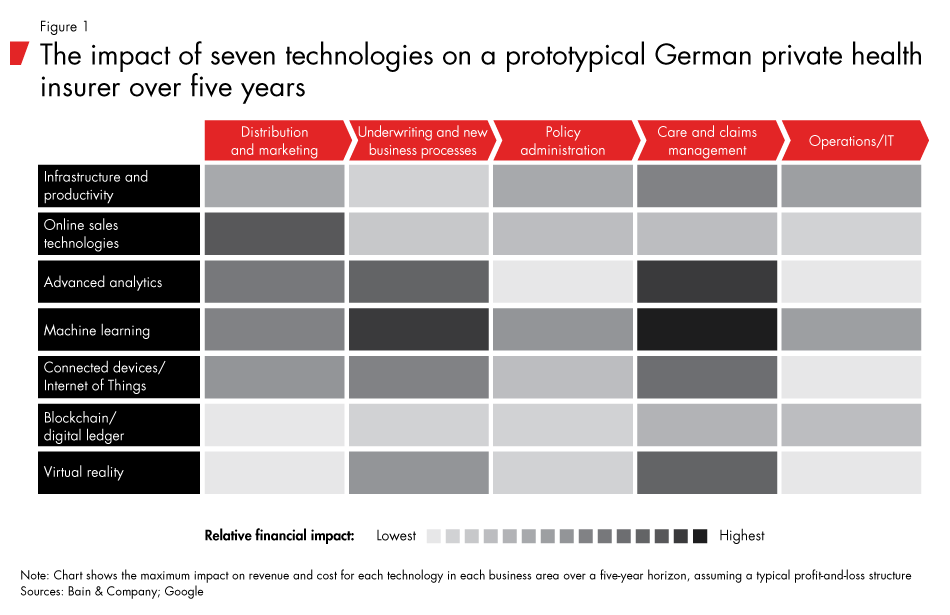
Advanced analytics. Insurers amass large amounts of data from different sources as they process claims. Using advanced analytics, they can develop sophisticated customer relationship management (CRM) systems that help provide targeted services and prevent churn. Further down the road, insurers also can use their data, with proper privacy protections, to help doctors deliver timely, proactive and cost-effective care to patients, while avoiding redundant, and possibly conflicting, tests, therapies and medications.
Machine learning. Insurers can use machine learning to manage digital interactions with their customers, enabling them to complete online transactions that previously required human interaction. Other potential uses for machine learning include claims processing and fraud detection.
Internet of Things. Many people already are wearing watches and other devices that measure their physical fitness. As these biosensors get more sophisticated, they will become links in a healthcare system that increasingly emphasizes home-based treatment and the prevention of illness. By using sensors to monitor their health, consumers can potentially detect early warning signs of problems before they develop into complicated and costly diseases.
Online sales technologies. As insurers expand into ecosystem services, they can use digital tools to better anticipate customers’ needs. With sophisticated digital marketing, including the use of social media, insurers can target customers efficiently and offer them services that fit their situation. They thus can make cross-selling more effective and reduce customer churn.
Infrastructure and productivity. To fully reap the benefits of digital healthcare, insurers need to help construct a powerful infrastructure, built around an all-encompassing information system that promotes the exchange of data.
Such a system can act as a clearinghouse for patients searching for information on doctors and treatments. As a repository of electronic medical records, it can help patients and their doctors coordinate care. The system also can simplify the purchase of prescription drugs and connect patients with each other. To get there, insurers will have to overhaul core legacy systems and embrace Agile software development and cloud-based solutions.
Distributed ledgers. When patients engage with the healthcare system, they often interact with multiple parties to treat a single illness. Using distributed ledger technology (DLT), all participants—patients, doctors, pharmacists, therapists and insurers—can securely access all information relevant to treatment. A pharmacist dispensing a drug, for example, can automatically trigger the payment process. With such a system, health insurers can precisely monitor and control treatment costs.
Virtual reality. Technical and legal hurdles need to be cleared in Germany and other countries before doctors can use the latest devices to diagnose patients remotely. However, in countries such as Switzerland, telemedicine already has become a part of everyday life. In the future, patients needing orthopedic shoes, for example, will be able to use their smartphones to record a 3-D data model of their feet, which they can email to their podiatrists. Insurers will be able to access those same models when they’re evaluating patient claims.
Gaining an edge from innovation
These seven technologies are already here in some fashion. Still others are just over the horizon. Within the next decade, for example, nanoparticles could revolutionize diagnosis and therapy, and 3-D printers could precipitate groundbreaking changes in medical technology. While these new techniques can be expensive in the short term, they can save money in the long run by helping patients get better faster, avoiding further procedures and hospitalizations.
Insurers will need to monitor these innovations closely and promote those they believe will provide patients with better outcomes and more cost-effective care. To realize the full potential of digital developments in healthcare, insurers will want to work closely with doctors, hospitals, pharmacists and other providers.
Bain and Google have jointly developed a unique model to demonstrate how insurers can benefit from digitalization, using market data on average premium income, capital structure and technology adoption to come up with a prototypical German private health insurer. We determined how the prototypical insurer could improve its competitive position in the next five years by exploiting 30 critical applications across the seven technological categories. Our analysis shows which applications are likely to have the earliest and most significant impact on different areas of the insurer’s business. To realize the full value of digitalization, the insurer must adopt a range of technologies along the entire value chain.
The prototypical insurer can increase revenues from premiums by 6% to 11% in the next five years, depending on which technologies it deploys and when it introduces them. For example, an insurer is likely to reap significant benefits by adopting a sophisticated CRM system and advanced online sales technologies. Using these tools, health insurers can efficiently target discrete groups of customers with tailor-made products. Someone trawling the Internet for vacations in tropical countries, for instance, is more likely to consider supplementary health insurance, and parents with small children are more likely to purchase comprehensive health coverage than those who have no children.
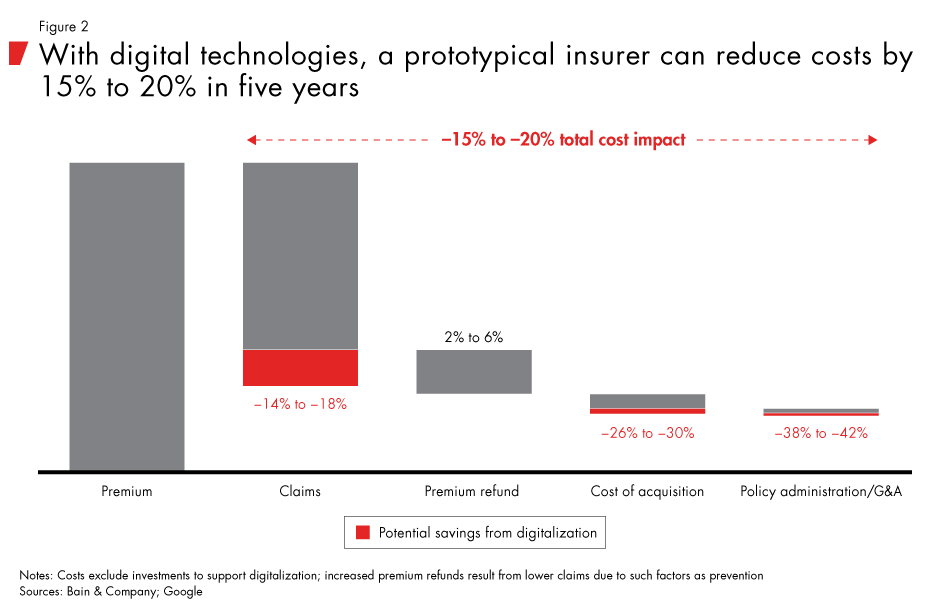
Health insurers also can use digital tools to cut costs—by as much as 15% to 20% (see Figure 2). They can realize much of these savings by more efficiently processing claims and by detecting and preventing fraud, not by cutting back on services to the customer. In fact, customers stand to benefit from cost-cutting, since insurers can pass along some of the savings in the form of lower premiums and discounts for ecosystem services, such as fitness club memberships.
Overall, customers are likely to gain from digitalization. It will mean higher quality, and less time-consuming and redundant care, much of it delivered remotely in the customer’s own home. Thus, insurers that rapidly embrace digitalization can dramatically improve their competitive positions, while helping to make life better for their customers. Across the entire German health insurance sector, digitalization presents a multibillion-dollar opportunity, with the savings shared by insurers, healthcare providers and consumers.
Six steps toward successful digitalization
For health insurers to reap the full benefits of digitalization, other participants in the healthcare system—including doctors, hospitals, pharmacies, drug companies and device makers—must do their part. As central players in healthcare delivery, insurers can play a leading role in bringing all players together to build a robust, interconnected infrastructure for sharing and processing information, while still complying with data-protection laws.
Forward-looking insurers recognize that digitalization is a multistep process, one guided by several foundational principles.
Make clear strategic choices. Healthcare and health insurance are in a state of flux. Consumers have rising expectations and new options, regulatory reform is fostering innovation, and non-healthcare players are entering the business. In this evolving environment, insurers need to make proactive choices about which innovations and technologies they want to adopt and what positions they want to occupy in the market.
Protect patient data. Data is the raw material of the digital age, but patients’ personal health information is particularly sensitive. Insurers have a wealth of information about their customers, and they must build in strong safeguards to protect confidentiality and prevent misuse. They can’t afford to lose their customers’ trust.
Create a better customer experience. Healthcare lags other industries in the way it treats customers. With digitalization, insurers can be at the forefront of the effort to give consumers more information, more choice and better service, while helping them lead healthier lives. Customers will benefit, and so will insurers’ bottom lines.
Be digitally aware. Failing to act in this digital age is not an option, but that does not mean insurers should rush to adopt the latest new technology. They should rigorously evaluate new techniques with an eye to prioritizing those that can quickly help improve their position in the marketplace. Just because a technology is “cool”—for example, a bot that can answer customer complaints in a chatroom—doesn’t mean it is the most effective. An insurer might find that less flashy applications, such as using artificial intelligence to speed up and improve claims processing, can deliver more significant results.
Launch and iterate. Technology is evolving fast. So too are customer behaviors and expectations. That makes long-term planning a challenge. Insurers that wait until a new application is totally developed run the risk of missing an opportunity or making a wrong turn. Forward-looking insurers are working with their business partners to swiftly bring prototypes to market and then refine them based on customer feedback.
Build a digital culture. Health insurers—along with other players in the healthcare system—are now adopting technologies that already have transformed other industries. Traditional ways of doing business are no longer viable. Health insurance executives who embrace digitalization and foster a climate of innovation have a tremendous opportunity to reduce costs and inefficiencies, improve their customers’ well-being—and lead the way to improving a healthcare delivery system that is long overdue for an overhaul.
Henrik Naujoks leads Bain & Company’s Financial Services practice in Europe, the Middle East and Africa, and is based in Zurich. Christian Kinder, who is based in Munich, is a partner in Bain’s Financial Services practice. Florian Mueller leads Bain’s Advanced Analytics practice in Europe, the Middle East and Africa, and is based in Munich. Nikos Kotalakidis is the industry leader for Consumer Products & Technology at Google Germany. Sarah Fix-Bähre is the industry leader for insurance at Google Germany.
About the partnership between Bain & Company and Google
Bain & Company is one of the world’s leading management consulting firms in the field of banking and insurance. Google has one of the most extensive cross-industry innovation pipelines worldwide that has major relevance for the financial sector. For this study, the insurance teams of both companies have combined their expertise to gain unique insights into the impact that digitalization will have on the customer experience and the operating business of health insurers. In September 2016, both companies prepared a similar groundbreaking analysis for Germany’s property and casualty insurers.
Special thanks go to Marian Mohr, manager in Bain’s Zurich office, and Aurélie Toubol, a consultant in Bain’s Paris office, as well as Torsten Scholl, industry manager for financial services at Google Germany.
Published in March 2018