
Skip to Content
  • Offices

    Offices

    North & Latin America
    • Atlanta
    • Austin
    • Bogota
    • Boston
    • Buenos Aires
    • Chicago
    • Dallas
    • Denver
    • Houston
    • Los Angeles
    • Mexico City
    • Minneapolis
    • Monterrey
    • Montreal
    • New York
    • Rio de Janeiro
    • San Francisco
    • Santiago
    • São Paulo
    • Seattle
    • Silicon Valley
    • Toronto
    • Washington, DC
    Europe & Africa
    • Amsterdam
    • Athens
    • Berlin
    • Brussels
    • Copenhagen
    • Dusseldorf
    • Frankfurt
    • Helsinki
    • Istanbul
    • Johannesburg
    • Kyiv
    • Lisbon
    • London
    • Madrid
    • Milan
    • Munich
    • Oslo
    • Paris
    • Rome
    • Stockholm
    • Vienna
    • Warsaw
    • Zurich
    Middle East
    • Doha
    • Dubai
    • Riyadh
    Asia & Australia
    • Bangkok
    • Beijing
    • Bengaluru
    • Brisbane
    • Ho Chi Minh City
    • Hong Kong
    • Jakarta
    • Kuala Lumpur
    • Manila
    • Melbourne
    • Mumbai
    • New Delhi
    • Perth
    • Seoul
    • Shanghai
    • Singapore
    • Sydney
    • Tokyo
    See all offices
  • Alumni
  • Media Center
  • Subscribe
  • Contact
  • Global | English

    Select your region and language

    Global
    • Global (English)
    North & Latin America
    • Brazil (Português)
    • Argentina (Español)
    • Canada (Français)
    • Chile (Español)
    • Colombia (Español)
    Europe, Middle East, & Africa
    • France (Français)
    • DACH Region (Deutsch)
    • Italy (Italiano)
    • Spain (Español)
    • Greece (Elliniká)
    Asia & Australia
    • China (中文版)
    • Korea (한국어)
    • Japan (日本語)
  • Saved items (0)
    Saved items (0)

    You have no saved items.

    Bookmark content that interests you and it will be saved here for you to read or share later.

    Explore Bain Insights
  • Industries
    Main menu

    Industries

    • Aerospace & Defense
    • Agribusiness
    • Chemicals
    • Construction & Infrastructure
    • Consumer Products
    • Financial Services
    • Healthcare & Life Sciences
    • Industrial Machinery & Equipment
    • Media & Entertainment
      Industries
      Media & Entertainment
      • Media Lab
    • Metals
    • Mining
    • Oil & Gas
    • Paper & Packaging
    • Private Equity
      Industries
      Private Equity
      • Due Diligence
      • Exit Planning
      • Firm Strategy & Operations
      • Portfolio Value Creation
    • Social Impact
    • Retail
    • Technology
    • Telecommunications
      Industries
      Telecommunications
      • Capital Expenditure
      • Telco Digital Transformation
    • Transportation
    • Travel & Leisure
    • Utilities & Renewables
  • Consulting Services
    Main menu

    Consulting Services

    • Customer Experience
    • Sustainability
    • Innovation
    • M&A
    • Operations
    • People & Organization
    • Private Equity
    • Sales & Marketing
    • Strategy
    • AI, Insights, and Solutions
    • Technology
    • Transformation
  • Digital
  • Insights
    Main menu

    Insights

    • Industry Insights
    • Services Insights
    • Bain Books
    • Webinars
    • Bain Futures
    View all Insights
    Featured topics
    • Tariff Response
    • Artificial Intelligence
    • Thriving in Uncertainty
    • Executive Conversations
    • Macro Trends
    • M&A Report
    • Healthcare Private Equity Report
    • Paper & Packaging Report
    • Technology Report
    • CEO's Guide to Sustainability
    • CEO Insights
    • CFO Insights
    • COO Insights
    • CIO Insights
    • CMO Insights
    View all featured topics
  • About
    Main menu

    About

    • What We Do
    • What We Believe
    • Our People & Leadership
    • Client Results
    • Awards & Recognition
    • Global Affiliations
    Further: Our global responsibility
    • Sustainability
    • Social Impact
    • World Economic Forum
    Learn more about Further
  • Careers
    Main menu

    Careers

    • Work with Us
      Careers
      Work with Us
      • Find Your Place
      • Our Work Areas
      • Integrated Teams
      • Students
      • Internships & Programs
      • Recruiting Events
    • Life at Bain
      Careers
      Life at Bain
      • Blog: Inside Bain
      • Career Stories
      • Our People
      • Where We Work
      • Supporting Your Growth
      • Affinity Groups
      • Benefits
    • Impact Stories
    • Hiring Process
      Careers
      Hiring Process
      • What to Expect
      • Interviewing
    FIND JOBS
  • Offices
    Main menu

    Offices

    • North & Latin America
      Offices
      North & Latin America
      • Atlanta
      • Austin
      • Bogota
      • Boston
      • Buenos Aires
      • Chicago
      • Dallas
      • Denver
      • Houston
      • Los Angeles
      • Mexico City
      • Minneapolis
      • Monterrey
      • Montreal
      • New York
      • Rio de Janeiro
      • San Francisco
      • Santiago
      • São Paulo
      • Seattle
      • Silicon Valley
      • Toronto
      • Washington, DC
    • Europe & Africa
      Offices
      Europe & Africa
      • Amsterdam
      • Athens
      • Berlin
      • Brussels
      • Copenhagen
      • Dusseldorf
      • Frankfurt
      • Helsinki
      • Istanbul
      • Johannesburg
      • Kyiv
      • Lisbon
      • London
      • Madrid
      • Milan
      • Munich
      • Oslo
      • Paris
      • Rome
      • Stockholm
      • Vienna
      • Warsaw
      • Zurich
    • Middle East
      Offices
      Middle East
      • Doha
      • Dubai
      • Riyadh
    • Asia & Australia
      Offices
      Asia & Australia
      • Bangkok
      • Beijing
      • Bengaluru
      • Brisbane
      • Ho Chi Minh City
      • Hong Kong
      • Jakarta
      • Kuala Lumpur
      • Manila
      • Melbourne
      • Mumbai
      • New Delhi
      • Perth
      • Seoul
      • Shanghai
      • Singapore
      • Sydney
      • Tokyo
    See all offices
  • Alumni
  • Media Center
  • Subscribe
  • Contact
  • Global | English
    Main menu

    Select your region and language

    • Global
      Select your region and language
      Global
      • Global (English)
    • North & Latin America
      Select your region and language
      North & Latin America
      • Brazil (Português)
      • Argentina (Español)
      • Canada (Français)
      • Chile (Español)
      • Colombia (Español)
    • Europe, Middle East, & Africa
      Select your region and language
      Europe, Middle East, & Africa
      • France (Français)
      • DACH Region (Deutsch)
      • Italy (Italiano)
      • Spain (Español)
      • Greece (Elliniká)
    • Asia & Australia
      Select your region and language
      Asia & Australia
      • China (中文版)
      • Korea (한국어)
      • Japan (日本語)
  • Saved items  (0)
    Main menu
    Saved items (0)

    You have no saved items.

    Bookmark content that interests you and it will be saved here for you to read or share later.

    Explore Bain Insights
  • Industries
    • Industries

      • Aerospace & Defense
      • Agribusiness
      • Chemicals
      • Construction & Infrastructure
      • Consumer Products
      • Financial Services
      • Healthcare & Life Sciences
      • Industrial Machinery & Equipment
      • Media & Entertainment
      • Metals
      • Mining
      • Oil & Gas
      • Paper & Packaging
      • Private Equity
      • Social Impact
      • Retail
      • Technology
      • Telecommunications
      • Transportation
      • Travel & Leisure
      • Utilities & Renewables
  • Consulting Services
    • Consulting Services

      • Customer Experience
      • Sustainability
      • Innovation
      • M&A
      • Operations
      • People & Organization
      • Private Equity
      • Sales & Marketing
      • Strategy
      • AI, Insights, and Solutions
      • Technology
      • Transformation
  • Digital
  • Insights
    • Insights

      • Industry Insights
      • Services Insights
      • Bain Books
      • Webinars
      • Bain Futures
      View all Insights
      Featured topics
      • Tariff Response
      • Artificial Intelligence
      • Thriving in Uncertainty
      • Executive Conversations
      • Macro Trends
      • M&A Report
      • Healthcare Private Equity Report
      • Paper & Packaging Report
      • Technology Report
      • CEO's Guide to Sustainability
      • CEO Insights
      • CFO Insights
      • COO Insights
      • CIO Insights
      • CMO Insights
      View all featured topics
  • About
    • About

      • What We Do
      • What We Believe
      • Our People & Leadership
      • Client Results
      • Awards & Recognition
      • Global Affiliations
      Further: Our global responsibility
      • Sustainability
      • Social Impact
      • World Economic Forum
      Learn more about Further
  • Careers
    Popular Searches
    • Agile
    • Digital
    • Strategy
    Your Previous Searches
      Recently Visited Pages

      Content added to saved items

      Saved items (0)

      Removed from saved items

      Saved items (0)

      Brief

      The Analytics of Sales Time Well Spent

      The Analytics of Sales Time Well Spent

      It's 10 AM. Do you know what your sales reps are doing?

      By Jonathan Frick and Mark Kovac

      • min read
      }

      Brief

      The Analytics of Sales Time Well Spent
      en

      Sales executives with even moderately large, distributed salesforces rely on data to help them understand which activities and behaviors lead to the best outcomes. Solid data and analysis allow them to make more reliable forecasts, close gaps in the sales pipeline and identify which practices produce superior performance. Yet much of the information that sales executives rely upon today, such as CRM reporting tools and time studies, is based on self-reported data. Even with good intentions, the quality of this data can be flawed. That leaves executives in the dark about what is actually occurring on the front lines, or whether those activities advance or impede progress toward desired outcomes.

      Using new software to analyze the digital exhaust of calendar and email metadata provides a practical way to build an accurate profile of how frontline sales representatives and managers spend their time, who they interact with externally and internally, and what effect this has on sales performance. These tools are proving useful in sales organizations, where both managers and reps often have clear success metrics but fuzzy mental models of where and how they should be investing their time.

      By seeing exactly where and how people spend their time—rather than relying on recollections, anecdotes or assumptions—executives have a solid basis for taking actions that will raise productivity. This view, combined with more traditional sources such as CRM data, quota attainment data, territory and account plans, and qualitative observations from ride-alongs and coaching sessions, allows executives to confidently identify which activities and behaviors matter most for sales performance.

      Bain has worked with several companies across business-to-business sectors to deploy one of these software applications, Microsoft's Workplace Analytics (formerly VoloMetrix), as part of a broader effort to improve sales effectiveness. The companies used the software in at least three situations: design of their coverage model; alignment of sales resources to market opportunities; and identification and widespread adoption of the behaviors with the strongest positive influence on sales performance. Let's examine each in turn.

      Infographic

      How New Analytics Can Boost Salesforce Productivity

      New tools can analyze calendar and email metadata to help improve sales performance.

      Coverage: Field and inside


      At the highest level, Workplace Analytics can provide a more factual foundation for decisions on sales structure and roles. For example, executives can gain insight into what will be the optimal mix of sales specialists and generalists.

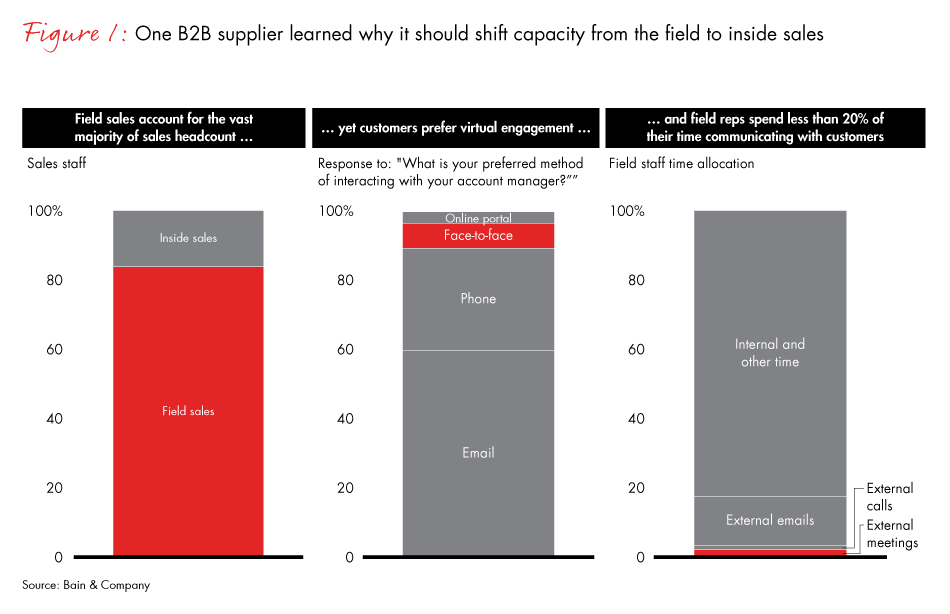
      Consider the case of a company selling basic supplies to businesses. The company had experienced lackluster sales growth, especially outside of its core product category. So it decided to examine how the sales group, which consisted of 85% field reps and 15% inside reps, spends its time.

      From customer surveys, the supplier learned that 60% of customers prefer to interact with sales reps by email, some 30% by phone, and fewer than 10% preferred in-person meetings. Field reps had naturally sensed customers' preferences, and were already communicating with customers mostly via email. Yet data from Workplace Analytics revealed that field reps spent less than one-fifth of their time with customers at all; the bulk of time was consumed on purely internal communications (see Figure 1). This raised the question: What was the point of having a field force? Based on the new time data, the company shifted to a predominantly inside sales model. Because compensation for an inside rep is roughly 55% of what a field rep receives, and an inside rep can cover more accounts, the company saved $40 million per year while also increasing coverage and time spent with customers.

      the-analytics-of-sales-time-well-spent-fig01_embed

      Alignment: Opportunities large and small


      Sales leaders would dearly like to know whether their deployment of sales capacity aligns with the most attractive opportunities in the market. Executives may worry that reps are farming exhausted fields rather than hunting rich grounds, but until recently they lacked hard data to prove it. The new digital tools can help achieve the right alignment.

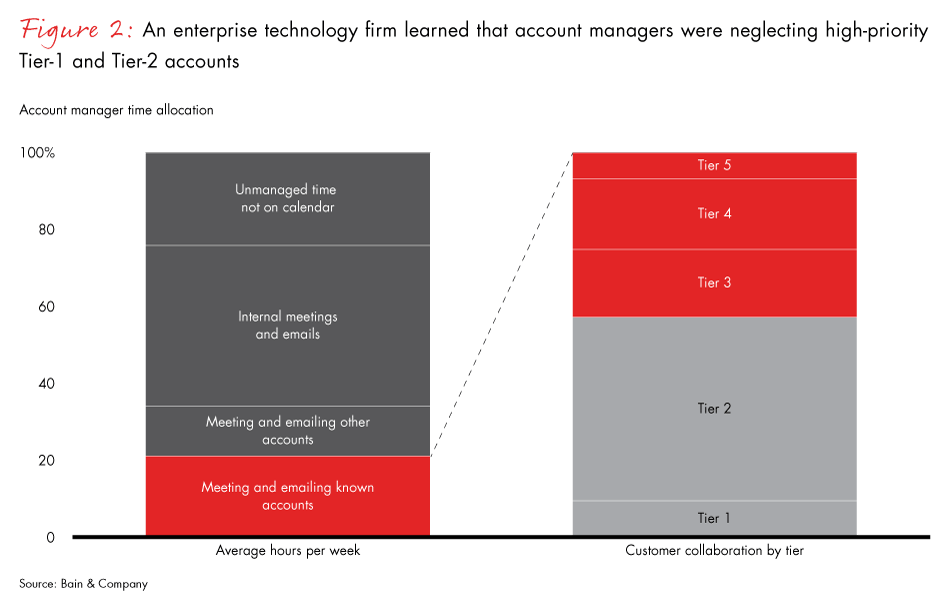
      An enterprise technology company confronted this issue after it shifted its strategy to focus on cross-selling in larger Tier-1 and Tier-2 accounts—those with the most potential spending across the company's product portfolio. The company discovered months later that account managers were still only spending one-third of their time meeting with customers, despite self-reporting a higher share of time. Worse, they were spending 40% of that customer time with accounts at Tier 3 and below (see Figure 2).

      the-analytics-of-sales-time-well-spent-fig02_embed

      With this new evidence in hand, sales leaders at the enterprise technology company were able to make the case for more dramatic changes, including reassigning about 30 account managers and 20 specialists, and adjusting the compensation scheme to pay certain reps only for sales to high-priority accounts.

      Behaviors: What top performers do differently


      Besides wrestling with coverage and alignment issues, sales leaders have always sought to understand why some of their reps consistently attain or exceed their goals, and others do not. More to the point, sales leaders struggle with how to get more reps to perform at top levels. Are sales stars born to the breed, or do they engage in specific, teachable behaviors that correlate with success? We believe the latter is true, and that sales leaders can use hard data to identify which behaviors matter most. They should, for example, be able to determine whether spending 10 hours with one buyer at a customer is more or less productive than speaking for one hour each with nine other influencers; or when to discuss Product A instead of Product B.

      One B2B supplier dealt with similar questions by combining metrics from Workplace Analytics with other sources that measured factors we hypothesized might improve sales performance, such as cross-selling new product categories. Using statistical techniques, we determined which factors explained the difference between the best performers and average ones. We also conducted traditional qualitative research such as interviews and ride-alongs to shed light on the root causes.

      We learned that top performers did a few things differently. Some were intuitive, such as spending an average of four more hours per week than other reps communicating with customers, or being 25% more likely to cross-sell other product categories. But some behavior was surprising. Top performers were:

      • Three times as likely to interact with multiple groups inside the company. They worked not only with sales specialists, but also people who could bring expertise to bear on, or expedite, the handling of a customer issue, such as staff in finance, legal, pricing or marketing. The size of a rep's internal network consistently predicted sales success.
      • Twice as likely to collaborate frequently with peer generalist reps, even though the structure of the salesforce made it unlikely that peers would ever work together on a deal.
      • 50% more likely to have weekly pipeline reviews with their direct managers.

      Given that software tools typically provide indicative metrics rather than the full scope of underlying behavior, combining quantitative insights with qualitative observations helps executives understand the root causes of performance differences. After reviewing both sets of information, the company learned:

      • The most successful reps came better prepared to their meetings with customers. Rather than showing up to a quarterly review to discuss how much the customer wanted to order, they prepared by assessing the potential needs of the customer, pulling in experts on other products that might be pitched. That allowed them to have richer conversations with customers in which they could credibly cross-sell new product lines.
      • Top sellers sought out opportunities for coaching and mentorship, whether through formal training or from their direct manager and their peers. That's why "peer time" became a predictor of sales success.
      • Best sellers often worked on teams where the frontline manager took advantage of weekly reviews to coach reps on how to advance opportunities, rather than to simply inspect their plans.

      Mark Kovac, a partner with Bain's Customer Strategy & Marketing practice, shares examples of how companies can use software to tap into calendar and email data to identify successful sales behaviors.

      The role of the coach


      We do not believe that software will ever spit out algorithms that robotically build supersellers for any market. But sales executives can begin to recognize patterns that will inform the design of an integrated program that uses sales training, frontline coaching and change management techniques to motivate reps to take the handful of actions that best correlate with higher performance. While some best practices apply to any salesforce, others vary by company and market context.

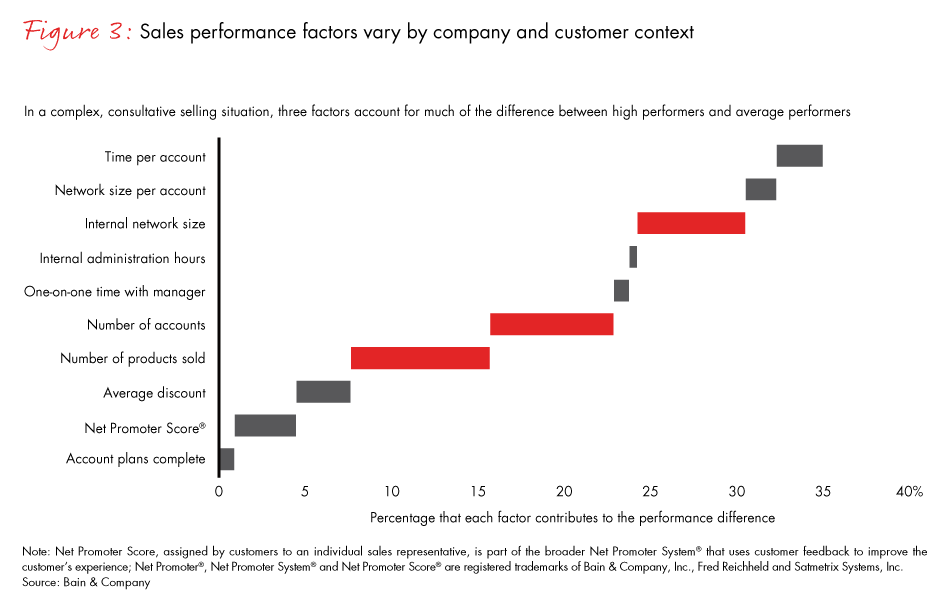
      For example, in complex, consultative selling situations—such as expensive technology products—it's important to factor in the size of the internal network and the number of products sold, because one rep rarely can successfully pitch a wide and complex portfolio (see Figure 3).

      the-analytics-of-sales-time-well-spent-fig03_embed

      Different tactics apply for companies selling a single, simple product. Successful reps in this situation typically maximize the number of customers they know, but then rigorously qualify opportunities and allocate their visits and time wisely.

      Indeed, new data derived from software is most effective when it answers specific questions about a specific problem, based on a hypothesis. Software tools should not be wielded as a hammer in search of nails. The data becomes most powerful when blended with other datasets and qualitative information. While it's interesting to learn that reps do not spend much time with Customer X, the richer insight comes from learning that Customer X has high potential value, a fact that might emerge from a customer lifetime value model.

      Moreover, insights derived from analytics will sit on the shelf if they aren't used to coach and reinforce reps' habits. Getting average performers to change their behaviors requires showing them why the change benefits both them and the company, training them in the different behaviors, providing them with the right tools, and urging supervisors to coach them. To assemble an effective account plan, for instance, a rep might need training in additional products, as well as easy access to a heuristic model that can help calculate the customer's wallet size. The rep's manager could reinforce the plan by periodically referring back to it in coaching sessions.

      The revelation of how salespeople actually spend their time paves the way to management based on facts, not myths. It makes clearer what combination of coverage, alignment and behaviors generates the best outcomes. And it gives frontline managers a specific agenda for coaching and training, all in the service of greater productivity for the entire sales team.

      Jonathan Frick is a principal in Bain's Customer Strategy & Marketing practice, and is based in San Francisco. Mark Kovac is a partner in the Customer Strategy & Marketing practice and leads the global Commercial Excellence group. He is based in Dallas.


      the-analytics-of-sales-time-well-spent-fig01_full

      the-analytics-of-sales-time-well-spent-fig02_full

      the-analytics-of-sales-time-well-spent-fig03_full
      Authors
      • Headshot of Jonathan Frick
        Jonathan Frick
        Partner, London
      • Headshot of Mark Kovac
        Mark Kovac
        Advisory Partner, Dallas
      Contact us
      Related Consulting Services
      • AI, Insights, and Solutions
      • Go-to-Market Strategy
      • Sales and Marketing
      How We Can Help
      • Go-to-Market Mobilizer
      • Sales Rep Catalyst
      Sales and Marketing
      It's 10 AM. Do You Know What Your Sales Reps Are Doing?

      New software can help executives identify which activities and behaviors matter most for sales performance.

      Read More
      Telecommunications
      Solving for the Dark Side of Metcalfe's Law

      Digital technology can help close the wide productivity gaps that plague so many modern organizations.

      Read More
      Sales Rep Catalyst
      How New Analytics Can Boost Salesforce Productivity

      New tools can analyze calendar and email metadata to help improve sales performance.

      Read More
      Sales Rep Catalyst
      Would Your Sales Reps Pay for an Hour of Their Manager’s Time?

      Frontline sales managers are the linchpin of the commercial engine, but too often, sales reps don’t get value from them. Here’s how to change that.

      Read More
      AI, Insights, and Solutions
      Better Questions, Better Sales Calls

      Top reps dig deep even when the deal doesn’t close on the first contact.

      Read More
      Published in April 2017
      Tags
      • AI, Insights, and Solutions
      • Go-to-Market Mobilizer
      • Go-to-Market Strategy
      • Sales and Marketing
      • Sales Rep Catalyst

      How We've Helped Clients

      Sales and Marketing A Manufacturer Catalyzes Growth with Sales Plays

      Read case study

      Go-to-Market Strategy A Logistics Company Transforms Its Salesforce and Account Planning Processes

      Read case study

      Sales and Marketing Sales blueprint puts IT Services Co.'s growth back on track

      Read case study

      Ready to talk?

      We work with ambitious leaders who want to define the future, not hide from it. Together, we achieve extraordinary outcomes.

      Stay ahead in a rapidly changing world. Subscribe to Bain Insights, our monthly look at the critical issues facing global businesses.

      *I have read and understand Bain’s Privacy Notice.

      Please read and agree to the Privacy Policy.
      Bain & Company
      Contact us Sustainability Accessibility Terms of use Privacy Modern Slavery Act Statement Cookie Policy Sitemap Log In

      © 1996-2026 Bain & Company, Inc.

      Contact Bain

      How can we help you?

      • Business inquiry
      • Career information
      • Press relations
      • Partnership request
      • Speaker request
      See all offices