
Skip to Content
  • Offices

    Offices

    North & Latin America
    • Atlanta
    • Austin
    • Bogota
    • Boston
    • Buenos Aires
    • Chicago
    • Dallas
    • Denver
    • Houston
    • Los Angeles
    • Mexico City
    • Minneapolis
    • Monterrey
    • Montreal
    • New York
    • Rio de Janeiro
    • San Francisco
    • Santiago
    • São Paulo
    • Seattle
    • Silicon Valley
    • Toronto
    • Washington, DC
    Europe & Africa
    • Amsterdam
    • Athens
    • Berlin
    • Brussels
    • Copenhagen
    • Dusseldorf
    • Frankfurt
    • Helsinki
    • Istanbul
    • Johannesburg
    • Kyiv
    • Lisbon
    • London
    • Madrid
    • Milan
    • Munich
    • Oslo
    • Paris
    • Rome
    • Stockholm
    • Vienna
    • Warsaw
    • Zurich
    Middle East
    • Doha
    • Dubai
    • Riyadh
    Asia & Australia
    • Bangkok
    • Beijing
    • Bengaluru
    • Brisbane
    • Ho Chi Minh City
    • Hong Kong
    • Jakarta
    • Kuala Lumpur
    • Manila
    • Melbourne
    • Mumbai
    • New Delhi
    • Perth
    • Seoul
    • Shanghai
    • Singapore
    • Sydney
    • Tokyo
    See all offices
  • Alumni
  • Media Center
  • Subscribe
  • Contact
  • Global | English

    Select your region and language

    Global
    • Global (English)
    North & Latin America
    • Brazil (Português)
    • Argentina (Español)
    • Canada (Français)
    • Chile (Español)
    • Colombia (Español)
    Europe, Middle East, & Africa
    • France (Français)
    • DACH Region (Deutsch)
    • Italy (Italiano)
    • Spain (Español)
    • Greece (Elliniká)
    Asia & Australia
    • China (中文版)
    • Korea (한국어)
    • Japan (日本語)
  • Saved items (0)
    Saved items (0)

    You have no saved items.

    Bookmark content that interests you and it will be saved here for you to read or share later.

    Explore Bain Insights
  • Industries
    Main menu

    Industries

    • Aerospace & Defense
    • Agribusiness
    • Chemicals
    • Construction & Infrastructure
    • Consumer Products
    • Financial Services
    • Healthcare & Life Sciences
    • Industrial Machinery & Equipment
    • Media & Entertainment
      Industries
      Media & Entertainment
      • Media Lab
    • Metals
    • Mining
    • Oil & Gas
    • Paper & Packaging
    • Private Equity
      Industries
      Private Equity
      • Due Diligence
      • Exit Planning
      • Firm Strategy & Operations
      • Portfolio Value Creation
    • Social Impact
    • Retail
    • Technology
    • Telecommunications
      Industries
      Telecommunications
      • Capital Expenditure
      • Telco Digital Transformation
    • Transportation
    • Travel & Leisure
    • Utilities & Renewables
  • Consulting Services
    Main menu

    Consulting Services

    • Customer Experience
    • Sustainability
    • Innovation
    • M&A
    • Operations
    • People & Organization
    • Private Equity
    • Sales & Marketing
    • Strategy
    • AI, Insights, and Solutions
    • Technology
    • Transformation
  • Digital
  • Insights
    Main menu

    Insights

    • Industry Insights
    • Services Insights
    • Bain Books
    • Webinars
    • Bain Futures
    View all Insights
    Featured topics
    • Tariff Response
    • Artificial Intelligence
    • Thriving in Uncertainty
    • Executive Conversations
    • Macro Trends
    • Private Equity Report
    • M&A Report
    • Healthcare Private Equity Report
    • Paper & Packaging Report
    • Technology Report
    • CEO Insights
    • CFO Insights
    • COO Insights
    • CIO Insights
    • CMO Insights
    View all featured topics
  • About
    Main menu

    About

    • What We Do
    • What We Believe
    • Our People & Leadership
    • Client Results
    • Awards & Recognition
    • Global Affiliations
    Further: Our global responsibility
    • Sustainability
    • Social Impact
    • World Economic Forum
    Learn more about Further
  • Careers
    Main menu

    Careers

    • Work with Us
      Careers
      Work with Us
      • Find Your Place
      • Our Work Areas
      • Integrated Teams
      • Students
      • Internships & Programs
      • Recruiting Events
    • Life at Bain
      Careers
      Life at Bain
      • Blog: Inside Bain
      • Career Stories
      • Our People
      • Where We Work
      • Supporting Your Growth
      • Affinity Groups
      • Benefits
    • Impact Stories
    • Hiring Process
      Careers
      Hiring Process
      • What to Expect
      • Interviewing
    FIND JOBS
  • Offices
    Main menu

    Offices

    • North & Latin America
      Offices
      North & Latin America
      • Atlanta
      • Austin
      • Bogota
      • Boston
      • Buenos Aires
      • Chicago
      • Dallas
      • Denver
      • Houston
      • Los Angeles
      • Mexico City
      • Minneapolis
      • Monterrey
      • Montreal
      • New York
      • Rio de Janeiro
      • San Francisco
      • Santiago
      • São Paulo
      • Seattle
      • Silicon Valley
      • Toronto
      • Washington, DC
    • Europe & Africa
      Offices
      Europe & Africa
      • Amsterdam
      • Athens
      • Berlin
      • Brussels
      • Copenhagen
      • Dusseldorf
      • Frankfurt
      • Helsinki
      • Istanbul
      • Johannesburg
      • Kyiv
      • Lisbon
      • London
      • Madrid
      • Milan
      • Munich
      • Oslo
      • Paris
      • Rome
      • Stockholm
      • Vienna
      • Warsaw
      • Zurich
    • Middle East
      Offices
      Middle East
      • Doha
      • Dubai
      • Riyadh
    • Asia & Australia
      Offices
      Asia & Australia
      • Bangkok
      • Beijing
      • Bengaluru
      • Brisbane
      • Ho Chi Minh City
      • Hong Kong
      • Jakarta
      • Kuala Lumpur
      • Manila
      • Melbourne
      • Mumbai
      • New Delhi
      • Perth
      • Seoul
      • Shanghai
      • Singapore
      • Sydney
      • Tokyo
    See all offices
  • Alumni
  • Media Center
  • Subscribe
  • Contact
  • Global | English
    Main menu

    Select your region and language

    • Global
      Select your region and language
      Global
      • Global (English)
    • North & Latin America
      Select your region and language
      North & Latin America
      • Brazil (Português)
      • Argentina (Español)
      • Canada (Français)
      • Chile (Español)
      • Colombia (Español)
    • Europe, Middle East, & Africa
      Select your region and language
      Europe, Middle East, & Africa
      • France (Français)
      • DACH Region (Deutsch)
      • Italy (Italiano)
      • Spain (Español)
      • Greece (Elliniká)
    • Asia & Australia
      Select your region and language
      Asia & Australia
      • China (中文版)
      • Korea (한국어)
      • Japan (日本語)
  • Saved items  (0)
    Main menu
    Saved items (0)

    You have no saved items.

    Bookmark content that interests you and it will be saved here for you to read or share later.

    Explore Bain Insights
  • Industries
    • Industries

      • Aerospace & Defense
      • Agribusiness
      • Chemicals
      • Construction & Infrastructure
      • Consumer Products
      • Financial Services
      • Healthcare & Life Sciences
      • Industrial Machinery & Equipment
      • Media & Entertainment
      • Metals
      • Mining
      • Oil & Gas
      • Paper & Packaging
      • Private Equity
      • Social Impact
      • Retail
      • Technology
      • Telecommunications
      • Transportation
      • Travel & Leisure
      • Utilities & Renewables
  • Consulting Services
    • Consulting Services

      • Customer Experience
      • Sustainability
      • Innovation
      • M&A
      • Operations
      • People & Organization
      • Private Equity
      • Sales & Marketing
      • Strategy
      • AI, Insights, and Solutions
      • Technology
      • Transformation
  • Digital
  • Insights
    • Insights

      • Industry Insights
      • Services Insights
      • Bain Books
      • Webinars
      • Bain Futures
      View all Insights
      Featured topics
      • Tariff Response
      • Artificial Intelligence
      • Thriving in Uncertainty
      • Executive Conversations
      • Macro Trends
      • Private Equity Report
      • M&A Report
      • Healthcare Private Equity Report
      • Paper & Packaging Report
      • Technology Report
      • CEO Insights
      • CFO Insights
      • COO Insights
      • CIO Insights
      • CMO Insights
      View all featured topics
  • About
    • About

      • What We Do
      • What We Believe
      • Our People & Leadership
      • Client Results
      • Awards & Recognition
      • Global Affiliations
      Further: Our global responsibility
      • Sustainability
      • Social Impact
      • World Economic Forum
      Learn more about Further
  • Careers
    Popular Searches
    • Agile
    • Digital
    • Strategy
    Your Previous Searches
      Recently Visited Pages

      Content added to saved items

      Saved items (0)

      Removed from saved items

      Saved items (0)

      Brief

      What Does It Really Take for Grocers to Win in Emerging Asia?

      What Does It Really Take for Grocers to Win in Emerging Asia?

      The moves that brought a retail company success in the past—very often in a different region—can’t necessarily be repeated in Asia.

      By Serge Hoffmann, Nikhil Ojha, Nader Elkhweet and Mike Booker

      • min read

      Brief

      What Does It Really Take for Grocers to Win in Emerging Asia?
      en

      These would seem like the best of times for the grocery business in emerging Asia.

      Home to about 44% of the world’s population, Asia’s emerging markets boast macro trends that would delight any retailer: healthy GDP growth, a rapidly rising middle class with increasing disposable income and populations that are steadily moving into cities, where the economics of distribution favor modern trade. By Bain & Company analysis, 30% of the world’s retail growth through 2017 will come from Asia’s emerging markets.

      But if the growth is strong and prospects are bright, why do some companies pull ahead while others follow distantly or fail? India’s Big Bazaar grew to $2.1 billion and earned 6% margins in 2012. China’s RT-Mart nearly tripled its revenues from 2007 to 2011, and Indonesia’s Hero Supermarket watched its revenue growth significantly outpace the total market during those years. However, in the same retailing environment, some of their multinational competitors lost share.

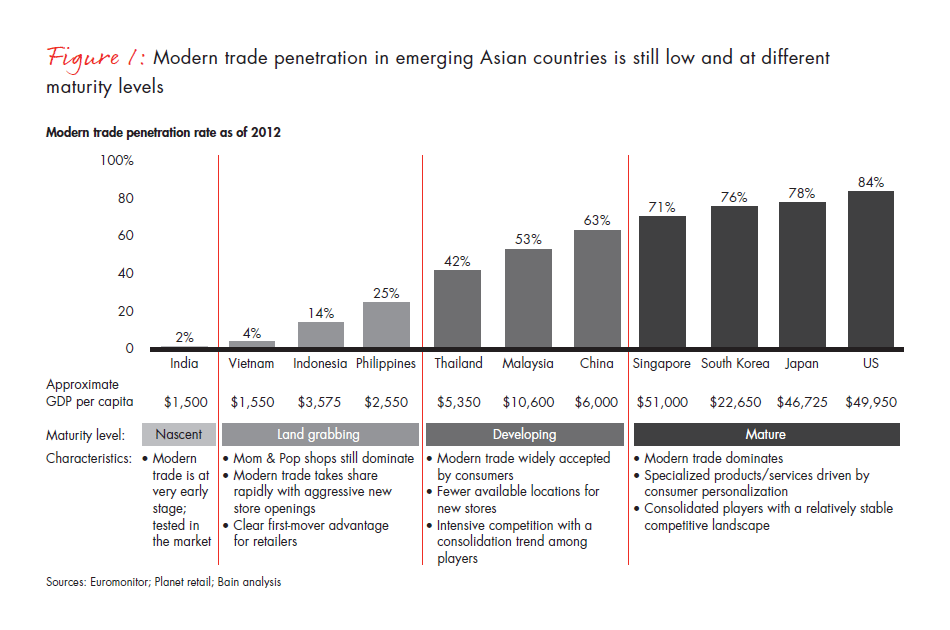
      Despite the dazzling macro trends that make emerging Asia so attractive to grocery retailers, there are a host of obstacles that also make this region a tricky one. In addition to dealing with intensified competition and a fragmented environment, retailers find they need to adapt their strategies to vastly different countries in varying stages of development—consider that modern trade generated $383 billion in China but only $5 billion in India in 2012 (see Figure 1).

      what-does-it-really-take-for-grocers-to-win-fig-01_embed

      Grocery retailers also must grapple with each country’s specific challenges. That means finding ways to win despite India’s poorly developed infrastructure, China’s massive urban traffic problems and Indonesia’s regulatory and protectionist measures. For example, in Indonesia, modern retailers can’t be located near existing traditional markets and 80% of the products carried by franchises are required to have “local content”—determined by raw materials used and the production location.

      In such a diverse and competitive landscape, it’s not always possible to grab share by repeating a standard or imported formula. Companies need to make critical adjustments. Consider what happened when Carrefour and Metro entered China. Both companies faced strong local competition and had to tailor their global product assortment.

      How to win? We extensively researched grocery retailing in Asia and identified nine rules for success as well as three country-specific considerations. History’s lesson is clear: Companies that follow these rules will propel ahead of their rivals, while companies that violate them will end up as casualties. 

      Rules for winning in emerging Asia

      From our research on the early winners in emerging Asia’s grocery race, we've identified nine rules for success:

      1. Local relative market share delivers higher sales and lower costs
      2. Trade areas with large income base and low competition contribute to higher sales
      3. Only a cost-effective concept will scale profitably
      4. An early omnichannel strategy reinforces overall competitiveness
      5. A locally relevant offer and emphasis on fresh food—with optimal procurement—will increase traffic and consumer spending
      6. Low-price perception (frequent consumer promotions or low shelf price) contributes to growth and share gain
      7. Superior store accessibility can raise customer counts
      8. Ability to find and lock the right real estate with reasonable price determines speed of expansion and potential sales
      9. Retention of great frontline managers (such as store managers and buyers) can raise sales

      In addition to these nine overarching rules, we've identified three country-specific considerations that contribute to success for grocery retailers in emerging Asia:

      1. Choose a store format based on a country's population concentration, transportation infrastructure and regulations
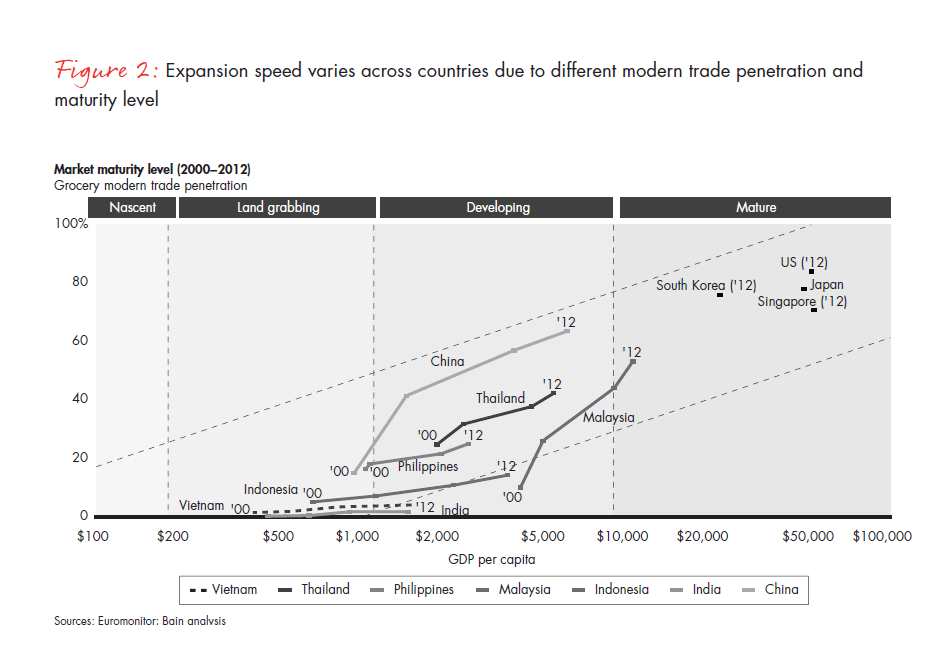
      2. Grow at a speed determined by modern trade penetration, market maturity and the level of saturation (see Figure 2)
      3. Find your expansion ceiling by considering the degree of urbanization, available talent, supply chain development and regulatory limits

      what-does-it-really-take-for-grocers-to-win-fig-02_embed

      Here’s how five of those rules were successfully applied in emerging Asia:

      Build successive local footprints focusing on local share. There’s abundant opportunity to grow in emerging Asia, but not everybody is taking the right path. The most successful companies find that nothing beats local relative market share. Growing by sequential geographic cluster allows a company to maintain a low-cost model, which in turn enables it to expand profitably. Among the reasons that Mumbai-based D-Mart is outpacing its rivals with 56% growth: Unlike those competitors, which opened stores throughout India, D-Mart focused its expansion efforts in western India. D-Mart’s strict regional approach to expansion helped the grocer control distribution costs. And D-Mart rigorously keeps costs low in other ways, too. It opts to own stores in densely populated areas, as opposed to paying high rents in shopping malls, and maintains no-frills interiors. The retailer uses the savings to fuel steady expansion and also can offer prices that are 6% to 7% lower than competitors. Its high local relative market share has delivered sales per store that are far above rivals.

      Learn omnichannel before your competitors do. Grocers in every corner of the world are striving to figure out how to make inroads into online grocery. China is quickly gaining ground. There, it’s estimated that 7% of grocery sales will be conducted online by 2020—much higher than the projected 4% rate in the US or 4.4% rate in Japan. Local Chinese e-commerce website Yihaodian grew revenues 27% in 2012, in a market where the prospects for online grocery are huge. Yihaodian has used its dedicated digital team to quickly learn what works and what doesn’t in everything from fulfillment to online merchandising to social media. A digital presence is key to the customer value proposition and successful early movers are getting ahead and consolidating their lead.

      Make fresh food and locally relevant products priorities. Walk into a Hero supermarket anywhere in Indonesia, and you’re overwhelmed by fresh food. The grocer’s tagline “the fresh food people” reflects an unwavering focus that delivers what customers ask for, and at the same time, it differentiates the retailer from competitors. Hero’s procurement initiatives are aimed at making fresh food a priority in its stores. For example, the company maintains strict quality control with detailed product specifications for all fresh food and encourages local farmers to be quality conscious through such incentives as the “Local Fresh Farmer of the Year” award. Hero has demonstrated that a focus on fresh foods doesn’t need to be expensive, and keeping costs low can help it maintain the fresh food emphasis. Hero controls distribution costs by maintaining a centralized and high-tech 20,000- square-meter distribution center near Jakarta. To further reduce costs, the company transfers stock of certain items among stores in

      close proximity—as opposed to distribution centers—to prevent out-of-stocks and expensive replenishment costs. The retailer is increasing its mix of smaller, cost-efficient supermarket formats to lower its initial investment and operational costs. As a result, Hero’s operating margin was 5% in 2011, double that in 2008, while its overhead expenses have dropped. The company’s revenue grew 34% from 2007 to 2012.

      Establish a low-price perception through frequent promotions and low shelf prices. In addition to showing a preference for fresh food, consumers in emerging Asia also tend to be highly price sensitive. That’s why a low-price perception is so important for grocers looking to build share. Grocers gain this distinction through such efforts as ongoing and frequent consumer promotions, or reducing average shelf price by boosting the number of private-label SKUs on the shelves. Look at how successful Big C, a wholly owned subsidiary of France’s Groupe Casino, has been in Southeast Asia. In Vietnam, the company relentlessly negotiates with manufacturers and uses its scale to sell products at 5% to 10% less than the printed price on packaging, often offering promotion discounts of up to 35%. Big C is the undisputed market leader in Vietnam, dominating the hypermarket format and growing at an annual 44% between 2007 and 2011. In Thailand, Big C uses private labels to strengthen its low-price perception. Private label’s contribution to Big C’s overall sales in Thailand nearly doubled between 2009 and 2010.

      Win the war for talent, especially on the front line. In industry after industry, surveys repeatedly reveal the same nagging fact: Talent is the No. 1 challenge for companies pursuing growth in emerging Asia. For retailers, the region suffers from a shortage of great store managers, buyers and other frontline talent that can keep a store running smoothly. “Finding large numbers of people experienced in grocery retail is impossible in China,” admits the chief executive of a major European retailer’s China operation. “You can find educated and motivated people, but you have to invest a lot to train and retain them.”

      In this short video, Mike Booker, practice leader for Bain's Consumer Products and Retail practices in the Asia-Pacific region, describes the three challenges that companies will face in fast-growing markets.

      Demand for retail workers more than doubled in the past year in Vietnam, but the labor force couldn’t keep up. Among the problems: Retail management is still a new profession in the country, and there is a lack of formal training. That’s why any company with a new idea for finding, developing and retaining talent has an edge over rivals. Vietnam’s Big C is one such innovator. The grocer has partnered with more than 30 training and educational institutions, domestic and overseas, with hundreds of training programs. For example, it collaborates with Hoa Sen University, Mahidol University and the French–Vietnamese Center for Management Education on a series of programs to educate young people for careers in grocery retail management, offering scholarships and jobs to promising students.

      The grocery retail market in emerging Asia is expected to be larger than those in Western Europe and North America by 2017. Lured by the vast potential, multinationals and local companies find themselves competing equally aggressively. Now, as the winners start to emerge, so does a critical lesson: The moves that brought a company success in the past—very often in a different region—can’t simply be repeated here.

      Ambitious multinationals with track records of success elsewhere don’t necessarily have a right to win. And the same can be said for domestic companies; while they may have an edge when it comes to understanding local consumers and maintaining a low-cost model, they need to learn how to scale effectively.

      But by sticking to these nine rules, retailers dramatically improve their odds of success.

      Serge Hoffmann is a Bain & Company partner based in Hong Kong, Nikhil Ojha is a partner based in New Delhi, Nader Elkhweet is a partner based in Jakarta and Mike Booker, a partner in Singapore, heads Bain’s Consumer Products and Retail practices in Asia-Pacific.


      what-does-it-really-take-for-grocers-to-win-fig-01_full

      what-does-it-really-take-for-grocers-to-win-fig-02_full
      Authors
      • Serge Hoffmann
        Former Partner, Munich
      • Headshot of Nikhil Prasad Ojha
        Nikhil Prasad Ojha
        Partner, Mumbai
      • Headshot of Nader Elkhweet
        Nader Elkhweet
        Partner, Milan
      • Headshot of Mike Booker
        Mike Booker
        Advisory Partner, Singapore
      Contact us
      Related Industries
      • Retail
      Retail
      China's e-commerce prize

      On a single day last November, more people logged on to China’s most popular e-commerce site than the entire population of Brazil.

      Read More
      Consumer Products
      Growing brands by understanding what Chinese shoppers really do

      The days of growing a brand just by riding a category wave are coming to an end, especially in top-tier cities. As in more mature markets, brand growth in China will need to come from share gains.

      Read More
      Consumer Products
      Brands versus private labels: Fighting to win

      How real is the private-label threat to branded products and what should national-brand manufacturers do about it?

      Read More
      Retail
      US Consumer Health Update

      Consumers at every income level entered the year on weaker footing, with the downside risks continuing to grow.

      Read More
      Retail
      Stay Relevant, Spark Energy: Pedro Arnt, CEO dLocal

      How can a hyperscaler grow at lightning speed without losing its soul? 

      Read More
      Published in February 2014
      Tags
      • Retail

      How We've Helped Clients

      Sales and Marketing Inspiring retail employees to think and act like owners

      Read case study

      Performance Improvement Retailer's performance improvement boosts shareholder value

      Read case study

      Digital Omnichannel strategy boosts fashion company

      Read case study

      Ready to talk?

      We work with ambitious leaders who want to define the future, not hide from it. Together, we achieve extraordinary outcomes.

      Stay ahead in a rapidly changing world. Subscribe to Bain Insights, our monthly look at the critical issues facing global businesses.

      *I have read and understand Bain’s Privacy Notice.

      Please read and agree to the Privacy Policy.
      Bain & Company
      Contact us Sustainability Accessibility Terms of use Privacy Modern Slavery Act Statement Cookie Policy Sitemap Log In

      © 1996-2026 Bain & Company, Inc.

      Contact Bain

      How can we help you?

      • Business inquiry
      • Career information
      • Press relations
      • Partnership request
      • Speaker request
      See all offices