

Article

한눈에 보기
- Setting the right price for a new innovation is not easy, but the bottom-line benefits make the effort well worthwhile.
- By following this proven framework your company can systematically address the strategic, segmentation, discounting, communication and other elements that should be factored in to this critical decision.
- To maximize the value, build this approach into your overall launch strategy.
We often see companies spend years developing innovations, but only a few hours pricing them. There are many reasons for such an inadequate approach; one of the biggest is discomfort with value pricing. But companies can systematically overcome this reluctance and arrive at an effective value-pricing strategy for innovation by following a six-step model we’ve developed, based on our deep experience in helping companies launch and successfully price a variety of innovations.
The bottom-line impact of a successful value pricing approach is significant: it can increase cumulative launch margins by at least double digits, compared with a conventional pricing approach.
Companies across many industries are already reaping the value of this breakthrough approach
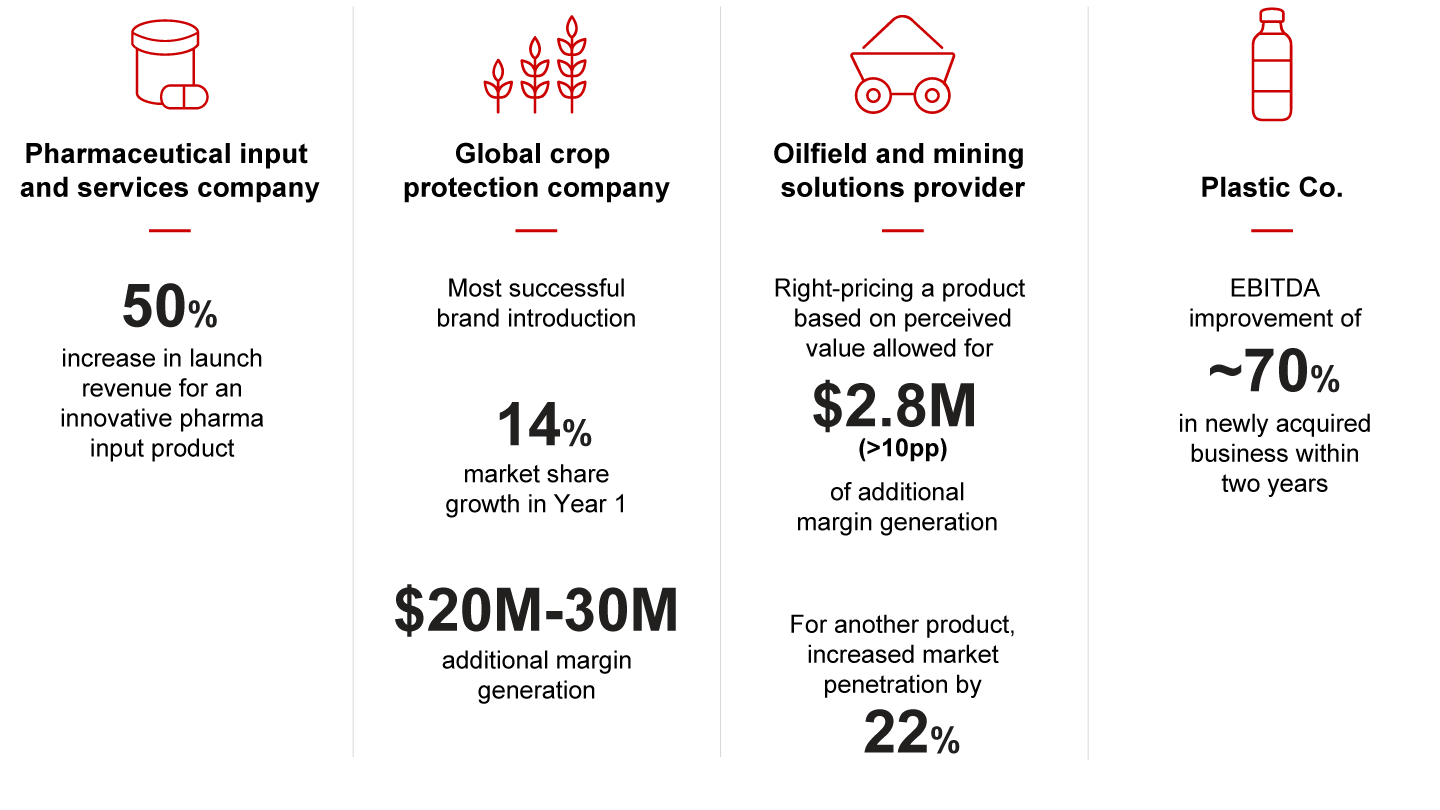

Organizations that price their innovations well do three things:
- Develop a deep understanding of the value their solutions provide to all customer segments
- Get their commercial teams fully prepared and excited about the value their solution delivers
- Create effective communications, tailored for each segment, to help customers fully appreciate the value of the innovation
Using our six-step framework, clients have developed the organizational muscle for successful value pricing and have realized the full pricing potential of their innovations.
This framework ensures that you price innovations appropriately and achieve all your strategic goals
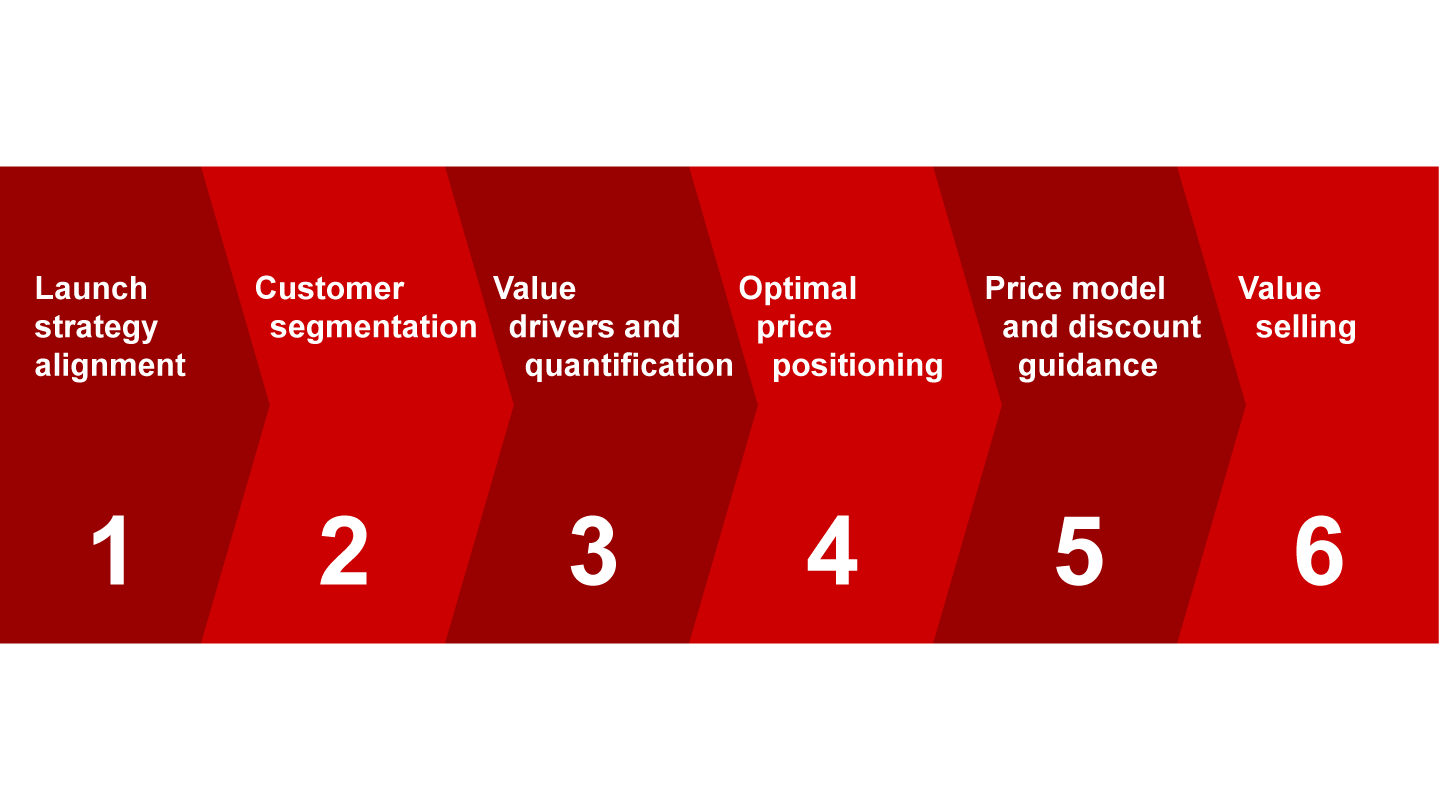

Step 1: Strategy alignment
A critical first step is to align the pricing strategy with the overall launch strategy. What’s the launch expected to achieve? Maximize margin? Gain share? Create portfolio pull-through (a halo effect)? Improve the customer experience? Increase capacity utilization?
Defining the launch objective(s) will determine whether or not value pricing is the right approach. That decision is informed by the following:
Degree of differentiation. How differentiated is your solution compared with alternatives available in the market? The value-pricing approach yields better results when applied to less commoditized and more differentiated solutions.
Ease of communication. How easily can customers understand the benefits and value of your solution? Products and solutions requiring complex sales messages across multiple stakeholders will require additional training and capabilities to make value selling succeed.
Organizational readiness. How ready is the commercial team to shift from its traditional selling model to value selling? How committed is the leadership to fostering the necessary changes in mindset and skill set? Your organization’s confidence in, and ability to execute, a value-selling approach builds over time, which mandates strong commitment from the leadership team.
Step 2: Customer segmentation
Different customer segments will perceive the value of your innovation in different ways. Understanding which benefits matter the most for which segment―and by how much―is critical to successful value pricing.
For example, we worked with an agricultural products company that was launching an innovative herbicide that promised significant increases in crop yields. A segmentation exercise conducted as part of the pricing strategy revealed that certain high-value crops could disproportionately command higher prices. Besides higher crop yield, the herbicide could also improve the produce's quality grade ranking, allowing farmers to charge a premium. Understanding how one customer segment could achieve an added benefit allowed the company to create a more effective pricing strategy and value-communication campaign.
Step 3: Value drivers and quantification
You must understand how your innovation maps to the value drivers for each customer segment. This can be challenging, but leading organizations do the following successfully:
- Understand the economics of your customers' businesses better than your competitors do
- Collect robust performance benchmark data on competitive offerings
- Be comfortable with "good-enough" assumptions while calculating the value to customers
- Enlist champions from different cross-functional areas (marketing, product management, sales, technical services, customer care, and procurement) to validate assumptions and calculations of value drivers
- Continuously improve value assumptions and calculations based on market feedback
Your approach to value modeling should address three components.
-
Define the most applicable competitive alternative to your innovation and benchmark data against that alternative.
To help you decide the best competitive alternative, you can ask, “What’s the reference in customers' minds when evaluating new solutions?”
-
List tangible and intangible value drivers and prioritize them based on what matters most to your customers.
Drivers can include positive and negative differentiators. Always ask, "What is the incremental financial or psychological value derived by customers using our solution over the competitive alternative?" Be exhaustive in listing the drivers, but prioritize them based on the degree of differentiation and relative importance to the customers.
-
Quantify value for high-priority tangible drivers.
Different analyses are required to calculate value drivers. An increase in customer revenue results from higher market share or higher sales price, both of which require downstream value chain analysis. A comprehensive approach to identifying and calculating both positive and negative value drivers allows for better sales communication with customers.
It’s worth noting that a common misconception is that you have to calculate all the drivers. We recommend starting with high-priority value drivers and a reasonable set of assumptions, knowing that you will get better over time. Intangible drivers are difficult to calculate, but we still recommend using them in value communication (to show customers that the total differential value they’re receiving is much higher than the quantifiable calculation indicates).
Step 4: Optimal price positioning
Once the value created by the solution is calculated, the biggest question will be how much of this perceived value should be retained in the price? Optimal price positioning should be determined by multiple factors, including the customer and competitive landscape, your overall strategy and your cost structure.
Price positioning can differ for products and segments to reflect a targeted strategy. For one company we worked with, two distinct customer segments had very different value derived from the same product. One segment was also much more price-sensitive than the other. So, we carefully designed the product offer and pricing structure to optimize price-to-value ratio and adoption across both segments.
Three screens can help decide the optimal price-to-value ratio.
Customer segment. What portion of the value will be retained by a customer or a segment? We recommend the following factors to help guide value split:
- Switching hurdle. How much investment is required (time, resources, regulatory hurdles, etc.) for customers to switch and qualify new material? If the switching hurdle is higher, the customer retains more value.
- Degree of risk in realizing potential value. If the risks of value realization are higher, the customer retains more value.
- Ease of communication. How easily can customers understand the value?
- The magnitude of marginal value. Is the innovation an incremental change over the competitive alternative, rather than a breakthrough or step change?
- The strategic importance of the customer or the segment. Should the innovation launch be used as a strategic investment opportunity for a customer or a segment?
Fairness perception. Would premium pricing be perceived as unfair or unethical with customers or stakeholders? (This factor is often ignored while setting a price, but can be the difference between success and failure.)
Product portfolio. How does the price of this launch impact future launches or existing products in your portfolio? No product launch should be considered in a silo; the price-to-value ratio also depends on your overall portfolio strategy.
Competition. How might your competitors react to a new product launch? We recommend comprehensive war-gaming exercises to anticipate their reactions. Your ability to capture the price for your offering also depends on competitors' moves after launch. The aforementioned agribusiness that had developed an innovative herbicide anticipated that one of its competitors would launch a low-price product in response. So the company worked with its distributors and customers (retailers and farmers) on programs that guaranteed performance and communicated the superior economic value of its new premium product.
Step 5: Price model and discount guidance
Setting the right price model and discount guidance allows you to maximize value capture and minimize margin leakage. Innovative models enable you to capture differentiated value across different segments.
Price guidance can include variations based on geography, segment and sales channel, and several differentiating dimensions, including package sizes, annual purchase volume or order quantities, multiple portfolio purchases, and more.
There are some key considerations for pricing structure and discounting guidelines.
- Discounts must have specific intent. Apply discounts in a targeted way to address specific customer concerns.
- Fencing criteria must be simple. Discount criteria should be easy to interpret and apply, reducing the risk of value leakage.
- Discounts don’t stack. Customers cannot apply multiple discounts to a single order, regardless of eligibility.
- Leadership must oversee large discounts. Senior leadership must approve discounts with significant revenue impact and set approval policies and processes to balance speed and oversight.
Step 6: Value communication and value selling
Many value-pricing efforts fail at this step because not enough emphasis is placed on perfecting value communication and preparing the organization for effective value selling. Companies that excel on this step do these things well.
Involve sales champions from the very beginning of the value-pricing exercise. Sales teams play a critical role in the success or failure of a new launch, but many organizations don’t include them until it’s too late. Identify sales champions ahead of time and have them contribute throughout the process. They should then take active ownership of influencing and training the sales organization in value selling.
Create strong internal and external communication materials. As you build the commercial team’s confidence in value messaging and pricing, it’s equally important to communicate externally to customers. Internal communication should align with cultural values, provide details and proof points on the product's value drivers, and include market intelligence. External messaging should clearly articulate the new solution’s differentiated benefits and the value these benefits bring to customers. It should generate enough awareness and excitement to spark customer-specific conversations.
Tailor value messaging for specific customers and segments. What each customer values will vary significantly from one to another, so you need to create customer-specific value propositions. Bear in mind that even within a given customer organization different stakeholders may have different priorities. Successful value communication targets the right value messages to the right stakeholders.
Enable sales with value-selling training and incentives designed to drive desired behavior. Value-selling capabilities require systematic investments in training and preparation. Initial efforts will require a certain level of handholding for the sales organization, and establishing proper incentives and metrics. We address this need with a variety of tools and training programs to help you position your teams for maximum pricing success.
Your company works hard and invests significant resources to develop successful innovations. Following this six-step framework to set the right price can help achieve the full profit potential of your launch strategy.