

Brief

한눈에 보기
- As inflation and other disruptions create uncertainty, corporate decision makers are working on mitigation plans.
- Now is the time to act. Our research shows a sharp divergence in performance between winners and losers both during and after disruptions.
- The best companies elevate the role of the chief financial officer, improve the customer experience, develop more sophisticated pricing models, build resilient operations, zero-base work and automate, and invest to create the best workplace.
The record-setting inflation that is escalating with spiking commodity prices and deepening supply shortages is only one dimension of the turbulence that is troubling corporate decision makers. Many are preparing for the chain of events that will follow—namely, consumers cutting back on nonessentials and showing increased price sensitivity as pressure mounts on central banks to raise interest rates, leading to a recession taking hold. This comes on top of a growing list of challenges, such as geopolitical realignment and the loss of assets because of the Russia-Ukraine conflict as well as continued supply chain constraints and gyrations in the financial markets, to name a few.
Amid mounting costs and a future that seems increasingly unpredictable, companies face risks everywhere they look. Rising costs combined with customers trading down pose a risk to margins. Customers and suppliers renegotiating terms pose a risk to cash flow. Increasing prices or stock-outs can lead to a decline in customer loyalty, posing a risk to top-line growth. Higher interest rates impact the cost of capital and make it more expensive to refinance debt.
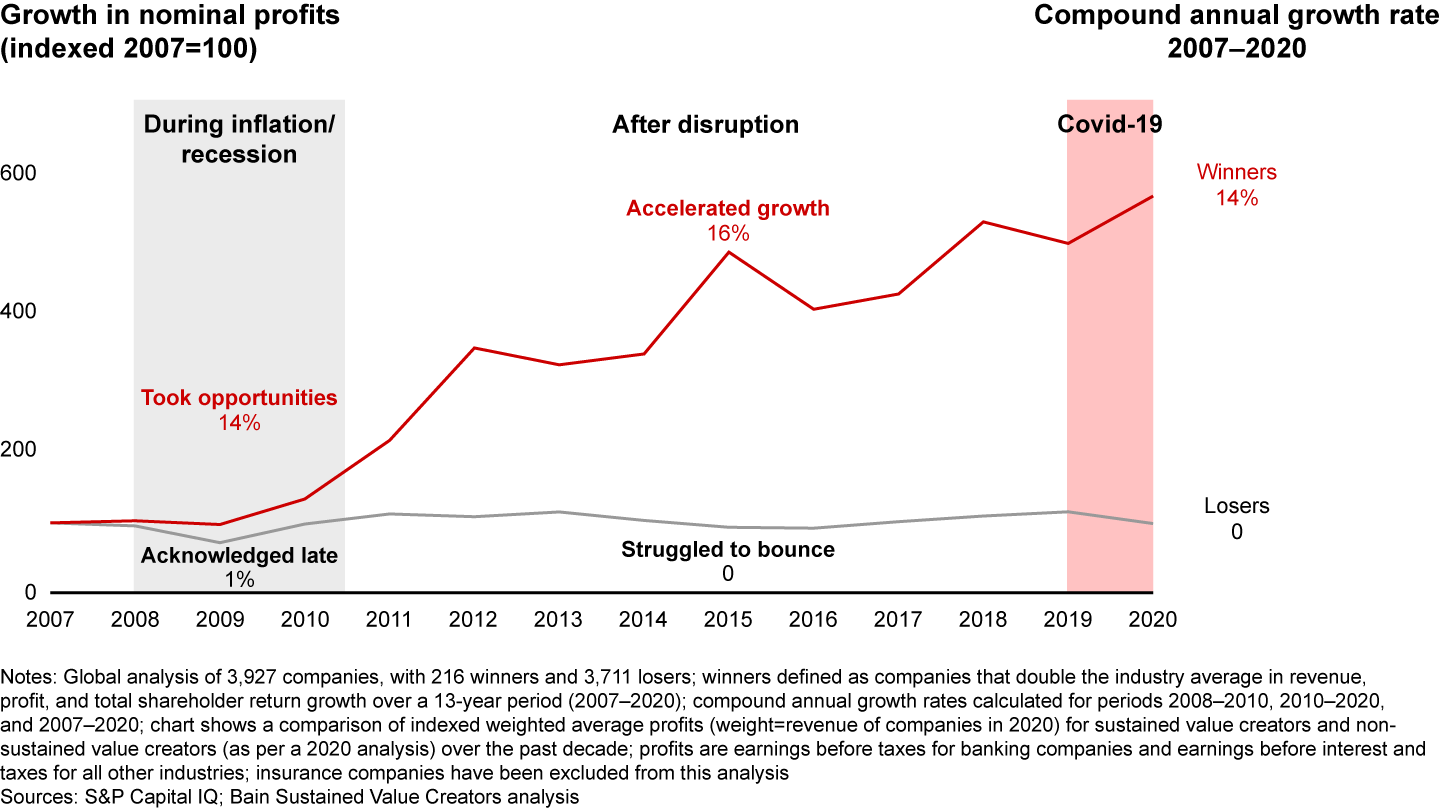
The best companies are feverishly working to get out ahead of these risks with an inflation and disruption mitigation plan. They’re thinking through a range of possible actions to respond and reposition themselves. History tells us that now is the time to act. Over the years beginning with 2008’s inflation and the recession that followed, our research of 3,900 companies globally showed a sharp divergence in performance between winners and losers both during and after disruptions (see Figure 1).
Figure 1

We see six essential strategies that every CEO should consider.
Expand the CFO role to C-Suite orchestrator
In any organization, the chief financial officer (CFO) now needs to work overtime to create high-resolution visibility on spending and critical areas for disruption response, such as the linkage between input costs and pricing decisions during inflation. Cash visibility and management are more important than ever given the competing forces of rising costs, tightening liquidity, and the need to invest in making the business more resilient against future disruptions. Business leaders will also want to track real gains in volume, revenue, and share to understand the true performance of the business without inflation noise.
Effective CFOs are heavily involved in driving scenario planning to understand the impact of different disruption scenarios and to strategize around uncertainty. It’s not about predicting the future; it’s about envisioning alternative futures and articulating the decisions you would need to make. This means developing a robust set of future scenarios that factor in the most critical uncertainties and then understanding the impact of each scenario on the future cost structure and margin profile—for example, how de-globalization results in import tariffs and restricted supply sources. Scenario planning also involves developing signposts and triggers to monitor emerging scenarios and having ready-to-follow playbooks when those triggers hit, allowing you to quickly respond and steer the organization through the volatility to come out ahead of the curve.

Accelerated Performance Transformation
Break through to a new level of performance
Given their unique position, CFOs stand to solidify investor confidence by generating regular investor communication around how cash is being managed and spent, the actions put in place to mitigate inflation pressures on margins, and the strategies being deployed to deliver real volume growth to improve market position. CFOs are also well positioned to lead a cross-functional team to execute on the inflation and disruption mitigation plan, including preparing sales teams with the right data and script for communicating the rationale for price adjustments or surcharges to customers.
Enhance growth and share through superior customer engagement
It’s no surprise that during times of disruption, customers tend to shop around. Winning companies are highly attuned to shifting customer needs and have a deep understanding of customer segments. During contract renewals and other moments of truth, you want to make sure that you’re doubling down on what’s most important to your customers. Focus on building sustained customer relationships and loyalty, particularly on key accounts, to reduce churn. For Pure Insurance, that meant jettisoning special incentives that offered new members a lower price than existing members. The company decided that those who deserve a lower rate—namely, its loyal customers—should receive one.
The best companies prepare themselves by building business intelligence to target customer segments based on potential disruption impact and competitive vulnerability. In an era of cost increases, scrutinize customers’ “value in use” of services to avoid gold plating. Develop compelling new offers to appeal to customers churning from competitors. Also important, ensure that you have the right go-to-market model to communicate the offering's value-add effectively and to reach customers efficiently. And invest in digital channels to add high-impact touchpoints with customers.
Price with confidence for inflation
Inflationary periods are times to get more sophisticated about pricing. With clear customer segmentation, a company is positioned to treat customers differently—that is, to know which ones will be the most price sensitive and which ones will focus on other parts of the value proposition. Instead of blanket pricing moves, use surgical increases informed by the cost to serve, historical performance, and value of an individual customer or segment. One consumer goods company developed a pricing roadmap for each product to assess pricing action and plan for the future if more pricing action were to be needed.
Doing this right may help capture additional business volume from existing or new customers that are disgruntled with other suppliers because of volume or price issues. When increasing prices is the right answer, be thoughtful in communicating the reasons for doing it, and understand how different customer segments might perceive it and react to it. Indirect increases can be one tactic to use. For example, Uber dealt with rising fuel prices by introducing a fuel surcharge. That sends customers a clear message that the price increase is a temporary and necessary measure. Other options companies can take include exchanging price for other benefits, such as volume guarantees to bundled products or adjusted service levels.
The current environment favors companies that act quickly to make the right pricing moves. Most business leaders view price increases during inflation as fair as long as they are justified by rising input costs. These customers will not, however, give their suppliers much credit for delaying price increases only to push them through 6 or 12 months from now. In supply-constrained industries, buyers have limited alternatives with which to negotiate. Price may be less important than supply and inventory availability.
Build resilient, growth-focused procurement and supply chain operations
Companies need to simultaneously consider both near-term and future-back actions. In the near term, that starts with basic moves such as pressure-testing supplier price increases. Are they reasonable increases and aligned to the market? But it’s also not good enough just to renegotiate lower prices. Success requires a more sophisticated approach. Companies can collaborate with suppliers on innovation, for example, to strengthen relationships, or simplify supplier requirements to compensate for possible shortages. The longer-term move is to reduce total system cost. This is no doubt more challenging than near-term “buy better” actions, but it is necessary to build operational resiliency against future disruptions. Among the options are reconfiguring the distribution network to lower transportation and storage costs or redesigning product specifications and tolerances to allow for input substitution. Winners emerging from current disruptions are also likely to have created a fully traceable end-to-end value chain that enables them to forecast price increases to inputs more accurately and mitigate supply availability issues.
Zero-base the work, and scale automation
In the current scarce labor environment, decision makers need to make sure that employees are being deployed against the most important activities in service of the company’s strategy. To achieve this, automate activities that humans don’t need to do, starting with geographies or parts of the business that are experiencing the highest rates of inflation. Before inflation, automation was predominantly focused on low-value work, but wage inflation is not having a disproportionate impact on such roles. Companies can now consider pivoting the automation focus to the higher-level roles where wage inflation is more acute. For example, by expanding automation to cross-selling and upselling activities, Bank of America now generates nearly 50% of its sales through digital channels.
Invest to build the best workplace
When automation isn’t the answer, companies need to think about how best to attract and retain people for the most critical roles. Companies that create the best places to work are those that invest to clearly understand and address employee needs. They deliver on what employees value the most, with the knowledge that in a tight labor market, it’s often more important to focus on retaining existing employees than attracting new ones.
Compensation is the top priority for only one in five workers, while work flexibility is in the top three priorities for half of all workers, according to Bain & Company research.
Companies that do the best job of retaining talent will regularly assess their total rewards package. During inflation, for example, opt to include benefits such as a one-time lump sum payment instead of wage adjustments. They also will double down on upskilling, especially for workers freed up by automation to take on higher-value activities, and rethink their talent strategy through the lens of each individual worker’s full potential. They’ll leverage alternative workforce options and structures. Consider how the contingent/gig workforce is rapidly disrupting labor models.
While the future business environment may be unpredictable, one thing is certain: Disruption and shocks to the system will continue long beyond the current inflationary period and the recession that may follow. If the past is any indication, companies that act swiftly to respond and reposition themselves to prepare for disruption will emerge as winners.
First published in 6월 2022