

Report

한눈에 보기
- Investors closed 145 healthcare provider deals in 2020, slightly down from the 159 deals closed in 2019, with disclosed value rising to $35.8 billion, topping two banner years in 2018 and 2019.
- Providers were hit hard by Covid-19, with investors facing widening bid-ask spreads, often due to challenges in aligning on a pandemic-adjusted steady-state level of earnings.
- Three major investment themes have spurred multiyear deal activity: consolidation of fragmented specialties and sites of care, with the pandemic accelerating this trend; risk-bearing providers offering opportunities for outsized returns when they have a proven model for managing costs; and healthcare IT providing solutions in alternative sites of care.
- Looking ahead, large-scale providers stand to thrive in the near term by effectively capturing pent-up demand, and over the longer term by providing a better value proposition to physicians and better outcomes for patients.
- A number of larger provider assets should come to market in the next 18 months. Many went through significant M&A during the previous holding period, making it particularly important to understand the cohesiveness of the current business as well as the future M&A runway.
This article is part of Bain's 2021 Global Healthcare Private Equity and M&A Report.
Despite the acute challenges presented by Covid-19, healthcare provider disclosed deal value increased to $35.8 billion in 2020 from $30.3 billion in 2019 (see Figure 1). However, deal count dipped to 145, compared with 159 in 2019. North America was the primary source of deal declines with 74 deals, or 51% of the total, down from 96 in 2019. The Asia-Pacific region actually saw an increase in deals, with 39 in 2020 vs. 29 in 2019, but that was partially offset by small declines in Europe, where both Covid-19 and regulatory restrictions on healthcare provider investments had a dampening effect.
Figure 1
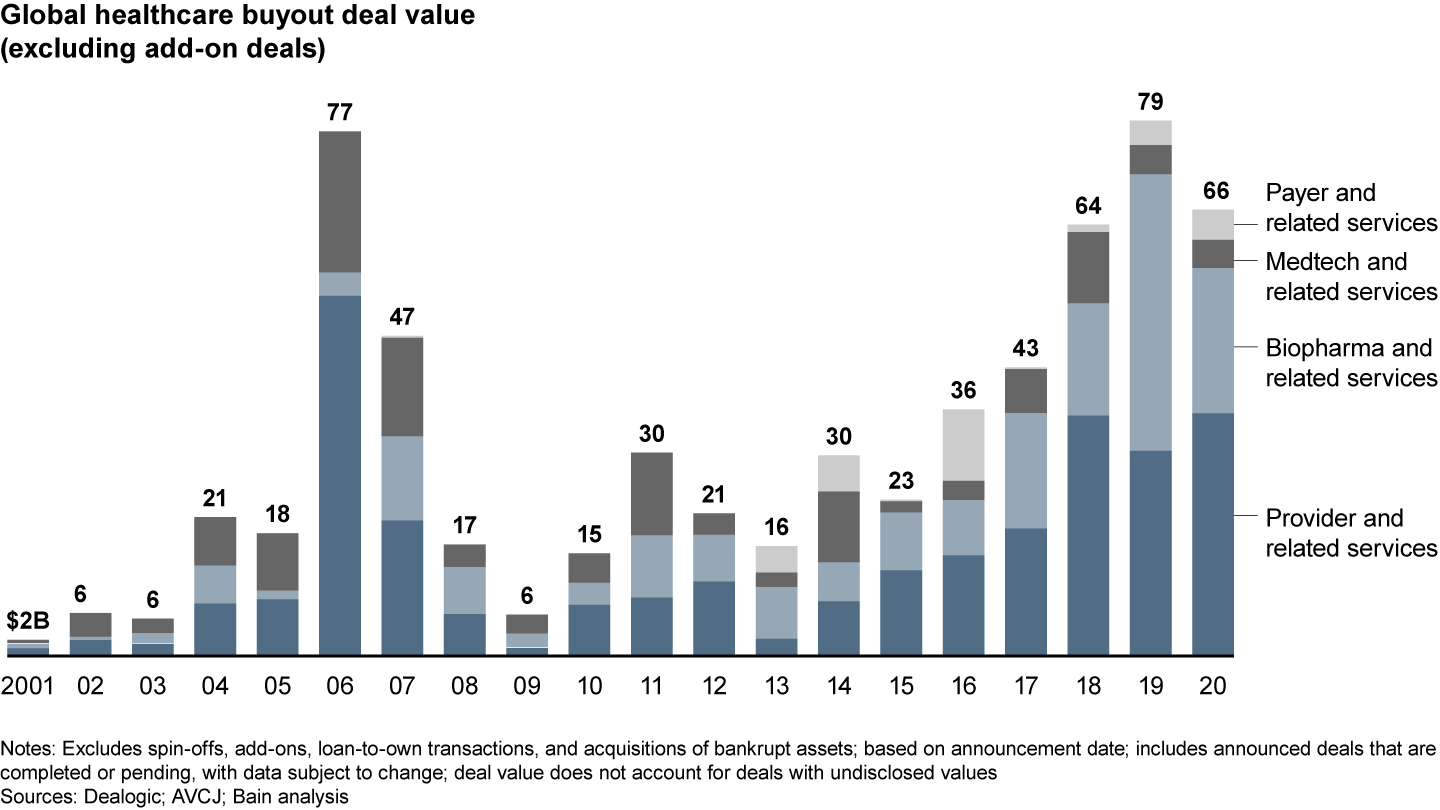

The increase in disclosed value may be understated, as many sizable assets changed hands without disclosing value, such as the Kelsey-Seybold Medical Group’s partnership with TPG Capital.
Three major investment trends characterized healthcare provider deals during the year:
- Continued consolidation of fragmented specialties and sites of care, with the pandemic accelerating this trend. Activity clustered in a few new areas, such as outpatient psychiatry and women’s health, as well as other more traditional areas, including veterinary and home care.
- Risk-bearing providers with proven models for managing costs.
- Healthcare IT solutions serving alternate sites of care with attractive underlying growth profiles.
Meet the members of Bain’s Healthcare Private Equity practice.
Continued consolidation of fragmented specialties and sites of care
Healthcare providers have experienced a wave of consolidation producing large platforms in segments such as retail health and certain outpatient specialties such as dermatology. The pace of deal activity now is picking up in traditional areas of interest and other fragmented segments, including behavioral health and women’s health.
Behavioral health companies’ growth has been spurred by socioeconomic conditions that include population growth, the rising prevalence of mental health and substance abuse conditions and diagnoses, growing patient use of treatment options, and favorable regulatory and reimbursement trends. Providers in outpatient mental health, opioid and other substance abuse, eating disorders, and autism all have seen rising demand, boosted in some cases by the pandemic.
Indeed, demand outstrips supply in this fragmented segment. During the year, investors sought to acquire and to professionalize companies, then scale them up through geographic expansion (both organic and through M&A), improved patient and referrer outreach, and building out the operational infrastructure, including healthcare payer contracting, an approach that is still in early stages.
Like other provider buy-and-build strategies, this one allows behavioral health companies to centralize back-office functions, to strengthen their negotiation position with payers, and to invest in professionalizing patient experiences, such as referrals and digital offerings.
This logic underpinned several deals in behavioral health: Priory Group (acquired by Waterland), LifeStance Health (investment by TPG Capital in partnership with Summit Partners and Silversmith Capital Partners), Evolve Treatment Centers (acquired by Galen Partners), Comprehensive Educational Services (investment by General Atlantic), and Refresh Mental Health (majority stake acquired by Kelso).
Women’s health also saw significant interest in 2020. This area holds the promise of a significant M&A runway given fragmentation in the market, the ability to better manage the cost of pregnancies, and the potential to expand a variety of ancillary services. Investors thus are eager to explore the value proposition that a scale platform can create. For instance, Altas Partners recently acquired a majority stake, partnering with Ares Management, in Unified Women’s Healthcare, an obstetrics and gynecology physician management group.
Specialty practice platforms drew investors who looked beyond temporary Covid-related dislocations to back platforms in areas where they had conviction in the long-term outlook and value of a scale platform. For example, Webster Equity Partners backed Retina Consultants of America in eye care and One GI in gastrointestinal care.
Although retail health broadly experienced fewer private equity deals in 2020, several pockets were active.
Veterinary clinics and pet care, for instance, have benefited from increased spending on pets and the broader consumerization of health care, in addition to the same underlying buy-and-build dynamics described above. These factors played into the acquisition of Pathway Vet Alliance, an owner and operator of veterinary care facilities across the US, by TSG Consumer Partners. And Summit Veterinary Pharmacy, a Canadian veterinary compounding pharmacy, received an investment from Persistence Capital Partners.
Within physical therapy and dental care in North America, the pandemic squeezed patient volumes during lockdowns, which may have motivated some smaller providers to consider becoming part of larger practices. For instance, US Physical Therapy, a national operator of over 500 physical therapy clinics that has employed a buy-and-build growth strategy in the past, acquired both a four-clinic outpatient physical therapy practice and a three-clinic physical therapy practice last year. The pace of demand returning to pre-Covid levels will help determine the urgency with which small operators evaluate joining broader platforms.
In Europe, on the other hand, proven types of retail healthcare—those with a high share of self-pay or owners of scarce capital equipment—have kept consolidating as investors look to improve on previous attempts to buy-and-build with fragmented assets across different countries. Magnum Capital, for example, acquired Clinica Actual (also known as Clínica Galena), a provider of plastic surgery and cosmetic medicine. Capturing the benefits of scale can be difficult, given the disparate health service relationships in each country, but investors still see this as an attractive space.
Other segments such as dental, primary care, and behavioral health have met more skepticism in northern and western Europe, where in-country consolidation is already advanced, cross-border synergies are limited, and regulatory bodies maintain high levels of physician independence. Southeastern European countries offer abundant opportunities for consolidation, but synergies may be tough to capture in lower-funded systems with low levels of self-pay.
Home care and hospice have benefited from the secular shift away from facility-based care, another trend accelerated by the pandemic. Lower-cost alternative sites of care gained attention from investors hoping to capture share in this high-single-digit growth market. For home-based providers, the infusion of private equity helps them expand the acuity level of the patients they treat. Moreover, many such providers have been run by nonprofit organizations, with highly variable levels of resources, which can potentially realize significant gains from standardizing and professionalizing their operations. We are also seeing interest in models targeting specific populations with a more holistic care approach, such as Programs of All-Inclusive Care for the Elderly.
Several deals in 2020 illustrate this theme. For instance, Help at Home, a provider of personal care services, was purchased by Centerbridge Partners and Vistria Group in a move to expand the company’s platform to new patient populations. Thomas H. Lee backed SeniorLink, a tech-enabled home-based senior care platform. Other deals include EQT’s $2.6 billion buyout of Colisée Patrimoine Group, which offers home care in addition to a spectrum of post-acute offerings, and the investment in InnovAge by Apax Partners, which coinvested alongside Welsh, Carson, Anderson & Stowe.
Of course, traditional provider acquisitions also occurred in Europe and developing nations in Asia-Pacific. For instance, KKR paid $4.1 billion to acquire French private healthcare operator ELSAN, and GIC invested $203 million in the Vietnamese private hospital operator Vinmec.
Risk-bearing providers with proven models for managing patient cost and outcomes
Risk-bearing primary care providers using a capitated revenue model, typically with Medicare Advantage patients, have captured the attention of many investors in the US. These businesses offer scale-up opportunities for well-run healthcare providers that can manage the cost and risk of a senior patient pool. As these companies grow, investors that instill strong operating practices can deliver care profitably and expand the range of patient services under one umbrella, leading to above-average returns and growth observed in the high single digits.
Cano Health’s initial public offering through a special purpose acquisition company, Jaws Acquisition, is a prime example of a Medicare Advantage provider investing to grow its value-based care model. Similarly, the Kelsey-Seybold Medical Group’s partnership with TPG Capital followed this Medicare Advantage trend. Humana and Welsh, Carson, Anderson & Stowe also formed a joint venture to open additional Medicare-focused primary care facilities.
Healthcare IT solutions serving alternate sites of care
Provider healthcare IT activity dipped to 33 deals in 2020, down from 36 in 2019. However, disclosed value rose to $11.8 billion from $10.1 billion the year earlier. The year 2020 saw an ongoing shift of care to alternative sites, and technology used in these sites continues to draw investor interest. As just one example, Hg Capital invested in Intelerad Medical Systems, a provider of medical imaging software and workflow solutions to radiology groups.
In Europe, previously reluctant investor sentiment around healthcare IT is shifting more positive, because of the high compliance burdens of the General Data Protection Regulation, post-Covid tracing and potential interoperability requirements, and the associated need for new technology solutions to solve these problems.
Outlook: A premium on operational excellence
Healthcare providers were hit hard by the direct effects of Covid-19, with the gap in expectations widening between buyers and sellers who often could not agree on a Covid-adjusted steady-state EBITDA. Looking ahead, developing a baseline understanding of provider performance apart from the pandemic’s effects, and identifying true gems for acquisition will be a challenge for investors. Broadly speaking, providers that can demonstrate faster rebounds in patient volume and revenue will stand out.
That said, we expect a few themes to motivate investments over the next year:
- Investors will hunt for physician practice management buy-and-build opportunities in new specialties, such as cardiology, gastroenterology, and urology, as well as those segments discussed above.
- Risk-bearing healthcare providers will continue to attract attention, as investors look to create the next Oak Street Health.
- The rise of enabling technologies, such as revenue cycle management and electronic medical records, used as tools to support buy-and-build platforms and telemedicine, also holds promise.
- In Europe, potential healthcare personnel shortages could create opportunities for well-run providers to improve overall utilization as they develop attractive employment options, while disadvantaged players may revert to staffing solutions or seek to consolidate with larger entities.
- Providers in growing care settings, such as behavioral health, often have to leverage inadequate, internally developed software tools, or repurpose those intended for a different setting. Vendors have an opportunity to develop purpose-built solutions in these underpenetrated segments.
Finally, we expect a number of assets that have grown through acquisitions over time to come to market based on historical holding periods and a desire for their owners to monetize the increased value. However, as investors run due diligence of these assets, they will need to get comfortable with both the existing business and the potential runway for additional M&A. Even if the current business does not need to be firing on all cylinders, private equity sponsors should be sure that the foundation is in place to instill operational excellence at the existing sites and the future acquisitions.
More from the report
-
Welcome Letter: Fertile Conditions for Healthcare Private Equity Investment
-
Healthcare Private Equity Market 2020: The Year in Review
-
The Covid-19 Paradox: Widespread Repercussions for Demand, but New Healthcare Investment Opportunities as Well
-
Healthcare Private Equity in North America: Bring On the Gem Assets
-
Healthcare Private Equity in Europe: Steady Dealmaking despite Many Deferrals
-
Healthcare Private Equity in Asia-Pacific: Riding a Wave of Domestic Innovation
-
Healthcare Providers: New Roll-Up Candidates and a New Look for Risk-Bearing Providers
-
Healthcare Payers: A Bid to Reduce Costs for Patients and Employers
-
Biopharma: Commercialization Support Services Are Thriving
-
Medtech: Four Themes Fueled Deals despite the Pandemic
-
Healthcare IT: Technologies Help Improve Patient Experiences at Lower Costs
-
Healthcare M&A: A Pandemic-Induced Slowdown in Every Sector
-
Healthcare Exit Activity: Robust Capital Markets Spur a Surge of IPOs
-
Healthcare Private Equity Outlook: 2021 and Beyond
Read our 2021 Global Healthcare Private Equity and M&A Report
First published in 3월 2021