

Brief

한눈에 보기
- A medical equipment manufacturer’s servicing capabilities can affect customer satisfaction and future purchasing decisions significantly.
- Service organizations are under increasing pressure and often operate below their full potential.
- Manufacturers can improve service quality and efficiency by addressing common service issues systematically at the local level.
- To create lasting change, service improvement programs must be line led and line owned.
Customers rely on medical equipment to provide high-quality diagnoses and treatments, and they view service reliability as a key factor when considering a vendor. Despite the negative effects on customer advocacy and sometimes revenue, many medical equipment manufacturers run their service businesses below their full potential.
When delivered effectively, service activities can increase customer advocacy and influence future sales. In fact, the Bain 2018 Europe Front Line of Healthcare Survey found that good service is among the top three reasons surgeons and procurement officers recommend a manufacturer, while poor service is one of the top two reasons surgeons and procurement officers become detractors.
Service is often bundled into a medical equipment sale, along with consumables, IT products and software. Services can range from classic maintenance to performance optimization and even operational outsourcing. The extent to which medtech companies charge for their services differs among subsectors: While services are an important profit contributor for diagnostic imaging manufacturers, they are often provided at no charge for in vitro diagnostics.
Service businesses are under pressure
Today’s service organizations are under increasing pressure. Customer expectations are rising, calling for 24/7 technical support and advanced service offerings. The customer landscape continues to consolidate, creating new pricing and budget constraints for manufacturers. Meanwhile, competition is intensifying as new players enter the industry and existing companies expand their geographic markets. TriMedX, for example, began in a hospital biomedical engineering department; it now provides manufacturer-agnostic medical equipment servicing and life cycle management.
Consequently, many manufacturers struggle to run their service businesses and operations at their full potential. Symptoms of underperformance include the following:
- inconsistent customer feedback on the companies’ customer service operations, often expressed by a Net Promoter Score® below 10%;
- significant variance in costs of providing service across countries and business lines that cannot be explained by local business specifics;
- service delivery costs that outpace growth in equipment and service sales,such as personnel, regulatory expenses or other overhead costs that creep up faster than related revenue;
- high variability in operational performance indicators, such as the percentage of first-time-right fixes for broken equipment and time to resolution for standard work orders; and
- inconsistent service processes and organizational structures across regions and businesses, leading to high operational complexity.
Look for champions outside the industry
When it comes to effectively delivering services across country markets, service champions exist in other industries that are often ahead of medical equipment manufacturers. For example, an industrial pump manufacturer standardizes its field maintenance and repair processes by providing technicians with step-by-step instructions on how to resolve common customer problems, as well as benchmark times to resolution to help measure technicians’ performance. A leading elevator manufacturer uses a skill matrix, GPS data and workload information to dispatch the optimal technicians to customer requests. Within the robotics manufacturing industry, one global company analyzes work order data and uses a knowledge-sharing platform to impart insights across local service organizations.
Bain Partner Dieter Meyer discusses how medical device manufacturers can address common service issues through a line-led approach.
Medtech service managers can benefit tremendously by interacting with service champions from outside their company and industry—for instance, they can learn best practices and how to apply them. The Bain Service Circle, a semiannual event that Bain organizes, gives service executives access to an experience-sharing platform and opportunities to build a service-specific business network outside of their own industry.
Identify and analyze factors influencing service
We recommend using a service value tree to improve service operations in medtech companies. A service value tree systematically links the main service cost buckets to a set of proven, subsector-agnostic operational levers that affect performance.
For example, field force costs are often the largest expense for service organizations. Manufacturers can design solutions to address specific labor costs, such as by adding remote capabilities for diagnosis and resolution, creating a matrix to help deploy the appropriate field technician for each issue, or introducing target times to resolution for common problems. The service value tree allows companies to identify and address productivity improvement opportunities in their service operations (see Figure 1).
Figure 1
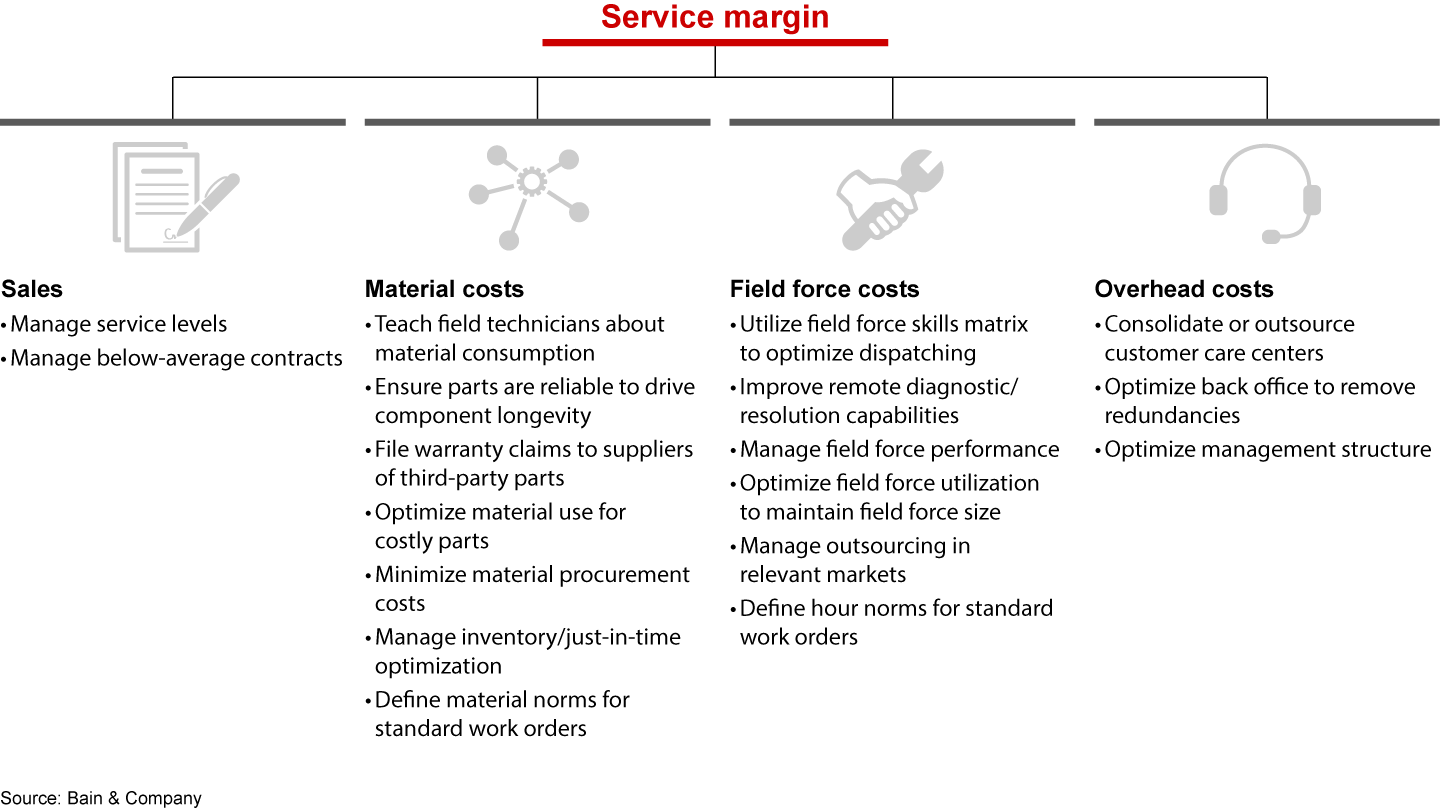

Service is a complex problem, with many factors affecting performance. We suggest focusing on five to seven of the most influential operational levers and benchmarking performance by country and key performance indicators. For example, in order to reduce material consumption, a company can collect material consumption rates for other service organizations in the same country to determine normal consumption for a business unit. A service productivity heat map can capture the benchmarking results and help management pinpoint the biggest operational and financial opportunities (see Figure 2).
Figure 2
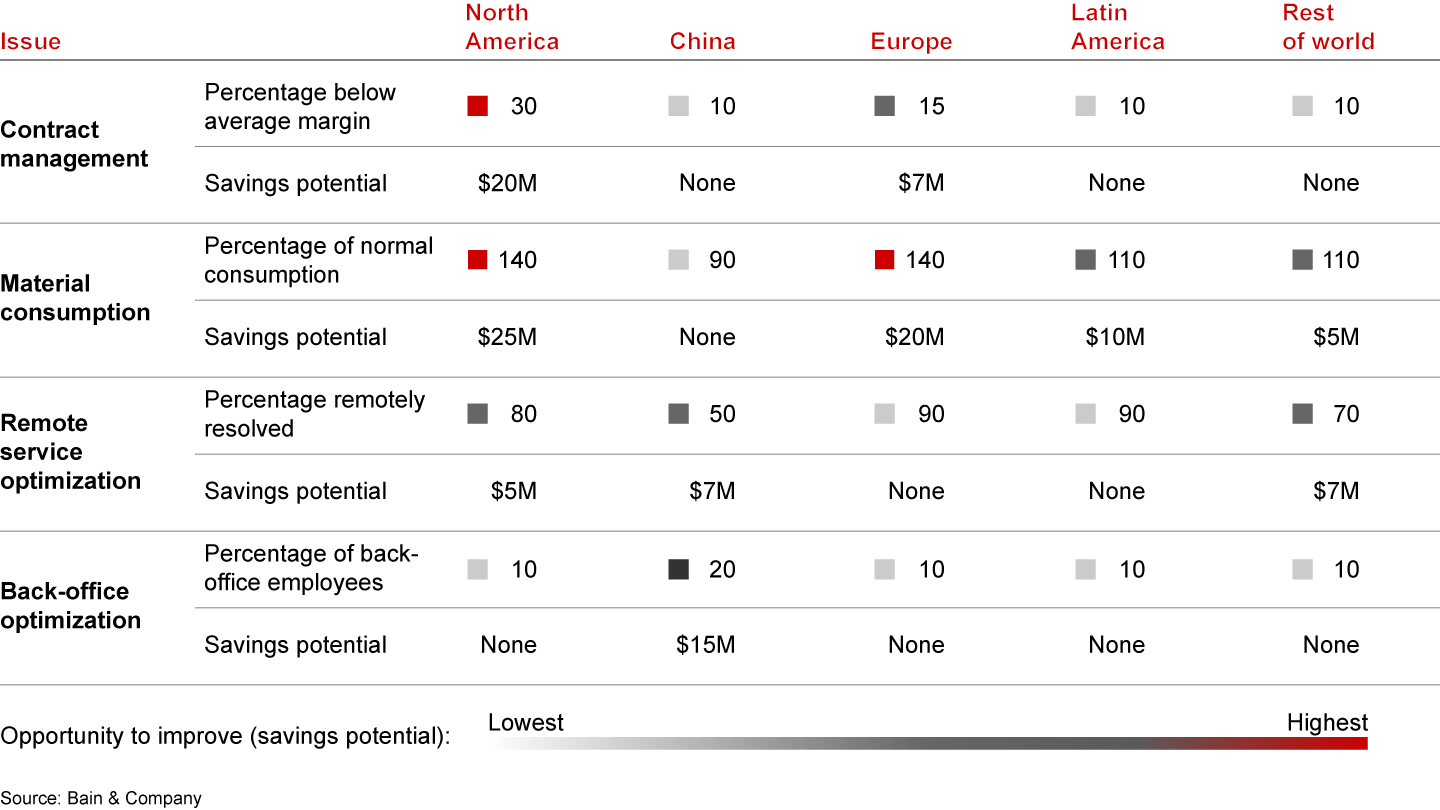

Fewer than five issues typically account for 80% to 90% of the productivity improvement opportunities in an organization. The most influential issues often differ among local service organizations; a one-size-fits-all approach to service productivity does not exist.
Set clear goals and mobilize the front line to achieve lasting results
Most medical equipment manufacturers run ongoing productivity improvement programs in their service businesses. Yet many senior service executives find it hard to achieve lasting results for two key reasons.
- Accountability for service results is dispersed. Large medical equipment manufacturers operate in highly matrixed structures in which global business units, global service functions and local service organizations share the responsibility for service costs.
- Improving service productivity is fundamentally a mobilization challenge. Behavioral change must occur at the service front line in the local markets to improve service productivity over the long term.
Senior management must clearly define the company’s service productivity goals and secure commitments from all relevant stakeholders. Use service champions across industries, not just in industry peer groups, to identify what best-in-class performance looks like and establish benchmarks. There should be clear financial and productivity targets based on both internal strategy considerations and external benchmarks.
Establish local service excellence factories
While medical equipment manufacturers tend to have a global mindset toward research and development, supply chain, and product management, their service organizations must be much more locally oriented.
To create lasting change, companies must tackle service productivity issues where the activity and cost ownership is located—namely, in local country market organizations. Thus, service productivity initiatives should be line-led and line-owned programs.
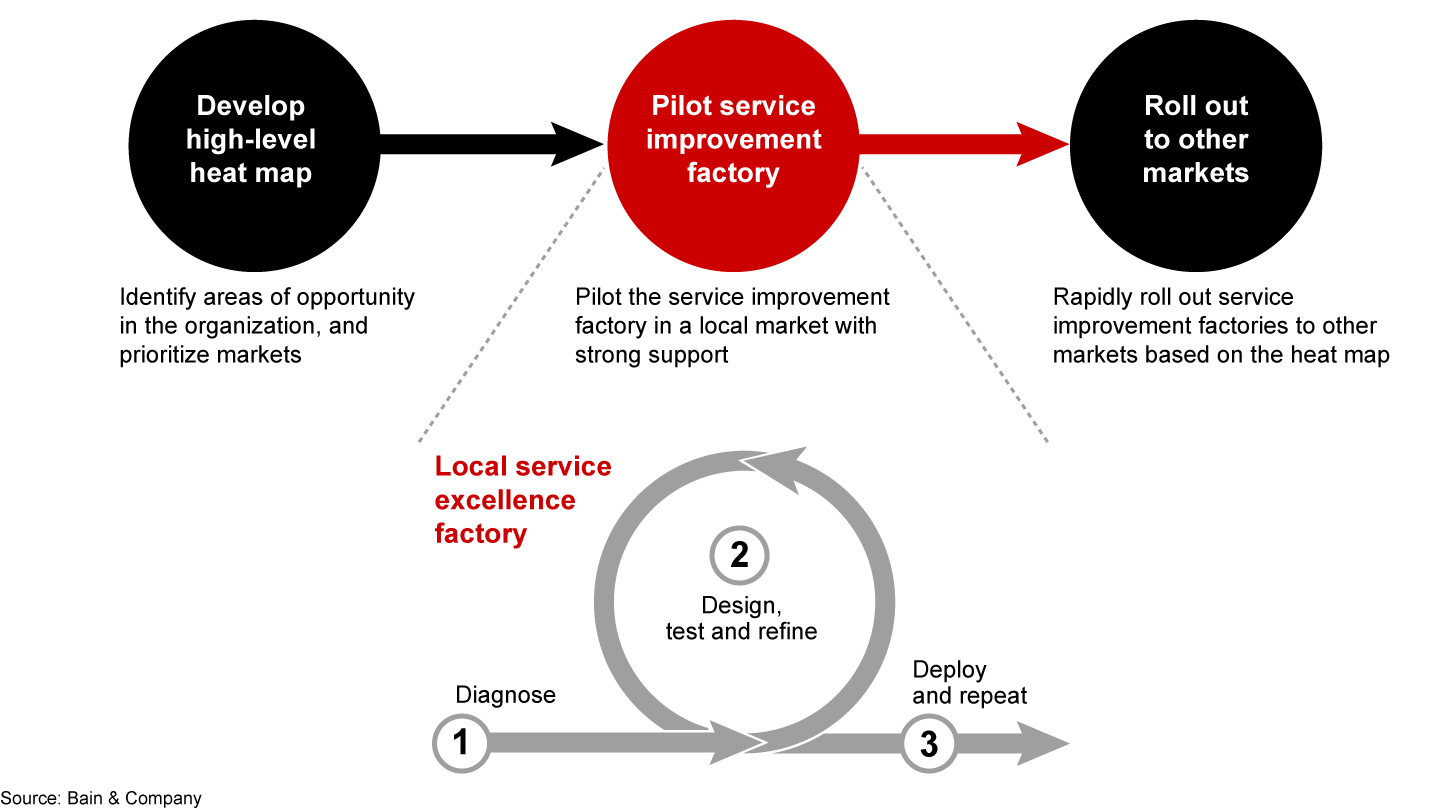
To achieve consistent and substantial results, we recommend setting up local service excellence factories in each market. Each factory will have a standard approach to identifying productivity improvements, designing solutions and enabling implementation.
- Start with a detailed study of the local market to understand root causes and identify key areas for improvement, substantiate senior management’s high-level heat map with operational data, measure the baseline, and quantify the potential upside.
- Next, design initiatives to address the key issues identified in the service value tree, and apply internal and external best practices while remaining localized and relevant to the market.
- Finally, let the local market implement, test and refine the initiatives.
We recommend launching a pilot service excellence factory in a market where there is strong local support for change. After demonstrating proof of concept in the pilot market, quickly roll out service excellence factories to the more resistant markets where improvement opportunities may be greater (see Figure 3).
Figure 3

Install a global service results office to coordinate the local service excellence factories’ activities. All local service excellence factories should follow the same reporting frequency to track progress systematically.
In addition, the global service results office should establish a consistent method for tracking progress and measuring achievement. We use the Bain Results Accelerator, part of the Bain Accelerated Transformation program, to capture all initiatives and measure progress against targets.
Share the success
The global service organization should collect and disseminate best practices systematically among the local service factories. The goal is to capture innovative solutions from across the global organization and share the information companywide to avoid reinventing the wheel. These best practices are not, however, directives for all markets; rather, local service factories should adapt the improvement ideas into best practices particular to their markets. Over time, these best practices will become standard business practices for different market clusters.
Service productivity programs are multiyear journeys that can transform service operations. Medical equipment manufacturers have the opportunity to increase revenue and lower the costs of providing service. Meanwhile, the overall quality of service and customer satisfaction can also rise so that it benefits everyone.
Dieter Meyer, Todd Johnson, Tim van Biesen and Vikram Kapur are partners with Bain & Company’s Healthcare practice. Dieter is based in Zurich, Todd and Tim are based in New York, and Vikram is based in Hong Kong.
Net Promoter®, Net Promoter System®, Net Promoter Score® and NPS® are registered trademarks of Bain & Company, Inc., Fred Reichheld and Satmetrix Systems, Inc.
First published in 10월 2018