


Brief

|
|
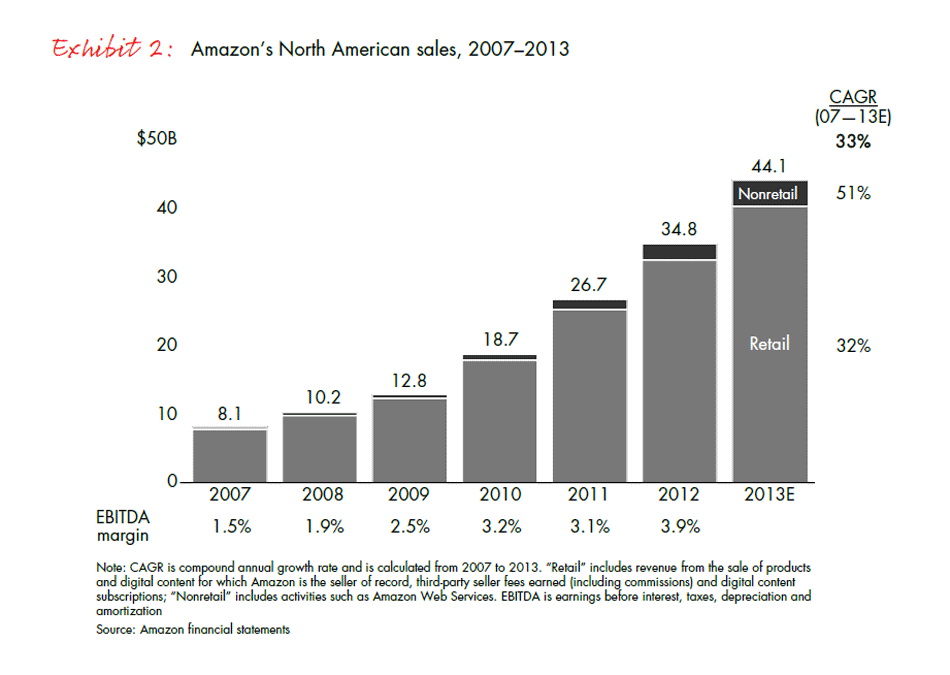
Initial November sales results were better than many feared, and digital commerce led the way, outpacing sales growth in stores by almost 8x in recent weeks. The digital tide is forcing retailers to make difficult strategic choices. Some are opting for business as usual, while others are betting big on digital innovations. Bain believes that successful retailers will pursue an omnichannel model, combining the best of digital technologies and physical stores to create entirely new ways of making customers happy. In this issue we review recent holiday sales and highlight innovations from Amazon and other digital pure plays. We also explore two ways winning retailers are creating the best of both digital and physical worlds: flexible fulfillment and the store as an omnichannel stage. Strong November growth led by digital sales Sales results continue to suggest growth in line with Bain’s omnichannel forecast of 4%.1 We had anticipated 2% to 3% growth in store sales, and this seems achievable: the Census Bureau reported 3.3% growth in GAFS sales for the month of November. In stores, furniture (including home furnishings) and electronics (including appliances) are outpacing general merchandise and apparel. We forecast online sales growth of 15% to 17%, and e-commerce continues to outperform that projection: comScore estimates that online sales for the six-week period starting four weeks before Thanksgiving increased by a whopping 25% compared to last year, and the NPD Group believes that online sales growth for the season could surpass 20%. Although year-over-year comparisons can vary significantly based on date ranges, it’s clear that digital sales are the star of the season.2 The increase in digital commerce reflects a fundamental shift in shoppers’ behavior. Customers are now moving seamlessly between digital and physical channels, even during the same shopping trip, blurring the lines between online and in-store shopping. In fact, Vibes estimates that 44% of shoppers often showroom, or look at a product in a store before buying it online. On the other hand, Google found that 84% of shoppers research products online before buying them in a store. Many of these new behaviors have been enabled by the rise of innovative online companies, in particular by Amazon. Amazon is redefining what’s possible Digital sales have quintupled over the past 10 years, and Amazon has grown even faster. The online giant’s sales rose by 16x over that period, and the company will likely end 2013 with more than $40 billion in North American retail sales (Appendix Exhibit 2). Growth is the core of CEO Jeff Bezos’s flywheel strategy:
The flywheel strategy has proved very successful at delivering growth, and Amazon prizes this outcome. The company believes that scale drives better pricing and faster delivery and has led it to a commitment to always do what’s best for the customer regardless of the short-term cost. In Jeff Bezos’s own words: "If you’re long term oriented, customer interests and shareholder interests are aligned. In the short term, that’s not always correct. I care very much about our share owners, and so I care very much about our long-term share price." It seems the market agrees with him: Amazon’s stock has gone up 700% since 2008. Amazon’s focus on growth is centered on creating "wow moments" or finding ways to eliminate pain points for shoppers. Other online pure-players are also finding ways to delight customers:
Omnichannel innovations: The best of both worlds The big question for retailers is the role of the store in an increasingly digital world. Some retailers think digital commerce could put physical stores out of business completely. Venture capitalist Marc Andreessen argues that "retail guys are going to go out of business and e-commerce will become the place everyone buys. Retail chains are a fundamentally implausible economic structure if there’s a viable alternative." Sears seems to be thinking along the same lines and is dramatically reducing its investment in stores: In 2012, the company spent just $1.46 per square foot on physical infrastructure, one-sixth of the average spent by other leading US department and mass-merchandise stores. Sears CEO Eddie Lampert notes that “for sure there is more money we could be investing in our stores, but when we did invest in our stores, we didn't see a return." Others are sticking with a store-dominant strategy for now (Figure 2). Costco, for example, is taking a wait-and-see approach. Says CFO Richard Galanti: "We're very much a brick-and-mortar company, with 97%-plus of our business done in-store, not online. People actually do like to go out and shop." Discount retailers Ross Stores and Marshalls have websites, but no products are available for purchase there. This may change for Marshalls. T. J. Maxx, which is owned by the same parent as Marshalls, recently began selling online. 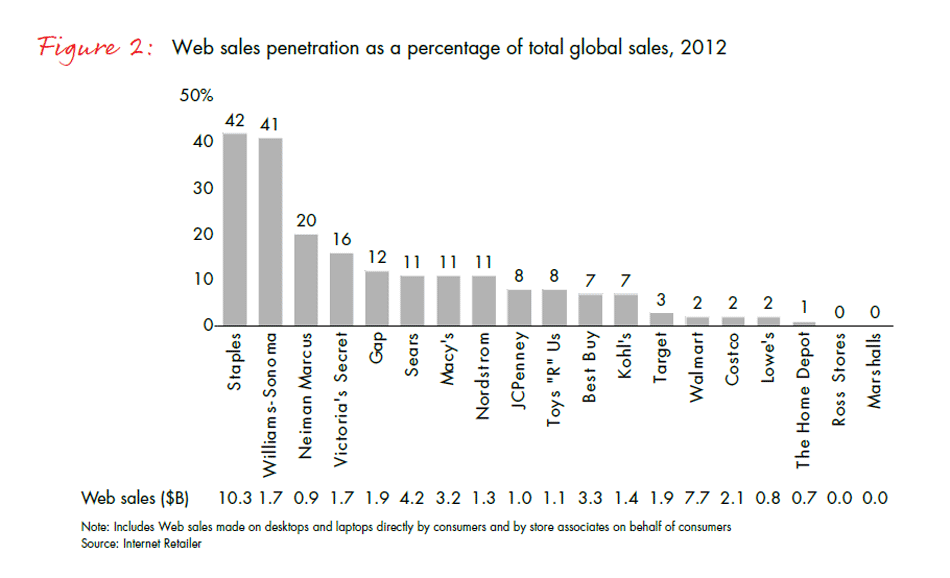
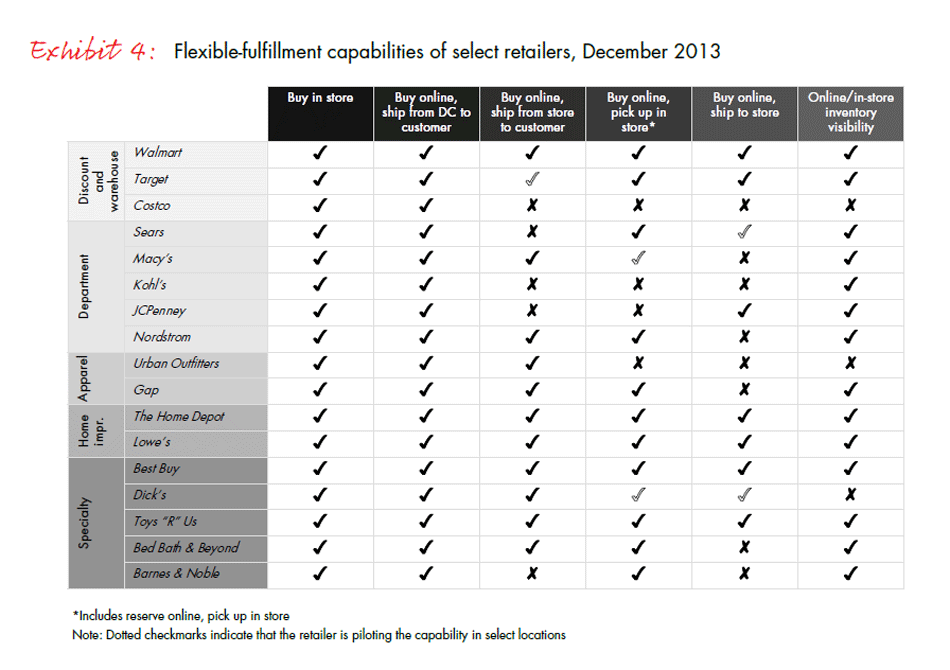
Bain believes the most likely scenario is that both stores and digital commerce will evolve in new and complementary ways, and that physical and online channels may eventually become so intertwined that consumers will no longer distinguish between them. Stores that survive will offer omnichannel experiences that combine the best of digital commerce—easy comparison shopping, expert advice, low prices and broad choices—with the best of physical shopping—sensory experiences, instant access, social interaction and easy returns. Two omnichannel experiences are getting a lot of attention this holiday season: flexible fulfillment and the store as an omnichannel stage. Flexible fulfillment: More ways for consumers to get their goods Shoppers value the ease of buying online, but that’s not the only factor in their decision making. Also important are delivery speed, security of the package, the cost of delivery, the ability to pay in cash and the ability to see and touch the product before buying it. Convenient delivery is a key pain point: comScore found that nearly half of shoppers would like to be able to pick up orders at a convenient location or to choose specific delivery dates and times. Online pure plays are moving fast to offer customers new fulfillment options. As part of its AmazonFresh rollout, Amazon is building fleets of trucks for same-day grocery delivery (currently available in Los Angeles, Seattle and San Francisco), which may ultimately be used to deliver all of the company’s products. The Amazon Locker program gives customers the option to have their orders delivered to a 7-Eleven or other local retailer, where orders can be picked up securely and conveniently. And we have all heard about the now-famous Amazon experiment in drone delivery! Google, ShopRunner and eBay are close to offering customers near-instant delivery on many goods. Customers can already pay eBay Now $5 to deliver orders from several major retailers within an hour in San Francisco, New York, Chicago and Dallas (the service is free through December 24). Instacart provides a similar service for groceries. The company operates in San Francisco, Los Angeles, Chicago and Boston, and delivers within an hour for as little as $3.99. But traditional retailers have a potential advantage in terms of fulfillment: their physical stores. One ambitious idea retailers are pursuing is redesigning stores as customer pickup and distribution centers. Retailers are facilitating in-store pickups of online orders, shipping online orders directly from stores, shipping inventory between stores and accepting in-store returns of online purchases (Appendix Exhibit 4). Macy’s is an early leader in fulfillment capabilities: By the end of the year, 500 of its 800 stores will have a ship-from-store capability, and a buy-online-pick-up-in-store option is set to begin next year. Other retailers are also investing heavily in fulfillment: Target rolled out in-store pickup just in time for Black Friday, and Gap Inc. expanded its reserve-online pilot to all Gap and Banana Republic stores. Offering these services isn’t business as usual. Store associates have to be trained and even incentivized. Assortment and inventory management becomes more complicated, requiring new technology and management processes. Stores may even need to be retrofitted or redesigned. However, Bain’s experience indicates that flexible fulfillment does more than increase shipping speed. Retailers can also see other benefits, from lower shipping and markdown costs to improved product availability, increased sell-through and higher customer satisfaction. The store as an omnichannel stage Customers still like going to physical stores. Bain’s survey with PollBuzzer found that 80% of shoppers over the four-day Thanksgiving weekend visited at least one store, and 52% of them made a purchase they weren’t planning to make. Even "born-digital" retailers recognize the power of a physical presence. Amazon, for example, recently opened a handful of pop-up stores to promote the company’s Kindle e-readers and show how well they perform even under adverse lighting conditions. Rent the Runway, which allows customers to rent designer dresses for special occasions, also made the offline transition with a new flagship showroom inside New York’s Henri Bendel department store. Shoppers can try on a wide array of dresses and accessories, and use the scanners and iPads in each fitting room to save their favorites to their "dream closet." Bonobos may be the most striking example: The online-gone-offline company has opened eight showrooms to allow customers to touch and try on its products, and also showcases products in 70 Nordstrom stores. Especially as pure plays begin to offer their own store experiences, the challenge for traditional retailers is to think creatively about using their brick-and-mortar advantage to delight customers. Here are some of the things they’re doing:
Moving from competitive benchmarking to customer path-breaking Many retailers are taking omnichannel steps, but are they moving fast enough, and in the right direction, to survive digital Darwinism? Often retailers get stuck in competitive benchmarking. They may call it "fast-follower strategy," but it’s still "follow the leader," a game that seldom gives players a competitive advantage. By the time companies realize they need to copy an innovation, they still face high costs, have lost years of experience and miss out on the loyalty benefits of being first. Few customers are likely to be impressed by something "new" that other retailers have been offering for two to five years. And when retailers are forced to play catch-up with an innovation that is years old, they fall even further behind on meeting the next wave of innovations—all while their rivals are moving on to new ways to win market share. Retailers who stand out as successful innovators have two traits in common: They dedicate themselves to improving the lives of their customers, and they maintain a long-term perspective. Retailers looking to innovate have a difficult task in front of them: They need to delight customers who often can’t articulate what they want. As Procter & Gamble’s CEO A.G. Lafley explains, "Here’s the problem—consumers cannot really tell us what they want. They can tell you why they like it or why they don’t like it, but they cannot tell you what they want. Nobody told us that they wanted Crest White Strips. Nobody told us that they were dying for a Swiffer. Nobody told us that Febreze would make their life better." Identifying what consumers can’t articulate demands a deep understanding of their behavior. The goal is to identify pain points that need easing and opportunities to delight. Bain research suggests companies that do this profitably blend creative thinking with commercial foundation. We call this BothBrain® innovation.6 And once a retailer finds a great idea, it still requires a leap of faith to invest in a yet-to-be-proved concept. For example, Apple recognized that customers needed to learn more about its innovative products, but the decision to launch stores cost the company close to $100 million at a time when it was already losing money. In 2012, Apple stores were the most productive stores in the world, with average annual revenue of more than $6,000 per square foot. Successful innovators also focus on the long term. Instead of evaluating an opportunity solely on its transactional profitability and contributions to short-term profits, these companies measure the returns generated by strong customer relationships. One example: Amazon Prime. The program seems like a terrible investment. For $79 a year, the company gives members unlimited two-day free shipping (which typically costs more than $10 for each order), free access to more than 40,000 streaming videos (movies and television episodes) and free downloads of more than 350,000 Kindle titles. Yet this seemingly poor investment appears to be generating strong returns: Amazon reached an estimated 16 million Prime members this year, and Piper Jaffray estimates that these customers more than double their spending with Amazon after joining Prime. Studying competitors isn’t always a bad thing, but thinking about what they might do versus what they’re already doing is important. Consider a few of Amazon’s possible moves. What if the company decides to open its own stores? Those stores could feature Amazon-branded products, or products from preferred sellers, and build on the Amazon Locker concept to offer around-the-clock pickups and returns for online orders. What if AmazonFresh and Amazon Pantry own the last mile of delivery in 30 of the top 50 metropolitan areas? What if Amazon Payments reduces its exposure to credit card fees and passes the savings along to Prime members? Some of these may seem impractical, but none are implausible given Amazon’s long-term focus on its customers. Retailers who don’t want to play "follow the leader" have to come up with their own aspirations for delighting customers and start figuring out how to turn the unimaginable into reality. The path forward While retailers are focused on building omnichannel capabilities and finding new ways to make their customers happy, they need to remember that successful innovation requires making difficult decisions. Just because a new technology is available doesn't mean it’s a good investment. Retailers have to make their own choices, and they should start by asking the following questions:
No matter the answers, every retailer must have the organizational flexibility to innovate, learn and adapt over time. Our next and final newsletter, released at the end of January, will recap holiday season sales and examine how leading retailers are modernizing their organizations to win in the future. We wish you a happy holiday and look forward to connecting with you in the New Year. For a list of selected references, please view the full article. Appendix 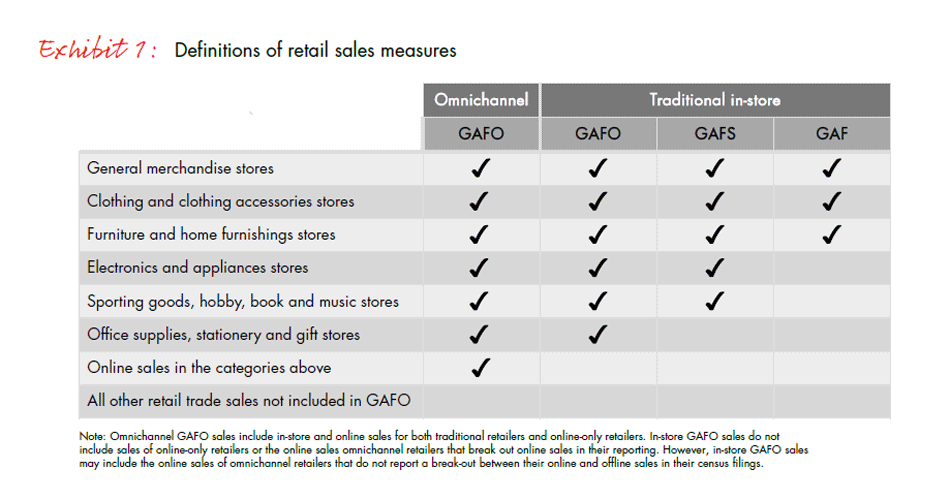
1 Bain’s forecast includes both in-store and online GAFO sales for the months of November and December. See Exhibit 1 in the Appendix for definitions of GAFO and other sales measures. 2 Year-over-year comparisons are more difficult this year due to the fact that Thanksgiving was later, pushing Cyber Monday into December and shortening the peak sales season between Thanksgiving and Christmas by six days. When comScore measured online sales growth over the same calendar days—November 1 to December 9—it found growth of just 9% (versus 25%). 3 A pricing analytics company, 360pi helps retailers make smarter pricing decisions. According to the company, it works with top retailers to enable them to "gain real-time visibility into the market, full awareness of the competitive pricing landscape and the ability to 'right-price' to shoppers, which often leads to revenue uplift and higher margins." 4 Net Promoter ScoreSM (NPS®) is a tool designed to measure customer loyalty and advocacy. The score is calculated by asking customers to rank the likelihood of their recommending the retailer to a friend or colleague. The percentage of respondents who answer 9 or 10 is then subtracted from the percentage of respondents who answer 6 or less. NPS® ties directly to behavior and economics at the individual-customer level: Those who give a retailer a high rating tend to stay longer in a store, buy more and refer more than those who assign lower ratings. Net Promoter ScoreSM and NPS® are registered trademarks of Bain & Company, Inc., Fred Reichheld and Satmetrix Systems, Inc. 5 PollBuzzer™ offers a real-time consumer opinion survey product. According to PollBuzzer, clients use demographic, geographic and socioeconomic filters to build customized panels drawn from PollBuzzer’s proprietary national respondent pool, build their own surveys using a do-it-yourself Web interface and receive Excel-formatted results in as little as one hour after launch. 6 Bain’s BothBrain® Innovation approach utilizes the creative and the analytic talents within organizations to innovate across the full customer experience. 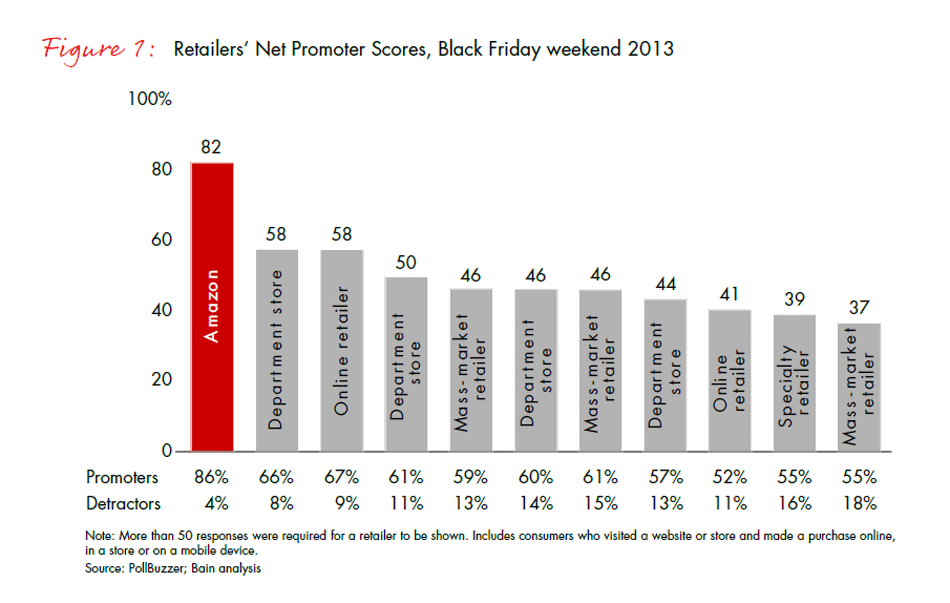 |