
Skip to Content
  • Bureaux

    Bureaux

    Amérique du Nord et Amérique du Sud
    • Atlanta
    • Austin
    • Bogota
    • Boston
    • Buenos Aires
    • Chicago
    • Dallas
    • Denver
    • Houston
    • Los Angeles
    • Mexico City
    • Minneapolis
    • Monterrey
    • Montreal
    • New York
    • Rio de Janeiro
    • San Francisco
    • Santiago
    • São Paulo
    • Seattle
    • Silicon Valley
    • Toronto
    • Washington, DC
    Europe, Moyen-Orient et Afrique
    • Amsterdam
    • Athens
    • Berlin
    • Brussels
    • Copenhagen
    • Doha
    • Dubai
    • Dusseldorf
    • Frankfurt
    • Helsinki
    • Istanbul
    • Johannesburg
    • Kyiv
    • Lisbon
    • London
    • Madrid
    • Milan
    • Munich
    • Oslo
    • Paris
    • Riyadh
    • Rome
    • Stockholm
    • Vienna
    • Warsaw
    • Zurich
    Asie et Australie
    • Bangkok
    • Beijing
    • Bengaluru
    • Brisbane
    • Ho Chi Minh City
    • Hong Kong
    • Jakarta
    • Kuala Lumpur
    • Manila
    • Melbourne
    • Mumbai
    • New Delhi
    • Perth
    • Seoul
    • Shanghai
    • Singapore
    • Sydney
    • Tokyo
    Voir tous les bureaux
  • Alumni
  • Presse
  • S’abonner
  • Contacter
  • France | Français

    Sélectionnez votre région et votre langue

    Global
    • Global (English)
    Amérique du Nord et Amérique du Sud
    • Brazil (Português)
    • Argentina (Español)
    • Canada (Français)
    • Chile (Español)
    • Colombia (Español)
    Europe, Moyen-Orient et Afrique
    • France (Français)
    • DACH Region (Deutsch)
    • Italy (Italiano)
    • Spain (Español)
    • Greece (Elliniká)
    Asie et Australie
    • China (中文版)
    • Korea (한국어)
    • Japan (日本語)
  • Saved items (0)
    Saved items (0)

    You have no saved items.

    Bookmark content that interests you and it will be saved here for you to read or share later.

    Explore Bain Insights
  • Expertises Sectorielles
    Menu principal

    Expertises Sectorielles

    • Aerospace et Défense
    • Agroalimentaire
    • Chimie
    • Infrastructures, BTP et Matériaux de Construction
    • Grande Consommation
    • Services Financiers
    • Santé
    • Engins & Equipements Industriels
    • Media et Divertissement
    • Metals
    • Mining
    • Pétrole & Gaz
    • Papier et Emballage
    • Private Equity
    • Secteur Public
    • Distribution
    • Technologie
    • Télécommunications
    • Transportation
    • Travel & Leisure
    • Utilities & Energies Renouvelables
  • Expertises Fonctionnelles
    Menu principal

    Expertises Fonctionnelles

    • Expérience Client
    • ESG
    • Innovation
    • Fusions et Acquisitions
    • Opérations
    • People & Organization
    • Private Equity
    • Sales & Marketing
    • Stratégie
    • IA, Perspectives et Solutions
    • Technology
    • Transformation
  • Digital
  • Points de Vue
  • À propos
    Menu principal

    À propos

    • Notre Activité
    • Nos Valeurs
    • Nos Collaborateurs et Notre Équipe Dirigeante
    • Notre Impact
    • Prix & Récompenses
    • Partenariats Internationaux
    • Evénements
    Further: Our global responsibility
    • Diversité et Inclusion
    • Impact Social
    • Sustainability
    • World Economic Forum
    Learn more about Further
  • Carrières
    Menu principal

    Carrières

    • Rejoignez-nous
      Carrières
      Rejoignez-nous
      • Find Your Place
      • Nos domaines d’expertise
      • Equipes multidisciplinaires
      • Étudiants
      • Stages et programmes
      • Événements de recrutement
    • La vie chez Bain
      Carrières
      La vie chez Bain
      • Blog: Inside Bain
      • Récits de carrière
      • Nos collaborateurs
      • Nos bureaux
      • Soutenir votre évolution professionnelle
      • Groupes d’affinités
      • Avantages chez Bain
    • Histoires d’impact
    • Notre processus de recrutement
      Carrières
      Notre processus de recrutement
      • Ce que vous pouvez attendre
      • Entretiens
    Trouver un poste
  • Bureaux
    Menu principal

    Bureaux

    • Amérique du Nord et Amérique du Sud
      Bureaux
      Amérique du Nord et Amérique du Sud
      • Atlanta
      • Austin
      • Bogota
      • Boston
      • Buenos Aires
      • Chicago
      • Dallas
      • Denver
      • Houston
      • Los Angeles
      • Mexico City
      • Minneapolis
      • Monterrey
      • Montreal
      • New York
      • Rio de Janeiro
      • San Francisco
      • Santiago
      • São Paulo
      • Seattle
      • Silicon Valley
      • Toronto
      • Washington, DC
    • Europe, Moyen-Orient et Afrique
      Bureaux
      Europe, Moyen-Orient et Afrique
      • Amsterdam
      • Athens
      • Berlin
      • Brussels
      • Copenhagen
      • Doha
      • Dubai
      • Dusseldorf
      • Frankfurt
      • Helsinki
      • Istanbul
      • Johannesburg
      • Kyiv
      • Lisbon
      • London
      • Madrid
      • Milan
      • Munich
      • Oslo
      • Paris
      • Riyadh
      • Rome
      • Stockholm
      • Vienna
      • Warsaw
      • Zurich
    • Asie et Australie
      Bureaux
      Asie et Australie
      • Bangkok
      • Beijing
      • Bengaluru
      • Brisbane
      • Ho Chi Minh City
      • Hong Kong
      • Jakarta
      • Kuala Lumpur
      • Manila
      • Melbourne
      • Mumbai
      • New Delhi
      • Perth
      • Seoul
      • Shanghai
      • Singapore
      • Sydney
      • Tokyo
    Voir tous les bureaux
  • Alumni
  • Presse
  • S’abonner
  • Contacter
  • France | Français
    Menu principal

    Sélectionnez votre région et votre langue

    • Global
      Sélectionnez votre région et votre langue
      Global
      • Global (English)
    • Amérique du Nord et Amérique du Sud
      Sélectionnez votre région et votre langue
      Amérique du Nord et Amérique du Sud
      • Brazil (Português)
      • Argentina (Español)
      • Canada (Français)
      • Chile (Español)
      • Colombia (Español)
    • Europe, Moyen-Orient et Afrique
      Sélectionnez votre région et votre langue
      Europe, Moyen-Orient et Afrique
      • France (Français)
      • DACH Region (Deutsch)
      • Italy (Italiano)
      • Spain (Español)
      • Greece (Elliniká)
    • Asie et Australie
      Sélectionnez votre région et votre langue
      Asie et Australie
      • China (中文版)
      • Korea (한국어)
      • Japan (日本語)
  • Saved items  (0)
    Menu principal
    Saved items (0)

    You have no saved items.

    Bookmark content that interests you and it will be saved here for you to read or share later.

    Explore Bain Insights
  • Expertises Sectorielles
    • Expertises Sectorielles

      • Aerospace et Défense
      • Agroalimentaire
      • Chimie
      • Infrastructures, BTP et Matériaux de Construction
      • Grande Consommation
      • Services Financiers
      • Santé
      • Engins & Equipements Industriels
      • Media et Divertissement
      • Metals
      • Mining
      • Pétrole & Gaz
      • Papier et Emballage
      • Private Equity
      • Secteur Public
      • Distribution
      • Technologie
      • Télécommunications
      • Transportation
      • Travel & Leisure
      • Utilities & Energies Renouvelables
  • Expertises Fonctionnelles
    • Expertises Fonctionnelles

      • Expérience Client
      • ESG
      • Innovation
      • Fusions et Acquisitions
      • Opérations
      • People & Organization
      • Private Equity
      • Sales & Marketing
      • Stratégie
      • IA, Perspectives et Solutions
      • Technology
      • Transformation
  • Digital
  • Points de Vue
  • À propos
    • À propos

      • Notre Activité
      • Nos Valeurs
      • Nos Collaborateurs et Notre Équipe Dirigeante
      • Notre Impact
      • Prix & Récompenses
      • Partenariats Internationaux
      • Evénements
      Further: Our global responsibility
      • Diversité et Inclusion
      • Impact Social
      • Sustainability
      • World Economic Forum
      Learn more about Further
  • Carrières
    Recherches les plus fréquentes
    • Agile
    • Digital
    • Stratégie
    Vos recherches précédentes
      Pages récemment visitées

      Content added to saved items

      Saved items (0)

      Removed from saved items

      Saved items (0)

      Etude

      A Rebounding China Assesses Where to Direct Its Energy

      A Rebounding China Assesses Where to Direct Its Energy

      The Covid-19 crisis has caused significant disruptions to the global commodities supply chain, putting energy and natural resource companies on a complex obstacle course to recovery.

      Par Thomas Luedi, Brian Murphy, et Neelam Phadke

      • min
      }

      Etude

      A Rebounding China Assesses Where to Direct Its Energy
      en

      The Covid-19 global outbreak has had a devastating effect on people and markets across the world, and executives everywhere are working to determine how they can care for their people, restore their productivity and contribute to recovery. For the energy, chemical and natural resource industries as well as those industries’ customers, the impact of the pandemic has been exacerbated by steep declines in oil prices, resulting in significant supply and demand shocks in global markets.

      Months after the initial wave of large coronavirus outbreaks took root in China’s Hubei province, world markets are now running at two speeds. Much of China’s production has come back online, and China’s Ministry of Industry and Information Technology has said that 80% of workers outside of Hubei are back to work as of March 13, with most large companies resuming operations. Even in Hubei, companies such as Wuhan Iron & Steel are resuming operations. Meanwhile, the rest of the world is still moving toward the most severe levels of the crisis. The extent of the pandemic still depends largely on the abilities of countries to contain the outbreak as they sacrifice short-term economic activity and implement quarantine measures to keep the spread of the disease under control.

      As China continues to recover quickly while much of the rest of the world dips into recession, the result will likely be a significant oversupply of products that China exports, including steel, polyester resins, fuel products and many finished goods. Stimulus efforts by China’s government could encourage producers to operate at high rates, further adding to the excess and price declines (see Figure 1). At the same time, we could see supply shortages for China’s major import products (for example, iron ore, copper and liquefied natural gas) as the pandemic slows production elsewhere, resulting in higher prices for these goods.

      Figure 1
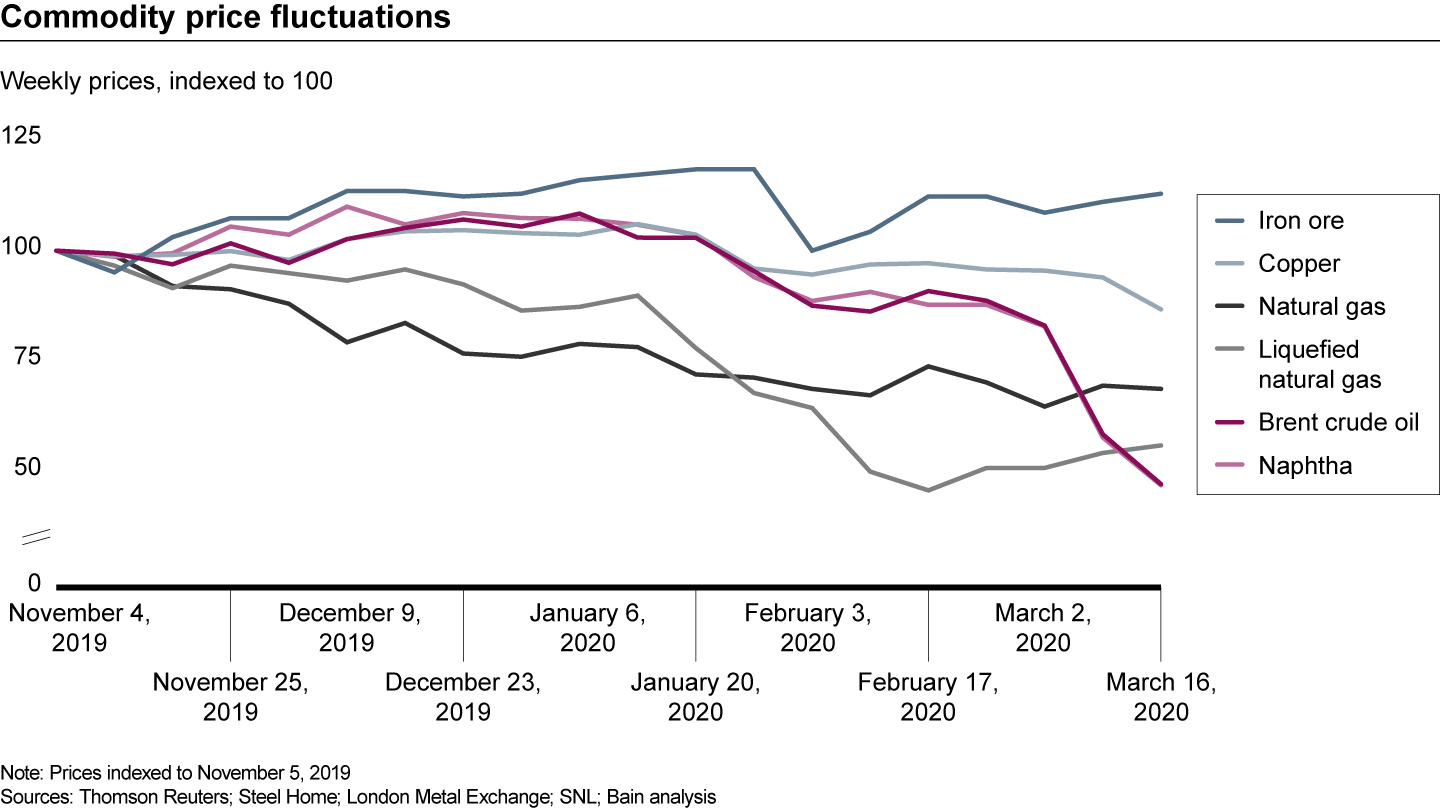
      Supply and demand imbalances have caused large fluctuations in prices for energy and natural resource commodities
      Supply and demand imbalances have caused large fluctuations in prices for energy and natural resource commodities
      Supply and demand imbalances have caused large fluctuations in prices for energy and natural resource commodities

      At this point, short-term responses to the crisis represent clear mandates.

      • Swiftly adjust daily operations to protect the workforce.
      • Focus aggressively on cash management.
      • Proactively initiate business development and other commercial activities in anticipation of a demand rebound from China.
      • Quickly identify alternative supply sources for the short term and as a longer-term contingency.

      It’s the mid- and long-term responses, however, that will determine the survival of the organization and its position in the wake of these dual crises.

      For Our Clients

      Macro Surveillance Platform

      For more detail on the business implications of coronavirus from Bain’s Macro Trends Group, log on to the Macro Surveillance Platform. Learn more about the platform >

      Accelerating trends already underway

      Rising labor costs in China and the two-year-old trade war between the US and China had already encouraged companies to diversify their supply chains and manufacturing bases to other low-cost countries in Southeast Asia, Eastern Europe and Central America. The unexpected supply chain disruption from the Covid-19 lockdown in China during February and March accelerated this trend as global companies found themselves forced to ramp up supply and manufacturing centers outside of China to meet customer demands.

      Diversification of customers, suppliers and asset footprint. Rising labor costs and the trade war between the US and China had already encouraged moves to broaden markets and production.

      • Customers: Tariffs and trade sanctions have led producers in China and elsewhere to broaden their customer bases. For example, as recently as 2017, South Korea accounted for 16% of China’s steel exports, but by the end of 2018, it accounted for only 11%. Similarly, for several years, exporters of liquefied natural gas into Asia have been trying to diversify their customer bases beyond the large markets of Japan and South Korea.
      • Suppliers: The current crises have accelerated a yearslong trend among manufacturers to diversify their supply chains beyond China. For example, automotive supplier F-Tech moved its brake pedal production from Wuhan, China, to the Philippines in January 2020. Apple supplier Foxconn has said it will invest $1 billion in Indonesia as it shifts R&D, software design, and manufacturing and assembly from China.
      • Asset footprint: Heading in the other direction, several global petrochemical companies, including ExxonMobil, BASF and LyondellBasell are investing in large sites in China to shorten supply chains, to avoid having to import feedstock or finished products, and to develop a better understanding of customers.

      Resurgence of domestic supply independence. As the trade war and other tensions have tested China’s relationship with the US and other Western economies, China has ramped up efforts to become more independent in its supply chains for energy, natural resources, food and other materials. Fallout from the Covid-19 pandemic could strain relations further and accelerate this trend as China and other countries continue to invest in greater self-reliance.

      Plans to become more independent in energy production and electricity generation are representative of these efforts.

      • Shale gas: Opening oil and gas exploration to private and foreign firms would accelerate the development of shale gas in China. Shale gas could provide 20% of China’s gas consumption by 2030, and it could contribute 40% to new electricity supply.
      • Renewable energy: China aims to deliver 40% of electricity from renewables by 2025, with solar power capacity reaching 500 gigawatts (twice the capacity of 2020) and wind delivering 400 gigawatts (three times as much as 2020).

      Automation of labor as a hedge. The experience of Covid-19 could accelerate digitization for health, safety and business continuity reasons. At least one company was already using automated mining technology in China, but Covid-19 has accelerated its deployment. During the outbreak in China, state-owned Inner Mongolia Datang International Mining was able to resume operations while still short on workers. Sugon, a $1.3 billion automation and technology company in China, says it was able to resume assembling server equipment in its Tianjin facility by mid-March, due to its previous investments in automated production lines.

      Action plan for recovery

      Crises can deliver fundamental changes for the energy and natural resource sector, offering insurgents the opportunity to rise. The 1973 oil embargo and resulting price shock led Western economies into a recession and permanently changed the balance of power in the oil and gas industry by acknowledging OPEC’s major role in managing the world’s oil prices and supply. While it’s too soon to predict the impact of the current dual crises, there are several no-regrets moves that executives should be considering in order to fortify their position in the months and years ahead.

      • Relentlessly focus on cash management; invest through the low cycle. Where necessary, take a ruthless approach toward pausing or delaying developments. In markets with sites locked down or with staff shortages, it is simply not possible presently to get the engineering or construction work done. When operations resume, it’s likely to be in a lower-cost phase of the capex cycle, and project owners will need to work closely with contract partners to reassemble the supply chain. High-cost producers may need to sell assets or release valuable talent, creating new opportunities for others.
      • Become a commercial excellence champion. As markets recover from the pandemic and the resulting economic downturns, commercial excellence will be a key differentiator for the speed and efficiency at which companies can resume their market positions. Leaders can start building trust now by helping customers that are struggling through these crises. Getting an early start on renewed commercial efforts can contribute to a rapid rebound in China and global markets in the months ahead (see Figure 2).
      Figure 2
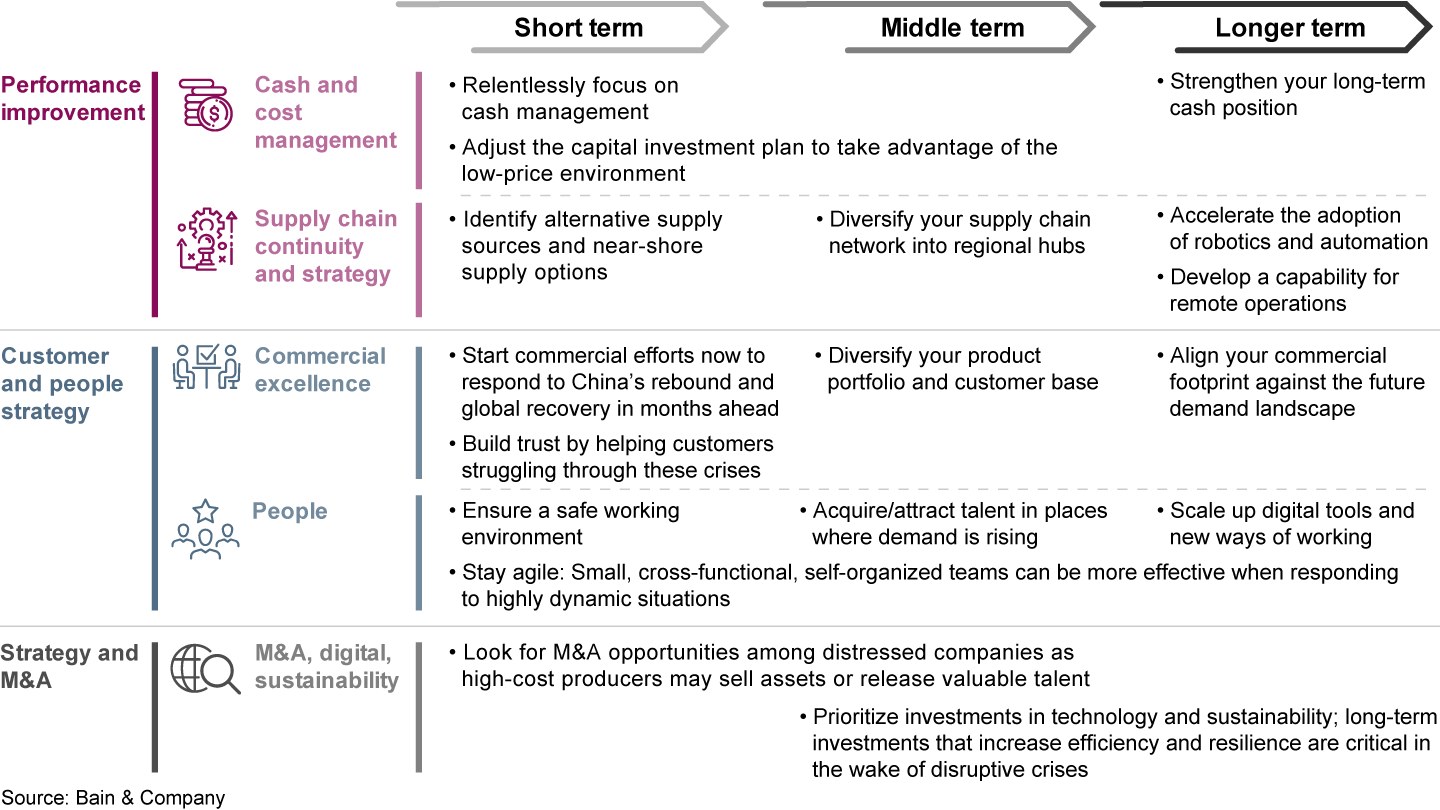
      Respond to the crisis in the short term; build resilience in the longer term
      Respond to the crisis in the short term; build resilience in the longer term
      Respond to the crisis in the short term; build resilience in the longer term
      • Monitor supply and demand balances, and adjust the portfolio, customer base and supply chain accordingly. Continue to align your commercial footprint against the future demand landscape. Alternative supply sources and near-shore backup options help diversify risk.
      • Prioritize investments in technology and sustainability. Long-term investments that increase efficiency and make organizations more resilient may be considered more critical in the wake of disruptive crises, but the recent focus on investments in sustainability will come under scrutiny during a time when many companies are struggling to survive. As operations resume, executives will need to make difficult decisions about trade-offs, and the visible results of cleaner air and a reduced carbon footprint because of the mandates to dial back industrial and transportation activity will inform these conversations.
      • Stay agile. Crises expose the obsolescence of large, mission-critical head offices far from operations. Small, cross-functional, self-organized teams can be more effective when responding to highly dynamic situations.

      Thomas Luedi and Brian Murphy are partners with Bain & Company’s Global Energy & Natural Resources practice, which Brian leads in Asia-Pacific. Thomas is based in Shanghai, and Brian is in Perth. Neelam Phadke is the practice director with Bain's Energy & Natural Resources practice in Asia-Pacific.

      The authors would like to thank Sara Pereira, Josh Zhu, Echo Hu, Jungyi Yoo, Hyunjin Kim and Hyunho Cho for their contributions.

      Related Insights

      Coronavirus

      The global Covid-19 pandemic has extracted a terrible human toll and spurred sweeping changes in the world economy. Across industries, executives have begun reassessing their strategies and repositioning their companies to thrive now and in the world beyond coronavirus.

      Auteurs
      • Headshot of Thomas Luedi
        Thomas Luedi
        Associé, Bangkok
      • Headshot of Brian Murphy
        Brian Murphy
        Associé, Perth
      • Headshot of Neelam Phadke
        Neelam Phadke
        Alumni, New Delhi
      Contactez-nous
      Synergies sectorielles
      • Energie et Ressources Naturelles
      Expertises fonctionnelles transverses
      • Accelerated Performance Transformation
      • Supply Chain
      Coronavirus
      Brilliant Under Pressure: The Global Diamond Industry 2020–21

      Our tenth annual report looks at performance in 2019, reviews the effects of the Covid-19 pandemic in 2020, and updates our long-term outlook for the diamond industry through 2030.

      Voir plus
      Coronavirus
      Cash Management Practices to Weather a Downturn

      Take an honest look at the business, and decide where to improve.

      Voir plus
      Energie et Ressources Naturelles
      When a New Organizational Structure Isn’t Enough: How to Truly Live Your Operating Model

      The goal of any organizational redesign is for people to work differently, but that only happens if leaders invest in changing the work itself.

      Voir plus
      Supply Chain
      Don’t Underestimate the Cost of Overcapacity

      Overcapacity is endemic to the paper and packaging industry, but these actions can help you maintain margins.

      Voir plus
      Coronavirus
      Ramping Up Online Grocery without Breaking the Bank

      Bain’s Marc-André Kamel discusses the challenges that online grocery presents for retailers and CPGs and how they can pair up to find a winning solution.

      Voir plus
      First published in mars 2020
      Mots clés
      • Accelerated Performance Transformation
      • Coronavirus
      • Energie et Ressources Naturelles
      • Supply Chain

      Comment nous avons aidé nos clients

      An Environmental Services Company Captures Massive Savings from a Merger

      Lire l’étude de cas

      Stratégie New products propel profitability for metals manufacturer

      Lire l’étude de cas

      Stratégie Client et Marketing Revitalizing a utility's market position with customer loyalty

      Lire l’étude de cas

      Vous souhaitez continuer cette conversation ?

      Nous aidons des dirigeants du monde entier à matérialiser des impacts et des résultats pérennes et créateurs de valeur dans leurs organisations.

      Les points de vue de Bain : notre perspective sur des problématiques auxquelles sont confrontées les entreprises à travers le monde, envoyés chaque mois dans votre boîte de réception. 

      *J’ai lu la politique de confidentialité et j’accepte les conditions.

      Merci de lire notre politique de confidentialité.
      Bain & Company
      Contactez-nous Sustainability Accessibility Conditions d’utilisation Politique de Confidentialité Cookie Policy Mentions Légales Sitemap Log In

      © 1996-2026 Bain & Company, Inc.

      Contacter Bain

      Comment pouvons-nous vous aider ?

      • Business inquiry
      • Career information
      • Press relations
      • Partnership request
      • Speaker request
      Voir tous les bureaux